
LAWC-203 · Lesson 2 of 12 · 22 min
Burdens, presumptions and the standard of proof
▶ Video coming soon A video version of this lesson is on the way.
In the second class, Professor Quaye writes two phrases on the board: 'beyond a reasonable doubt' and 'balance of probabilities'. 'Everything you learn in this course happens inside one of these two frames,' she says. 'Before we talk about what evidence gets in, we need to know what it has to prove, who has to prove it and how much proof is enough.' She turns to the Calder file. The Crown says Calder shoved Dorey unlawfully and caused his death. Calder's lawyer, she explains, may argue self-defence: that Dorey swung first. 'Who has to prove what? And what happens if the jury simply cannot tell who swung first?'
The legal burden and the evidential burden
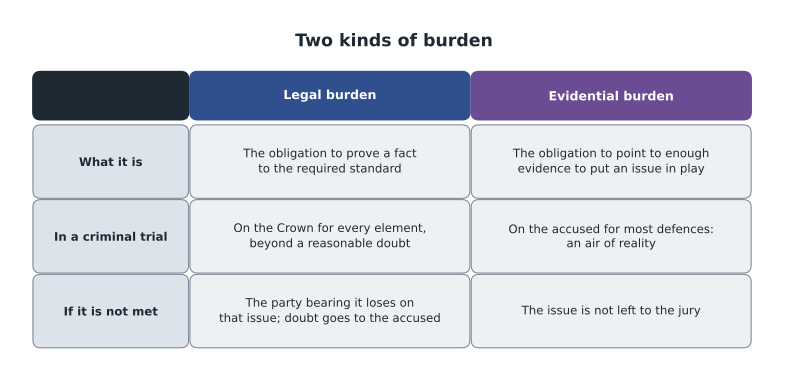
The word 'burden' is used in two different senses. The legal burden, sometimes called the persuasive burden or burden of proof, is the obligation to prove a fact to the required standard. If the trier of fact is left in doubt at the end of the case, the party with the legal burden loses on that issue. The evidential burden is the obligation to point to enough evidence to make an issue a live one, so that the trier of fact must consider it. A party who fails to meet an evidential burden does not get the issue put to the jury at all.
In a criminal case, the Crown bears the legal burden of proving every element of the offence beyond a reasonable doubt. That rule is ancient, stated in Woolmington v. Director of Public Prosecutions, [1935] A.C. 462 (H.L.), and it is now constitutional, protected by section 11(d) of the Charter. The Crown also bears the legal burden of disproving most defences once they are raised. But before a defence is left to the jury, there must be an air of reality to it. In R. v. Cinous, 2002 SCC 29, the Court held that the trial judge must ask whether there is evidence on the record upon which a properly instructed jury acting reasonably could acquit if it believed the evidence to be true. The judge does not weigh credibility at this stage. If there is an air of reality, the defence goes to the jury and the Crown must disprove it beyond a reasonable doubt. If there is not, the judge keeps the defence from the jury.
In Calder, then, the accused bears an evidential burden on self-defence. If a witness testifies that Dorey threw the first punch and Calder pushed him away to protect himself, there is an air of reality. The Crown must then prove beyond a reasonable doubt that the conditions in section 34 of the Criminal Code are not met. If the jury cannot tell who swung first and is left in reasonable doubt about whether Calder acted in self-defence, it must acquit.
In civil cases, the general rule is that the party who asserts a fact bears the legal burden of proving it. Rosa Ingram must prove that Corwin Plaza Holdings breached its duty under the Occupiers' Liability Act and that the breach caused her injury. If Plaza argues contributory negligence, Plaza bears the burden of proving it. Statutes sometimes shift burdens. Under section 6.1 of the Occupiers' Liability Act, the failure to give written notice within 60 days bars a claim unless the plaintiff establishes a reasonable excuse and the defendant is not prejudiced.
The criminal standard: proof beyond a reasonable doubt
The meaning of reasonable doubt was settled in R. v. Lifchus, [1997] 3 S.C.R. 320. Justice Cory, for the Court, set out what a jury should be told: the standard is inextricably linked to the presumption of innocence; the burden rests on the prosecution throughout and never shifts to the accused; a reasonable doubt is not based on sympathy or prejudice but on reason and common sense; it is logically connected to the evidence or the absence of evidence; it does not involve proof to an absolute certainty; and more is required than proof that the accused is probably guilty. Jurors should not be told that the words 'reasonable doubt' have an ordinary meaning, nor should the standard be equated with moral certainty or with the degree of proof people use in important decisions in their own lives.
In R. v. Starr, 2000 SCC 40, the Court added that it is helpful to explain that the standard falls much closer to absolute certainty than to proof on a balance of probabilities. Trial judges are not required to use any magic words, but an instruction that leaves the jury thinking that probable guilt is enough is a serious error.
The standard applies to the elements of the offence and to the ultimate question of guilt, not to every individual piece of evidence. In R. v. Morin, [1988] 2 S.C.R. 345, the Court held that jurors should not subject each item of evidence to the reasonable doubt standard separately. They consider the evidence as a whole and ask whether the Crown has proved each element beyond a reasonable doubt. Some preliminary questions, such as the voluntariness of a confession, must be proved by the Crown beyond a reasonable doubt on a voir dire, because of their importance.
Circumstantial evidence and reasonable doubt
Where the Crown relies on circumstantial evidence to prove an element, the question is whether the only reasonable inference is guilt. In R. v. Villaroman, 2016 SCC 33, Justice Cromwell explained that the trier of fact must consider other plausible theories and other reasonable possibilities inconsistent with guilt, and that these alternatives need not arise from proven facts. A reasonable doubt can arise from a gap in the evidence. But the alternatives must be reasonable, not speculative or fanciful. The Crown does not have to negative every conceivable possibility.
Suppose the Crown in Calder relies on the fact that Calder left the scene quickly and deleted his texts with Pruitt the next morning as evidence of consciousness of guilt. The jury must consider whether those actions might reasonably be explained by something else, such as panic, embarrassment or fear of being blamed for a fight, before using them to infer guilt. Lesson 3 returns to post-offence conduct.
Credibility and reasonable doubt: R. v. W.(D.)
When the accused testifies and the case turns on credibility, the jury must not decide by choosing which version it prefers. In R. v. W.(D.), [1991] 1 S.C.R. 742, the Court suggested a three-part instruction. First, if you believe the evidence of the accused, obviously you must acquit. Second, if you do not believe the testimony of the accused but you are left in reasonable doubt by it, you must acquit. Third, even if you are not left in doubt by the evidence of the accused, you must ask yourself whether, on the basis of the evidence which you do accept, you are convinced beyond a reasonable doubt by that evidence of the guilt of the accused.
The framework is not a magic formula, and later cases have emphasized substance over form. What matters is that the jury understands that the burden never shifts, that a credibility contest is not resolved by preference, and that disbelief of the accused does not by itself prove guilt. The W.(D.) principles also apply to exculpatory evidence from defence witnesses and to exculpatory statements by the accused introduced by the Crown.
The civil standard
In civil cases there is one standard of proof: the balance of probabilities. In F.H. v. McDougall, 2008 SCC 53, the Court rejected the idea of an intermediate standard for serious allegations such as fraud or sexual assault in civil proceedings. The trial judge must scrutinize the evidence with care, and the evidence must be clear, convincing and cogent, but the standard remains whether the fact is more likely than not. The seriousness of the allegation does not change the standard, although it may affect how carefully the evidence is examined.
In Ingram, Rosa must prove on a balance of probabilities that the parking lot was unreasonably icy, that Plaza or its contractor failed to take reasonable care, and that the ice caused her fall. If the evidence on whether the lot was salted at 6:15 a.m. is evenly balanced, she fails on that point, because she bears the legal burden.
Presumptions and reverse onuses
A presumption is a rule of law that, when one fact is proved, another fact must or may be assumed. Some presumptions are permissive inferences that the trier of fact may draw. Others are mandatory and shift a burden. The Criminal Code contains many presumptions. For example, section 258 formerly created presumptions about blood alcohol readings, and section 354(2) creates a presumption about possession of a motor vehicle with an obliterated identification number.
Mandatory presumptions that require the accused to disprove a fact on a balance of probabilities are reverse onuses, and they engage section 11(d) of the Charter. In R. v. Oakes, [1986] 1 S.C.R. 103, the Court struck down a provision that required a person found in possession of a narcotic to prove that he was not in possession for the purpose of trafficking. The Court held that a provision violates the presumption of innocence whenever it requires an accused to prove or disprove a fact on a balance of probabilities, because the accused could then be convicted despite a reasonable doubt. In R. v. Downey, [1992] 2 S.C.R. 10, the Court applied the same principle to a presumption that a person living with a prostitute was living on the avails, although a majority upheld the provision under section 1. In R. v. Whyte, [1988] 2 S.C.R. 3, the Court made clear that the label does not matter: if a provision allows a conviction despite a reasonable doubt about an essential element or a defence, it limits section 11(d).
Not every presumption is unconstitutional. An evidential presumption that the accused can displace simply by raising a reasonable doubt, rather than proving something on a balance of probabilities, is generally compatible with section 11(d). Some reverse onuses have been justified under section 1.
Judicial notice and formal admissions
Some facts need no proof. Under the doctrine of judicial notice, a court may accept facts that are so notorious or generally accepted as not to be the subject of debate among reasonable persons, or facts capable of immediate and accurate demonstration by resort to readily accessible sources of indisputable accuracy. That is the test in R. v. Find, 2001 SCC 32. The more central a fact is to the dispute, the stricter the court will be. In R. v. Spence, 2005 SCC 71, the Court explained that social and legislative facts, which concern the broader context rather than the parties' dispute, may be noticed more readily, but courts should still be cautious when such facts are dispositive. A court can take judicial notice that it is dark in Corwin at 11 p.m. in February, but not that a particular bar's front camera recorded accurately.
Formal admissions also remove facts from dispute. In criminal cases, section 655 of the Criminal Code allows the accused to admit any fact alleged against him for the purpose of dispensing with proof. In Calder, the defence may admit that the deceased was Mark Dorey and that he died of a brain bleed caused by a skull fracture, focusing the trial on whether Calder's shove was unlawful. In civil cases, admissions may be made in pleadings, in response to a request to admit under Rule 51, or by agreement. Formal admissions are binding, unlike informal admissions such as a party's out-of-court statement, which are evidence that may be contradicted. Lesson 7 deals with those.
Applying the frame to Calder
Sophie Tremblay-Hart summarizes for the class. The Crown must prove beyond a reasonable doubt that Calder committed an unlawful act that caused Dorey's death. Calder must point to evidence giving self-defence an air of reality; if he does, the Crown must disprove it beyond a reasonable doubt. If Calder testifies, the jury must be instructed along W.(D.) lines. Any reliance on circumstantial evidence, such as flight, must leave guilt as the only reasonable inference. 'And the agreed facts take the medical cause of death off the table,' Arjun Mehta adds, sketching a flowchart. Quaye smiles. 'Now we can start talking about what evidence gets in.'
Worked problem
Is there an air of reality to self-defence?
In the Calder trial, the bouncer testifies that Dorey stepped toward Calder with his fists raised and shouted a threat before Calder shoved him. Calder does not testify. The Crown argues that the shove was out of proportion because Dorey was smaller and drunk. Should self-defence be left to the jury?
Show solution
- The accused bears an evidential burden: is there an air of reality to self-defence (Cinous)?
- The judge asks whether there is evidence on which a properly instructed jury acting reasonably could acquit if it believed the evidence.
- The bouncer's evidence that Dorey advanced with fists raised and threatened Calder could support a reasonable belief that force was threatened and a defensive purpose under section 34.
- Proportionality and the other section 34(2) factors are for the jury to weigh; the judge does not decide credibility or weigh the evidence at this stage.
- Self-defence should be left to the jury, and the Crown must disprove it beyond a reasonable doubt.
Common mistakes
MistakeSaying the accused must prove self-defence.
InsteadThe accused bears only an evidential burden (air of reality); the Crown must disprove the defence beyond a reasonable doubt.
MistakeTelling a jury that reasonable doubt means moral certainty or ordinary everyday doubt.
InsteadFollow Lifchus and Starr: more than probable guilt, much closer to absolute certainty than to a balance of probabilities.
MistakeDeciding a credibility case by asking which version the jury prefers.
InsteadApply W.(D.): disbelief of the accused does not by itself prove guilt.
MistakeUsing a heightened civil standard for serious allegations.
InsteadF.H. v. McDougall: one civil standard, the balance of probabilities, applied with careful scrutiny.
Practice problems
Work each problem on paper first, then reveal the answer to check.
What is the difference between a legal and an evidential burden?
Show answer
The legal burden is the obligation to prove a fact to the required standard; the evidential burden is the obligation to point to enough evidence to make an issue live.
What did Oakes hold about reverse onuses?
Show answer
A provision requiring the accused to prove or disprove a fact on a balance of probabilities violates section 11(d), because conviction could follow despite a reasonable doubt.
State the three W.(D.) steps.
Show answer
If you believe the accused, acquit; if you do not believe the accused but are left in reasonable doubt, acquit; even if not left in doubt by the accused's evidence, convict only if the evidence you accept proves guilt beyond a reasonable doubt.
What is the test for judicial notice in Find?
Show answer
Facts so notorious as not to be the subject of debate among reasonable persons, or capable of immediate and accurate demonstration from readily accessible sources of indisputable accuracy.
What does section 655 of the Criminal Code allow?
Show answer
The accused may admit facts alleged against him to dispense with proof.
Summary and key terms
- The legal burden is the burden of persuasion; the evidential burden is the burden of putting an issue in play.
- The Crown bears the legal burden of proving guilt beyond a reasonable doubt and of disproving defences that have an air of reality (Cinous).
- Lifchus and Starr explain reasonable doubt: more than probable guilt and much closer to absolute certainty than to a balance of probabilities.
- W.(D.) guides credibility contests; Villaroman guides circumstantial cases.
- The civil standard is a single balance of probabilities (F.H. v. McDougall).
- Reverse onuses limit section 11(d) (Oakes, Whyte, Downey); judicial notice (Find, Spence) and formal admissions remove facts from dispute.
- Legal burden
- The obligation to prove a fact to the required standard of proof.
- Evidential burden
- The obligation to point to sufficient evidence to make an issue live.
- Air of reality
- The threshold for leaving a defence to the jury.
- Reverse onus
- A provision requiring the accused to prove or disprove a fact.
- Judicial notice
- Acceptance of a fact without proof because it is notorious or indisputable.
- Formal admission
- A binding concession of a fact that removes it from dispute.
Lesson quiz · 5 questions
Score 60% or more to complete this lesson.
Create a free account to save your progress, take quizzes and earn a certificate.