
LAWC-203 · Lesson 12 of 12 · 25 min
Capstone: ruling on evidence in a trial problem
▶ Video coming soon A video version of this lesson is on the way.
Professor Quaye's last class is a mock trial ruling day. She hands out a twelve-page file, R. v. Treadwell, written for the course. Every name in it is invented. Each student will act as the trial judge on one or more evidentiary applications and give an oral ruling with reasons, then the class as a whole will decide what the jury hears. 'The method is the same one we used on the first day,' she says. 'Four gates. What is it, and what is it for? Then the rule, then the exception, then the discretion. Rule on each piece of evidence separately, and then look at the whole trial.'
The file
Gideon Treadwell, 29, is charged with robbery and aggravated assault. The Crown alleges that at about 9:40 one weekday evening he entered the Hartley Street Pharmacy in Corwin wearing a grey hooded sweatshirt and a surgical mask, demanded opioids from the pharmacist, Ilse Brandvold, 66, and struck her in the face with a metal bar when she hesitated, fracturing her cheekbone. He left with several bottles of oxycodone and hydromorphone. A neighbour, Beatrix Oyelaran, called 911 from her apartment window across the street: 'He's running, he's got a bag, he's going down the lane behind the laundromat, grey hoodie, he's limping.' Police found a partial shoe print in spilled syrup near the counter.
Treadwell was arrested two days later on the strength of a tip and a still image from the pharmacy's security camera. At the time of arrest, the arresting officer took his phone, which was unlocked, and scrolled through his recent photos and messages at the roadside. She found a photo of pill bottles on a kitchen table and a message to someone saved as 'K' reading 'got the stuff, Hartley St was easy.' Treadwell was then taken to the station, where Detective Sergeant Farah Kessler interviewed him for five hours. He asked to speak to a lawyer, spoke to duty counsel for four minutes, and was told by Kessler that 'this is your chance, if you tell me where the pills are we can talk to the Crown about bail.' He eventually said, 'Fine, I was there, but I didn't mean to hit her that hard.'
Brandvold testified at the preliminary inquiry and was cross-examined by Treadwell's lawyer, who was the same lawyer now acting at trial. She identified the robber's voice as 'young, raspy' and said she could not see his face. She died of an unrelated illness four months before trial. The Crown also has a footwear examiner, Dr. Paulo Esteves, who will say that Treadwell's runners 'could have made' the syrup print, and a civilian analyst who ran the security still through facial comparison software and will testify that Treadwell's booking photo was 'the top-ranked match.' Rory Skerritt, a man held in the same cell range as Treadwell, has come forward to say Treadwell told him he 'did a pharmacy on Hartley.' Skerritt has eleven fraud convictions and a pending charge, and has asked about a deal. Finally, the Crown wants to lead evidence that Treadwell was convicted three years ago of robbing a pharmacy in Peterborough in the same way, with a mask and a metal bar, and Treadwell has prior convictions for that robbery, two thefts and a breach of probation.
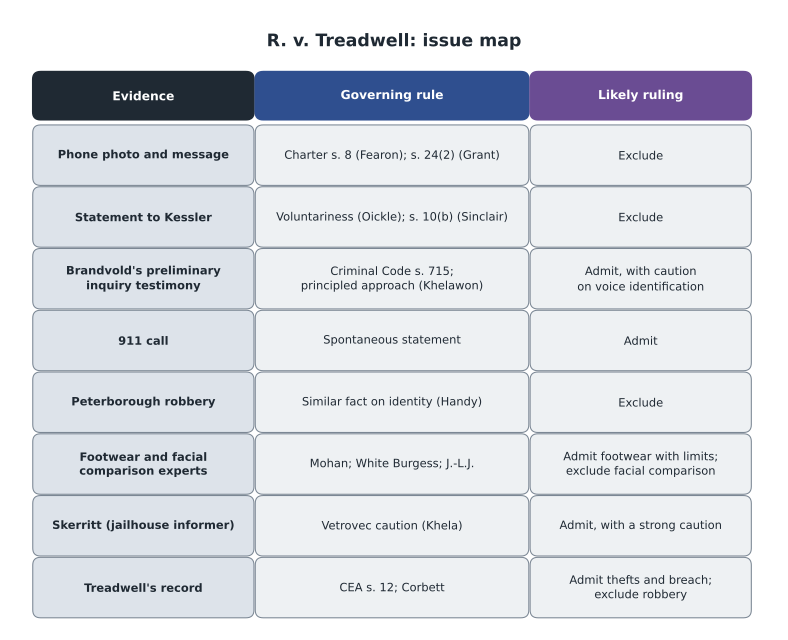
Ruling 1: the cellphone search
Arjun Mehta takes the first application, the defence's section 8 challenge to the roadside phone search. He begins with the law. In R. v. Fearon, 2014 SCC 77, the Supreme Court held that police may search a cellphone incident to a lawful arrest without a warrant only if the arrest was lawful, the search is truly incidental to the arrest, meaning the police have a reason for it related to the arrest such as protecting police or the public, preserving evidence or discovering evidence including locating additional suspects, the nature and extent of the search are tailored to that purpose, usually limited to recently sent or drafted messages, recent photos and the call log, and the police take detailed notes of what they examined and why.
Mehta finds the arrest lawful, because the tip and the still image gave reasonable grounds. The search of recent photos and messages could be justified as discovering evidence, such as the location of the pills or an accomplice. But the officer's notes say only 'checked phone,' with no record of what was examined or why, and the officer cannot explain at the voir dire why she looked at the photos. Mehta rules that the search breached section 8 because the notes requirement in Fearon was not met and the purpose was not established.
He moves to section 24(2) and the three lines of inquiry from R. v. Grant, 2009 SCC 32, that lesson 8 introduced. First, the seriousness of the Charter-infringing state conduct: Fearon was decided over a decade before this arrest and its requirements are well known to police; failure to take notes is not technical, because it prevents review. This line favours exclusion moderately. Second, the impact on the accused's Charter-protected interests: cellphones hold intensely private information, though the search here was relatively brief. This line favours exclusion. Third, society's interest in adjudication on the merits: the evidence is reliable and important to the Crown. This line favours admission. Balancing, and given the importance the Supreme Court has placed on protecting privacy in digital devices, Mehta excludes the photo and the message. 'The exclusion is not a reward for Treadwell,' he says. 'It is about what the court allows itself to be associated with.'
Ruling 2: the statement to Kessler
Sophie Tremblay-Hart takes the voir dire on the statement. Because the statement was made to a person in authority, the Crown must prove voluntariness beyond a reasonable doubt (R. v. Oickle, 2000 SCC 38). She considers the four Oickle factors. Threats or promises: Kessler's offer to 'talk to the Crown about bail' in exchange for the location of the pills is an inducement. Oickle holds that a quid pro quo is the most important consideration, and the strength of the inducement, measured against the circumstances of the suspect, determines whether it raises a reasonable doubt. A suggestion of bail for a man facing a serious robbery charge is a powerful inducement. Oppression: five hours is not in itself oppressive, but the record shows that Treadwell said several times he was in withdrawal and was not given anything. Operating mind: he understood what he was saying. Police trickery: none.
She also addresses section 10(b). Treadwell spoke to duty counsel for four minutes. Under R. v. Sinclair, 2010 SCC 35, a detainee generally gets one consultation; a further consultation is required only on a change of circumstances, such as a new procedure or a change in jeopardy, or where there is reason to think the initial advice was inadequate. The record does not show any of these, so she finds no breach of section 10(b). But she holds that the Crown has not proved voluntariness beyond a reasonable doubt, given the bail inducement combined with withdrawal symptoms. The statement is excluded for all purposes, including cross-examination if Treadwell testifies, because an involuntary statement is inadmissible for any purpose.
Ruling 3: Brandvold's preliminary inquiry testimony
Daniel Whitecloud takes the Crown's application to read in Brandvold's preliminary inquiry evidence. Section 715 of the Criminal Code allows evidence given at a preliminary inquiry to be read in at trial if the witness is dead, insane, too ill to travel or testify, or absent from Canada, and the evidence was taken in the presence of the accused, who had full opportunity to cross-examine. Brandvold has died, Treadwell was present, and his counsel cross-examined her. The statutory conditions are met. The trial judge retains a narrow discretion to exclude where admission would be unfair, but here the defence had the same counsel and the same motive to cross-examine. Whitecloud admits the testimony. He adds that even without section 715, the testimony would likely be admissible under the principled approach (R. v. Khelawon, 2006 SCC 57): necessity is established by death, and threshold reliability by the oath and the cross-examination.
He notes the limits of the evidence. Brandvold could not identify the robber's face. Her description of the voice as 'young, raspy' is weak identification evidence, and the judge will need to caution the jury about it.
Ruling 4: the 911 call
Hannah Kowalczyk takes the 911 call. It is hearsay if the Crown wants the jury to accept that a man was running down the lane behind the laundromat in a grey hoodie and limping. She considers the spontaneous statement exception, also called res gestae, discussed in lesson 7. The statement was made by an observer under the pressure of a startling event, while the event was ongoing, with no opportunity for concoction. The exception applies. The call is also admissible under the principled approach: Oyelaran is available and will testify, so necessity is weaker, but the recording is the best evidence of what she observed in the moment. Oyelaran will testify, so the defence can cross-examine her about lighting and distance.
Kowalczyk points out that 'limping' is useful to the defence if Treadwell has no limp. The jury can weigh it either way.
Ruling 5: the Peterborough robbery
Theo Marchetti takes the Crown's similar fact application. Evidence of other discreditable conduct is presumptively inadmissible, and the Crown must show on a balance of probabilities that its probative value outweighs its prejudicial effect (R. v. Handy, 2002 SCC 56). The Crown says the Peterborough robbery shows identity. Where similar fact evidence is offered on identity, a high degree of similarity is required, approaching a signature, and the Crown must show that the accused committed the earlier act.
Marchetti looks at the connecting factors. Both robberies were of pharmacies, both involved masks and metal bars, both targeted opioids. But masks and blunt weapons are common in pharmacy robberies, and opioids are the obvious target. There is no distinctive feature, no unusual phrase, method of entry or item of clothing. The similarity is generic, not striking. On the prejudice side, a prior robbery conviction for the same type of offence carries a heavy risk of moral prejudice, inviting the jury to reason that Treadwell is a robber and so probably did it, and reasoning prejudice, as the jury might be distracted by the earlier case. Marchetti excludes the evidence. 'If the Crown could lead every prior pharmacy robbery as identity evidence,' he says, 'it would be propensity evidence by another name.'
Ruling 6: the experts
Mehta returns for the expert evidence. Dr. Esteves, the footwear examiner, has training and experience in a recognized discipline. His opinion that the runners 'could have made' the print is relevant and outside ordinary experience, so it meets the Mohan threshold (R. v. Mohan, [1994] 2 S.C.R. 9). At the gatekeeping stage (White Burgess, 2015 SCC 23), its probative value is modest, because 'could have made' means only that the runners cannot be excluded. Mehta admits the evidence but instructs that Esteves explain how common the tread pattern is, so the jury can assess its weight.
The facial comparison analyst is a harder case. The analyst is not a scientist and cannot explain how the software ranks matches, what database it was run against, or its error rate, particularly with a masked face in a low-resolution still. This is novel science, or established science used for a novel purpose, and under R. v. J.-L.J., 2000 SCC 51, the Crown must establish the reliability of the underlying method. It has not. The 'top-ranked match' evidence also risks being treated by the jury as scientific identification, which it is not. Mehta excludes it. Any witness who knows Treadwell well, such as a probation officer, could be asked whether they recognize the person in the still image, as recognition evidence, subject to a caution.
Ruling 7: the jailhouse informer
Tremblay-Hart takes the Crown's application to call Skerritt. Jailhouse informers are admissible witnesses, and their evidence is not excluded because they have records or hope for a benefit. But the law treats their testimony with special caution. In Vetrovec v. The Queen, [1982] 1 S.C.R. 811, the Court held that the trial judge has discretion to warn the jury about witnesses whose evidence requires special scrutiny, and R. v. Khela, 2009 SCC 4, set out the elements of the caution: drawing the jury's attention to the testimony requiring special scrutiny, explaining why, cautioning that it is dangerous to convict on that evidence without confirmation, and explaining that confirmatory evidence should give comfort that the witness is telling the truth about the accused's involvement. The Kaufman Commission into the wrongful conviction of Guy Paul Morin (1998) found that jailhouse informers were a leading cause of wrongful convictions.
Tremblay-Hart admits Skerritt's evidence but requires a strong Vetrovec caution. She also orders that the Crown disclose any benefit Skerritt has received or requested, the details of his record, and any prior occasions on which he has acted as an informer. Defence counsel can cross-examine on all of it. She notes that, with the phone evidence and the statement excluded, there is little to confirm Skerritt's account; the jury will be told that the absence of confirmation is a reason for extra caution.
Ruling 8: Treadwell's record if he testifies
Whitecloud takes the Corbett application. If Treadwell testifies, section 12 of the Canada Evidence Act allows the Crown to cross-examine him on his prior convictions. Under R. v. Corbett, [1988] 1 S.C.R. 670, the trial judge has discretion to exclude some or all of the record where its prejudicial effect outweighs its probative value on credibility. The factors include the nature of the prior convictions, with crimes of dishonesty more probative of credibility than crimes of violence; their remoteness; their similarity to the charged offence, since similar convictions are especially prejudicial; and whether the defence has attacked the credibility of Crown witnesses, which can make it unfair to leave the jury with a distorted picture.
The two thefts are crimes of dishonesty and are probative of credibility. The breach of probation is minor. The Peterborough robbery is the problem: it is the same type of offence and the jury would be tempted to use it as propensity evidence, precisely what Ruling 5 tried to prevent. Whitecloud permits cross-examination on the two thefts and the breach, but excludes the robbery conviction, with a limiting instruction that the jury may use the record only in assessing credibility.
The trial as a whole
Quaye puts the rulings together on the board. The jury will hear Brandvold's preliminary inquiry evidence, the 911 call and Oyelaran's testimony, the footwear opinion with its limits, the security still, and Skerritt with a strong Vetrovec caution. It will not hear the phone evidence, the statement, the Peterborough robbery, the facial comparison opinion or the robbery conviction. If Treadwell testifies, the judge will instruct the jury on W.(D.) (R. v. W.(D.), [1991] 1 S.C.R. 742), the burden of proof and reasonable doubt as lesson 2 explained, and on circumstantial evidence under R. v. Villaroman, 2016 SCC 33.
'Is the Crown's case strong enough now?' Marchetti asks. 'That is the jury's question, not ours,' Quaye says. 'Our job was to decide what the jury could fairly hear. Look at what happened. Some of the most persuasive evidence was the least trustworthy, and some was obtained in ways the court could not accept. The law of evidence is not about making the trial easy. It is about making the verdict one people can trust.'
Worked problem
Drafting a ruling
Write the structure of an oral ruling on the facial comparison evidence that a trial judge could deliver in under five minutes.
Show solution
- Identify the evidence and its purpose: an analyst's testimony that facial comparison software ranked Treadwell's booking photo as the top match to the security still, offered on identity.
- State the governing law: Mohan and White Burgess, with the J.-L.J. reliability inquiry for novel science or science used for a novel purpose.
- Apply the threshold: relevance is met; necessity may be met; but the reliability of the method, its database and error rate with masked low-resolution images is not established, and the analyst cannot explain it.
- Apply the gatekeeping stage in the alternative: even if the threshold were met, the risk that the jury treats a software ranking as scientific identification outweighs its modest probative value.
- Rule: the evidence is excluded. Note that recognition evidence from a witness familiar with the accused may be led, subject to a caution.
Common mistakes
MistakeRuling on the whole case instead of on each piece of evidence.
InsteadRule on each application separately, with the governing test, and then consider the trial as a whole.
MistakeTreating a breach of the Charter as automatically requiring exclusion.
InsteadApply the three Grant lines of inquiry and balance them under section 24(2).
MistakeAdmitting similar fact evidence on identity because the offences are of the same type.
InsteadIdentity requires a high degree of distinctive similarity (Handy).
MistakeExcluding a jailhouse informer because he has a record.
InsteadThe evidence is admissible but requires a strong Vetrovec caution (Khela) and full disclosure.
Practice problems
Work each problem on paper first, then reveal the answer to check.
What are the Fearon conditions for searching a cellphone incident to arrest?
Show answer
Lawful arrest; search truly incidental to the arrest for a valid purpose; search tailored to that purpose; detailed notes of what was examined and why.
What are the conditions under section 715 of the Criminal Code for reading in preliminary inquiry evidence?
Show answer
The witness is dead, insane, too ill, or absent from Canada, and the evidence was taken in the accused's presence with full opportunity to cross-examine.
What elements does a Vetrovec caution include under Khela?
Show answer
Draw attention to the testimony, explain why it needs scrutiny, caution about convicting without confirmation, and explain what confirmatory evidence is.
What Corbett factors guide editing of an accused's record?
Show answer
Nature of the convictions (dishonesty versus violence), remoteness, similarity to the charge, and whether the defence attacked Crown witnesses' credibility.
Why does an involuntary statement stay out even for cross-examination?
Show answer
An involuntary statement to a person in authority is inadmissible for any purpose.
Summary and key terms
- Rule on each piece of evidence separately: identify it and its purpose, then the rule, exception and discretion.
- Charter-obtained evidence turns on the breach and the Grant balance (Fearon; Grant).
- Statements to persons in authority must be proved voluntary beyond a reasonable doubt (Oickle).
- Prior testimony and spontaneous statements can come in under statutory and common law exceptions (section 715; res gestae; Khelawon).
- Similar fact, expert, informer and record evidence each require careful balancing (Handy; Mohan; White Burgess; J.-L.J.; Vetrovec; Khela; Corbett).
- Voir dire
- A hearing within the trial, in the absence of the jury, to decide the admissibility of evidence.
- Vetrovec caution
- A jury warning about witnesses whose evidence requires special scrutiny.
- Jailhouse informer
- A person in custody who testifies about statements allegedly made by the accused.
- Recognition evidence
- Identification by a witness who knows the accused, distinct from identification of a stranger.
- Corbett application
- A motion to edit an accused's criminal record before cross-examination.
- Issue map
- A list of each piece of evidence with its governing rule and likely ruling.
Lesson quiz · 5 questions
Score 60% or more to complete this lesson.
Create a free account to save your progress, take quizzes and earn a certificate.