
LAWC-203 · Lesson 10 of 12 · 22 min
Opinion evidence
▶ Video coming soon A video version of this lesson is on the way.
The Crown in R. v. Calder plans to call three opinion witnesses. Dr. Anjali Rao, the forensic pathologist, will testify that Dorey died of a subdural hematoma caused by a skull fracture, consistent with a fall against a hard surface, and that his skull was unusually thin. A police officer will testify that Calder appeared 'pretty drunk' on the bar's video. And the Crown would like to call a use-of-force instructor to tell the jury that Calder's shove was 'not a defensive move'. Professor Quaye lists them on the board. 'Witnesses testify to facts,' she says. 'Opinions are the exception. Which of these three can the jury hear?'
The general rule and lay opinion
The general rule is that witnesses testify to facts within their knowledge, observation and experience, and the trier of fact draws inferences and forms opinions from those facts. Opinion evidence is presumptively inadmissible. The rule reflects the division of labour between witness and trier of fact. Two exceptions are recognized: lay opinion and expert opinion.
Lay witnesses may give opinions on matters within ordinary human experience where the opinion is a compendious way of stating facts that are too subtle or complicated to describe separately. In R. v. Graat, [1982] 2 S.C.R. 819, the Court held that a police officer and other lay witnesses could give their opinion that a driver's ability to drive was impaired by alcohol, because people commonly form such opinions from a combination of observations. Lay witnesses routinely give opinions about speed, distance, age, sobriety, emotional state, identity of persons and the identity of handwriting they know. The opinion must be based on the witness's own observations and must be helpful; its weight is for the trier of fact.
The officer's opinion that Calder appeared 'pretty drunk' on the video raises a further problem: the officer did not observe Calder in person, and the jury can watch the video itself. An opinion on a video the jury can see for itself adds little unless the officer has some special familiarity, such as knowing Calder well. The judge may well limit the officer to describing what he observed in person, if anything.
Expert opinion: the Mohan framework
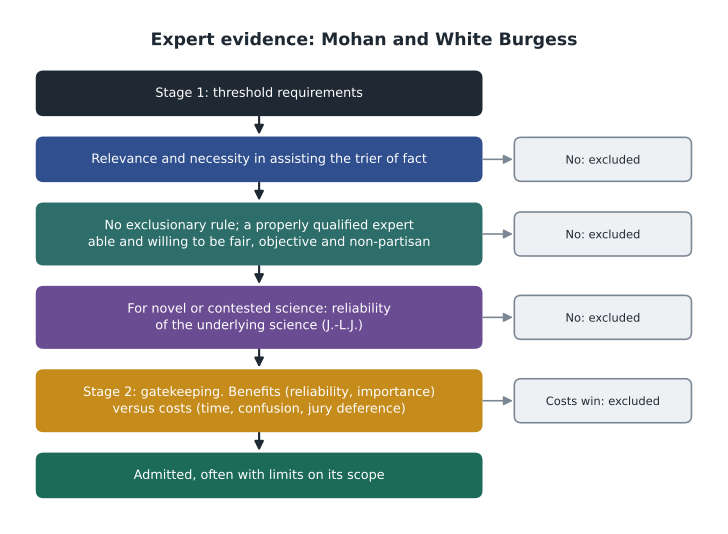
Expert opinion is admissible where the trier of fact needs specialized knowledge to understand the evidence and draw correct inferences. In R. v. Mohan, [1994] 2 S.C.R. 9, the Court set out four requirements: relevance, necessity in assisting the trier of fact, the absence of any exclusionary rule, and a properly qualified expert. Necessity means that the evidence provides information likely to be outside the experience and knowledge of the judge or jury; it is not enough that the evidence would be helpful. The Court warned of the dangers of expert evidence: it may be given more weight than it deserves because of its scientific appearance, it can consume time and distract the trier of fact, and jurors may simply defer to the expert instead of deciding the issue themselves.
The qualification of an expert is decided on a voir dire, usually at the start of the expert's evidence. The proponent proves the witness's education, training and experience, and the opposing party may cross-examine on them. Abbey (2009) stressed that the trial judge should define the nature and scope of the proposed opinion precisely at this stage, because an expert who is qualified in one field can easily drift into neighbouring fields where he has no special knowledge. A clearly worded ruling on the scope of the expertise makes it easier for the judge, and opposing counsel, to object when the expert strays during testimony.
White Burgess: independence and the two-stage test
In White Burgess Langille Inman v. Abbott and Haliburton Co., 2015 SCC 23, the Court restructured the analysis into two stages and addressed expert independence. A group of shareholders sued their former auditors. The defendants challenged the plaintiffs' accounting expert as biased because her firm had been involved earlier in the matter. Justice Cromwell, for the Court, held that an expert's duty to the court requires that the expert be fair, objective and non-partisan. The threshold question is whether the expert is able and willing to carry out that duty. Once the expert attests or testifies to recognizing and accepting the duty, the burden shifts to the opposing party to show a realistic concern that the expert is unable or unwilling to comply. A mere employment relationship or familial connection is not automatically disqualifying; what matters is whether the expert has a direct financial interest in the outcome, a close relationship with a party, or has assumed the role of advocate. Most concerns about independence go to weight rather than admissibility.
The two stages are as follows. At the first stage, the proponent must establish the threshold requirements of admissibility: the Mohan factors of relevance, necessity, absence of an exclusionary rule and a properly qualified expert, plus, for opinions based on novel or contested science or science used for a novel purpose, the reliability of the underlying science. Evidence that does not meet these requirements is excluded. At the second stage, the trial judge acts as gatekeeper and decides whether the benefits of admitting the evidence outweigh its potential risks. This is a discretionary cost-benefit analysis.
The gatekeeper role: Abbey
In R. v. Abbey, 2009 ONCA 624, Justice Doherty of the Ontario Court of Appeal described the gatekeeping stage in a way that White Burgess endorsed. The benefit side of the analysis considers the probative potential of the evidence, including its reliability and the significance of the issue to which it relates. The cost side considers the consumption of time, prejudice, confusion and the danger that the jury will be unable to make an effective and critical assessment of the evidence. In R. v. Abbey, 2017 ONCA 640, the Court of Appeal returned to the case on a fresh evidence application concerning the expert whose evidence had been admitted at the retrial, and emphasized the importance of an expert's reliability and of assessing the methodology behind experience-based expertise.
Experience-based expertise, such as the opinion of a police officer on the meaning of gang tattoos or drug jargon, is common. Courts have increasingly insisted that such experts explain the basis of their knowledge and that their methodology be tested, rather than accepting long experience as sufficient. Wrongful convictions, including those examined in the Goudge Inquiry into Pediatric Forensic Pathology in Ontario (2008), demonstrated the danger of uncritical acceptance of expert evidence, even from apparently eminent experts.
Novel science and reliability
Where expert evidence is based on a novel scientific theory or technique, or uses established science for a new purpose, the trial judge must examine the reliability of the underlying science with special care. In R. v. J.-L.J., 2000 SCC 51, the Court excluded expert evidence that the perpetrator of child sexual abuse would have had distinctive psychological characteristics that the accused lacked, finding the underlying science insufficiently reliable. The Court drew on factors from the American case Daubert v. Merrell Dow Pharmaceuticals, 509 U.S. 579 (1993): whether the theory or technique can be and has been tested, whether it has been subjected to peer review and publication, its known or potential rate of error, and whether it is generally accepted. In R. v. Trochym, 2007 SCC 6, the Court held that post-hypnosis testimony was presumptively inadmissible because the reliability of hypnosis as a memory aid had not been established.
The scope of expert testimony
Even admissible expert evidence must stay within its proper scope. Experts may not testify to matters outside their expertise. In R. v. Sekhon, 2014 SCC 15, a police expert on drug importation testified that in his experience couriers always know they are carrying drugs. The Court held that this evidence was inadmissible because it was not necessary, was not relevant to the particular accused's knowledge, and had a prejudicial effect, as it invited the jury to convict on the basis of what other people did. Trial judges must monitor expert testimony and intervene when an expert strays.
Experts also may not usurp the jury's role. The old ultimate issue rule, which barred experts from giving an opinion on the very issue the jury must decide, has been relaxed; experts may sometimes give opinions that come close to the ultimate issue, but the closer they come, the more carefully the judge must scrutinize necessity and prejudice. Expert evidence on a witness's credibility is inadmissible, as lesson 5 explained, although experts may explain behaviour outside ordinary experience, such as delayed disclosure by child complainants (Marquard) or the effects of battered woman syndrome (R. v. Lavallee, [1990] 1 S.C.R. 852).
The use-of-force instructor's opinion that Calder's shove was 'not a defensive move' fails on necessity and scope. Whether a shove outside a bar was a reasonable response to a perceived threat is precisely what jurors, drawing on ordinary experience and the law of self-defence explained by the judge, are asked to decide. The opinion would invite the jury to defer to an expert on the central question. It would likely be excluded, although a use-of-force expert might be admissible in a different case, such as one involving specialized police techniques.
Hearsay and the basis of expert opinion
Experts often rely on information they did not personally observe, such as medical records, statements from others, or published studies. In R. v. Abbey, [1982] 2 S.C.R. 24, the Supreme Court held that an expert may rely on hearsay in forming an opinion, but the hearsay is not evidence of its truth, and the weight of the opinion depends on the extent to which its factual basis is proved by admissible evidence. In R. v. Lavallee, the Court clarified that an expert's opinion does not become inadmissible merely because some of its factual basis is unproven, though the weight given to it may be reduced. In R. v. Phillion, [1978] 1 S.C.R. 18, the Court held that an expert could not be used as a conduit to put an accused's self-serving statements before the jury.
Procedure: notice and reports
In criminal cases, section 657.3 of the Criminal Code requires a party intending to call an expert to give notice, the expert's name, area of expertise and qualifications, and, for the Crown, a copy of the report or summary of the opinion within a reasonable time before trial. Section 7 of the Canada Evidence Act limits each side to five experts without leave. In Ontario civil cases, Rule 53.03 requires a party to serve an expert's report containing specified information, including the instructions provided, the facts and assumptions relied on, and a signed acknowledgment of the expert's duty to provide opinion evidence that is fair, objective and non-partisan, within deadlines set before the pre-trial conference. Section 12 of the Ontario Evidence Act limits each side to three experts without leave. In Moore v. Getahun, 2015 ONCA 55, the Ontario Court of Appeal held that consultation between counsel and experts in the preparation of reports is proper and necessary, so long as it does not interfere with the expert's independence.
In Ingram, Rosa's orthopaedic surgeon will give opinion evidence that she has a permanent loss of grip strength. Plaza may retain its own expert to examine her and dispute the prognosis, and either side may call a human factors or winter maintenance expert on whether the salting was reasonable. Each report must comply with Rule 53.03 and include the acknowledgment form.
Back to Calder
Quaye runs through the three witnesses. Dr. Rao, the pathologist, is a classic expert: cause of death and the mechanics of a skull fracture are outside ordinary experience, she is qualified, and her evidence is reliable and important. Her opinion that Dorey's skull was unusually thin is relevant because the thin skull rule makes Calder liable for the consequences even if an ordinary person would have survived. But she must stay within her expertise and should not speculate about how hard Calder pushed unless she can support it. The officer's opinion on intoxication is weak because it rests on video the jury can watch. The use-of-force instructor's opinion would likely be excluded as unnecessary and as usurping the jury's role.
Worked problem
Should the expert be admitted?
In Ingram, Corwin Plaza Holdings proposes to call a meteorologist who will testify that, based on weather station records, freezing drizzle began at about 7:30 a.m. on the day of the fall, more than an hour after Northline salted the lot at 6:15 a.m. Rosa's counsel objects that the meteorologist is employed by a firm that does consulting work for Northline. How should the judge rule?
Show solution
- Stage 1, relevance: the timing of freezing drizzle bears on whether the lot was reasonably maintained.
- Necessity: interpreting weather station data and local conditions requires specialized knowledge beyond ordinary experience.
- Qualification: a meteorologist with relevant training and experience is properly qualified.
- Independence (White Burgess): the meteorologist must sign the Rule 53.03 acknowledgment. Rosa's counsel must show a realistic concern of inability or unwillingness to be impartial. An employment link with a firm that consults for a third party is not automatically disqualifying; it goes mainly to weight unless the expert has a direct interest.
- Stage 2: the benefits outweigh the costs. The evidence is admissible, and Rosa's counsel may cross-examine on the relationship and on the reliability of applying station data to the Plaza lot.
Common mistakes
MistakeAdmitting expert evidence because it would be helpful.
InsteadMohan requires necessity: the evidence must provide information likely outside the trier of fact's experience.
MistakeExcluding any expert with a connection to a party.
InsteadUnder White Burgess, the opponent must show a realistic concern of partiality; most concerns go to weight.
MistakeAccepting long experience as automatically reliable expertise.
InsteadExperience-based experts must explain their methodology; Abbey and the Goudge Inquiry show the risks.
MistakeLetting an expert tell the jury what other people in similar situations usually do.
InsteadSekhon: such evidence is irrelevant to the accused and highly prejudicial.
Practice problems
Work each problem on paper first, then reveal the answer to check.
What are the four Mohan requirements?
Show answer
Relevance, necessity in assisting the trier of fact, absence of an exclusionary rule, and a properly qualified expert.
What did White Burgess hold about expert independence?
Show answer
Experts owe a duty to be fair, objective and non-partisan; once they accept it, the opponent must show a realistic concern of inability or unwillingness to comply; most concerns go to weight.
What happens at the second stage of the expert analysis?
Show answer
The judge weighs the benefits of admitting the evidence against its costs, as a gatekeeper (Abbey).
Name two Daubert factors adopted in J.-L.J.
Show answer
Testability, peer review and publication, known error rate, and general acceptance.
When may a lay witness give an opinion?
Show answer
When the opinion is a compendious statement of facts within ordinary experience, based on the witness's observations (Graat).
Summary and key terms
- Witnesses testify to facts; opinions are exceptional.
- Lay opinion is admissible as a compendious statement of observed facts within ordinary experience (Graat).
- Expert opinion requires relevance, necessity, no exclusionary rule and a properly qualified expert (Mohan), and an expert able and willing to be impartial (White Burgess).
- At the second stage the judge acts as gatekeeper, weighing benefits against costs (Abbey); novel science requires a reliability inquiry (J.-L.J.; Trochym).
- Experts must stay within scope (Sekhon), may rely on hearsay subject to weight (Abbey 1982; Lavallee), and must comply with notice and report rules (section 657.3; Rule 53.03).
- Lay opinion
- An opinion by an ordinary witness that compendiously states observed facts.
- Expert opinion
- Opinion evidence from a witness with specialized knowledge, admitted under Mohan and White Burgess.
- Necessity
- The requirement that expert evidence provide information likely outside the trier of fact's experience.
- Gatekeeping
- The judge's discretionary weighing of the benefits and costs of expert evidence.
- Novel science
- A new theory or technique, or established science used for a new purpose, requiring special reliability scrutiny.
- Rule 53.03
- The Ontario rule governing expert reports and the expert's acknowledgment of duty.
Lesson quiz · 5 questions
Score 60% or more to complete this lesson.
Create a free account to save your progress, take quizzes and earn a certificate.