
LAWC-202 · Lesson 9 of 12 · 21 min
Remedies
▶ Video coming soon A video version of this lesson is on the way.
Professor Delisle asks the class in the ninth session to imagine that Marisol Quintero wins her judicial review. 'What does she actually get?' she asks. Theo Marchetti says she gets her licence back. Hannah Kowalczyk says the court will probably just cancel the revocation and send it back to the committee. Arjun Mehta asks whether she can recover the three months of income she lost. 'All three answers raise the law of remedies,' Delisle says. 'And remedies on judicial review are discretionary. Winning on the merits does not guarantee relief, and the relief you get may not be the relief you want.'
The prerogative remedies
Judicial review grew out of the prerogative writs, orders issued by the superior courts in the name of the Crown to keep inferior bodies within their jurisdiction. Certiorari quashes a decision that has already been made, setting it aside as if it had never been made. Prohibition stops a decision-maker from acting beyond its authority before it acts. Mandamus compels a public body to perform a public legal duty that it has refused or failed to perform. Habeas corpus requires the person detaining someone to justify the lawfulness of the detention. Quo warranto challenged a person's right to hold a public office and is now rarely used. Alongside these, courts grant declarations, which state the legal position without ordering anyone to do anything, and injunctions, which restrain unlawful conduct.
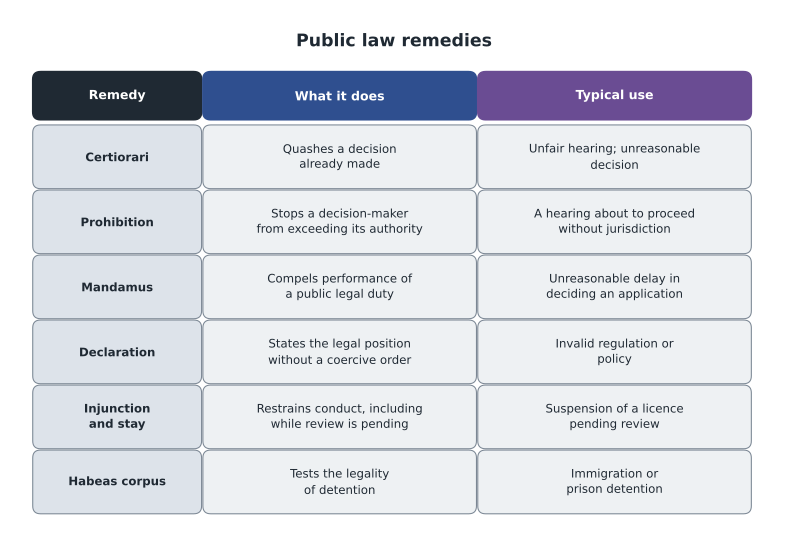
In Ontario, the Judicial Review Procedure Act, R.S.O. 1990, c. J.1, simplified the procedure. Section 2 allows a court, on an application for judicial review, to grant any relief that the applicant would be entitled to in proceedings for an order in the nature of mandamus, prohibition or certiorari, and a declaration or injunction in relation to the exercise or refusal to exercise a statutory power. Federally, section 18.1(3) of the Federal Courts Act allows the Federal Court or Federal Court of Appeal to order a federal board, commission or other tribunal to do any act or thing it has unlawfully failed or refused to do or has unreasonably delayed doing, or to declare invalid, quash, set aside, set aside and refer back, prohibit or restrain a decision, order, act or proceeding. Section 18.1(4) lists the grounds on which the court may grant relief, including acting without jurisdiction, failing to observe procedural fairness, erring in law, basing a decision on an erroneous finding of fact made in a perverse or capricious manner or without regard for the material, and acting by reason of fraud or perjured evidence.
Quashing and remitting
The most common result of a successful judicial review is that the court quashes the decision and remits the matter to the decision-maker for redetermination, often by a different member or panel and sometimes with directions. Remittal respects the legislature's choice to give the decision to the administrative body: the court has found that the decision was unreasonable or unfair, not what the right decision is. In Vavilov, the Supreme Court said that the general rule is to remit, but that a court may decline to do so where it becomes evident that a particular outcome is inevitable and that remitting the case would therefore serve no useful purpose. Concerns about delay, fairness to the parties, urgency, the costs of remittal, the nature of the regulatory regime, whether the decision-maker had a genuine opportunity to weigh in on the issue and the efficient use of public resources may also influence the court's discretion. In Vavilov itself, the Court declined to remit, because the only reasonable interpretation of the citizenship exception meant that Vavilov was a citizen.
The question of when a court should decide rather than remit is contested. In Pepa (2025), discussed in lesson 6, the majority remitted the matter to the Immigration Appeal Division while stating that only one interpretation of the statute was reasonable; Justice Rowe agreed with the result but disagreed about the remedy, and two justices dissented on both outcome and remedy. Commentators have argued that the single-reasonable-outcome exception should be applied narrowly, so that courts do not use it to substitute their own preferred answers. In practice, a lawyer asking a court to decide the matter rather than remit should show why the result is legally inevitable on the record, not merely why it is the best result.
Mandamus
Mandamus is the remedy for a decision-maker that will not decide. Applicants often seek it when an immigration application has been pending far beyond normal processing times, or when an official refuses to issue a licence that the statute requires to be issued once conditions are met. The leading test comes from the Federal Court of Appeal in Apotex Inc. v. Canada (Attorney General), [1994] 1 F.C. 742, affirmed by the Supreme Court, [1994] 3 S.C.R. 1100. Mandamus will issue only if there is a public legal duty to act; the duty is owed to the applicant; there is a clear right to performance of the duty, in particular because the applicant has satisfied all conditions precedent, has demanded performance, and the decision-maker has refused, expressly or by unreasonable delay, after a reasonable time; there is no other adequate remedy; the order will have practical value or effect; no equitable bar to relief exists; and, on a balance of convenience, the order should issue.
Where the duty involves discretion, mandamus can compel the decision-maker to exercise its discretion and decide, but it generally cannot dictate how the discretion is exercised, unless the discretion has been exhausted or only one lawful outcome remains. The Federal Court frequently grants mandamus requiring immigration officials to decide long-delayed applications within a set time, while leaving the merits to the officer.
Declarations and injunctions
A declaration states the rights of the parties or the legal effect of a law or decision. It is flexible and is often used against the Crown, which historically could not be the subject of an injunction, and in constitutional cases. In Daniels v. Canada (Indian Affairs and Northern Development), 2016 SCC 12, for example, the Court granted a declaration that Métis and non-status Indians are 'Indians' within section 91(24) of the Constitution Act, 1867. Declarations have practical force because governments generally comply with them. Injunctions restrain conduct. On judicial review, courts can grant interim relief, such as a stay of the decision under review, while the application is pending, applying the test from RJR-MacDonald Inc. v. Canada (Attorney General), [1994] 1 S.C.R. 311: a serious issue to be tried, irreparable harm if relief is refused, and a balance of convenience favouring relief. In Ontario, section 4 of the Judicial Review Procedure Act allows the court to make interim orders pending the final determination of an application.
Discretionary refusal of relief
Even when an applicant shows a reviewable error, the court may decline relief. The main grounds are the following. First, an adequate alternative remedy: in Strickland v. Canada (Attorney General), 2015 SCC 37, the Supreme Court upheld the Federal Court's refusal to hear a judicial review challenging the validity of the Federal Child Support Guidelines because the provincial superior courts, deciding child support cases under the Divorce Act, offered an adequate forum for the same arguments. Courts consider the convenience of the alternative, the nature of the error, the remedial capacity of the alternative body and the efficient use of resources. Democracy Watch (2026) added that political remedies will rarely be an adequate alternative. Second, prematurity: courts generally will not intervene in an ongoing administrative process until it has run its course, as the Federal Court of Appeal emphasized in C.B. Powell Ltd. v. Canada (Border Services Agency), 2010 FCA 61, absent exceptional circumstances. Third, mootness: where events have made the dispute academic, courts usually decline to decide, applying Borowski v. Canada (Attorney General), [1989] 1 S.C.R. 342, unless there are reasons to decide anyway. Fourth, delay or misconduct by the applicant, such as bad faith or lack of clean hands, can bar relief, as can the futility of an order with no practical effect.
Damages and other monetary relief
Judicial review does not normally produce damages. A person who wants compensation for losses caused by an unlawful administrative decision must usually bring a civil action in tort or contract, or a claim for Charter damages. In Canada (Attorney General) v. TeleZone Inc., 2010 SCC 62, the Supreme Court held that a claimant need not first obtain judicial review of a federal decision in the Federal Court before suing the Crown for damages in a provincial superior court; the claimant may challenge the decision's lawfulness as part of the damages action. Successful damages claims against public bodies are difficult, because courts protect policy decisions from liability, require proof of a private law duty of care, and in cases of deliberate abuse require proof of misfeasance in public office, which the Supreme Court described in Odhavji Estate v. Woodhouse, 2003 SCC 69, as deliberate unlawful conduct in the exercise of public functions with awareness that the conduct is unlawful and likely to harm the plaintiff. Damages under section 24(1) of the Charter are available where they are appropriate and just, applying Vancouver (City) v. Ward, 2010 SCC 27.
Costs on judicial review follow the usual principles of the court hearing the application, although public interest litigants may sometimes avoid adverse costs. Tribunals whose decisions are reviewed may participate to explain their jurisdiction and the record, but courts limit their role in defending the merits of their own decisions, as the Supreme Court discussed in Ontario (Energy Board) v. Ontario Power Generation Inc., 2015 SCC 44.
Remedies in the running files
Delisle walks through the files. In the Quintero file, the most likely result of a successful application is certiorari quashing the revocation, with the matter remitted to a differently constituted committee, without Councillor Pellerin, for a fresh decision after a fair hearing. Because the decision is void for bias and unfair procedure, Quintero's licence would revive while the matter is reconsidered, although the city could start new proceedings. Mandamus ordering the city to reinstate the licence permanently is unlikely unless the record shows that no lawful basis for revocation exists. While the application is pending, her lawyer should consider asking for an interim order under section 4 of the Judicial Review Procedure Act staying the revocation, arguing that losing a full season of business is irreparable harm. Her lost income could be pursued only in a separate action, and only if she could establish a cause of action such as misfeasance, which would require proof that Pellerin acted deliberately and knew his conduct was unlawful.
In the Anyanwu file, if the Federal Court finds the refusal unreasonable, it will set aside the decision and refer the application back to a different officer. It will almost never order the officer to issue the study permit, because issuing a permit involves assessments the officer must make. If, instead, the department had simply sat on his application for a year, mandamus compelling a decision within a fixed period would be the remedy to seek. Daniel Whitecloud observes that the remedies seem modest compared with the time and expense of litigation. 'They are,' Delisle replies. 'That is why the best administrative lawyers spend so much effort getting the first decision right, and why lesson 11 is about the other places a client can go.'
Worked problem
A permit that never comes
A restaurant owner applied fourteen months ago for a provincial liquor sales licence. The statute says the registrar "shall issue" a licence to an applicant who meets listed requirements, which the owner meets. The registrar has not decided and has not responded to two letters asking for a decision. What remedy should the owner seek?
Show solution
- Identify the problem: no decision at all, so certiorari has nothing to quash.
- Mandamus (Apotex): a public legal duty ("shall issue"), owed to the applicant, conditions precedent met, demands made and ignored for an unreasonable time.
- Other conditions: no adequate alternative remedy, practical value in an order, no equitable bar, and the balance of convenience favours the applicant.
- Because the duty is mandatory once conditions are met, the court may order issuance; if discretion were involved, it would more likely order a decision within a fixed time.
Common mistakes
MistakeExpecting the court to substitute its own decision whenever the applicant wins.
InsteadThe general rule is to remit; substitution is for cases where the outcome is inevitable (Vavilov).
MistakeClaiming lost income in a judicial review application.
InsteadDamages require a separate action in tort, contract or under section 24(1) of the Charter (TeleZone; Ward).
MistakeSeeking mandamus to tell an official how to exercise a discretion.
InsteadMandamus usually compels a decision, not a particular outcome.
MistakeIgnoring alternative remedies and prematurity.
InsteadCourts may refuse relief where an adequate alternative exists or the process is ongoing (Strickland; C.B. Powell).
Practice problems
Work each problem on paper first, then reveal the answer to check.
What does certiorari do?
Show answer
It quashes a decision that has already been made.
When will a court decide a matter rather than remit it under Vavilov?
Show answer
Rarely, where a particular outcome is inevitable and remitting would serve no useful purpose, considering factors such as delay and fairness.
Name four of the Apotex conditions for mandamus.
Show answer
Any four: public legal duty, owed to the applicant, clear right including demand and refusal, no adequate alternative, practical value, no equitable bar, balance of convenience.
What did Strickland (2015) decide?
Show answer
A court may decline judicial review where an adequate alternative forum exists, here the provincial superior courts in child support cases.
What did TeleZone (2010) hold?
Show answer
A claimant may sue the federal Crown for damages in provincial superior court without first obtaining judicial review in the Federal Court.
Summary and key terms
- Public law remedies include certiorari, prohibition, mandamus, declarations, injunctions and habeas corpus.
- Ontario's Judicial Review Procedure Act and section 18.1 of the Federal Courts Act provide the procedural vehicles.
- The usual remedy is to quash and remit; courts decide the matter only where the outcome is inevitable (Vavilov; Pepa).
- Mandamus compels performance of a public duty under the Apotex test.
- Relief is discretionary and may be refused for adequate alternatives, prematurity, mootness or the applicant's conduct.
- Damages require a separate cause of action (TeleZone; Odhavji; Ward).
- Certiorari
- An order quashing an administrative decision.
- Prohibition
- An order preventing a decision-maker from exceeding its authority.
- Mandamus
- An order compelling performance of a public legal duty.
- Declaration
- A non-coercive statement of the legal position.
- Remittal
- Sending a matter back to the decision-maker for redetermination.
- Adequate alternative remedy
- Another available process that justifies a court in declining judicial review.
Lesson quiz · 5 questions
Score 60% or more to complete this lesson.
Create a free account to save your progress, take quizzes and earn a certificate.