
LAWC-202 · Lesson 2 of 12 · 21 min
Delegated legislation and its review
▶ Video coming soon A video version of this lesson is on the way.
Professor Delisle starts the second class by putting two documents on the screen. The first is a one-page section of a provincial statute authorizing the Lieutenant Governor in Council to make regulations 'respecting licences for short-term rental platforms, including conditions of licences'. The second is a twenty-page regulation made under that section, setting out who must hold a licence, what data platforms must share with municipalities, and how much they must pay. 'Most of the law that governs daily life is in documents like the second one,' she says. 'Legislatures pass the framework; the executive fills in the detail. Today's question is how courts decide whether the detail stays within the frame.' The class will treat the statute and the regulation as fictional teaching examples.
What delegated legislation is
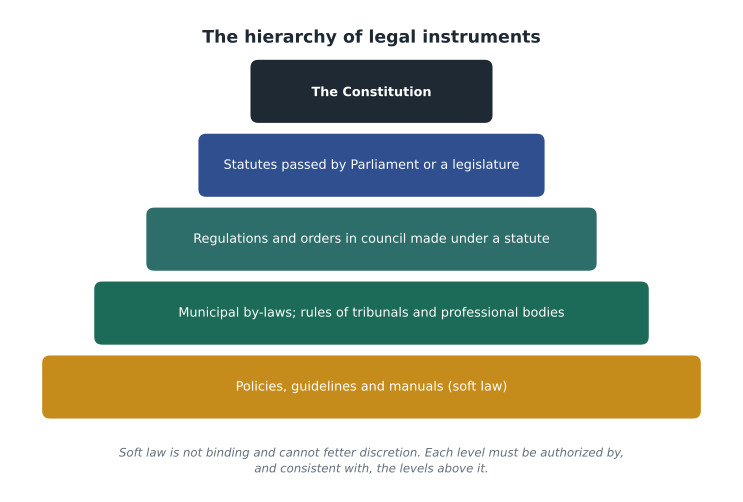
Delegated legislation, also called subordinate or secondary legislation, is law made by someone other than the legislature under authority the legislature has delegated by statute. It includes regulations made by the Governor in Council or the Lieutenant Governor in Council, ministerial regulations and orders, municipal by-laws, rules of court and of tribunals, and the by-laws and regulations of self-regulating professions. Delegated legislation has the force of law if it is validly made. It allows governments to respond quickly to technical or changing circumstances, but it is made without the public debate and votes that accompany a statute, so the law insists that it stay within the authority delegated.
Every piece of delegated legislation must trace back to an enabling provision in a statute. An instrument made without statutory authority, or beyond the limits of that authority, is ultra vires and of no force or effect. The enabling provision is therefore the first thing a lawyer reads. Some enabling provisions are narrow and specific; others are broad, such as a power to make regulations 'respecting any matter necessary or advisable to carry out effectively the intent and purpose of this Act'. Broad provisions give the delegate more room, but they do not give unlimited room: the regulation must still be consistent with the statute's text, context and purpose.
Making and publishing regulations
In Ontario, the Legislation Act, 2006, S.O. 2006, c. 21, Sched. F, governs the filing and publication of regulations. A regulation must be filed with the Registrar of Regulations and is published on e-Laws, Ontario's official online source of statutes and regulations. Federally, the Statutory Instruments Act, R.S.C. 1985, c. S-22, requires most regulations to be examined, registered and published in Part II of the Canada Gazette, and the Standing Joint Committee for the Scrutiny of Regulations, made up of senators and members of Parliament, reviews regulations for legality and procedural regularity. Federal policy also generally requires proposed regulations to be published in Part I of the Canada Gazette for public comment, with a regulatory impact analysis statement. These processes provide some democratic and expert oversight, but the courts remain the final word on whether a regulation is authorized by law.
Some statutes contain so-called Henry VIII clauses, which allow the executive to amend the statute itself by regulation. They are controversial because they let the executive change law passed by the legislature. In References re Greenhouse Gas Pollution Pricing Act, 2021 SCC 11, the Supreme Court upheld the federal carbon pricing statute, including a power for the Governor in Council to change the list of provinces and gases covered by the fuel charge. The majority held that Henry VIII clauses are not unconstitutional in themselves, because Parliament retains its power to legislate and the delegated power remains bounded by the statute's purpose. Courts nonetheless interpret such clauses narrowly.
The old approach: Katz Group
For years, the leading case on challenges to regulations was Katz Group Canada Inc. v. Ontario (Health and Long-Term Care), 2013 SCC 64. Katz Group established a strong presumption that regulations are valid, placed the burden on the challenger, and required courts to interpret the regulation and its enabling statute so as to reconcile them where possible. Most strikingly, it held that a regulation would be struck down only if it was irrelevant, extraneous or completely unrelated to the statutory purpose, a threshold so high that challenges almost never succeeded. Katz Group also said that the court does not assess the policy merits of a regulation, its wisdom or whether it will work.
After Vavilov in 2019, which made reasonableness the presumptive standard for reviewing administrative decisions, courts disagreed about whether Katz Group's highly deferential approach survived. Some appellate courts continued to apply Katz Group; others applied the Vavilov framework to regulations as to any other administrative action.
Auer and TransAlta (2024)
The Supreme Court resolved the disagreement on November 8, 2024, in two unanimous decisions written by Justice Côté. In Auer v. Auer, 2024 SCC 36, a father who paid child support challenged the Federal Child Support Guidelines, made by the Governor in Council under the Divorce Act, arguing that they required paying parents to bear a larger share of child-related costs than recipient parents and so exceeded the delegated authority. In TransAlta Generation Partnership v. Alberta (Minister of Municipal Affairs), 2024 SCC 37, a power company challenged ministerial guidelines for assessing linear property under Alberta's Municipal Government Act as discriminatory and inconsistent with the statute's purposes.
The Court held that the Vavilov framework, including the presumption of reasonableness review, applies to the review of the vires of subordinate legislation. Some Katz Group principles survive: subordinate legislation is presumed valid, the challenger bears the burden of showing it is invalid, the court interprets the regulation and the statute so as to reconcile them where possible, and the court does not review the policy merits. But the court no longer needs to find the regulation irrelevant, extraneous or completely unrelated to the statute's purpose before striking it down. Instead, the court asks whether the regulation reasonably falls within the scope of the authority conferred, considering the governing statutory scheme, other applicable statutory and common law, and the principles of statutory interpretation. These legal constraints are the key ones; a delegate cannot read its own authority more broadly than the text, context and purpose allow.
Applying that framework, the Court upheld both instruments. In Auer, the Guidelines fell reasonably within the Governor in Council's authority, particularly because section 26.1(2) of the Divorce Act requires the Guidelines to be based on the principle that spouses have a joint financial obligation to maintain their children in accordance with their relative abilities to contribute. In TransAlta, no exception to reasonableness applied and the guidelines were within the minister's authority. Commentators have called the decisions the end of a hyperdeferential era, because a regulation that misreads the scope of its enabling statute can now be struck down without meeting Katz Group's near-impossible threshold.
Correctness and constitutional challenges
Auer and TransAlta concern challenges to whether subordinate legislation is authorized by its enabling statute. A challenge that a regulation violates the Charter or the division of powers raises a constitutional question, and constitutional questions are reviewed for correctness. Similarly, if a statute expressly prescribes a standard of review or provides a statutory appeal, the Vavilov exceptions discussed in lesson 5 apply. The usual case, a claim that a regulation goes beyond what the statute allows, is reviewed for reasonableness.
Municipal by-laws
Municipalities have no inherent powers. Their authority comes from provincial statutes, which in Ontario now give them broad powers to pass by-laws respecting matters within listed spheres, including business licensing. In Catalyst Paper Corp. v. North Cowichan (District), 2012 SCC 2, the Supreme Court held that municipal by-laws are reviewed for reasonableness, but with considerable deference: a by-law would be set aside only if it was one no reasonable elected municipal council could have passed, because councils weigh broad social, economic and political factors and answer to their electors. Ontario's Municipal Act, 2001 also allows a person to apply to the Superior Court to quash a by-law for illegality, and it provides that a by-law passed in good faith under the Act may not be quashed or open to review because of the unreasonableness or supposed unreasonableness of the by-law.
How Auer applies to municipal by-laws is still being worked out. Auer itself involved federal regulations and TransAlta involved ministerial guidelines, and the Court said the framework applies to subordinate legislation generally. Courts have begun to treat Catalyst Paper's deference to elected councils as part of the context of reasonableness review rather than a separate test. For Quintero, this matters because the Corwin by-law requires food trucks to stay at least one hundred metres from any restaurant. If the city's licensing powers do not authorize regulating competition between businesses, a challenge could argue the buffer is outside the by-law-making power; if they do, the challenge will be much harder.
Soft law, sub-delegation and fettering
Governments also issue soft law: policies, guidelines, manuals and operational bulletins that do not have the force of law. Soft law promotes consistency and tells the public how discretion will usually be exercised, and courts encourage it. But a decision-maker may not treat a guideline as binding where the statute gives it discretion; doing so fetters its discretion and is a reviewable error. In Thamotharem v. Canada (Minister of Citizenship and Immigration), 2007 FCA 198, the Federal Court of Appeal upheld a guideline of the Immigration and Refugee Board setting the usual order of questioning at refugee hearings because it allowed members to depart from it in appropriate cases.
A delegate also generally may not sub-delegate its power to someone else unless the statute allows it, under the maxim delegatus non potest delegare. The principle is applied flexibly, especially for administrative functions. Under the Carltona doctrine, recognized in Canada, a minister may act through responsible officials in the department without express statutory authority, because the minister remains accountable to the legislature. Ontario's Legislation Act, 2006 and the federal Interpretation Act also contain rules on who may exercise a minister's powers.
Applying the framework to the regulation
Delisle returns to the short-term rental regulation. Its enabling section allows regulations respecting licences and conditions of licences. One condition requires platforms to share each host's name, address and booking history with the municipality monthly; another requires platforms to pay a fee of five dollars per night booked into a provincial housing fund. Arjun Mehta argues that the data-sharing condition is reasonably within a power to set licence conditions, because a licensing scheme needs information to enforce it. Hannah Kowalczyk argues that the per-night payment looks like a tax, and that the section authorizes licence conditions and fees, not a revenue measure to fund housing. 'That is exactly the kind of argument Auer now makes possible,' Delisle says. 'Under Katz Group, you would have had to show the payment was completely unrelated to licensing. Under Auer, you argue that the text, context and purpose of the section do not reasonably authorize it, and that a delegated power to impose fees is read in light of the constitutional rule that taxes must be imposed by the legislature.'
Worked problem
Challenging a licence condition
A provincial statute authorizes regulations "respecting the licensing of tow truck operators, including conditions of licences." A regulation requires every licensed operator to buy its trucks from manufacturers on an approved list. A small operator challenges the condition. How would you analyze it after Auer?
Show solution
- Identify the instrument and its enabling provision: a regulation made under the licensing section.
- Standard of review: the challenge is to vires, not a constitutional question, so reasonableness presumptively applies (Auer; TransAlta).
- Interpret the enabling section: text (licensing and conditions), context (the statute's safety and consumer protection scheme) and purpose.
- Ask whether the purchasing condition reasonably falls within a power to set licence conditions: is it connected to safety or consumer protection, or does it pursue a purpose such as industrial policy that the statute does not authorize?
- Remember the surviving Katz principles: the regulation is presumed valid, the operator bears the burden, and the court will not judge whether the policy is wise.
Common mistakes
MistakeArguing that a regulation is invalid because it is bad policy.
InsteadCourts do not review the policy merits; the question is whether the regulation reasonably falls within the delegated authority.
MistakeApplying Katz Group's "irrelevant, extraneous or completely unrelated" test after 2024.
InsteadAuer and TransAlta replaced that threshold with Vavilov reasonableness review.
MistakeTreating a policy manual as binding law that the decision-maker must follow.
InsteadSoft law guides discretion but cannot fetter it.
MistakeReviewing a Charter challenge to a regulation for reasonableness.
InsteadConstitutional questions are reviewed for correctness.
Practice problems
Work each problem on paper first, then reveal the answer to check.
What standard of review applies to a challenge to the vires of a regulation after Auer v. Auer (2024)?
Show answer
Reasonableness under the Vavilov framework, presumptively.
Which Katz Group principles survive Auer?
Show answer
The presumption of validity, the burden on the challenger, reconciling interpretation and no review of policy merits.
What is a Henry VIII clause?
Show answer
A statutory power allowing the executive to amend the statute by regulation.
What standard did Catalyst Paper (2012) apply to municipal by-laws?
Show answer
Deferential reasonableness: set aside only if no reasonable elected council could have passed it.
What does it mean to fetter discretion?
Show answer
To treat a guideline or policy as binding so that the decision-maker does not genuinely exercise the discretion the statute gives.
Summary and key terms
- Delegated legislation must be authorized by an enabling statute and stay within its limits.
- Ontario's Legislation Act, 2006 and the federal Statutory Instruments Act govern filing, publication and scrutiny of regulations.
- Auer and TransAlta (2024) apply Vavilov reasonableness to vires challenges, keeping the presumption of validity but dropping Katz Group's extreme threshold.
- Constitutional challenges to regulations are reviewed for correctness.
- Municipal by-laws are reviewed with deference to elected councils (Catalyst Paper), within the Municipal Act's limits.
- Soft law guides but cannot fetter discretion, and delegates generally cannot sub-delegate without authority.
- Delegated legislation
- Law made by an executive body or other delegate under authority conferred by statute.
- Ultra vires
- Beyond the powers conferred by law, and therefore invalid.
- Enabling provision
- The section of a statute that authorizes the making of delegated legislation.
- Henry VIII clause
- A provision allowing the executive to amend a statute by regulation.
- Soft law
- Non-binding policies, guidelines and manuals that guide discretion.
- Fettering
- Treating non-binding guidance as binding, so that discretion is not genuinely exercised.
Lesson quiz · 5 questions
Score 60% or more to complete this lesson.
Create a free account to save your progress, take quizzes and earn a certificate.