
LAWC-202 · Lesson 7 of 12 · 21 min
Correctness review and the limits of deference
▶ Video coming soon A video version of this lesson is on the way.
Professor Delisle begins the seventh class with a question from the end of the last one. Hannah Kowalczyk had argued that the short-term rental regulation's per-night payment was really a tax that only the legislature could impose. 'On what standard would a court review the ministry's view that it was a fee?' Delisle asks. Arjun Mehta answers that the question is constitutional, because section 53 of the Constitution Act, 1867 and the principle of no taxation without representation require that taxes be imposed by the legislature, and Vavilov says constitutional questions are reviewed for correctness. 'Right,' Delisle says. 'Today is about the questions where deference stops, and about a 2026 decision that tells legislatures where their power to limit review stops too.'
Why some questions require correctness
Vavilov explained that correctness review is required where the rule of law demands a single, determinate answer that is consistent across the legal system. Those questions cannot be left to many administrative decision-makers, each of which might reach a different answer within a range of reasonable ones. When correctness applies, the reviewing court does its own analysis and asks whether the decision-maker's answer is the right one; if not, the court substitutes its own answer. Correctness categories are exceptions to the presumption of reasonableness, and courts guard against expanding them.
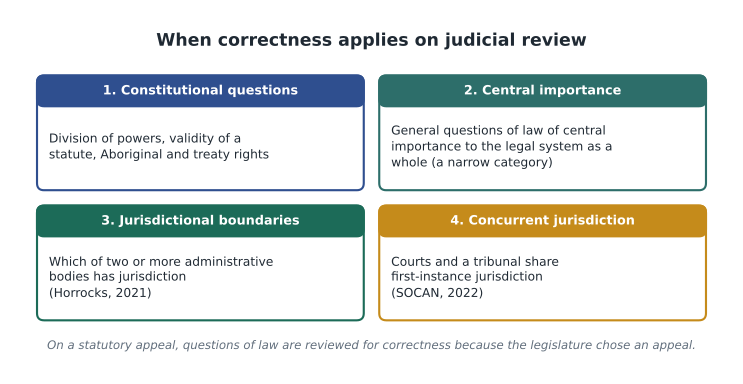
Constitutional questions
Constitutional questions are reviewed for correctness because the Constitution is the supreme law and its meaning cannot vary from one tribunal to another. This category includes questions about the division of powers between Parliament and the provinces, the relationship between the legislature and other branches, the scope of Aboriginal and treaty rights under section 35, and challenges to the validity of a statute or regulation under the Charter. Tribunals with the power to decide questions of law may decide constitutional questions arising in their proceedings, as the Supreme Court held in Nova Scotia (Workers' Compensation Board) v. Martin, 2003 SCC 54, and R. v. Conway, 2010 SCC 22, but their answers are reviewed for correctness.
An important qualification concerns discretionary decisions that engage Charter protections. Where a decision-maker applies a valid statute and exercises discretion in a way that limits Charter protections, the Supreme Court has applied a reasonableness-based framework from Doré v. Barreau du Québec, 2012 SCC 12, rather than correctness. Lesson 8 examines that framework. The distinction is between a challenge to the law itself, which is a constitutional question, and a challenge to how a decision-maker exercised discretion under a valid law.
General questions of central importance
The second category covers general questions of law of central importance to the legal system as a whole. Vavilov narrowed this category: the question must have legal implications for many other statutes or for the administration of justice generally, not merely be important to the parties or to the public. The Court gave examples from earlier cases, such as the scope of solicitor-client privilege, which it reviewed for correctness in Alberta (Information and Privacy Commissioner) v. University of Calgary, 2016 SCC 53, and the scope of parliamentary privilege. The fact that a question is of wide public interest, or that it is a question of human rights law, does not alone bring it within the category. In Mason, the Court declined to treat the interpretation of international law in an immigration statute as a question requiring correctness, although international law remained a constraint on reasonableness.
Jurisdictional boundaries between administrative bodies
The third category covers questions about the jurisdictional boundaries between two or more administrative bodies, where courts must say which body has authority so that the two do not issue conflicting decisions or leave a gap. In Northern Regional Health Authority v. Horrocks, 2021 SCC 42, an employee in Manitoba filed a human rights complaint after being dismissed for reasons she said related to her addiction. The employer argued that a labour arbitrator under the collective agreement had exclusive jurisdiction. The Supreme Court held that the question of which body had jurisdiction was reviewed for correctness, and that, absent clear legislative intent to the contrary, a labour arbitrator's jurisdiction over disputes arising from a collective agreement is exclusive, so the human rights adjudicator lacked jurisdiction. Horrocks matters in practice, because unionized employees often have overlapping routes for workplace disputes.
Concurrent first-instance jurisdiction: SOCAN
In Society of Composers, Authors and Music Publishers of Canada v. Entertainment Software Association, 2022 SCC 30, the Court added a fourth category. The Copyright Board interpreted the 'making available' provision in the Copyright Act. Courts also interpret the same provision at first instance in copyright infringement actions. Justice Rowe, for the majority, held that where courts and an administrative body share first-instance jurisdiction over the same legal question, the rule of law and legislative intent require correctness review, to avoid inconsistent interpretations of the same statute depending on whether a question is raised before the Board or a court. Applying correctness, the Court held that the Board had misinterpreted the provision. The Court presented the category as a narrow addition consistent with Vavilov, not a reopening of the list.
Statutory appeals revisited
Correctness also applies to questions of law on statutory appeals, but for a different reason: not because of the rule of law, but because the legislature, by providing a right of appeal, chose appellate review. As lesson 5 explained, palpable and overriding error applies to factual findings and mixed questions on appeal, with correctness for any extricable question of law. Lawyers should identify early whether a statutory appeal exists, whether leave is required, what grounds it covers and what time limit applies, because the answer changes both the standard and the procedure.
Privative clauses after Democracy Watch
For decades, legislatures used privative clauses to signal that courts should defer to specialized tribunals, and before Vavilov privative clauses were a factor pointing to deference. Vavilov held that privative clauses are no longer relevant to selecting the standard, because reasonableness is presumed anyway, but it also reaffirmed that legislatures cannot shield administrative decision-makers from review entirely. The Supreme Court went further in Democracy Watch v. Canada (Attorney General), 2026 SCC 28, released on July 30, 2026.
Democracy Watch sought judicial review in the Federal Court of Appeal of a decision of the federal Conflict of Interest and Ethics Commissioner. Section 66 of the Conflict of Interest Act, S.C. 2006, c. 9, s. 2, provided that the Commissioner's orders and decisions were final and could be questioned or reviewed only on limited grounds under the Federal Courts Act, which excluded review for errors of law and fact. The Federal Court of Appeal, in 2024 FCA 158, struck the application on that basis. The Supreme Court unanimously allowed Democracy Watch's appeal.
The Court held that the constitutional guarantee of judicial review, grounded in sections 96 to 101 of the Constitution Act, 1867 and the rule of law, extends to the legality of all aspects of an administrative decision, including questions of fact and law. A legislature cannot place any exercise of public authority beyond the courts' power to review whether it was lawful. Because an irrational decision is necessarily unlawful, rationality review is also protected. The guarantee applies equally where Parliament assigns judicial review to a section 101 court such as the Federal Court of Appeal. Section 66 was therefore of no force or effect to the extent that it prohibited review of questions of fact and law. The Court also rejected the argument that political oversight of the Commissioner by Parliament was an adequate alternative remedy that justified declining review, and it sent the matter back for a hearing on the merits.
Democracy Watch did not constitutionalize Vavilov. The Court did not hold that reasonableness review as defined in Vavilov is constitutionally required, and it left open the possibility that a legislature could prescribe a more deferential standard, such as one akin to patent unreasonableness, provided it respects the rule of law. Where that line falls was left for future cases. The Court also confirmed that legislatures may regulate the procedure for judicial review, such as time limits and leave requirements, as long as they do not oust the courts' supervisory role. Commentators described the decision as the end of privative clauses as a means of barring review, while noting that quasi-privative clauses prescribing deferential standards may survive.
Applying correctness to the files
Delisle maps the categories onto the running files. Kowalczyk's tax argument against the short-term rental regulation is a constitutional question: the court will decide for itself whether the per-night payment is a regulatory charge connected to the licensing scheme or a tax requiring legislative authority, applying the Supreme Court's tests from cases such as 620 Connaught Ltd. v. Canada (Attorney General), 2008 SCC 7. The ordinary vires challenge, whether data-sharing conditions fall within a power to set licence conditions, remains reasonableness under Auer. In the Quintero file, no correctness category applies to the committee's decision, but if the city argued that a different body, such as the Ontario Land Tribunal or a provincial licensing body, had exclusive jurisdiction over her dispute, that boundary question would be reviewed for correctness under Horrocks.
Daniel Whitecloud asks whether a city could put a privative clause in a by-law to stop Quintero from going to court. 'No,' Delisle says. 'A municipality can only do what its statute allows, and no Ontario statute lets a council oust the Superior Court's supervisory jurisdiction. After Democracy Watch, even Parliament and the legislatures cannot bar review of the legality of a decision. What they can do is set short time limits and procedural requirements, so you must still move quickly.'
Consistency, discord and the rule of law
One argument for correctness review that Vavilov rejected deserves attention. Before 2019, some judges argued that where tribunal members persistently reached conflicting interpretations of the same provision, the courts should step in and settle the meaning on a correctness standard, because the rule of law requires that like cases be treated alike. The majority in Vavilov declined to make persistent discord a correctness category. It reasoned that consistency is better addressed by the tribunal itself, through internal mechanisms such as plenary meetings of members, practice notes, jurisprudential guides and reconsideration procedures, of the kind upheld in IWA v. Consolidated-Bathurst and Thamotharem. Conflicting decisions remain relevant, however. A decision that departs from a tribunal's own longstanding practice or from its earlier decisions bears a justificatory burden: the reasons must explain the departure. Where a tribunal's members cannot agree, the legislature can also respond by clarifying the statute.
Correctness review itself is simple to describe and demanding to apply. The court asks what the right answer is. It may consider the tribunal's reasons and may find them persuasive, but it owes them no deference, and if it disagrees it substitutes its own view, often without remitting the matter. That is why the categories are narrow: every category is a decision that the courts, not the administrative body, will have the last word on a question. Arjun Mehta points out that this leaves tribunals with the final word on most questions about their own statutes. 'Subject to reasonableness review,' Delisle says. 'Which, as you saw last week, still has teeth.'
Worked problem
Sorting questions by standard
A provincial labour board decides: (1) that a provincial statute regulating a trucking company's labour relations applies even though the company argues it is a federal undertaking; (2) that a grievance falls within the collective agreement rather than the employment standards scheme administered by another body; (3) that an employer's conduct was an unfair labour practice. What standard applies to each on judicial review?
Show solution
- (1) Whether provincial labour law applies to an interprovincial undertaking is a division of powers question: correctness.
- (2) Which of two administrative bodies has jurisdiction is a jurisdictional boundary question: correctness (Horrocks).
- (3) Applying the statute to the facts is the board's core work: reasonableness, presumed under Vavilov.
- If the statute instead gave an appeal to the court on questions of law, legal questions in (3) would be reviewed for correctness as a matter of appellate review.
Common mistakes
MistakeArguing correctness because a question is important to the public.
InsteadThe central importance category requires significance to the legal system as a whole, which is narrow.
MistakeTreating every Charter-related decision as a constitutional question reviewed for correctness.
InsteadDiscretionary decisions engaging the Charter are reviewed under Doré, discussed in lesson 8.
MistakeAssuming a privative clause can bar judicial review of errors of law.
InsteadDemocracy Watch (2026): legality review, including fact and law, is constitutionally guaranteed.
MistakeOverlooking SOCAN when a court and a tribunal both interpret the same provision at first instance.
InsteadShared first-instance jurisdiction calls for correctness.
Practice problems
Work each problem on paper first, then reveal the answer to check.
Why does the rule of law require correctness for some questions?
Show answer
Because they need a single, consistent answer across the legal system that only courts can provide.
What did Horrocks (2021) decide?
Show answer
Jurisdictional boundary questions between bodies are reviewed for correctness, and a labour arbitrator's jurisdiction over collective agreement disputes is exclusive absent clear contrary intent.
What category did SOCAN (2022) add?
Show answer
Correctness for questions over which courts and an administrative body share first-instance jurisdiction.
What did Democracy Watch (2026) hold about section 66 of the Conflict of Interest Act?
Show answer
It was of no force or effect to the extent it barred review of questions of fact and law.
What did Democracy Watch leave open?
Show answer
How deferential a legislated standard of review may be, and where the line between permissible procedural limits and impermissible limits falls.
Summary and key terms
- Correctness applies where the rule of law needs a single answer, and the court then substitutes its own view.
- Constitutional questions, general questions of central importance to the legal system and jurisdictional boundaries between bodies are reviewed for correctness (Vavilov; Horrocks).
- SOCAN (2022) added concurrent first-instance jurisdiction as a correctness category.
- Questions of law on statutory appeals get correctness because the legislature chose an appeal.
- Democracy Watch (2026) holds that legality review, including fact and law, cannot be ousted by privative clauses.
- Legislatures may still regulate procedure and may prescribe deferential standards within limits not yet defined.
- Correctness categories
- The defined exceptions in which courts decide questions for themselves on judicial review.
- Constitutional question
- A question about the division of powers, section 35 or the validity of law under the Charter.
- Jurisdictional boundary
- The line between the authority of two or more administrative bodies.
- Concurrent first-instance jurisdiction
- Authority shared by a court and a tribunal to decide the same legal question at first instance.
- Legality review
- Review of whether public power was exercised lawfully, constitutionally guaranteed.
- Quasi-privative clause
- A clause prescribing a deferential standard of review rather than barring review.
Lesson quiz · 5 questions
Score 60% or more to complete this lesson.
Create a free account to save your progress, take quizzes and earn a certificate.