
LAWC-202 · Lesson 12 of 12 · 22 min
Capstone: solving an administrative law problem
▶ Video coming soon A video version of this lesson is on the way.
For the last class, Professor Delisle hands out a problem and gives the class ninety minutes to outline an answer before she takes them through it. The problem is entirely fictional, including the statute and the regulator, and is written to bring together every part of the course. After the outlines are collected, she works through a model answer, which follows the facts below.
The problem
The Pet Care Professions Act, 2024, a fictional Ontario statute, creates the College of Registered Dog Groomers of Ontario. Only registered members may use the title registered dog groomer. The College's council may make regulations, with the approval of the Lieutenant Governor in Council, 'respecting professional misconduct'. The Act establishes a discipline committee and provides that the Statutory Powers Procedure Act applies to its hearings. Section 41 provides: 'A party may appeal a decision of the discipline committee to the Divisional Court on a question of law within thirty days after the decision is delivered.' Section 42 provides: 'Except as provided in section 41, a decision of the discipline committee is final and shall not be questioned in any court.'
The College also publishes a Penalty Guideline, a policy document approved by council, which says that 'a finding of rough handling causing injury shall result in a suspension of not less than twelve months.' The Act does not mention the Guideline.
Tomasz Brennan has been a registered groomer in Corwin for fourteen years. He runs a small shop and employs two assistants. A customer posted a short video online showing Brennan restraining a struggling terrier on a grooming table; the dog later had a small cut on its ear. The customer complained to the College. The College's deputy registrar investigated, prepared the allegation of professional misconduct, and then sat with the discipline panel during deliberations 'to assist with drafting'. The panel of three included a public member, a lawyer member, and a groomer member, Celeste Arnaud, who owns a competing grooming business four kilometres from Brennan's shop. Arnaud did not disclose her business, and Brennan did not know about it until after the hearing.
Brennan received the College's disclosure, including an expert report from a veterinarian, two days before the hearing. He asked for a four-week adjournment so that he could get his own veterinary opinion that the cut was caused by the dog's sudden movement against clippers, not rough handling. The panel refused, saying that 'the College has an interest in prompt resolution of complaints involving animal welfare.' At the hearing, Brennan testified that he used a standard restraint technique and that the cut was an accident. The panel found him guilty of professional misconduct for rough handling causing injury. Its reasons, two pages long, describe the video and the College's expert report, do not mention Brennan's explanation of the technique, and state: 'Applying the Penalty Guideline, the panel must impose a suspension of not less than twelve months.' The panel imposed a twelve-month suspension. It added that Brennan's 'disrespectful public statements criticizing the College on social media' were an aggravating factor that confirmed the need for a significant penalty. Brennan had posted several times that the College was 'run by big chains to squeeze out small shops.'
The decision was delivered twenty-two days ago. Brennan has come to you. What are his options, and what are his chances?
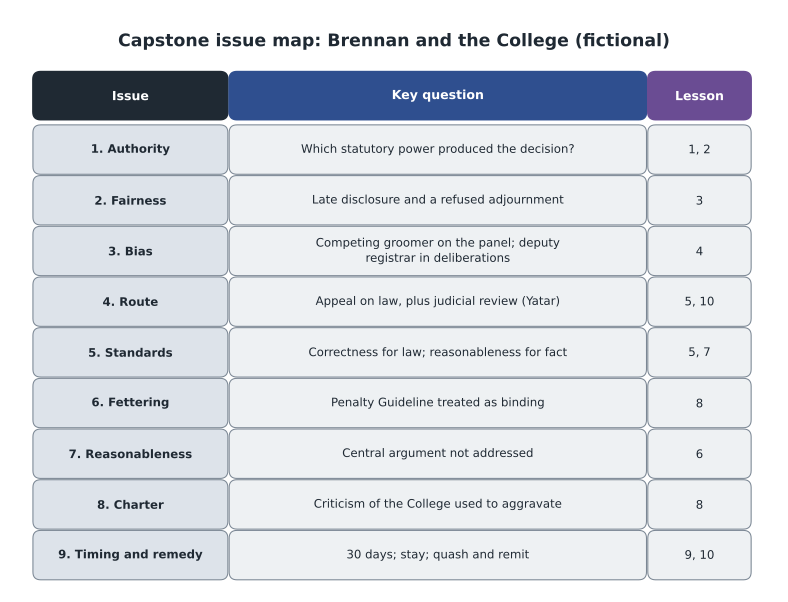
Step 1: authority and the decision
The decision-maker is the discipline committee of a statutory self-regulating profession, exercising a statutory power of decision under the Pet Care Professions Act. The Statutory Powers Procedure Act applies. The decision has two parts: the finding of professional misconduct and the penalty. Both are subject to review, and the College is the respondent. The deputy registrar's role and the Penalty Guideline are part of the context. The first task is to read the Act closely, especially sections 41 and 42 and the provisions on the discipline committee's powers to impose penalties, which, we will assume, allow it to reprimand, impose conditions, suspend for up to twenty-four months or revoke registration.
Step 2: the route and the clock
Section 41 gives a statutory appeal to the Divisional Court on questions of law within thirty days. Twenty-two days have passed, so eight remain. The appeal must be started immediately. Section 42 purports to make the decision otherwise final. Under Yatar v. TD Insurance (2024), a limited statutory appeal does not by itself preclude judicial review of other questions, such as questions of fact or mixed fact and law. Under Democracy Watch (2026), section 42 cannot bar review of the legality of the decision, including questions of fact and law, so it does not prevent a judicial review application. The practical approach is to file a notice of appeal under section 41 and, at the same time, an application for judicial review under the Judicial Review Procedure Act within the thirty-day limit in section 5, and to ask that they be heard together. Fairness and bias complaints can be raised in either proceeding, as they go to the legality of the process.
Brennan should also consider an interim stay of the suspension pending the hearing. The Statutory Powers Procedure Act provides that an appeal generally operates as a stay unless another statute provides otherwise, but the Pet Care Professions Act may say something different, so the lawyer must check; if no automatic stay applies, Brennan can move for one under the RJR-MacDonald test, arguing a serious issue, irreparable harm to his business and employees, and a balance of convenience that can be protected by conditions, such as supervision of his work pending the appeal.
Step 3: procedural fairness
A duty of fairness is plainly owed: the decision is final and individual and affects Brennan's livelihood (Knight). Its content is high. Applying the Baker factors, the discipline process is court-like, with allegations, evidence and findings; the statutory appeal is limited to law; the decision is extremely important to Brennan; and the Statutory Powers Procedure Act signals a full adjudicative process. Fairness required timely disclosure of the case to meet and a genuine opportunity to answer it. Disclosure of an expert report two days before the hearing, combined with the refusal of an adjournment to obtain responding expert evidence on the central issue of causation, deprived Brennan of a fair opportunity to respond. The panel's stated reason, the College's interest in prompt resolution, is legitimate in general, but a four-week adjournment would not have endangered any animal, especially since conditions could have been imposed in the meantime. A court would likely find a breach of procedural fairness, which alone would require the decision to be quashed.
Step 4: bias and institutional independence
Two bias issues arise. First, Celeste Arnaud owns a competing business four kilometres away. The discipline committee is an adjudicative body, so the strict reasonable apprehension standard applies (Committee for Justice and Liberty; Newfoundland Telephone). A reasonable, informed person would likely apprehend that a direct competitor, who stands to benefit from a rival's year-long suspension, might not decide fairly. Her failure to disclose the connection aggravates the concern. Brennan did not raise the objection at the hearing, but he did not know the facts, so there is no waiver. Second, the deputy registrar investigated and prosecuted the case and then sat with the panel during deliberations. Under the principles in Régie des permis d'alcool and Consolidated-Bathurst, a person who played an adversarial role in the case should not participate in the panel's deliberations, because that creates an apprehension that the panel heard from one side in private. Either issue alone is likely fatal, and a decision tainted by bias is void, regardless of whether the result would have been the same.
Step 5: the standards of review
On the statutory appeal, questions of law, including the interpretation of 'professional misconduct' and of the committee's penalty powers, and the legal effect of the Penalty Guideline, are reviewed for correctness (Vavilov; Bell Canada). Findings of fact and mixed fact and law, such as whether Brennan's technique amounted to rough handling and whether the cut was caused by it, fall outside section 41; on judicial review they would be reviewed for reasonableness, subject to the Divisional Court's discretion under Yatar. The fairness and bias issues are assessed by asking whether the process was fair and impartial, without deference. The Charter issue in Step 8 involves a discretionary penalty decision engaging the Charter and would be analysed under Doré, which applies reasonableness review, although on a statutory appeal a court might treat a legal error in failing to consider the Charter as an error of law.
Step 6: fettering by the Penalty Guideline
The panel said it must impose a suspension of at least twelve months because of the Penalty Guideline. The Act gives the committee a range of penalties, from a reprimand to revocation, to be chosen in each case. The Guideline is soft law: a policy approved by council, not a regulation made under the Act. Treating it as binding fettered the panel's discretion (Thamotharem), and the panel's own words show that it did not consider whether a lesser penalty was appropriate on the facts. That is an error of law within section 41, reviewed for correctness, and also an unreasonable exercise of discretion. Had the College wanted a mandatory minimum, it would have needed authority in the Act, and even a regulation would have to fall reasonably within the regulation-making power under Auer.
Step 7: reasonableness of the misconduct finding
Even if the process had been fair, the misconduct finding is vulnerable on reasonableness review. Brennan's central argument was that he used a standard restraint technique and that the cut was an accident caused by the dog's movement. The panel's reasons do not mention that explanation. Under Vavilov, a decision-maker's failure to meaningfully grapple with a central argument, especially where the consequences for the individual are severe, can make a decision unreasonable. The reasons also do not explain how the panel concluded that the handling was rough rather than appropriate restraint, an essential element of the allegation. The panel is entitled to deference on its assessment of the video and the expert evidence, and a reviewing court will not reweigh them, but it needs reasons showing that the panel considered both sides of the central question. Given the twelve-month suspension, responsive justification was required and is missing.
Step 8: the Charter and the aggravating factor
The panel treated Brennan's online criticism of the College as an aggravating factor. Criticizing a regulator is expression protected by section 2(b) of the Charter, and the College, as a statutory body exercising public power, is bound by the Charter when it disciplines members. Under Doré and Loyola, the panel's penalty decision had to reflect a proportionate balance between Brennan's expressive freedom and the statutory objective of protecting the public. Using lawful criticism of the College, unrelated to the handling of animals, to increase a penalty for rough handling does not advance the objective of animal welfare and limits expression more than necessary. The panel did not even identify the Charter interest, which under the 2023 TNO decision is itself a reason the decision is unreasonable. Professional regulators can discipline members for expression in some cases, as in Doré, where the lawyer's letter breached a duty of civility, but here the criticism was not the subject of any allegation, and Brennan had no notice that it would be used against him, which is also a fairness problem.
Step 9: remedy
The likely result is that the Divisional Court allows the appeal and the application, quashes both the finding and the penalty, and remits the matter to a differently constituted panel, without Arnaud and without the deputy registrar's participation in deliberations, for a new hearing with adequate time for Brennan to obtain responding expert evidence. The court is unlikely to substitute its own finding, because whether Brennan's handling was rough is a factual question for the committee and no outcome is inevitable (Vavilov). The court may give directions, for example that the Penalty Guideline may not be treated as binding and that his public criticism may not be used as an aggravating factor. Brennan should seek his costs.
Parallel routes
Brennan might also file a complaint about the College's process with the College itself and raise the conflict-of-interest issue with its council, and his lawyer might use the College's own access to records policy, or a request to the Ontario ministry that oversees the statute, to learn whether the deputy registrar routinely sits with panels. If the problem is systemic, it could support a public interest challenge by an association of independent groomers. None of these routes stops the thirty-day clocks, so the appeal and application must be filed first.
Back to the course
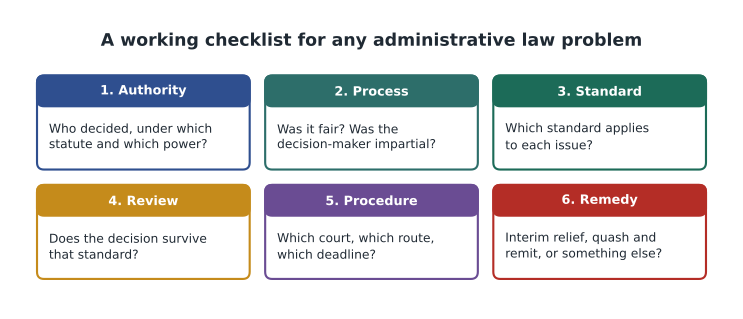
Delisle closes by pointing to the six questions on the board. 'Every problem you will see in practice has the same structure,' she says. 'Who decided and under what authority. Whether the process was fair and the decision-maker impartial. Which standard applies to each issue. Whether the decision survives that standard. Where to go and how fast. And what remedy actually helps the client. Marisol Quintero's case and Tomasz Brennan's case are both about small business owners facing public power. Administrative law is how the law keeps that power honest.'
Worked problem
Outlining under time pressure
You have ninety minutes for a problem like Brennan's. How should you organize the answer?
Show solution
- Spend the first ten minutes reading the statute and listing every decision, actor and time limit.
- Address the route and the deadlines first, because a missed deadline defeats every other argument.
- Take process issues (fairness, bias) before substance, because they can be decisive and do not depend on the standard of review.
- For each substantive issue, state the standard of review with authority, then apply it.
- Finish with the remedy, interim relief and parallel routes, and state a bottom line on the client's chances.
Common mistakes
MistakeIgnoring the statutory appeal and filing only for judicial review.
InsteadUse the statutory appeal for law and judicial review for other questions, within the same 30-day window.
MistakeTreating a final-and-binding clause as barring all court review.
InsteadDemocracy Watch (2026): legality review, including fact and law, cannot be ousted.
MistakeArguing the merits before checking for fairness and bias.
InsteadProcess defects can be decisive and void the decision on their own.
MistakeAsking the court to find the client not guilty.
InsteadThe usual remedy is to quash and remit for a new hearing.
Practice problems
Work each problem on paper first, then reveal the answer to check.
Why can Brennan seek judicial review despite section 42?
Show answer
Yatar allows judicial review alongside a limited appeal, and Democracy Watch holds that legality review cannot be ousted.
What fairness breach is most serious in the problem?
Show answer
Late disclosure of the expert report combined with refusing an adjournment to obtain responding evidence on the central issue.
Why is the deputy registrar's role a problem?
Show answer
Someone who investigated and prosecuted the case sat with the panel during deliberations, creating an apprehension of bias.
What error did the panel make with the Penalty Guideline?
Show answer
It treated a non-binding policy as mandatory, fettering its statutory discretion.
What is the likely remedy?
Show answer
Quashing the finding and penalty and remitting the matter to a differently constituted panel, with directions.
Summary and key terms
- Start every problem with the decision-maker's authority and the statute's appeal and finality provisions.
- Check routes and deadlines first: statutory appeals and judicial review may both be needed within 30 days.
- Fairness and bias are assessed without deference and can void a decision on their own.
- Choose the standard issue by issue: correctness for law on appeal, reasonableness for facts on review, Doré for Charter-engaging discretion.
- Fettering by soft law, failure to grapple with central arguments and disproportionate limits on Charter protections are common reviewable errors.
- The usual remedy is to quash and remit, with interim relief and parallel routes considered early.
- Issue map
- A structured list of the issues in a problem and the law governing each.
- Final and binding clause
- A statutory provision purporting to make a decision unreviewable.
- Interim stay
- An order suspending a decision while it is under review.
- Remit with directions
- Sending a matter back with instructions on how it must be redecided.
- Parallel routes
- Pursuing several accountability mechanisms at once.
- Bottom line
- A clear statement of the client's likely outcome.
Lesson quiz · 5 questions
Score 60% or more to complete this lesson.
Create a free account to save your progress, take quizzes and earn a certificate.