
LAWC-202 · Lesson 5 of 12 · 21 min
Standard of review
▶ Video coming soon A video version of this lesson is on the way.
Professor Delisle draws a line across the whiteboard in the fifth class. At one end she writes 'the court decides the question for itself'; at the other, 'the court leaves the question to the decision-maker'. 'Every judicial review sits somewhere on this line,' she says. 'The standard of review tells the court how much it should defer. For forty years Canadian courts struggled to find the right point. In 2019 the Supreme Court tried to settle it, and today's class is about that settlement.'
Why the standard of review matters
When a court reviews an administrative decision, it must decide whether to substitute its own view or to respect the decision-maker's conclusion if it falls within a range of acceptable outcomes. Deference recognizes that legislatures often choose to give decisions to specialized bodies with experience, policy responsibility and closeness to the facts, and that courts should respect that choice. Correctness review recognizes that some questions, particularly about the Constitution and the general legal system, require one right answer that only courts can give. The standard of review is therefore not a technicality; it often decides the case.
A short history
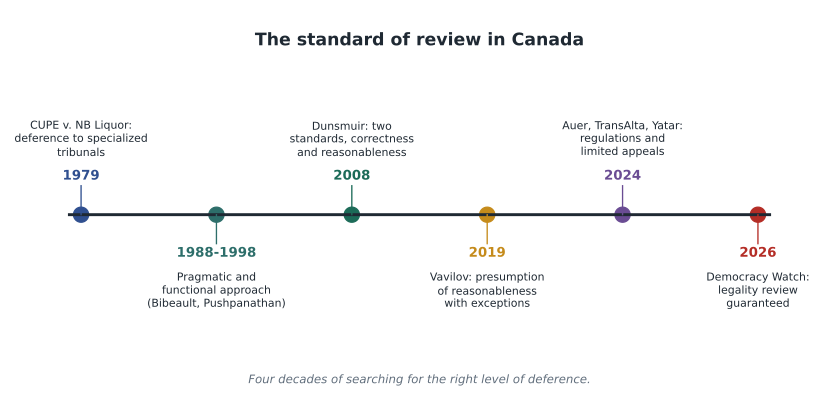
In Canadian Union of Public Employees, Local 963 v. New Brunswick Liquor Corp., [1979] 2 S.C.R. 227, Justice Dickson urged courts not to brand as jurisdictional, and so review for correctness, questions that were doubtfully so, and to defer to a specialized labour board protected by a privative clause unless its interpretation was patently unreasonable. Over the following decades, the Court developed the pragmatic and functional approach, refined in U.E.S., Local 298 v. Bibeault, [1988] 2 S.C.R. 1048 and Pushpanathan v. Canada (Minister of Citizenship and Immigration), [1998] 1 S.C.R. 982. Courts weighed four factors, the presence of a privative clause, the expertise of the decision-maker, the purpose of the statute and the nature of the question, to choose among three standards: correctness, reasonableness simpliciter and patent unreasonableness.
The approach was criticized as complicated and unpredictable. In Dunsmuir v. New Brunswick, 2008 SCC 9, the Court collapsed reasonableness simpliciter and patent unreasonableness into a single reasonableness standard and recast the analysis as a standard of review analysis. Dunsmuir kept correctness for constitutional questions, questions of general law of central importance to the legal system and outside the decision-maker's expertise, questions of true jurisdiction and boundaries between tribunals. In the decade that followed, the Court presumed reasonableness when a tribunal interpreted its home statute, but disagreements continued about true jurisdiction, about expertise and about how to review reasons, and the case law became fragmented.
Vavilov
In Canada (Minister of Citizenship and Immigration) v. Vavilov, 2019 SCC 65, a seven-judge majority set out a revised framework intended to bring coherence and predictability. Alexander Vavilov was born in Toronto to parents who were Russian spies living under assumed Canadian identities. The Registrar of Citizenship cancelled his citizenship certificate on the basis that his parents were employees or representatives of a foreign government at the time of his birth, an exception to birthright citizenship in the Citizenship Act. The Court held that the Registrar's decision was unreasonable, because the Registrar had failed to grapple with the statutory text, context and purpose and with the consequences of the interpretation for Vavilov, and because the exception was meant to cover people with diplomatic privileges and immunities, which his parents did not have.
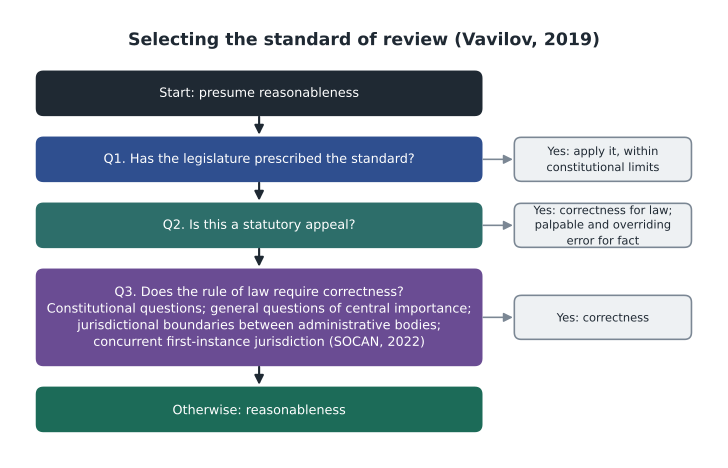
The framework begins with a presumption that reasonableness is the applicable standard whenever a court reviews an administrative decision. The presumption rests on respect for the legislature's institutional design choice to give the decision to an administrative body rather than a court. Expertise is no longer a factor in choosing the standard, although it remains relevant to how reasonableness review is conducted.
The presumption can be rebutted in two kinds of situations. First, where the legislature has indicated that it intends a different standard, either by explicitly prescribing the standard of review or by providing a statutory appeal mechanism from the administrative decision to a court. Second, where the rule of law requires correctness review: for constitutional questions, for general questions of law of central importance to the legal system as a whole, and for questions regarding the jurisdictional boundaries between two or more administrative bodies. The Court abolished the category of true questions of jurisdiction, which had proved impossible to define.
Statutory appeals
The statutory appeal rule was one of Vavilov's most significant changes. Before 2019, courts often applied reasonableness even on statutory appeals from specialized tribunals. Vavilov held that where the legislature has provided a right of appeal to a court, it has signalled that the court should apply appellate standards of review, the same standards that apply when an appellate court reviews a trial judge: correctness for questions of law, and palpable and overriding error for questions of fact and of mixed fact and law, unless an extricable question of law can be identified, in which case correctness applies to that question. The companion case, Bell Canada v. Canada (Attorney General), 2019 SCC 66, applied this approach to a statutory appeal from the Canadian Radio-television and Telecommunications Commission and reviewed its interpretation of its statute for correctness.
Many statutes provide appeals only on questions of law, sometimes only with leave. In Yatar v. TD Insurance Meloche Monnex, 2024 SCC 8, the Supreme Court held that where a statute provides a limited right of appeal, such as an appeal on questions of law only from Ontario's Licence Appeal Tribunal in accident benefits cases, judicial review remains available for other questions, such as questions of fact or of mixed fact and law. On judicial review, those questions are reviewed for reasonableness under Vavilov, and the reviewing court retains discretion whether to hear the application, but the limited appeal does not by itself preclude judicial review.
Legislated standards
Some legislatures prescribe the standard themselves. British Columbia's Administrative Tribunals Act, S.B.C. 2004, c. 45, sets standards for tribunals to which it applies, including patent unreasonableness for some findings and decisions of tribunals protected by privative clauses. Vavilov held that legislated standards must be respected, within constitutional limits, so a court reviewing a B.C. tribunal covered by the Act applies the standard the Act prescribes. In Democracy Watch v. Canada (Attorney General), 2026 SCC 28, the Court confirmed that Vavilov's reasonableness standard is not itself constitutionally entrenched and left open how deferential a legislated standard may be, while holding that the Constitution guarantees review of legality. Lesson 7 returns to that case.
What the standard of review does not cover
The Vavilov framework applies to the substance of administrative decisions. It does not govern procedural fairness, which courts assess by asking whether the process was fair in all the circumstances, as lesson 3 explained. It also does not govern a court's discretion to refuse relief, considered in lessons 9 and 10. And it applies to judicial review and statutory appeals of administrative decisions, not to appeals from courts, which are governed by Housen v. Nikolaisen, 2002 SCC 33. One consequence is that a single judicial review can involve several standards: fairness for the process, reasonableness for most of the decision, and correctness for any constitutional question embedded in it.
Selecting the standard in the three files
The class applies the framework. In the Quintero file, the Licensing Appeal Committee's decision to revoke her licence is reviewed on judicial review, because the by-law provides no appeal to a court. No statute prescribes a standard, and the question of whether the complaints justified revocation does not fall within any correctness category. The standard is reasonableness, and the fairness and bias issues are assessed separately. In the Anyanwu file, the study permit refusal is reviewed in the Federal Court on an application for leave and judicial review under the Immigration and Refugee Protection Act. No statutory appeal exists for that decision and no correctness category applies, so reasonableness applies. In the provincial regulation file, Auer and TransAlta tell us the vires challenge is reviewed for reasonableness, but Kowalczyk's argument that the per-night payment is an unconstitutional tax raises a constitutional question, which must be decided correctly.
Arjun Mehta asks what happens if Quintero's by-law had allowed an appeal to the Superior Court 'on any question of law or fact'. 'Then Vavilov's statutory appeal rule applies,' Delisle says. 'The court would review legal questions for correctness and factual findings for palpable and overriding error. That is why the first thing you read, after the decision, is the statute that tells you how it can be challenged.'
Criticism and debate
Vavilov has been praised for simplifying the selection of the standard, and criticized from both sides. Some argue that treating statutory appeals as calling for appellate standards ignores the expertise of specialized tribunals, which was the reason legislatures created them; Justices Abella and Karakatsanis wrote a concurrence arguing that the majority's approach undermined decades of deference. Others argue that the correctness categories are still too narrow, leaving important questions of law to be answered differently by different tribunals. The Court has refined the framework since, in cases such as Society of Composers, Authors and Music Publishers of Canada v. Entertainment Software Association, 2022 SCC 30, which added a correctness category for concurrent first-instance jurisdiction, and Mason v. Canada (Citizenship and Immigration), 2023 SCC 21, which declined to add a correctness category for questions of international law and showed how robust reasonableness review can be.
The record on review
The standard of review tells the court how closely to look; the record tells it what to look at. On judicial review, the court generally considers only the material that was before the decision-maker, because the question is whether the decision was lawful on what the decision-maker had, not whether a better decision could be made on new evidence. The Federal Court of Appeal summarized the recognized exceptions in Association of Universities and Colleges of Canada v. Canadian Copyright Licensing Agency (Access Copyright), 2012 FCA 22: an affidavit may provide general background that helps the court understand the issues; it may bring to light procedural defects that cannot be found in the record, such as a hearing notice that was never received; and it may show the complete absence of evidence for a finding. Ontario courts apply similar principles. The record therefore matters as much as the standard. A party who wants to argue that a finding is unreasonable must point to what the decision-maker had and did with it, and a party who complains of unfairness may need affidavit evidence of what happened.
In the Quintero file, the record will include the complaints, inspection reports, the committee's notice and its decision. Quintero's evidence that the email notice arrived after the meeting is admissible on judicial review because it goes to procedural fairness, but evidence that her truck passed a new inspection last month is not, because it was not before the committee and goes to the merits. 'Build the record before the tribunal,' Delisle tells the class. 'On review, it is usually too late.'
Worked problem
Choosing the standard
A provincial statute gives an appeal "to the Divisional Court on a question of law" from decisions of a professional college's discipline committee. A dentist wants to challenge (a) the committee's interpretation of the statute's definition of professional misconduct, (b) its finding that she lied to a patient, and (c) its conclusion that the disciplinary process violated her section 7 Charter rights. Which standards apply?
Show solution
- Start with the presumption of reasonableness, then ask whether the legislature has displaced it.
- (a) The statutory appeal covers questions of law, so Vavilov's appellate standards apply: correctness for the interpretation of the definition.
- (b) The credibility finding is a question of fact outside the appeal right; under Yatar it may be raised on judicial review, where reasonableness applies, subject to the court's discretion.
- (c) A Charter challenge is a constitutional question, so correctness applies whether it is raised on appeal or judicial review.
- Procedural fairness complaints, if any, are assessed for fairness, not under the Vavilov framework.
Common mistakes
MistakeChoosing the standard by weighing the tribunal's expertise, as under the pragmatic and functional approach.
InsteadAfter Vavilov, expertise does not determine the standard; reasonableness is presumed.
MistakeApplying reasonableness on a statutory appeal on questions of law.
InsteadVavilov applies appellate standards: correctness for law.
MistakeArguing that a question is reviewable for correctness because it is jurisdictional.
InsteadVavilov abolished the category of true questions of jurisdiction.
MistakeAssuming a limited statutory appeal bars judicial review of other questions.
InsteadYatar (2024): judicial review remains available, on reasonableness, at the court's discretion.
Practice problems
Work each problem on paper first, then reveal the answer to check.
What is the starting presumption under Vavilov?
Show answer
That reasonableness is the standard of review.
What are the two ways the presumption can be rebutted?
Show answer
Legislative intent (a prescribed standard or a statutory appeal) and the rule of law (certain categories of questions).
Name the rule of law correctness categories in Vavilov.
Show answer
Constitutional questions, general questions of central importance to the legal system as a whole, and jurisdictional boundaries between administrative bodies.
What standards apply on a statutory appeal?
Show answer
Correctness for questions of law; palpable and overriding error for fact and mixed questions without an extricable legal error.
What did Yatar v. TD Insurance (2024) decide?
Show answer
A limited statutory appeal does not preclude judicial review of other questions, reviewed for reasonableness, at the court's discretion.
Summary and key terms
- The standard of review sets how much a court defers to an administrative decision.
- Canadian law moved from CUPE and the pragmatic and functional approach through Dunsmuir to Vavilov (2019).
- Vavilov presumes reasonableness, rebutted by legislative intent (prescribed standards, statutory appeals) or the rule of law (specific correctness categories).
- Statutory appeals attract appellate standards (Vavilov; Bell Canada); limited appeals leave room for judicial review (Yatar, 2024).
- Legislated standards are respected within constitutional limits (Democracy Watch, 2026).
- Fairness is assessed separately from the substantive standard of review.
- Standard of review
- The degree of deference a court gives an administrative decision.
- Reasonableness
- A deferential standard asking whether the decision is justified, transparent and intelligible within its constraints.
- Correctness
- A standard under which the court decides the question for itself.
- Statutory appeal
- A right of appeal to a court created by statute.
- Palpable and overriding error
- An obvious error that affects the outcome; the appellate standard for facts.
- Presumption of reasonableness
- Vavilov's starting point for choosing the standard.
Lesson quiz · 5 questions
Score 60% or more to complete this lesson.
Create a free account to save your progress, take quizzes and earn a certificate.