
LAWC-202 · Lesson 6 of 12 · 21 min
Reasonableness review
▶ Video coming soon A video version of this lesson is on the way.
Professor Delisle hands out two decisions at the start of the sixth class. The first is the Licensing Appeal Committee's decision in the Quintero file: 'The Committee has considered the matter of Licence MFV-2026-114. Having regard to the repeated complaints received regarding the operation of the licensee's mobile food vending vehicle, the Committee is of the view that revocation of the licence is in the public interest. The licence is revoked effective immediately.' The second is an immigration officer's notes in the Anyanwu file: 'I am not satisfied that the applicant will leave Canada at the end of the period authorized for their stay, based on the purpose of visit and family ties in Canada and country of residence. Application refused.' 'Both decisions will be reviewed for reasonableness,' Delisle says. 'Today we learn what that means, and whether either one survives it.'
Reasonableness is a robust standard
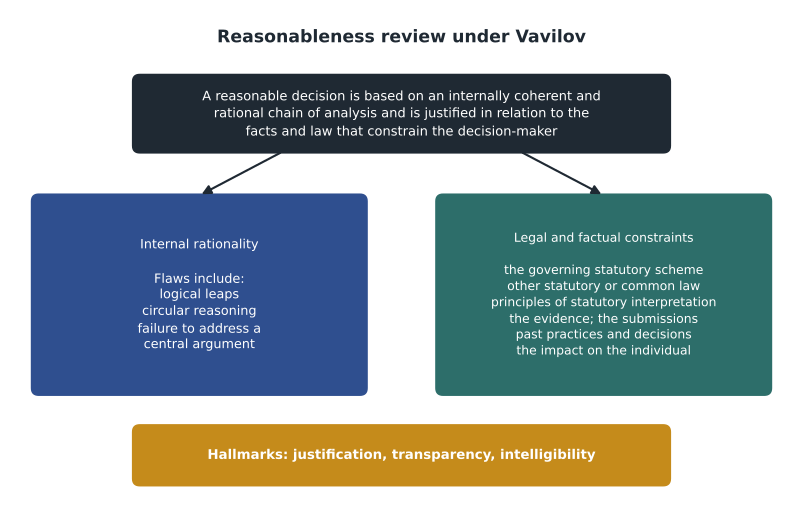
Vavilov insisted that reasonableness review is a robust form of review, not a rubber stamp. Deference does not mean that courts accept any outcome a decision-maker reaches; it means that courts respect the decision-maker's role and start with its reasons. The Court described a reasonable decision as one that is based on an internally coherent and rational chain of analysis and that is justified in relation to the facts and law that constrain the decision-maker. The hallmarks of reasonableness are justification, transparency and intelligibility. A decision must be justified, not merely justifiable: a court should not uphold a decision on the basis of reasons the decision-maker could have given but did not.
Reasons first
Vavilov adopted a reasons-first approach. Where reasons are required and given, the reviewing court begins with them, reads them holistically and contextually, and seeks to understand the reasoning process the decision-maker followed. Reasons are read in light of the record and the institutional context. Administrative decision-makers are not expected to write like judges, and reasons need not refer to every argument or piece of evidence. A reviewing court should not conduct a line-by-line treasure hunt for error. But reasons must address the key issues and central arguments raised by the parties, and a decision-maker's failure to meaningfully grapple with key issues or central arguments may call into question whether it was actually alert and sensitive to the matter before it.
Where no reasons are required or given, as is common for municipal councils or some high-volume decisions, the court looks to the record as a whole to understand the decision and to see whether it is reasonable in light of the relevant constraints. In Canada Post Corp. v. Canadian Union of Postal Workers, 2019 SCC 67, a companion case to Vavilov, the Court upheld an appeals officer's interpretation of occupational health and safety obligations, reading the reasons alongside the record and the statutory context.
Two kinds of fundamental flaw
Vavilov identified two types of fundamental flaws that make a decision unreasonable. The first is a failure of rationality internal to the reasoning process. The reasoning must be rational and logical: a decision will be unreasonable if its reasons contain a fundamental gap, an unreasonable chain of analysis, circular reasoning, false dilemmas, unfounded generalizations or an absurd premise, or if they are so vague or conclusory that the court cannot tell how the decision-maker reached its result.
The second is that the decision is untenable in light of the relevant factual and legal constraints that bear on it. Vavilov listed the main constraints: the governing statutory scheme; other relevant statutory or common law; the principles of statutory interpretation; the evidence before the decision-maker and facts of which it may take notice; the submissions of the parties; the past practices and decisions of the decision-maker; and the potential impact of the decision on the individual to whom it applies.
The legal constraints
The governing statute is the most important constraint. A decision-maker interpreting its statute must do so consistently with the text, context and purpose of the provision, applying the modern principle of statutory interpretation from Rizzo and Rizzo Shoes Ltd. (Re), [1998] 1 S.C.R. 27. It need not write a formal interpretive analysis, but the reasons must show that it considered the elements of the provision that matter. Where the statute uses broad or open-ended language, the decision-maker has more room; where it uses precise and narrow language, the room shrinks. Sometimes the text, context and purpose leave only one reasonable interpretation, and then a decision that adopts any other is unreasonable.
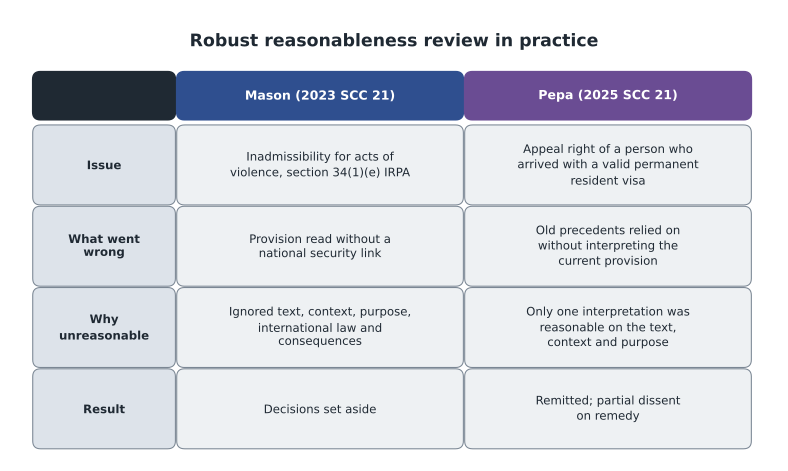
Other law also constrains. A decision-maker must respect the common law and other statutes, including international law where relevant. In Mason v. Canada (Citizenship and Immigration), 2023 SCC 21, the Immigration Division and Immigration Appeal Division found that two foreign nationals were inadmissible under section 34(1)(e) of the Immigration and Refugee Protection Act for engaging in acts of violence that would or might endanger the lives or safety of persons in Canada, reading the provision as covering any serious violence, without any link to national security. Justice Jamal, for seven judges, applied Vavilov and held both decisions unreasonable. The decision-makers had failed to address key elements of the statutory context, including the provision's placement among security grounds, the consequences of the interpretation, which would make section 34(1)(e) overlap and conflict with the criminality grounds, and Canada's obligations under the Refugee Convention. Properly interpreted, the provision requires a nexus to national security or the security of Canada. Justice Côté concurred in the result but would have applied correctness. Mason shows how seriously courts take the legal constraints even under deferential review.
The factual constraints
A decision must be justified in light of the evidence. Reviewing courts do not reweigh evidence, and they defer heavily to findings of fact. But a decision is unreasonable if the decision-maker fundamentally misapprehended or failed to account for the evidence before it, for example by ignoring critical evidence that contradicts its conclusion. The reasons must also respond to the parties' submissions: a decision-maker that fails to address a central argument, particularly one that, if accepted, would change the result, risks being found unreasonable.
Consistency matters too. Administrative decision-makers are not bound by precedent in the way courts are, but where a decision-maker departs from its own longstanding practices or established internal authority, it bears the justificatory burden of explaining that departure. Unexplained inconsistency can make a decision arbitrary.
Impact on the individual
Vavilov emphasized the principle of responsive justification. Where a decision has particularly harsh consequences for the affected individual, the decision-maker must explain why its decision best reflects the legislature's intention. This includes decisions with consequences that threaten an individual's life, liberty, dignity or livelihood. The more serious the consequences, the more the reasons must show that the decision-maker considered them. Vavilov itself turned partly on the Registrar's failure to consider the consequences of stripping citizenship from a person born and raised in Canada.
Pepa (2025)
In Pepa v. Canada (Citizenship and Immigration), 2025 SCC 21, Dorinela Pepa, an Albanian national, arrived in Canada in 2018 with an unexpired permanent resident visa obtained as a dependent child. At the port of entry she disclosed that she had recently married, which meant she no longer qualified as a dependent child, and the medical documents supporting her visa expired days before her admissibility hearing. The Immigration Division issued a removal order, and the Immigration Appeal Division held that it had no jurisdiction to hear her appeal because section 63(2) of the Immigration and Refugee Protection Act gives an appeal to a foreign national who 'holds a permanent resident visa', and she no longer held a valid visa when the removal order was made. The Federal Court and Federal Court of Appeal upheld that decision.
Justice Martin, for the majority, held the Appeal Division's decision unreasonable. The Appeal Division had relied on earlier decisions interpreting a predecessor provision without explaining why they still applied, and it had not conducted the statutory interpretation the question required. Properly interpreted in light of its text, context and purpose, section 63(2) refers to holding a valid visa when the person arrives, and the majority concluded that this was the only reasonable interpretation. The Appeal Division also failed to consider the impact of its decision on Pepa and her family. The majority remitted the matter to the Appeal Division to decide on the basis of that interpretation. Justice Rowe agreed with the result but would have dealt with the remedy differently, and Justices Côté and O'Bonsawin dissented. Pepa reinforces two points: reasons must engage with the statute actually in force, and when only one interpretation is reasonable, a reviewing court may say so.
Brief reasons in high-volume decisions
Not every decision needs extensive reasons. Vavilov recognized that in high-volume contexts, such as immigration officers' decisions on visitor and study permits, short reasons may be adequate, because the institutional context and the record can fill in the reasoning. The Federal Court frequently upholds brief refusal notes where the record shows why the officer was not satisfied. But brevity is not a licence for boilerplate. Where an applicant has submitted evidence that directly answers the officer's concern, such as proof of funds, an admission letter and evidence of family and employment ties at home, and the officer's notes recite a generic ground without engaging with that evidence, the Federal Court has often found the refusal unreasonable because the reasons do not show why the evidence was insufficient.
Applying the standard to the two decisions
The class turns to the handouts. The Licensing Appeal Committee's decision refers to repeated complaints and the public interest, but it does not identify which provision of the by-law justified revocation, what the complaints alleged, whether any were substantiated, or why Quintero's response did not answer them. It does not mention the impact on her livelihood. Sophie Tremblay-Hart argues that the reasons are conclusory and that the committee failed to grapple with the central question, whether her truck had actually breached the licence conditions; a generic reference to the public interest cannot justify a decision that ends someone's business. Delisle agrees that the decision is vulnerable, and adds that if the committee's real reason was to protect restaurants from competition, the decision may also be unreasonable in light of the by-law's purposes, echoing Roncarelli.
The Anyanwu notes are a closer case. Anyanwu submitted bank statements showing tuition and living costs for the first year, a scholarship letter from Brannock University, a letter from his employer in Lagos holding his job for his return, and evidence that his wife and young daughter would remain in Nigeria. The notes say only that the officer was not satisfied he would leave Canada, given his purpose of visit and family ties in Canada and in his country of residence. Theo Marchetti points out that Anyanwu has no family in Canada at all, and that his family ties in Nigeria point toward return, so the notes appear to rest on a misapprehension of the evidence. Delisle notes that the Federal Court would read the notes with the record and give the officer latitude in a high-volume context, but that the mismatch between the stated ground and the evidence is the kind of flaw that has led the Court to set aside refusals.
Worked problem
Testing a decision against its constraints
A provincial benefits tribunal denies a disability benefit because the applicant "can work part time." The statute defines disability as a substantial impairment that substantially restricts the person's ability to attend to personal care, function in the community or function in a workplace. The applicant's doctor reported severe restrictions in personal care and community functioning. The tribunal's reasons discuss only work. Is the decision reasonable?
Show solution
- Read the reasons first, holistically and with the record.
- Legal constraint: the statute lists three alternative areas of functioning, so focusing only on work misreads the definition.
- Factual constraint: the medical evidence about personal care and community functioning is central and unaddressed.
- Submissions: if the applicant relied on those restrictions, the tribunal failed to grapple with a central argument.
- Impact: the benefit affects the applicant's livelihood, which heightens the need for responsive justification. The decision is likely unreasonable and should be remitted.
Common mistakes
MistakeUpholding a decision because the court can think of good reasons for it.
InsteadVavilov: the decision must be justified by the reasons given, not by reasons the court supplies.
MistakeCombing the reasons line by line for any error.
InsteadRead reasons holistically; only fundamental flaws make a decision unreasonable.
MistakeReweighing the evidence and substituting the court's view of the facts.
InsteadCourts defer on facts unless the decision-maker fundamentally misapprehended or ignored critical evidence.
MistakeIgnoring the impact of the decision on the person affected.
InsteadHarsh consequences require responsive justification.
Practice problems
Work each problem on paper first, then reveal the answer to check.
What are the hallmarks of a reasonable decision under Vavilov?
Show answer
Justification, transparency and intelligibility.
Name the two types of fundamental flaw.
Show answer
A failure of internal rationality, and a decision that is untenable in light of the legal and factual constraints.
List four constraints identified in Vavilov.
Show answer
Any four of: the statutory scheme, other law, principles of interpretation, the evidence, the submissions, past practices and decisions, and the impact on the individual.
Why were the decisions in Mason unreasonable?
Show answer
They read section 34(1)(e) without a national security nexus and failed to address statutory context, consequences and international law.
What did Pepa (2025) add?
Show answer
Reasons must engage with the current statute, and where only one interpretation is reasonable the court may identify it, here when remitting the matter.
Summary and key terms
- Reasonableness is robust review that starts with the decision-maker's reasons.
- A reasonable decision rests on a rational chain of analysis and is justified in light of its legal and factual constraints.
- The constraints include the statute, other law, interpretation principles, the evidence, the submissions, past practice and the impact on the individual.
- Mason (2023) and Pepa (2025) show that legal constraints can leave only one reasonable interpretation.
- Where no reasons are given, courts look to the record; brief reasons may suffice in high-volume contexts if the record supports them.
- Courts do not reweigh evidence or rewrite reasons, but they will set aside decisions with fundamental flaws.
- Reasons first
- Vavilov's approach of beginning review with the decision-maker's own reasons.
- Justification
- Reasons that explain why the decision was reached in light of the facts and law.
- Responsive justification
- Reasons that respond to the stakes and the central arguments.
- Legal constraints
- The statute, other law and interpretive principles that bound a decision.
- Internal rationality
- Logical coherence of the decision-maker's chain of reasoning.
- Treasure hunt for error
- Line-by-line searching for mistakes, which Vavilov warns against.
Lesson quiz · 5 questions
Score 60% or more to complete this lesson.
Create a free account to save your progress, take quizzes and earn a certificate.