
LAWC-202 · Lesson 11 of 12 · 20 min
Oversight beyond the courts
▶ Video coming soon A video version of this lesson is on the way.
Professor Delisle starts the eleventh class with a confession. 'In eleven years at the Ombudsman's office, I saw hundreds of people who had been treated unfairly by government and who would never go to court,' she says. 'Court was too slow, too expensive or too frightening, or the problem was not a single decision but a pattern of delay, rudeness or broken systems. Courts are the guarantee of legality, but they are not the only accountability mechanism. A good administrative lawyer knows all the doors.'
Ombudsmen
An ombudsman is an independent officer, usually reporting to a legislature, who investigates complaints about the administrative conduct of public bodies. The model originated in Sweden and spread across the Commonwealth in the twentieth century. Ombudsmen do not decide disputes and generally cannot overturn decisions. They investigate, often with broad powers to obtain documents and interview officials, and they make recommendations. Their influence comes from their independence, their access to information and the public nature of their reports. Because they look at maladministration rather than only legality, they can address problems a court cannot, such as unreasonable delay, poor communication, inadequate policies and systemic failures.
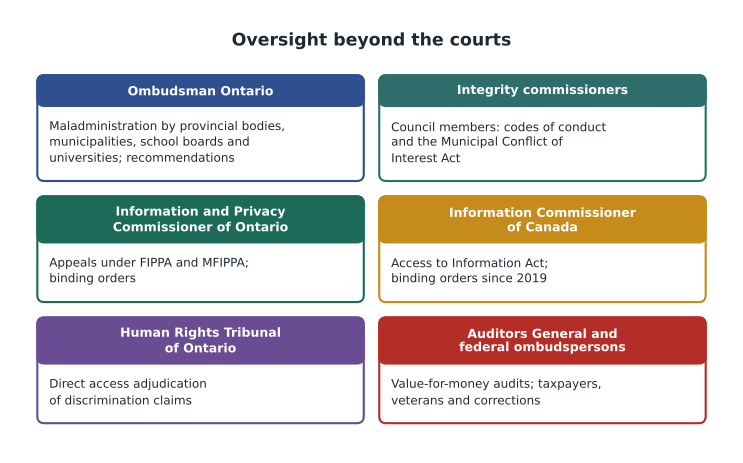
Ombudsman Ontario, established under the Ombudsman Act, R.S.O. 1990, c. O.6, is an officer of the Legislative Assembly. It investigates complaints about provincial ministries, agencies, boards and commissions, and since legislative changes taking effect in 2015 and 2016, its jurisdiction also extends to municipalities, school boards and universities. In 2019, the functions of the French Language Services Commissioner were moved into the Ombudsman's office, and the office also took over some of the investigative work of the former Provincial Advocate for Children and Youth. The Ombudsman can investigate individual complaints and launch systemic investigations on its own initiative, and its reports have prompted changes in areas such as correctional segregation, disability support payments and the handling of developmental services. The Ombudsman generally expects complainants to use available appeal or review processes before it investigates, and it does not investigate decisions of the courts or of the cabinet.
Federally, Canada has no general ombudsman for all departments, but several specialized offices exist, including the Office of the Taxpayers' Ombudsperson, the Veterans Ombud, the Ombudsperson for the Department of National Defence and the Canadian Armed Forces, and the Office of the Correctional Investigator, which acts as ombudsman for federal prisoners. Other provinces have general ombudsmen with varying jurisdiction.
Municipal accountability officers
Ontario's Municipal Act, 2001 requires municipalities to have codes of conduct for members of council and to appoint, or have access to, an integrity commissioner who can investigate complaints that a member has breached the code. Integrity commissioners may recommend penalties, such as a reprimand or suspension of pay for up to ninety days, which council decides whether to impose. Since amendments in force in 2019, integrity commissioners can also investigate whether a member has contravened the Municipal Conflict of Interest Act, and may apply to a judge for a determination; an elector may also apply directly to a judge under that Act. The Municipal Act also requires closed-meeting investigations: a person may ask whether a council or committee met in private improperly, and the municipality's closed-meeting investigator, or the Ombudsman by default, investigates.
For the Quintero file, these offices offer a parallel route. A complaint to Corwin's integrity commissioner could examine whether Councillor Pellerin breached the city's code of conduct by chairing a hearing after publicly prejudging food trucks, and whether his brother's business interest engaged any conflict rule. As lesson 4 noted, the Municipal Conflict of Interest Act deems the interests of a parent, spouse or child to be the member's, but not a sibling's, so a code of conduct may be the more promising basis. The integrity commissioner cannot restore Quintero's licence, but a finding could support her judicial review, deter similar conduct and lead council to change how the Licensing Appeal Committee works.
Access to information and privacy
Access to information laws give the public a right to obtain records held by public bodies, subject to limited exemptions. In Ontario, the Freedom of Information and Protection of Privacy Act, R.S.O. 1990, c. F.31, covers provincial institutions, and the Municipal Freedom of Information and Protection of Privacy Act, R.S.O. 1990, c. M.56, covers municipalities and local boards. A requester applies to the institution, which must generally respond within thirty days, subject to extensions and fees. Exemptions protect information such as cabinet records, advice to government, law enforcement information, solicitor-client privileged records and personal information of others. A requester who is refused can appeal to the Information and Privacy Commissioner of Ontario, which can mediate and, if necessary, adjudicate and issue binding orders, reviewable in the Divisional Court.
Federally, the Access to Information Act and the Privacy Act give rights of access to records held by federal institutions and to one's own personal information. Since amendments made by Bill C-58 in 2019, the Information Commissioner of Canada has had power to issue binding orders in access complaints, with a further right to apply to the Federal Court for a new hearing. The Privacy Commissioner of Canada oversees the Privacy Act and the private-sector Personal Information Protection and Electronic Documents Act, generally through investigations and recommendations rather than binding orders.
Access requests are a practical tool in administrative litigation. Quintero's lawyer could request, under the Municipal Freedom of Information and Protection of Privacy Act, the complaints the committee relied on, emails between councillors about food trucks and staff reports. Some records may be withheld or redacted to protect the complainants' personal information, but the request can surface evidence that the record filed in a judicial review would not include. In the Anyanwu file, immigration applicants routinely request their file notes under the federal legislation, although in a judicial review the department must produce the certified tribunal record once leave is granted.
Human rights commissions and tribunals
Human rights statutes create their own enforcement systems. Since 2008, Ontario has used a direct access model: a person who believes they have been discriminated against in a protected social area, such as services, housing or employment, on a protected ground, applies directly to the Human Rights Tribunal of Ontario, which is part of Tribunals Ontario. The Ontario Human Rights Commission no longer screens individual complaints but develops policy, conducts inquiries and may intervene in cases. Federally, complaints go first to the Canadian Human Rights Commission, which screens them and may refer them to the Canadian Human Rights Tribunal. As lesson 7 discussed, where a collective agreement governs, a labour arbitrator may have exclusive jurisdiction over workplace disputes, which can displace the human rights route (Horrocks). Human rights decisions are reviewable on judicial review and, in some regimes, appealable.
Tribunal openness and internal review
Tribunals themselves provide internal accountability through reconsideration processes, appeal divisions, practice directions and public reporting. Many tribunals publish decisions and annual reports with statistics on caseloads and timelines. In Ontario, the Tribunal Adjudicative Records Act, 2019 made many adjudicative records of listed tribunals presumptively available to the public, following a 2018 Superior Court decision holding that the earlier regime, which subjected tribunal records to the access-to-information process, infringed freedom of the press. Openness is itself a form of oversight, because public scrutiny encourages careful decisions.
Auditors and legislative officers
Auditors General at the federal and provincial levels examine whether public programs are run with due regard for economy, efficiency and effectiveness, and their reports often reveal administrative failures, such as long backlogs, poor information systems or weak oversight of contracted services. Legislative committees, such as the federal Standing Joint Committee for the Scrutiny of Regulations discussed in lesson 2, scrutinize delegated legislation. Members of the legislature and their constituency offices also resolve many individual problems by contacting departments directly, a form of political accountability that is often fast and effective, although, as Democracy Watch emphasized, political oversight is not a substitute for the legal right to judicial review.
Choosing the right door
Delisle closes with a practical framework. The right route depends on what the client needs. If the client needs a decision set aside and a fresh hearing, judicial review or a statutory appeal is usually necessary, and the time limits are short. If the problem is delay, a mandamus application may be needed, but a call to the department, a complaint to an ombudsman or a letter from a member of the legislature may produce a decision faster and at no cost. If the client needs information, an access request comes first. If the problem is the conduct of an elected official, an integrity commissioner may be the right audience. If the problem is systemic, affecting many people, an ombudsman investigation or a public interest application may achieve more than an individual case. Often several routes run in parallel: a judicial review to protect the client's legal position, an access request to gather evidence, and a complaint to an oversight body to address the underlying conduct.
Sophie Tremblay-Hart asks whether pursuing an ombudsman complaint could hurt a client's judicial review by causing delay. 'It can,' Delisle answers. 'An ombudsman complaint does not stop the thirty-day clock under the Judicial Review Procedure Act. If the client needs the decision quashed, file the judicial review on time, and use the other doors at the same time. Never let a complaint process cost a client a legal remedy.'
Federal counterparts
The federal government has its own set of oversight bodies, which matter for files such as Anyanwu's. The Information Commissioner of Canada investigates complaints under the Access to Information Act and, since amendments made by Bill C-58 in 2019, can make binding orders, which the institution may challenge in the Federal Court. The Privacy Commissioner of Canada oversees the Privacy Act for federal institutions and the Personal Information Protection and Electronic Documents Act for private-sector organizations, though under the Privacy Act the Commissioner generally makes findings and recommendations rather than binding orders. The Public Sector Integrity Commissioner receives disclosures of wrongdoing by federal public servants under the Public Servants Disclosure Protection Act. The Conflict of Interest and Ethics Commissioner administers the Conflict of Interest Act for ministers and senior officials and the code for members of the House of Commons, and the Commissioner of Official Languages investigates complaints under the Official Languages Act.
Canada has no general federal ombudsman with jurisdiction over all departments. Instead, several specialized offices deal with particular sectors, such as the Taxpayers' Ombudsperson for the Canada Revenue Agency, the Veterans Ombud and the National Defence and Canadian Armed Forces Ombudsman. For an immigration applicant like Anyanwu, the practical federal routes are an application for leave and judicial review in the Federal Court within the time limit in the Immigration and Refugee Protection Act, a fresh application with better evidence, a request for his file under the Access to Information Act or the Privacy Act to see the officer's notes, and a complaint or inquiry through his member of Parliament. As with the provincial bodies, none of these suspends the time limit for judicial review.
Worked problem
A delayed disability payment
A client's provincial disability support payments stopped four months ago after a file transfer between offices. Calls go unanswered. No decision has been made to end her eligibility. What routes are available, and in what order?
Show solution
- Clarify the problem: an administrative failure and delay, not a decision on the merits.
- Fast informal steps: a written request to the program office and to a supervisor, and a call to her member of the provincial parliament's constituency office.
- Ombudsman Ontario: a complaint about delay and maladministration in a provincial program is squarely within its mandate, and it is free.
- Access request: under FIPPA, request her file to see what happened.
- Court as a last resort: if a clear duty to pay exists and delay continues, consider mandamus; if a decision terminating eligibility is made, follow the statutory appeal route within its time limit.
Common mistakes
MistakeTreating an ombudsman as a court that can overturn decisions.
InsteadOmbudsmen investigate and recommend; their power is persuasive and public.
MistakeLetting an oversight complaint run while the judicial review deadline passes.
InsteadComplaints do not stop the 30-day clock; file on time and pursue other routes in parallel.
MistakeAssuming all information commissioners make binding orders.
InsteadOntario's IPC and, since 2019, the federal Information Commissioner can; the federal Privacy Commissioner mostly recommends.
MistakeFiling a human rights complaint with the Ontario Human Rights Commission.
InsteadOntario uses direct access to the Human Rights Tribunal of Ontario.
Practice problems
Work each problem on paper first, then reveal the answer to check.
What can Ombudsman Ontario do?
Show answer
Investigate complaints and systemic issues of maladministration and make public recommendations; it cannot overturn decisions.
Which bodies has Ombudsman Ontario's jurisdiction extended to since 2015 and 2016?
Show answer
Municipalities, school boards and universities.
What can a municipal integrity commissioner investigate?
Show answer
Breaches of a council code of conduct and, since 2019, contraventions of the Municipal Conflict of Interest Act.
Which Ontario statute governs access to municipal records?
Show answer
The Municipal Freedom of Information and Protection of Privacy Act.
What model does Ontario use for human rights complaints?
Show answer
Direct access to the Human Rights Tribunal of Ontario, in place since 2008.
Summary and key terms
- Courts guarantee legality, but many other bodies provide accountability for administrative action.
- Ombudsmen investigate maladministration and recommend change; Ombudsman Ontario now covers municipalities, school boards and universities.
- Integrity commissioners and closed-meeting investigators oversee municipal councils.
- Access to information laws and commissioners help clients obtain records; some commissioners issue binding orders.
- Human rights systems, tribunal openness rules, auditors and legislative committees add further oversight.
- Choose routes by the client's needs, and never let a complaint process defeat a judicial review deadline.
- Ombudsman
- An independent officer who investigates complaints of maladministration and makes recommendations.
- Maladministration
- Unfair, unreasonable or inefficient administrative conduct, including delay and poor service.
- Integrity commissioner
- A municipal officer who investigates complaints about council members' conduct.
- Access to information
- A legal right to obtain records held by public bodies, subject to exemptions.
- Direct access
- Ontario's model allowing human rights claims to be filed directly with the tribunal.
- Systemic investigation
- An inquiry into a pattern of problems rather than a single complaint.
Lesson quiz · 5 questions
Score 60% or more to complete this lesson.
Create a free account to save your progress, take quizzes and earn a certificate.