
LAWC-202 · Lesson 10 of 12 · 21 min
Judicial review procedure, timing and standing
▶ Video coming soon A video version of this lesson is on the way.
Professor Delisle opens the tenth class with a calendar. 'Suppose the Licensing Appeal Committee revoked Marisol Quintero's licence on a Tuesday, and she first came to see a lawyer five weeks later,' she says. 'What is the first thing the lawyer should worry about?' Arjun Mehta answers immediately: the thirty-day limit. 'Exactly,' Delisle says. 'Administrative law cases are won and lost on procedure more often than students expect. Today is about where to go, how fast, with what evidence, and who is allowed to bring the case at all.'
Judicial review in Ontario
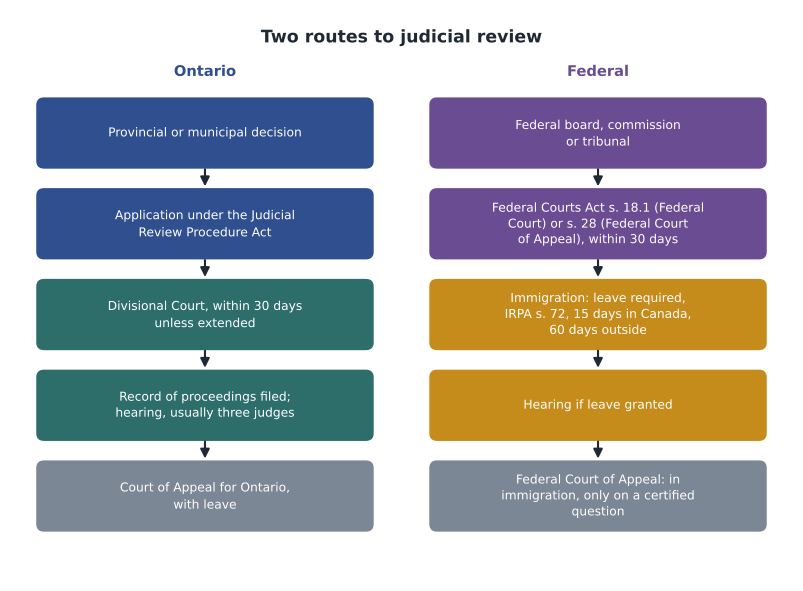
In Ontario, the Judicial Review Procedure Act governs applications for judicial review of the exercise or refusal to exercise a statutory power, including decisions of municipalities, provincial ministries, tribunals and professional regulators. Under section 6(1), an application for judicial review is made to the Divisional Court, a branch of the Superior Court of Justice that usually sits in panels of three judges. Under section 6(2), with leave, an application may be made to a single judge of the Superior Court where the case is urgent and the delay required for a Divisional Court hearing is likely to involve a failure of justice. A further appeal from the Divisional Court lies to the Court of Appeal for Ontario only with leave.
Since July 8, 2020, when the Smarter and Stronger Justice Act, 2020 received royal assent, section 5 of the Judicial Review Procedure Act has required that an application for judicial review be made no later than thirty days after the date the decision or matter for which judicial review is being sought was made or occurred, unless another Act provides otherwise. Before then, the Act had no fixed limit and courts relied on the equitable doctrine of delay. The court may extend the time if it is satisfied that there are apparent grounds for relief and that no substantial prejudice or hardship will result to any person affected by reason of the delay. Extensions are discretionary, and a lawyer who misses the deadline must explain why and show the merits are real.
Procedure on the application is governed by the Act, the Rules of Civil Procedure, in particular Rule 68, and the Divisional Court's practice directions. The applicant serves a notice of application on the decision-maker, the other parties and, in most cases, the Attorney General of Ontario, who is entitled to notice under section 9(4) of the Act. Under section 10, the decision-maker must file the record of the proceedings in which the decision was made. The parties then file application records and factums, and the panel hears oral argument. The Divisional Court can also hear statutory appeals from many provincial tribunals, each with its own time limits under the relevant statute, so lawyers must check whether the enabling statute provides an appeal before choosing judicial review.
Judicial review in the federal courts
Decisions of federal boards, commissions and other tribunals, a term that includes federal ministers and officials exercising statutory powers, are reviewed exclusively in the Federal Court or the Federal Court of Appeal under sections 18 and 18.1 of the Federal Courts Act, subject to some exceptions. Section 28 sends applications concerning a list of federal tribunals, such as the Canada Industrial Relations Board, directly to the Federal Court of Appeal; other federal decisions go to the Federal Court. Under section 18.1(2), an application must be made within thirty days after the decision was first communicated to the applicant, or within any further time a judge allows.
The Federal Court of Appeal has developed factors for extending that time, drawn from Canada (Attorney General) v. Hennelly and confirmed in Canada (Attorney General) v. Larkman, 2012 FCA 204: whether the applicant had a continuing intention to pursue the application, whether the application has some merit, whether the respondent is prejudiced by the delay, and whether there is a reasonable explanation for the delay. The overriding consideration is the interests of justice.
Immigration matters follow a special regime. Under section 72 of the Immigration and Refugee Protection Act, judicial review of any decision under the Act requires leave of the Federal Court. The application for leave must be filed within fifteen days after the applicant is notified of a decision made in Canada, or within sixty days for a decision made outside Canada. A study permit refusal by a visa officer abroad, like Chidi Anyanwu's, therefore has a sixty-day limit. Leave is decided on the written record, usually without reasons, and if leave is granted the application is heard on its merits. An appeal to the Federal Court of Appeal is available only if the Federal Court judge certifies a serious question of general importance, under section 74(d).
The record and new evidence
Judicial review is a review of a decision on the record that was before the decision-maker, not a new hearing. As a general rule, the reviewing court does not admit evidence that was not before the decision-maker, because the question is whether the decision was reasonable or fair on the material it had. The Federal Court of Appeal summarized the exceptions in Association of Universities and Colleges of Canada v. Canadian Copyright Licensing Agency, 2012 FCA 22: an affidavit providing general background that helps the court understand the issues; evidence of procedural defects that cannot be found in the record, such as evidence that a party was not given notice; and evidence highlighting the complete absence of evidence before the decision-maker on a particular finding. Ontario courts apply similar principles. This means that the time to build the record is before the decision-maker, which is why a lawyer at a tribunal hearing should always think about what a reviewing court will need to see.
Prematurity and exhaustion
Courts generally require applicants to exhaust adequate administrative remedies before seeking judicial review and will not intervene in ongoing administrative proceedings. In C.B. Powell Ltd. v. Canada (Border Services Agency), 2010 FCA 61, the Federal Court of Appeal held that, absent exceptional circumstances, parties cannot proceed to court until the administrative process has run its course, and that concerns about procedural fairness or jurisdiction, or even the presence of constitutional issues, are not in themselves exceptional circumstances. Courts in Ontario apply the same principle, sometimes refusing to hear judicial review of interlocutory tribunal rulings so that issues can be raised at the end of the process. Internal appeals, reconsideration processes and statutory appeals to a tribunal must usually be used first.
Who may apply: private interest standing
A person directly affected by a decision, such as Quintero, whose licence was revoked, or Anyanwu, whose permit was refused, has standing as of right to seek judicial review. Section 18.1(1) of the Federal Courts Act allows an application by the Attorney General or by anyone directly affected by the matter in respect of which relief is sought. The question becomes harder when an organization or a person not personally affected wants to challenge a decision or a law in the public interest.
Public interest standing
Canadian courts grant public interest standing on a discretionary basis. In Canada (Attorney General) v. Downtown Eastside Sex Workers United Against Violence Society, 2012 SCC 45, a society of current and former sex workers sought to challenge the constitutionality of Criminal Code prostitution provisions. The Supreme Court held that courts should consider three factors: whether the case raises a serious justiciable issue, whether the party bringing the action has a real stake or a genuine interest in its outcome, and whether, in all the circumstances, the proposed suit is a reasonable and effective means to bring the case to court. The factors are to be weighed cumulatively, in a flexible and purposive way, in light of the principles of legality and access to justice. The Court granted standing.
In British Columbia (Attorney General) v. Council of Canadians with Disabilities, 2022 SCC 27, an advocacy organization challenged British Columbia's mental health legislation allowing treatment of involuntary patients without consent, after the individual plaintiffs withdrew. The Supreme Court restored the organization's public interest standing. It clarified that the third factor should be assessed flexibly: the court considers the plaintiff's capacity to bring the claim, whether the case is of public interest, whether there are realistic alternative means of bringing it, and the potential impact on others, and an organization does not always need an individual co-plaintiff with a direct stake. The decision lowered barriers for public interest litigants, especially where the people most affected face obstacles to litigating themselves.
Parties, interveners and the decision-maker
The respondent to a judicial review is usually the decision-maker or the government department that made the decision, along with any party to the original proceeding; in federal matters the Attorney General of Canada is often the named respondent. Third parties with a distinct perspective may seek leave to intervene. The tribunal whose decision is under review may appear, but its role is limited: in Ontario (Energy Board) v. Ontario Power Generation Inc., 2015 SCC 44, the Supreme Court held that a tribunal's participation is a matter of discretion for the reviewing court, considering factors such as whether the tribunal adjudicated a dispute between parties, in which case its impartiality calls for restraint, or regulated in the public interest, in which case it may defend its decision more fully, and that a tribunal should not use the review to bootstrap its reasons by adding new justifications.
Applying the procedure to the files
Delisle returns to the calendar. If Quintero comes to a lawyer five weeks after the revocation, the thirty-day limit under section 5 of the Judicial Review Procedure Act has already passed. Her lawyer must move to extend time, showing apparent grounds for relief, which the fairness and bias problems supply, and that no substantial prejudice or hardship to anyone results from the delay, which should be manageable if she acts at once. The application will go to the Divisional Court, with notice to the City of Corwin and the Attorney General. Because the record of the committee's meeting may be thin, her lawyer should consider an affidavit describing the late notice and the refusal to disclose the complaints, which falls within the exception for procedural defects not apparent on the record. Evidence about Pellerin's brother's bistro, discovered after the meeting, would also go in by affidavit to support the bias claim.
For Anyanwu, the clock is sixty days from notification, because the refusal was made outside Canada. He will need leave from the Federal Court, and his application record should include the material he submitted to the officer and the officer's notes, which the department produces after leave is granted. Hannah Kowalczyk asks whether a Corwin food truck association could challenge the hundred-metre buffer rule in the by-law even though none of its members has yet been refused a licence. 'Consider the Downtown Eastside factors,' Delisle says. 'Is there a serious issue? Does the association have a genuine interest? Is its application a reasonable and effective way to bring the issue to court, compared with waiting for an individual vendor to be refused? Under Council of Canadians with Disabilities, an association with the capacity to run the case may well get standing.'
Worked problem
Choosing the route and checking the clock
A client was denied a provincial professional registration by a regulator's registration committee 20 days ago. The statute allows an appeal to a provincial tribunal within 30 days, and then an appeal to the Divisional Court on questions of law. The client wants to go straight to the Divisional Court on judicial review. What do you advise?
Show solution
- Read the statute: there is an internal appeal to a tribunal, then a statutory appeal on law.
- Exhaustion: the court is likely to refuse judicial review as premature while an adequate appeal to the tribunal is available (C.B. Powell; Strickland).
- Timing: the tribunal appeal must be filed within 30 days of the committee's decision, so about 10 days remain.
- Later stages: after the tribunal decides, a statutory appeal on questions of law goes to the Divisional Court on correctness (Vavilov); factual issues may be raised on judicial review under Yatar, at the court's discretion.
- Advice: file the tribunal appeal now, and build the record there.
Common mistakes
MistakeAssuming there is no deadline for judicial review in Ontario.
InsteadSince July 8, 2020, section 5 of the JRPA requires filing within 30 days unless extended.
MistakeFiling a judicial review of a visa refusal without seeking leave.
InsteadIRPA section 72 requires leave, within 15 days (in Canada) or 60 days (outside Canada).
MistakeFiling new evidence on judicial review to show what the decision-maker should have considered.
InsteadReview is on the record, subject to narrow exceptions (Association of Universities and Colleges).
MistakeAssuming only a directly affected person can ever bring a challenge.
InsteadPublic interest standing is available under Downtown Eastside and Council of Canadians with Disabilities.
Practice problems
Work each problem on paper first, then reveal the answer to check.
Where are applications for judicial review in Ontario normally heard?
Show answer
In the Divisional Court, usually by a panel of three judges (JRPA s. 6(1)).
What is the test for extending the 30-day limit under section 5 of the JRPA?
Show answer
Apparent grounds for relief, and no substantial prejudice or hardship to any person affected by the delay.
What are the Larkman factors for extending time in the Federal Court?
Show answer
Continuing intention, some merit, no prejudice to the respondent, and a reasonable explanation for the delay; the interests of justice govern.
What are the three public interest standing factors?
Show answer
A serious justiciable issue, a genuine interest, and a reasonable and effective means of bringing the case to court.
What did C.B. Powell (2010) decide?
Show answer
Absent exceptional circumstances, parties must complete the administrative process before seeking judicial review.
Summary and key terms
- Ontario judicial review goes to the Divisional Court under the JRPA, with a 30-day limit since July 8, 2020.
- Federal decisions are reviewed in the Federal Court or Federal Court of Appeal under the Federal Courts Act, within 30 days of communication.
- Immigration judicial reviews need leave under IRPA section 72, within 15 or 60 days.
- Review proceeds on the record, with narrow exceptions for new evidence.
- Courts require exhaustion of adequate administrative processes (C.B. Powell).
- Directly affected persons have standing; public interest standing is discretionary and purposive (Downtown Eastside; Council of Canadians with Disabilities).
- Divisional Court
- A branch of Ontario's Superior Court that hears judicial reviews and many statutory appeals.
- Record of proceedings
- The material before the decision-maker, filed for the reviewing court.
- Leave
- Permission from a court to bring a proceeding.
- Exhaustion
- The requirement to use available administrative remedies before going to court.
- Public interest standing
- Discretionary standing for parties not directly affected who raise serious issues of public importance.
- Intervener
- A non-party allowed to make submissions in a proceeding.
Lesson quiz · 5 questions
Score 60% or more to complete this lesson.
Create a free account to save your progress, take quizzes and earn a certificate.