
LAWC-202 · Lesson 1 of 12 · 21 min
The administrative state
▶ Video coming soon A video version of this lesson is on the way.
Professor Amara Delisle begins the first class of Administrative Law by asking the 2L students in the Lister Room to list every public body that made a decision about them in the past year. The list on the whiteboard grows quickly: the Ontario Student Assistance Program, which decided Daniel Whitecloud's loan; the Ministry of Transportation, which renewed Hannah Kowalczyk's driver's licence; Immigration, Refugees and Citizenship Canada, which issued a study permit to a friend of Arjun Mehta's; the City of Corwin, which gave Theo Marchetti a parking ticket and his landlord a rental housing licence; the Law Society of Ontario, which will one day decide whether each of them may practise. 'Notice how few of these involved a judge,' Delisle says. 'Most of the law that touches people's lives is applied by officials, boards and tribunals. Administrative law is the law that keeps them inside the boundaries of their power.'
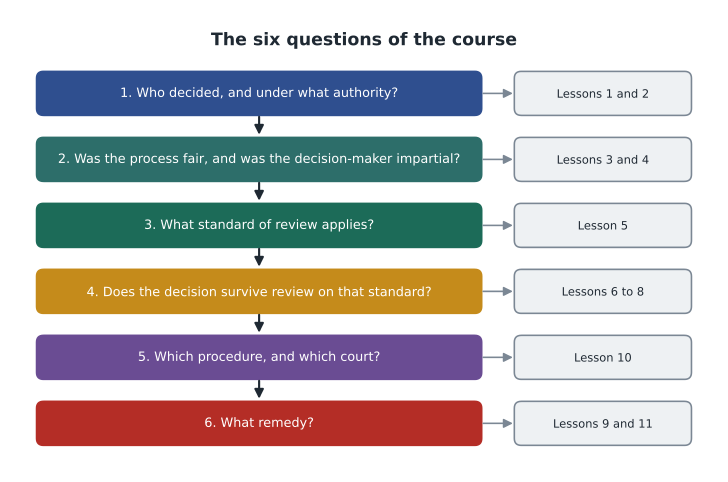
Delisle spent eleven years as counsel at the Office of the Ombudsman of Ontario and then six years as a vice-chair of a provincial adjudicative tribunal before joining the faculty. She tells the class that the course will follow a single running file, the Quintero file, from start to finish, and that by the end they should be able to answer the six questions she writes on the board about any decision made by any public body.
What administrative law is
Administrative law is the body of law that governs how public officials and bodies exercise the powers given to them, and how courts and other institutions hold them to account. Constitutional law asks whether a legislature can pass a law at all. Administrative law usually assumes the statute is valid and asks a different set of questions: did the decision-maker have the power to decide what it decided, did it follow a fair process, was it impartial, and was its decision reasonable or correct? When the answer is no, administrative law supplies remedies, most importantly judicial review in the superior courts.
The subject is largely judge-made. Statutes such as Ontario's Statutory Powers Procedure Act, R.S.O. 1990, c. S.22, and Judicial Review Procedure Act, R.S.O. 1990, c. J.1, and the federal Federal Courts Act, R.S.C. 1985, c. F-7, supply procedure and some minimum standards. But the core doctrines, procedural fairness, bias, the standard of review and the remedies, were built by courts over centuries of common law and refined by the Supreme Court of Canada, most importantly in Canada (Minister of Citizenship and Immigration) v. Vavilov, 2019 SCC 65.
The growth of the administrative state
Through the twentieth century, legislatures in Canada and elsewhere took on tasks that courts were poorly suited to handle: workers' compensation, labour relations, broadcasting, energy and transportation regulation, immigration, social assistance, human rights and professional discipline. They created specialized bodies with expertise, speed and lower cost, and often protected those bodies from court interference with privative clauses, statutory provisions declaring their decisions final and not subject to review. The classical constitutional theorist A. V. Dicey had been suspicious of this kind of administrative power, which he thought threatened the rule of law. Functionalist scholars responded that specialized tribunals could deliver justice more effectively than courts in many fields, and that courts should respect the choices of legislatures that created them. Much of Canadian administrative law is the story of courts searching for a balance between these two views.
Who exercises public power
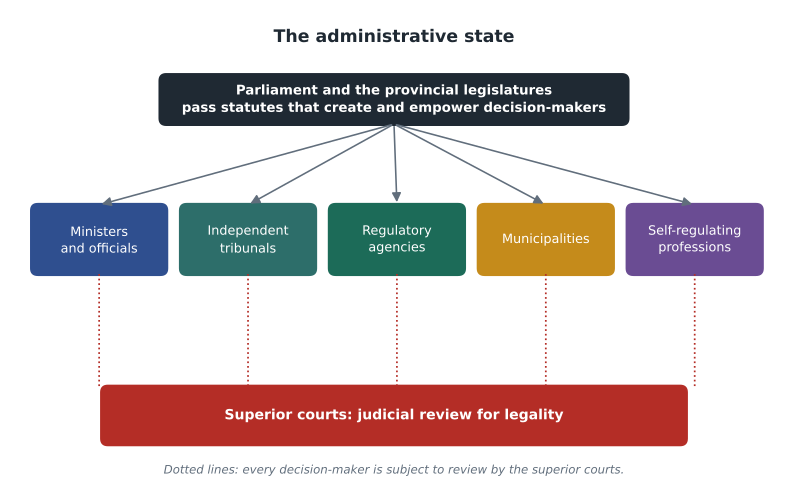
Administrative decision-makers come in many forms. Ministers and the officials who act for them make an enormous number of decisions, from granting licences to issuing permits and approvals; in immigration alone, officers make millions of decisions each year. Independent adjudicative tribunals decide disputes between citizens and the state or between private parties under a regulatory statute. In Ontario, many of these are grouped in Tribunals Ontario, an organization that includes the Landlord and Tenant Board, the Human Rights Tribunal of Ontario, the Social Benefits Tribunal, the Ontario Land Tribunal and others. Federally, the Immigration and Refugee Board of Canada is the largest tribunal in the country.
Regulatory agencies such as the Canadian Radio-television and Telecommunications Commission, the Canada Energy Regulator and the Ontario Energy Board combine rule-making, licensing and adjudication. Municipalities are creatures of provincial statute, such as Ontario's Municipal Act, 2001 and the City of Toronto Act, 2006, and they pass by-laws and make licensing and planning decisions. Self-regulating professions, such as the Law Society of Ontario, the College of Physicians and Surgeons of Ontario and dozens of others, license members of the profession, set standards and discipline members who breach them. Even bodies that are not part of government can be subject to administrative law when they exercise public power delegated by statute.
Where the power comes from
An administrative decision-maker has only the powers given to it by law. Most powers come from statute: a legislature passes an act that creates a body or office and gives it authority to make decisions, sometimes in detail and sometimes in very broad terms. Some powers come from the royal prerogative, the residue of discretionary authority that the Crown still holds under the common law, such as the conduct of foreign affairs, the issuing of passports and the granting of honours. Courts can review the exercise of prerogative powers when it affects individual rights, although some prerogative matters are not justiciable. Governments also act under their general capacity as legal persons when they enter contracts and manage property, and courts have treated purely commercial government decisions as matters of private law rather than public law.
The principle that every exercise of public power must have a legal source is fundamental. In Roncarelli v. Duplessis, [1959] S.C.R. 121, the Premier of Quebec directed the cancellation of a restaurant owner's liquor licence because the owner had repeatedly posted bail for Jehovah's Witnesses. The statute gave the liquor commission broad discretion to cancel permits, but the Supreme Court held that the cancellation was unlawful. Justice Rand wrote that there is no such thing as absolute and untrammelled discretion: discretion must be exercised for the purposes of the statute that confers it, not for an extraneous reason. Roncarelli was awarded damages against the Premier personally. The case remains the classic statement that even broad discretion has legal limits.
The constitutional foundation of judicial review
Judicial review is not simply a creature of statute. The superior courts of the provinces have an inherent supervisory jurisdiction over inferior tribunals that predates Confederation, and section 96 of the Constitution Act, 1867, together with sections 97 to 100, protects the core of that jurisdiction. In Crevier v. Attorney General of Quebec, [1981] 2 S.C.R. 220, the Supreme Court held that a province cannot give a tribunal unreviewable power to decide the limits of its own jurisdiction, because that would create a section 96 court in all but name. In Democracy Watch v. Canada (Attorney General), 2026 SCC 28, released on July 30, 2026, a unanimous Supreme Court went further: it held that the Constitution guarantees review of the legality of every aspect of an administrative decision, including questions of fact and law, and struck down a privative clause in the federal Conflict of Interest Act to the extent that it tried to bar that review. Lesson 7 examines Democracy Watch in detail.
For Ontario, the Statutory Powers Procedure Act sets minimum procedural rules for tribunals that exercise a statutory power of decision and are required by statute or otherwise by law to hold a hearing. It deals with notice, the right to counsel, the right to call evidence and cross-examine, written and electronic hearings, and reasons on request. Many tribunals also have their own rules of procedure under their enabling statutes. Federally, there is no general procedure statute, so the common law of procedural fairness and each body's own statute and rules supply the procedure.
The Quintero file
Delisle introduces the running file, which is fictional. Marisol Quintero operates a food truck called Sol y Sal in downtown Corwin. Under the City of Corwin's mobile food vending by-law, she needs an annual licence from the city's licensing officer, and a licence can be suspended or revoked by the Licensing Appeal Committee, a committee of three city councillors. After complaints from restaurant owners that food trucks were taking customers, the committee revoked her licence at a meeting she learned about only the day before. The committee chair, Councillor Dale Pellerin, had told a local newspaper a month earlier that food trucks were killing downtown restaurants. His brother owns a bistro two blocks from Quintero's usual spot. The committee gave a one-paragraph written decision saying that her truck had been the subject of repeated complaints and that the revocation was in the public interest.
The class will see two other files. In the Anyanwu file, an immigration officer refuses a study permit to Chidi Anyanwu, a Nigerian student admitted to a master's program at Brannock University, in three lines of notes. In the provincial file, Ontario makes a regulation under a statute that the class will treat as fictional, setting new conditions on licences for short-term rental platforms. Each file raises a different part of administrative law, and the capstone will bring them together.
The six questions
Delisle's six questions organize the course. First, who decided, and under what authority? The answer tells you what powers the decision-maker had and what statute governs it. Second, was the process fair, and was the decision-maker impartial? Lessons 3 and 4 cover procedural fairness and bias. Third, what standard of review applies? After Vavilov, the answer is usually reasonableness, but there are important exceptions, covered in lessons 5 and 7. Fourth, does the decision survive review on that standard? Lessons 6 to 8 explain how courts conduct reasonableness and correctness review and how the Charter applies to discretionary decisions. Fifth, which procedure and which court? Lesson 10 covers judicial review applications in the Divisional Court and the Federal Court, time limits and standing. Sixth, what remedy? Lesson 9 covers the remedies, and lesson 11 looks at oversight bodies that can sometimes help a client more quickly and cheaply than a court.
Sophie Tremblay-Hart asks whether Quintero could simply sue the city for the income she lost. 'Sometimes,' Delisle replies, 'but a civil action for damages against a public body is a different and narrower route, governed by the law of torts, Crown liability statutes and doctrines such as misfeasance in public office. Roncarelli won damages because the Premier acted in bad faith for a purpose foreign to the statute. Most people who are wronged by an administrative decision want the decision set aside and their licence back. That is what judicial review is for.'
Why this matters in practice
Administrative law is not only for government lawyers. A family law client may need a decision of the Family Responsibility Office reviewed; a business client may face a licence suspension, an environmental order or a competition investigation; an employee may bring a claim before the Human Rights Tribunal of Ontario; a refugee claimant's life may depend on a single decision of the Refugee Protection Division. Corporate lawyers deal with securities commissions and energy regulators, and criminal lawyers deal with parole boards and review boards. Delisle tells the class that many of them will appear before a tribunal long before they appear before a judge, and that the first skill they need is reading an enabling statute carefully, from the definitions section to the regulations, before forming any view about whether a decision was lawful.
Worked problem
Identifying the source of power
Three decisions affect a client: (1) a passport officer refuses to issue her a passport; (2) the City of Corwin refuses to renew her rental housing licence; (3) a provincial tribunal dismisses her application for social assistance. For each, identify the likely source of the power and the first question you would ask.
Show solution
- Passport refusal: passports are issued under the royal prerogative, now structured by the Canadian Passport Order; ask whether the decision affects her rights in a way that makes it reviewable and what the Order provides.
- Rental licence: municipalities have only the powers given by provincial statute; ask which section of the Municipal Act, 2001 authorizes the licensing by-law and what the by-law lets the licensing officer do.
- Social assistance: the tribunal is created by statute; ask what the enabling statute says about its powers, its procedure and any appeal or review route, and whether the Statutory Powers Procedure Act applies.
- In each case, the answer to the first question shapes everything that follows: the procedure owed, the standard of review and the route to court.
Common mistakes
MistakeAssuming that a broadly worded discretion lets an official act for any reason.
InsteadRoncarelli v. Duplessis: discretion must be exercised for the purposes of the statute that confers it.
MistakeTreating judicial review as purely a statutory remedy that a legislature can abolish.
InsteadThe superior courts' supervisory jurisdiction is constitutionally protected (Crevier; Democracy Watch, 2026).
MistakeThinking that only tribunals with hearings are subject to administrative law.
InsteadMinisters, officials, municipalities, regulators and professional bodies all exercise public power subject to review.
MistakeStarting with the remedy before identifying the decision and its legal source.
InsteadAlways begin by asking who decided and under what authority.
Practice problems
Work each problem on paper first, then reveal the answer to check.
What principle did Roncarelli v. Duplessis establish?
Show answer
There is no absolute and untrammelled discretion; discretion must be exercised for the purposes of the statute, not for extraneous reasons.
What did Crevier (1981) hold?
Show answer
A province cannot insulate a tribunal from superior court review of the limits of its jurisdiction, because the supervisory jurisdiction is protected by section 96.
What does Ontario's Statutory Powers Procedure Act do?
Show answer
It sets minimum procedural rules for tribunals exercising a statutory power of decision that must hold a hearing.
Name three sources of administrative power.
Show answer
Statute, the royal prerogative and the Crown's general capacity as a legal person.
What did Democracy Watch (2026 SCC 28) hold about privative clauses?
Show answer
They cannot bar review of the legality of any aspect of a decision, including questions of fact and law.
Summary and key terms
- Administrative law governs how public officials and bodies exercise statutory and prerogative powers, and how they are held to account.
- Decision-makers include ministers and officials, tribunals, regulatory agencies, municipalities and self-regulating professions.
- Every exercise of public power needs a legal source, and even broad discretion has limits (Roncarelli v. Duplessis).
- The superior courts' supervisory jurisdiction is constitutionally protected (Crevier; Democracy Watch, 2026).
- Ontario's Statutory Powers Procedure Act sets minimum procedures for tribunals that must hold hearings.
- The course follows six questions: authority, fairness and bias, standard of review, review on that standard, procedure, and remedy.
- Administrative law
- The law governing the exercise of public power by officials and bodies other than courts and legislatures.
- Judicial review
- A superior court's review of the legality of an administrative decision.
- Privative clause
- A statutory provision that tries to make a decision-maker's decisions final and not reviewable.
- Royal prerogative
- The residue of discretionary authority held by the Crown under the common law.
- Enabling statute
- The statute that creates a decision-maker and defines its powers.
- Tribunal
- A body created by statute to adjudicate disputes under a regulatory scheme.
Lesson quiz · 5 questions
Score 60% or more to complete this lesson.
Create a free account to save your progress, take quizzes and earn a certificate.