
LAWC-202 · Lesson 8 of 12 · 21 min
Discretion, the Charter and administrative decisions
▶ Video coming soon A video version of this lesson is on the way.
Professor Delisle starts the eighth class with a scene that some students recognize from Constitutional Law II. The City of Corwin's parks by-law bans tents in Riverside Park overnight. Last winter, a by-law officer ordered a man sleeping in a tent near the river to remove it at 2 a.m. on a night when both shelters were full and the temperature was minus twenty. 'In Charter class you asked whether the by-law itself was constitutional,' Delisle says. 'That is a question about the validity of a law, tested under section 1 and Oakes. Today the question is different. Suppose the by-law is valid but gives the officer discretion about when to enforce it. How does a court review the officer's choice? That is administrative law meeting the Charter.' She adds that, as before, the facts are a teaching hypothetical.
The nature of discretion
Many statutes give decision-makers discretion: the power to choose among options, often expressed in words such as 'may', 'in the public interest' or 'if satisfied'. Discretion is essential to administration, because no legislature can foresee every situation. But since Roncarelli v. Duplessis, Canadian law has insisted that discretion is never unfettered. It must be exercised in good faith, for the purposes for which it was conferred, on relevant considerations, without fettering, and within the bounds of the Constitution.
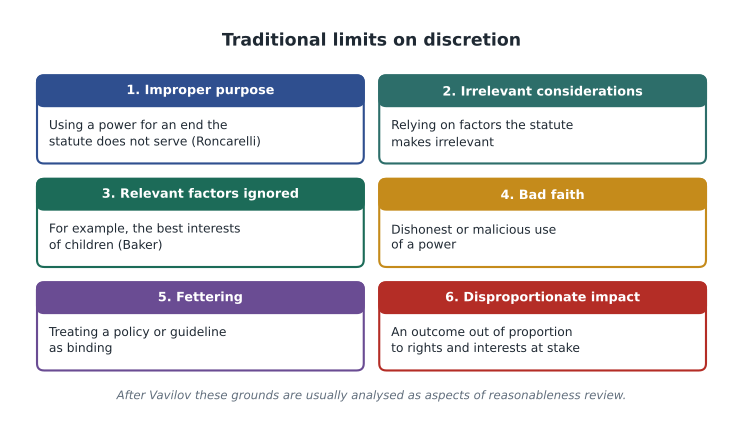
Traditional limits on discretion
Before Vavilov, courts reviewed discretion on a series of nominate grounds. A decision made for an improper purpose, such as cancelling a licence to punish someone's religious associations, is unlawful. A decision that takes into account irrelevant considerations, or fails to take into account considerations the statute makes relevant, is unlawful. A decision made in bad faith, dishonestly or with malice is unlawful. A decision-maker that applies a policy as if it were a binding rule fetters its discretion. In Baker, the Supreme Court held that the officer's decision was unreasonable in part because the officer had not been alert, alive and sensitive to the best interests of Baker's Canadian children, a central consideration given the humanitarian purpose of the power and Canada's commitments under the Convention on the Rights of the Child. Baker also emphasized that discretion must be exercised in accordance with the values underlying the grant of discretion.
After Vavilov, these traditional grounds are usually analysed as aspects of reasonableness review. Improper purposes and irrelevant considerations show that a decision is untenable in light of its statutory constraints; a failure to consider a central factor shows a failure of justification. The vocabulary of the older cases remains useful, because courts still cite them, but the analysis now runs through the Vavilov constraints.
The Charter and administrative decisions
Administrative decision-makers are bound by the Charter. Section 32 applies it to Parliament, the provincial legislatures and the governments of Canada, and courts have held that it applies to bodies exercising statutory authority, such as municipalities, school boards and tribunals, at least when they exercise governmental functions. A statute cannot authorize a decision-maker to infringe Charter rights unjustifiably, and broad statutory discretion is presumed to be limited by the Charter. The question is how courts should review discretionary decisions that limit Charter protections.
Two approaches compete. One treats the decision like a law: identify the infringed right, then ask whether the infringement is justified under section 1 using the Oakes test, reviewed for correctness. The other, adopted by the Supreme Court in 2012, integrates Charter protections into administrative law's review of discretion.
Doré v. Barreau du Québec
In Doré v. Barreau du Québec, 2012 SCC 12, a Quebec lawyer wrote a scathing private letter to a judge who had made disparaging remarks about him in court. The Barreau's disciplinary council reprimanded the lawyer for breaching the code of ethics, which required lawyers to act with objectivity, moderation and dignity. The lawyer argued that the reprimand infringed his freedom of expression under section 2(b) of the Charter.
Justice Abella, for a unanimous Court, held that where a discretionary administrative decision engages the Charter, the reviewing court should not apply the Oakes test as if the decision were a law. Instead, the decision-maker must balance the Charter values at stake with the statutory objectives. The decision-maker should first consider the statutory objectives, then ask how the Charter value at issue will best be protected in view of those objectives, balancing the severity of the interference with the Charter protection against the objectives. On review, the question is whether the decision reflects a proportionate balance, and the standard is reasonableness, reflecting deference to the decision-maker's expertise and its closer familiarity with the context. The Court upheld the reprimand: the lawyer's letter went well beyond what the duty of civility allowed, and the disciplinary council had proportionately balanced his expressive rights against the profession's interest in civility.
Loyola and Trinity Western
In Loyola High School v. Quebec (Attorney General), 2015 SCC 12, Quebec required all schools to teach an Ethics and Religious Culture program from a neutral perspective. Loyola, a private Catholic boys' school, asked the minister for an exemption to teach an equivalent program from a Catholic perspective, and the minister refused. The Court applied Doré and refined it: the question is whether the decision limits Charter protections more than necessary in light of the statutory objectives. Justice Abella, for the majority, held that requiring Loyola to teach Catholicism itself from a neutral perspective interfered with freedom of religion in a way that was not proportionate, because it went further than necessary to achieve the program's objectives of tolerance and respect for others. The minister's decision was set aside. Three justices concurred in the result but would have applied a different analysis.
In Law Society of British Columbia v. Trinity Western University, 2018 SCC 32, and its companion case from Ontario, the law societies refused to accredit a proposed law school at an evangelical Christian university because the university required students to sign a covenant prohibiting sexual intimacy outside marriage between a man and a woman. The majority held that the law societies' decisions limited the religious freedom of the university's community, but that the decisions reflected a proportionate balance between that limit and the law societies' statutory objectives, including promoting equal access to the legal profession and protecting the public interest in the administration of justice. The decisions were reasonable. Two justices dissented, and two concurred with different reasoning, and the case remains a central reference point in debates about Doré.
Commission scolaire francophone des TNO
In Commission scolaire francophone des Territoires du Nord-Ouest v. Northwest Territories (Education, Culture and Employment), 2023 SCC 31, the Northwest Territories minister refused requests by parents who were not rights holders under section 23 of the Charter, the minority language education right, to enrol their children in French-language schools. The minister relied on a ministerial directive limiting admission of non-rights holders. Justice Côté, for the Court, held that even though the parents were not section 23 rights holders, the minister's discretion had to be exercised with regard to the values underlying section 23, including the preservation and flourishing of minority language communities. The minister's decision did not reflect consideration of those values and was unreasonable, and the Court sent the matter back for reconsideration.
The case confirmed that Doré applies not only where a decision limits a person's own Charter rights but also where it engages the values underlying a Charter right, and that a decision-maker's failure to consider those values at all makes the decision unreasonable.
The continuing debate
Doré has been criticized. Some judges and scholars argue that Charter values are vague, that the framework gives too little protection to Charter rights because it applies deference, and that it is inconsistent with Vavilov, which made reasons and legal constraints central and did not address Doré. In Vavilov, the majority expressly declined to reconsider Doré. Others defend the framework as a sensible way to integrate rights into the vast number of discretionary decisions made by officials who are not judges. For now, Doré, Loyola and the 2023 TNO decision are good law, and lawyers challenging discretionary decisions on Charter grounds should argue both that the decision-maker failed to consider the Charter protection and that its balance was disproportionate.
Applying the framework to the tent removal
The class returns to Riverside Park. The by-law's objectives include keeping parks available for public use and protecting public health and safety. The officer's decision to order the removal of the tent at 2 a.m., when no shelter beds were available and the temperature was minus twenty, engages section 7 of the Charter, because it affects the man's security of the person. Under Doré, the question is whether the officer's decision reflects a proportionate balance between the by-law's objectives and the section 7 protection. Theo Marchetti argues that ordering removal in those conditions limits security of the person far more than necessary, because waiting until morning, or until a shelter bed opened, would have served the by-law's objectives almost as well. Sophie Tremblay-Hart adds that the city's enforcement policy, if it required officers to enforce the by-law at all hours without regard to shelter capacity, might fetter discretion. Delisle notes that a court would also ask what the officer actually considered, because under Vavilov the decision must be justified, not merely justifiable.
Delisle closes by linking back to the Quintero file. Quintero has not raised any Charter claim, but if the committee had revoked her licence because she spoke out at council meetings against restaurant owners, the decision would engage freedom of expression, and Doré would require the committee to balance that protection against the by-law's objectives. 'Discretion is where most administrative law lives,' she says. 'The Charter does not disappear when an official exercises it.'
Practical points for counsel
The Doré framework affects how cases are prepared. First, counsel should identify the Charter protection before the decision-maker, not for the first time on review. A decision-maker is expected to consider Charter protections that are clearly engaged, but a reviewing court will look at what was argued and what the decision-maker had before it, and an argument raised late is much weaker. Second, the distinction between a challenge to a law and a challenge to a decision matters. If the client's complaint is that the statute or by-law itself limits a Charter right, the challenge is to the law, and the Oakes test under section 1 applies, usually in a court. If the complaint is that the official exercised a discretion under a valid law in a way that limits a Charter protection more than necessary, Doré applies. Third, the decision-maker may be able to decide the Charter question itself. Under Nova Scotia (Workers' Compensation Board) v. Martin, 2003 SCC 54, a tribunal with power to decide questions of law is presumed to be able to decide constitutional questions arising in its proceedings, and R. v. Conway, 2010 SCC 22, held that such a tribunal can grant Charter remedies within its statutory mandate.
Fourth, the remedy is usually administrative. A decision that fails the Doré test is unreasonable and is quashed and remitted. Charter damages under section 24(1) are possible in principle, as Vancouver (City) v. Ward, 2010 SCC 27, shows, but they are rare in judicial review proceedings and are better pursued in an action. Finally, counsel should keep in mind that the reviewing court will look at the reasons for evidence of balancing. A decision that never mentions the Charter protection at all, where the protection was clearly engaged, is difficult to defend.
Worked problem
A library room booking
A public library board, created under provincial statute, refuses to rent a meeting room to a lawful advocacy group because its views are controversial and might upset other patrons. The library's policy allows refusals that would "interfere with library operations." Analyze the refusal.
Show solution
- Identify the decision: a discretionary decision by a statutory body applying a policy, not a challenge to a law.
- Charter engagement: refusing a room because of the group's views engages freedom of expression under section 2(b).
- Statutory objectives: providing public library services and maintaining orderly operations.
- Proportionate balance (Doré; Loyola): is refusing the booking because of the content of the group's views, without evidence of actual disruption, more than necessary to protect library operations?
- Reasons: if the board did not consider the expression interest at all, its decision is unreasonable (TNO, 2023); remit for reconsideration.
Common mistakes
MistakeApplying the Oakes test to an individual discretionary decision as if it were a law.
InsteadDoré applies reasonableness review asking whether the decision proportionately balanced Charter protections and statutory objectives.
MistakeUsing Doré to attack the validity of the statute itself.
InsteadA challenge to the law is a constitutional question under section 1 and Oakes, reviewed for correctness.
MistakeAssuming Doré applies only when the applicant is a Charter rights holder.
InsteadThe TNO case (2023) applied it to the values underlying section 23 for parents who were not rights holders.
MistakeArguing that broad statutory discretion permits any outcome.
InsteadDiscretion is limited by the statute's purposes, relevant considerations and the Charter.
Practice problems
Work each problem on paper first, then reveal the answer to check.
What is the Doré framework?
Show answer
The decision-maker must proportionately balance Charter protections with statutory objectives; the court reviews that balance for reasonableness.
How did Loyola (2015) refine Doré?
Show answer
It asked whether the decision limits Charter protections more than necessary given the statutory objectives.
What did Trinity Western (2018) decide?
Show answer
The law societies' refusals limited religious freedom but proportionately balanced it against their statutory objectives, so they were reasonable.
What did the 2023 TNO decision add?
Show answer
Decision-makers must consider the values underlying a Charter right, here section 23, even for non-rights holders.
Name three traditional limits on discretion.
Show answer
Improper purpose, irrelevant considerations, bad faith, fettering, or failure to consider relevant factors.
Summary and key terms
- Discretion is never unfettered and must be exercised in good faith, for proper purposes and on relevant considerations.
- Traditional grounds of review of discretion are now usually analysed through Vavilov reasonableness.
- Doré (2012) requires discretionary decisions engaging the Charter to proportionately balance Charter protections and statutory objectives, reviewed for reasonableness.
- Loyola (2015) and Trinity Western (2018) applied and refined the framework.
- The TNO decision (2023) extended it to the values underlying section 23.
- Doré remains debated after Vavilov but is good law.
- Discretion
- A power to choose among options within limits set by law.
- Improper purpose
- Using a power for a goal the statute does not authorize.
- Charter values
- The values underlying Charter rights that decision-makers must consider when exercising discretion.
- Proportionate balance
- The Doré requirement that Charter protections be limited no more than necessary given statutory objectives.
- Doré framework
- The administrative law approach to discretionary decisions engaging the Charter.
- Oakes test
- The section 1 justification test for laws limiting Charter rights.
Lesson quiz · 5 questions
Score 60% or more to complete this lesson.
Create a free account to save your progress, take quizzes and earn a certificate.