
LAWC-202 · Lesson 4 of 12 · 21 min
Bias and independence
▶ Video coming soon A video version of this lesson is on the way.
The fourth class picks up where the third left off. A month before the Licensing Appeal Committee met, Councillor Dale Pellerin told the Corwin Courier that 'food trucks are killing downtown restaurants, and I intend to do something about it.' His brother owns a bistro two blocks from where Marisol Quintero usually parks Sol y Sal. Pellerin chaired the meeting that revoked her licence and moved the motion to revoke. Professor Delisle asks the class whether Quintero could have expected a councillor to have no opinions at all. 'Of course not,' says Daniel Whitecloud. 'But there is a difference between having views about food trucks and deciding her licence after promising to get rid of trucks like hers.' 'That,' Delisle says, 'is the whole law of bias in two sentences.'
Why impartiality matters
The rule against bias, nemo judex in sua causa, is the second pillar of natural justice. It protects both the parties, who are entitled to a decision-maker who will decide on the evidence and the law rather than on prejudice or interest, and public confidence in the administration of justice. Bias can be actual, but actual bias is rarely provable, because it concerns the decision-maker's state of mind. The law therefore asks whether there is a reasonable apprehension of bias: whether the circumstances would lead a reasonable observer to think the decision-maker might not decide fairly.
The reasonable apprehension test
The classic statement comes from Justice de Grandpré's dissent in Committee for Justice and Liberty v. National Energy Board, [1978] 1 S.C.R. 369, which the Supreme Court has adopted many times since. The apprehension of bias must be a reasonable one, held by reasonable and right-minded persons, applying themselves to the question and obtaining the required information. The test is what would an informed person, viewing the matter realistically and practically, and having thought the matter through, conclude: would that person think it more likely than not that the decision-maker, whether consciously or unconsciously, would not decide fairly? In the case itself, the majority held that the chair of the National Energy Board should not sit on a panel deciding which pipeline should be built because he had previously been involved, as president of a development corporation, in a study group that supported one of the applicants.
The threshold is high. In Wewaykum Indian Band v. Canada, 2003 SCC 45, the Supreme Court considered whether Justice Binnie should have sat on an appeal involving a claim he had dealt with years earlier as associate deputy minister of justice. The Court affirmed the presumption of impartiality, emphasized that the inquiry is highly fact-specific, and concluded that his remote involvement, which he did not remember, did not create a reasonable apprehension of bias. Courts require cogent evidence before finding bias, because a finding casts doubt on the integrity of the decision-maker.
Kinds of bias
Bias claims usually fall into a few patterns. Pecuniary or personal interest arises where the decision-maker or someone close to them stands to gain or lose from the outcome; even a small direct financial interest has traditionally disqualified a decision-maker. Personal relationships with a party, a witness or counsel can create an apprehension. Prejudgment arises where statements or conduct suggest that the decision-maker has already made up their mind, as where a member comments publicly on a pending case. Attitudinal bias arises from hostility toward a party or a group, as in Baker, where the officer's notes revealed stereotyped views. Conduct during a hearing, such as hostile interruptions or refusing to let a party present evidence, can also give rise to an apprehension. In Yukon Francophone School Board, Education Area #23 v. Yukon (Attorney General), 2015 SCC 25, the Supreme Court held that a trial judge's conduct during the trial, viewed cumulatively, gave rise to a reasonable apprehension of bias, although his past involvement in a community organization would not on its own have done so, and it ordered a new trial.
A flexible standard: Newfoundland Telephone
Administrative decision-makers are not all alike, and the bias standard adjusts to their function. In Newfoundland Telephone Co. v. Newfoundland (Board of Commissioners of Public Utilities), [1992] 1 S.C.R. 623, a commissioner of a utility regulator made strong public statements against the utility's executive pay both before and during a hearing into its costs. Justice Cory held that decision-makers fall on a spectrum. Those performing adjudicative functions are held to a standard close to that of judges. Those with policy-making functions, such as elected municipal councillors, are held to a more flexible standard: they will be disqualified only if they have prejudged the matter to the extent that any representations to the contrary would be futile, that is, if their mind is closed. Before the hearing began, the commissioner's statements might have been acceptable for a member of a policy-oriented board; but once the hearing started, the board was acting in an adjudicative capacity, and statements suggesting the commissioner had already decided the issue created a reasonable apprehension of bias. The resulting decision was void.
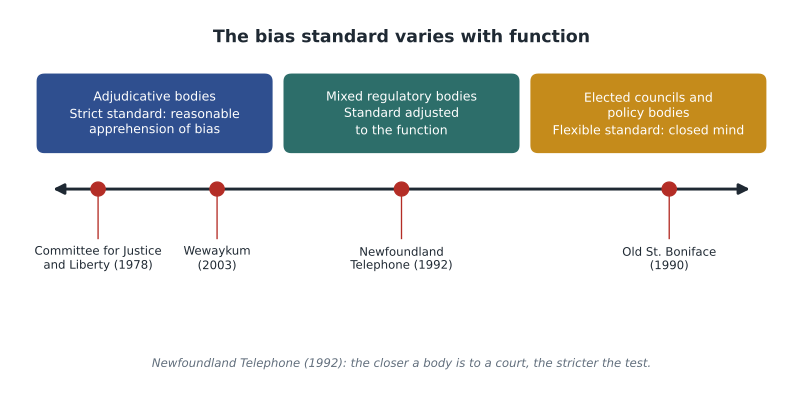
In Old St. Boniface Residents Assn. Inc. v. Winnipeg (City), [1990] 3 S.C.R. 1170, the Court applied the flexible standard to a city councillor who had supported a development before a rezoning decision. Justice Sopinka held that elected councillors are expected to have views and to campaign on them; the test for prejudgment is whether the councillor is amenable to persuasion, not whether they have expressed opinions. A councillor who has a closed mind, or a personal interest in the outcome, is disqualified. The companion case, Save Richmond Farmland Society v. Richmond (Township), [1990] 3 S.C.R. 1213, applied the same approach.
Statutory conflict of interest rules
Statutes add rules on pecuniary interests. Ontario's Municipal Conflict of Interest Act, R.S.O. 1990, c. M.50, requires a member of council or a local board who has a direct or indirect pecuniary interest in a matter to disclose the interest, not take part in the discussion or vote, and not attempt to influence the vote. Under the Act, the pecuniary interest of a parent, spouse or child of the member is deemed to be the member's interest if the member knows of it. The Act does not list siblings. A councillor whose brother owns a competing business therefore may not have a deemed pecuniary interest under the statute, but that does not end the analysis: the common law rule against bias applies independently, and a close family member's business interest can still give rise to a reasonable apprehension of bias, especially where the councillor sits in an adjudicative role.
Institutional bias and independence
Bias can also be institutional. In 2747-3174 Québec Inc. v. Quebec (Régie des permis d'alcool), [1996] 3 S.C.R. 919, the liquor permit board's lawyers could investigate, prosecute and then advise the board members who decided the same case, and the board's directors could initiate proceedings and then sit on the panel. The Supreme Court held that this overlapping of functions, without adequate separation within the institution, gave rise to a reasonable apprehension of bias in a substantial number of cases. Overlapping functions are not unlawful in themselves, because many statutes deliberately combine investigation and adjudication in one agency; the question is whether the agency has internal safeguards that prevent the same people from playing incompatible roles in the same case. A statute that expressly authorizes the overlap will prevail, subject to constitutional limits.
Institutional consultation is permitted within limits. In IWA v. Consolidated-Bathurst Packaging Ltd., [1990] 1 S.C.R. 282, the Court held that a labour board could hold full-board meetings to discuss policy issues raised by a draft decision, provided the meetings did not introduce new evidence, were not imposed on the panel, and left the panel free to decide. Ellis-Don Ltd. v. Ontario (Labour Relations Board), 2001 SCC 4, confirmed that approach.
Independence is related to impartiality but distinct from it. Courts enjoy constitutionally protected judicial independence, which requires security of tenure, financial security and administrative independence, as set out in Valente v. The Queen, [1985] 2 S.C.R. 673. Tribunals are different. In Ocean Port Hotel Ltd. v. British Columbia (General Manager, Liquor Control and Licensing Branch), 2001 SCC 52, the Court held that, absent constitutional constraints, the degree of independence required of a tribunal is determined by its enabling statute: the legislature may choose to have tribunal members serve at pleasure, and courts must respect that choice if it is clearly expressed. The common law requirements of independence apply only where the statute is silent. Where the Charter or the Canadian Bill of Rights applies, such as where section 7 rights are at stake, constitutional requirements may impose minimum independence.
In Bell Canada v. Canadian Telephone Employees Association, 2003 SCC 36, the Court upheld a statutory power for the Canadian Human Rights Commission to issue guidelines binding on the Canadian Human Rights Tribunal in a class of cases, and the chair's power to extend members' terms for ongoing cases. Given the statute, neither compromised the tribunal's independence or impartiality to an unacceptable degree, because the tribunal had a policy-implementation role and the guidelines were a form of law that it applied, not directions in particular cases.
Raising bias and its consequences
A party who suspects bias should raise it at the earliest opportunity, usually by asking the decision-maker to recuse. A party who knows of the facts and stays silent, hoping for a favourable result, may be taken to have waived the objection. Where every qualified decision-maker is affected, the doctrine of necessity may allow the decision to proceed. A finding of reasonable apprehension of bias is fatal: the decision is void and must be remade by an unbiased decision-maker, and it does not matter that the outcome might have been the same. As the Supreme Court said in Newfoundland Telephone, the damage created by apprehension of bias cannot be remedied.
Applying the law to Pellerin
The class works through the Quintero facts. The Licensing Appeal Committee is made up of councillors, which might suggest the flexible Old St. Boniface standard. But in deciding whether to revoke an individual's licence on complaints, the committee performs an adjudicative function, and Newfoundland Telephone teaches that the standard rises when a policy body adjudicates. Pellerin's public statement that he intended to do something about food trucks, made a month before the meeting, suggests prejudgment of the very question the committee had to decide. His brother's bistro, two blocks away, gives him a family connection to the competing interests behind the complaints, even if the Municipal Conflict of Interest Act's deemed-interest rule does not reach siblings. Hannah Kowalczyk concludes that a reasonable, informed observer would likely apprehend that Pellerin would not decide fairly, and that because he chaired and moved the motion, the whole decision is tainted. Delisle notes one practical point: Quintero did not object at the meeting, and the city will argue waiver; her answer will be that she learned of the brother's bistro only afterward and had no lawyer at the time.
Worked problem
A tribunal member's social media post
While a hearing about a landlord's eviction application is adjourned, a tribunal member posts online that "some landlords will say anything to get rid of tenants." The landlord's lawyer sees the post before the hearing resumes. What should the lawyer do and what will a court ask?
Show solution
- Raise the issue promptly: ask the member to recuse before the hearing resumes, to avoid any argument of waiver.
- Identify the function: an adjudicative tribunal deciding an individual dispute, so a strict standard applies (Newfoundland Telephone).
- Apply the test: would an informed person, viewing the matter realistically and practically, think the member would likely not decide fairly (Committee for Justice and Liberty)?
- Consider the presumption of impartiality and the high threshold (Wewaykum), but a generalized hostile comment about a class of parties during the hearing is the kind of statement that has led to findings of bias.
- If bias is found, the decision is void and must be reheard by a different member; it does not matter whether the result would have changed.
Common mistakes
MistakeAsking whether the decision-maker was actually biased.
InsteadThe test is a reasonable apprehension of bias in the eyes of an informed observer.
MistakeApplying the same strict standard to a city council's policy decision as to a tribunal.
InsteadElected and policy bodies are disqualified only for a closed mind or personal interest (Old St. Boniface; Newfoundland Telephone).
MistakeConcluding that no bias issue exists because a statute on pecuniary interests does not apply.
InsteadThe common law rule against bias applies independently of conflict of interest statutes.
MistakeWaiting until after the decision to raise a known bias concern.
InsteadRaise it at the earliest opportunity or risk waiver.
Practice problems
Work each problem on paper first, then reveal the answer to check.
State the test for reasonable apprehension of bias.
Show answer
What would an informed person, viewing the matter realistically and practically and having thought it through, conclude: would the decision-maker, consciously or unconsciously, likely not decide fairly?
What standard applies to elected councillors making policy decisions?
Show answer
Whether they have a closed mind, that is, are no longer amenable to persuasion (Old St. Boniface).
What did Ocean Port (2001) hold about tribunal independence?
Show answer
Absent constitutional constraints, the required degree of independence is set by the enabling statute.
When is institutional bias found (Régie des permis d'alcool)?
Show answer
When overlapping functions without adequate internal separation would lead a well-informed person to apprehend bias in a substantial number of cases.
What is the consequence of a reasonable apprehension of bias?
Show answer
The decision is void and must be remade; it is irrelevant whether the result would have been the same.
Summary and key terms
- The rule against bias protects parties and public confidence; the test is a reasonable apprehension of bias (Committee for Justice and Liberty).
- Impartiality is presumed and the threshold is high (Wewaykum).
- The standard varies with function: strict for adjudicators, a closed-mind test for elected and policy bodies (Newfoundland Telephone; Old St. Boniface).
- Statutes such as Ontario's Municipal Conflict of Interest Act add rules but do not displace the common law.
- Institutional bias arises from overlapping roles without safeguards (Régie); full-board consultation is allowed within limits (Consolidated-Bathurst).
- Tribunal independence is mainly statutory (Ocean Port; Bell Canada), and bias makes a decision void.
- Reasonable apprehension of bias
- The perception of a reasonable, informed observer that a decision-maker would likely not decide fairly.
- Prejudgment
- Having decided the issue before hearing the parties.
- Closed mind
- The test for elected or policy decision-makers: no longer amenable to persuasion.
- Institutional bias
- An apprehension of bias arising from the structure of a decision-making body.
- Independence
- Freedom of a decision-maker from improper influence, protected for courts by the Constitution.
- Waiver
- Losing a bias objection by failing to raise it promptly when the facts are known.
Lesson quiz · 5 questions
Score 60% or more to complete this lesson.
Create a free account to save your progress, take quizzes and earn a certificate.