
LAWC-202 · Lesson 3 of 12 · 21 min
Procedural fairness
▶ Video coming soon A video version of this lesson is on the way.
Professor Delisle opens the third class with the Quintero file. The Licensing Appeal Committee's notice of its meeting reached Marisol Quintero by email at 4 p.m. the day before. It said only that the committee would consider 'the status of Licence MFV-2026-114'. She was not told that eleven restaurant owners had complained, or what they said. When she arrived at the meeting, the chair, Councillor Pellerin, allowed her five minutes to speak, would not let her see the complaints, and refused her request for a two-week adjournment so she could bring a lawyer. The committee revoked her licence in a one-paragraph decision. 'Before we talk about whether the decision was reasonable,' Delisle says, 'we ask whether it was made fairly. Courts take procedure seriously because the right to be heard is one of the oldest principles of justice.'
From natural justice to fairness
The common law has long required those who decide disputes to observe the rules of natural justice: audi alteram partem, hear the other side, and nemo judex in sua causa, no one should be a judge in their own cause. For much of the twentieth century, courts applied these rules only to bodies classified as judicial or quasi-judicial, leaving purely administrative decisions largely unregulated. In Nicholson v. Haldimand-Norfolk Regional Board of Commissioners of Police, [1979] 1 S.C.R. 311, the Supreme Court rejected that rigid classification. A probationary police constable who was dismissed without being told why or given a chance to respond was entitled to a measure of procedural fairness, even though he had no statutory right to a hearing. The Court held that a general duty of fairness applies to administrative decisions, with content that varies with the context.
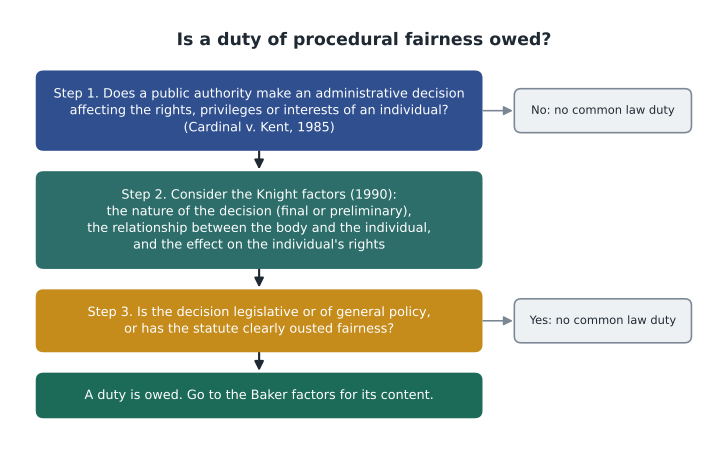
In Cardinal v. Director of Kent Institution, [1985] 2 S.C.R. 643, the Court stated the principle broadly: there is, as a general common law principle, a duty of procedural fairness lying on every public authority making an administrative decision which is not of a legislative nature and which affects the rights, privileges or interests of an individual. The Court also held that the denial of a fair hearing always renders a decision invalid, whether or not the court thinks a hearing would have made a difference, because a person is entitled to a fair process as an independent right.
Is a duty owed?
In Knight v. Indian Head School Division No. 19, [1990] 1 S.C.R. 653, the Court identified three factors for deciding whether a duty of fairness exists: the nature of the decision, the relationship between the decision-maker and the individual, and the effect of the decision on the individual's rights. A final decision attracts fairness more readily than a preliminary or investigative step, although preliminary decisions that lead to serious consequences can attract a duty too. The dismissal of a school director by a board, a decision that ended his employment, attracted a duty of fairness, but on the facts the director had been told of the board's concerns and had a chance to respond, so the duty was met.
Fairness does not apply to legislative decisions or decisions of a general policy nature. In Attorney General of Canada v. Inuit Tapirisat of Canada, [1980] 2 S.C.R. 735, the Court held that the federal cabinet owed no duty of fairness when it decided an appeal from a telephone rate decision under a statute giving it broad power to vary the order, because it was acting in a legislative or policy capacity. Regulations, by-laws of general application and broad policy decisions are controlled through the legislative process, judicial review of their vires and the political process rather than through individual hearing rights. Statutes may also limit or exclude fairness, but only by clear language, and any limit must respect the Charter where it applies.
The content of the duty: Baker
Once a duty exists, the question is what it requires. The leading case is Baker v. Canada (Minister of Citizenship and Immigration), [1999] 2 S.C.R. 817. Mavis Baker, a Jamaican citizen who had lived in Canada for eleven years without status and had four Canadian-born children, applied for an exemption from the requirement to apply for permanent residence from outside Canada on humanitarian and compassionate grounds. An immigration officer refused her application, and the notes of a second officer, which the decision-maker relied on, contained stereotyped and dismissive remarks about her mental illness and her children.
Justice L'Heureux-Dubé, writing for the Court, held that the content of the duty of fairness is flexible and variable and depends on an appreciation of the context. She identified five non-exhaustive factors: (1) the nature of the decision being made and the process followed in making it, with more protection the more the process resembles judicial decision-making; (2) the nature of the statutory scheme and the terms of the statute, including whether an appeal is available; (3) the importance of the decision to the individual affected; (4) the legitimate expectations of the person challenging the decision; and (5) the choices of procedure made by the agency itself, particularly where the statute leaves it to choose its own procedure or where it has expertise in choosing appropriate procedures. The purpose of the duty is to ensure that decisions are made using a fair and open procedure, appropriate to the decision and its context, with an opportunity for those affected to put forward their views and evidence fully and have them considered.
Applying those factors, the Court held that Baker was entitled to a meaningful opportunity to present the various types of evidence relevant to her case and have it fully and fairly considered, but not to an oral interview: written submissions were enough in the context of humanitarian applications. The Court also held, for the first time, that the duty of fairness requires a written explanation for a decision in certain circumstances, such as where the decision has important significance for the individual or there is a statutory right of appeal, and that the officer's notes could serve as reasons. Finally, the notes gave rise to a reasonable apprehension of bias, because they suggested the officer was not approaching the case with an open mind. The decision was set aside.
Participatory rights in practice
Fairness requires, at a minimum, that a person know the case to be met and have a fair opportunity to respond. The notice must be timely and specific enough to allow a response; a vague notice given the day before a hearing rarely satisfies the duty where serious interests are at stake. Disclosure of the information the decision-maker will rely on is usually required in proportion to the stakes. In May v. Ferndale Institution, 2005 SCC 82, the Court held that federal inmates reclassified to higher security were entitled to the scoring matrix used to classify them, because the information was relevant and its withholding left them unable to respond meaningfully.
An oral hearing is not always required, but it is required where credibility is central and the stakes are high. In Singh v. Minister of Employment and Immigration, [1985] 1 S.C.R. 177, three justices held that refugee claimants were entitled under section 7 of the Charter to an oral hearing where their credibility was in issue, and three others reached the same result under the Canadian Bill of Rights. There is no general common law right to counsel before administrative bodies, but representation may be required where the issues are complex or the consequences serious, and Ontario's Statutory Powers Procedure Act gives parties before tribunals it covers the right to be represented by a lawyer or licensed paralegal. Adjournment requests must be considered fairly, balancing the reasons for the request against the need for timely decisions.
Legitimate expectations
The doctrine of legitimate expectations protects procedural expectations created by a public authority's conduct. In Canada (Attorney General) v. Mavi, 2011 SCC 30, the Court held that where a government official makes representations within the scope of their authority to an individual about an administrative process that the government will follow, and the representations are clear, unambiguous and unqualified, the government may be held to its word, provided the representations are procedural in nature and do not conflict with the decision-maker's statutory duty. In Agraira v. Canada (Public Safety and Emergency Preparedness), 2013 SCC 36, ministerial guidelines published in an operational manual created a legitimate expectation that applications for ministerial relief would be decided under the process they described, though the Court found that the process had been followed.
In Canada, legitimate expectations give procedural protection only: they may entitle a person to be consulted or heard, or to a particular procedure, but not to a particular substantive outcome. That differs from English law, where courts have sometimes enforced substantive expectations. A promise of a particular result may be relevant to whether a decision is reasonable, but it is not enforceable through fairness.
Reasons, consequences and review
Since Baker, reasons are required where the decision is important to the individual, where there is a right of appeal, or in other circumstances where fairness demands them. Where reasons are given, Vavilov makes them the focus of reasonableness review, as lesson 6 will show. The adequacy of reasons is not a free-standing ground for setting aside a decision under fairness once some reasons have been provided; instead, gaps in the reasoning go to whether the decision is reasonable.
Courts do not defer to decision-makers on whether fairness was respected. The question is whether the procedure was fair having regard to all the circumstances, including the Baker factors, and courts often describe this as a correctness-like inquiry, although they give weight to the agency's own choice of procedure under the fifth Baker factor. A breach generally results in the decision being quashed and sent back. In rare cases, such as Mobil Oil Canada Ltd. v. Canada-Newfoundland Offshore Petroleum Board, [1994] 1 S.C.R. 202, a court may decline to remit where the outcome is legally inevitable, but courts are cautious about predicting what a fair hearing would have produced.
Where section 7 of the Charter is engaged because life, liberty or security of the person is at stake, the principles of fundamental justice may require more than the common law. In Suresh v. Canada (Minister of Citizenship and Immigration), 2002 SCC 1, a person facing deportation to a risk of torture was entitled to disclosure of the material relied on, an opportunity to respond in writing and written reasons from the minister.
Applying fairness to Quintero
Theo Marchetti walks the class through the analysis. A duty is owed: the revocation is a final decision by a public body that ends Quintero's livelihood, and it is an individual decision, not a legislative one. On content, the process looks adjudicative, a committee deciding on complaints about a named licensee; the by-law provides no appeal; the decision is very important to Quintero; and nothing suggests the city chose a summary process for good reason. Fairness therefore required reasonable notice of the case against her, disclosure of the substance of the complaints, a real opportunity to respond, fair consideration of her adjournment request and reasons. One day's vague notice, no disclosure and a five-minute statement are unlikely to meet that standard. 'And we have not even reached Councillor Pellerin,' Delisle adds. 'That is next class.'
Worked problem
How much process does a licence suspension need?
A provincial registrar suspends a home renovator's registration for 30 days after a single customer complaint. The statute allows the renovator to appeal to a tribunal for a full hearing. The registrar gave the renovator written notice of the complaint and ten days to respond in writing, then decided without an oral meeting. Was the process fair?
Show solution
- A duty is owed: an individual decision affecting the renovator's livelihood (Cardinal; Knight).
- Nature of the decision: an administrative first-level decision, not a court-like hearing, which points to fewer procedural protections.
- Statutory scheme: a full appeal hearing before a tribunal is available, so the first-level process can be lighter.
- Importance: significant but temporary, a 30-day suspension.
- Conclusion: written notice of the complaint, disclosure of its substance and a written opportunity to respond, followed by reasons, likely satisfy the duty at this stage.
Common mistakes
MistakeSaying fairness applies only to bodies that act like courts.
InsteadSince Nicholson and Cardinal, fairness applies to administrative decisions affecting individual rights, privileges or interests.
MistakeInsisting on an oral hearing in every case.
InsteadThe Baker factors decide; written submissions often suffice unless credibility is central and the stakes are high.
MistakeUsing legitimate expectations to demand a promised outcome.
InsteadIn Canada the doctrine protects procedural expectations only (Mavi; Agraira).
MistakeDeferring to the tribunal on whether its own process was fair.
InsteadCourts decide fairness themselves, giving some weight to the agency's procedural choices.
Practice problems
Work each problem on paper first, then reveal the answer to check.
What are the three Knight factors?
Show answer
The nature of the decision, the relationship between the body and the individual, and the effect on the individual's rights.
List the five Baker factors.
Show answer
Nature of the decision and process; statutory scheme; importance to the individual; legitimate expectations; the agency's choice of procedure.
What did Baker hold about reasons?
Show answer
Written reasons are required in some circumstances, such as important decisions or where there is a right of appeal, and officers' notes can serve as reasons.
What must a representation be to found a legitimate expectation?
Show answer
Clear, unambiguous and unqualified, procedural in nature and not in conflict with statutory duty (Mavi).
Does fairness apply to legislative decisions?
Show answer
No; decisions of a legislative or general policy nature do not attract the common law duty (Inuit Tapirisat).
Summary and key terms
- Nicholson and Cardinal created a general duty of fairness for administrative decisions affecting individual rights, privileges or interests.
- Knight identifies when the duty exists; legislative and general policy decisions are excluded.
- Baker's five factors set the content of the duty, which is flexible and contextual.
- Fairness usually requires notice, disclosure in proportion to the stakes, an opportunity to respond and, in important cases, reasons.
- Legitimate expectations protect procedures, not outcomes (Mavi; Agraira).
- Courts decide fairness themselves, and a breach usually means the decision is quashed and remitted.
- Procedural fairness
- The common law duty to follow a fair process before making an administrative decision.
- Audi alteram partem
- Hear the other side: the right to know the case and respond.
- Baker factors
- Five factors that determine the content of the duty of fairness.
- Legitimate expectation
- A procedural expectation created by clear, unambiguous and unqualified representations of a public authority.
- Disclosure
- Providing the affected person with the information the decision-maker will rely on.
- Reasons
- A written explanation of why a decision was made.
Lesson quiz · 5 questions
Score 60% or more to complete this lesson.
Create a free account to save your progress, take quizzes and earn a certificate.