
LAWC-201 · Lesson 9 of 12 · 20 min
Case management, mediation and settlement
▶ Video coming soon A video version of this lesson is on the way.
Professor Renaud asks the class to guess what proportion of civil actions in Ontario end in a trial. Guesses range from a quarter to a tenth. The real figure is far lower: only a small fraction of actions commenced in the Superior Court are decided at trial. Most settle, many are abandoned, and some end on motions. 'The rules you have studied so far are not mainly about trials,' Renaud says. 'They are about the conditions under which people decide to settle. Discovery tells each side how strong its case is. Costs tell each side what losing will cost. Offers to settle put a price on stubbornness. And case management and mediation put the parties in a room.'
Case management
Ontario has moved over several decades from leaving litigation entirely to the parties to having judges manage cases actively. Rule 77 governs civil case management. Its stated purpose is to establish a framework for the case management of actions and applications in the Superior Court to reduce unnecessary cost and delay and facilitate early and fair settlements. Under the current version of the rule, case management applies where the court assigns a case to it, often on a party's request or for complex cases, rather than to every case automatically. A case management judge or associate judge may convene case conferences, set timetables, make procedural orders and, in some regions, hold settlement conferences.
Practice directions in each region add more. The Toronto Region has a commercial list for complex commercial matters, where a small group of judges case-manage closely and motions are heard quickly. Other regions use civil practice courts or triage appearances to schedule long motions and trials. Class actions are case-managed by a single judge under the Class Proceedings Act, 1992. Since February 1, 2026, a judge or associate judge may also transfer a case to another location on their own initiative after a case conference.
Pre-trial conferences
Every action set down for trial has a pre-trial conference under Rule 50. The parties file pre-trial conference briefs summarizing the issues, the evidence and their settlement positions, along with expert reports and any offers to settle. Clients or representatives with authority to settle must attend. The pre-trial judge may express views on the merits and on the likely outcome, encourage settlement, narrow the issues, and make orders about the conduct of the trial, such as limits on the number of witnesses or the use of affidavit evidence. What is said at a pre-trial conference about settlement is confidential, and Rule 50.10 provides that a judge who presides at a pre-trial conference shall not preside at the trial of the action unless the parties consent. Pre-trial conferences settle a large share of the cases that reach them, because the parties hear a neutral judge's view of their chances shortly before the expense of trial.
Mandatory mediation
Rule 24.1 imposes mandatory mediation in actions in Toronto, Ottawa and the County of Essex, which includes Windsor. It applies to most case-managed and non-case-managed actions in those places, with exceptions such as family law matters, certain estate proceedings (which have their own mediation rule in Rule 75.1), and actions on the commercial list. Under Rule 24.1.09, a mediation session must take place within 180 days after the first defence has been filed, unless the court orders otherwise or the parties agree to postpone it. The parties choose a mediator from a roster or agree on another qualified mediator. Each party must attend with its lawyer and, for a corporation, a person with authority to settle, and each must file a statement of issues before the session. The mediator files a report stating whether the case settled. A party who fails to attend or comply can face costs or other sanctions.
Corwin, the fictional city where Lakeshore is based, is not one of the three places, so Rule 24.1 would not apply to Lakeshore v. Northwood. But private mediation is common everywhere in Ontario, and many judges encourage or order it. In a mediation, a neutral third party helps the parties negotiate; unlike an arbitrator or judge, the mediator decides nothing. Mediators often meet the parties separately, in caucus, to test their positions privately, and a good mediator brings both a sense of litigation risk and creativity about solutions a court could never order, such as a supply agreement for next year at a discount.
Arbitration and other options
Parties can also agree to take their dispute out of the courts entirely. Under the Arbitration Act, 1991, S.O. 1991, c. 17, parties may agree to have a dispute decided by an arbitrator, whose award is final and binding, subject to limited rights of appeal and to applications to set aside for jurisdictional or procedural unfairness. Commercial contracts often contain arbitration clauses, and as lesson 1 noted, courts must generally stay court proceedings brought in breach of them. Judicial dispute resolution, in which a judge conducts a settlement conference or mini-trial with non-binding views, is available in some regions and courts. Early neutral evaluation, in which an experienced lawyer or retired judge gives the parties an early assessment of the case, is another private option.
Offers to settle: Rule 49
Rule 49 is one of the most important rules in Ontario practice, because it attaches costs consequences to settlement offers. Any party may serve a written offer to settle any claim on any other party. If the offer is accepted, the claim is settled on its terms; if one party fails to comply with an accepted offer, the other may move for judgment under Rule 49.09. An offer made under Rule 49 may be withdrawn in writing before it is accepted, unless it states otherwise, and it expires according to its terms or when the court disposes of the claim.
The costs consequences come in Rule 49.10. Under Rule 49.10(1), where a plaintiff makes an offer that is made at least seven days before the commencement of the hearing, is not withdrawn and does not expire before the commencement of the hearing, and is not accepted by the defendant, and the plaintiff obtains a judgment as favourable as or more favourable than the terms of the offer, the plaintiff is entitled to partial indemnity costs to the date the offer was served and substantial indemnity costs from that date, unless the court orders otherwise. Under Rule 49.10(2), where a defendant makes such an offer and the plaintiff obtains a judgment as favourable as or less favourable than the terms of the offer, the plaintiff is entitled to partial indemnity costs to the date the offer was served and the defendant is entitled to partial indemnity costs from that date, unless the court orders otherwise.
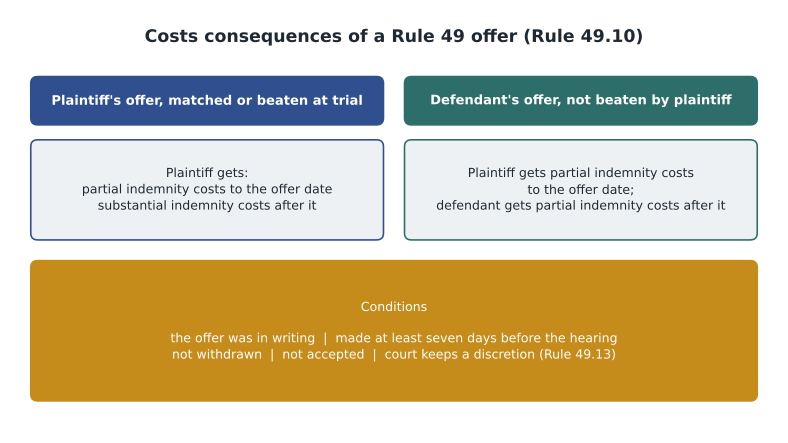
The burden of proving that the judgment is as favourable as or more favourable than the offer lies on the party who claims the benefit of Rule 49.10. Comparing an offer with a judgment can be complicated where the offer includes non-monetary terms or where interest and costs must be accounted for. Under Rule 49.13, the court has a residual discretion: even where Rule 49.10 does not strictly apply, the court may take into account any written offer, the date it was made and its terms in exercising its discretion as to costs, and it may depart from Rule 49.10 where justice requires. Offers to contribute, under Rule 49.12, allow defendants to offer to contribute to a settlement among themselves.
Substantial indemnity costs are defined in Rule 1.03 as 1.5 times the partial indemnity rate. Partial indemnity costs usually cover only a portion of a party's actual legal fees, often well under the full amount billed. The difference between partial and substantial indemnity can be tens of thousands of dollars in a contested trial, which is why lawyers serve Rule 49 offers early and update them as the case develops. A sensible offer that the other side refuses can change the economics of the whole case.
Applying Rule 49 to Lakeshore
Renaud puts numbers on the board. Suppose that a year before trial, Lakeshore serves an offer to settle for 300,000 dollars plus costs. Northwood refuses. At trial Lakeshore recovers 320,000 dollars. Lakeshore beat its own offer, so under Rule 49.10(1) it presumptively receives partial indemnity costs to the date of the offer and substantial indemnity costs after it. Now suppose instead that Northwood had served an offer to pay 250,000 dollars plus costs, and Lakeshore recovered only 230,000 dollars at trial. Lakeshore failed to beat Northwood's offer, so under Rule 49.10(2) Lakeshore receives partial indemnity costs only to the date of Northwood's offer, and Northwood receives its partial indemnity costs from that date to the end of trial. Those costs are set off against the judgment, and in a long trial Lakeshore's net recovery could shrink dramatically.
Settlement privilege and partial settlements
Settlement discussions are protected by settlement privilege, which encourages candour: a party's willingness to accept less does not become an admission that its claim is weak. The privilege covers communications made with the intention that they remain confidential if the negotiations fail, in a litigious context, for the purpose of attempting to settle. Rule 49 offers are a statutory exception for costs purposes: under Rule 49.06, an offer is not filed with the court and may not be communicated to the trial judge until all questions of liability and relief have been decided, except for the purpose of a motion or a pre-trial conference.
Multi-party litigation often settles in stages. A plaintiff may settle with one defendant and continue against others. Agreements of this kind, often called Pierringer agreements after an American case, typically require the settling defendant to drop its crossclaims, and the plaintiff to limit its claim against the remaining defendants to their several share of the liability. In Sable Offshore Energy Inc. v. Ameron International Corp., 2013 SCC 37, discussed in lesson 7, the Supreme Court held that the remaining defendants must be told of such agreements and their non-financial terms, but that the settlement amounts remain privileged, at least until the trial judge must account for them in calculating damages.
Settlement formalities
A settlement is a contract, so the principles students learned in Contracts apply: offer, acceptance, consideration and certainty. Lawyers usually record settlements in minutes of settlement and a full and final release, and the action is ended by a consent dismissal order or a notice of discontinuance. Settlements involving parties under disability require court approval under Rule 7.08, and class action settlements require approval under the Class Proceedings Act, 1992. A lawyer who has authority to negotiate does not necessarily have authority to settle, and a lawyer must have the client's instructions before accepting any offer.
What the review would change
The Civil Rules Review's Final Policy Report proposes directions conferences early in each case, fixed timelines, stronger costs presumptions and pre-litigation protocols that require parties to exchange information and consider settlement before suing. It would keep and strengthen incentives to settle while reducing the cost of getting to a fair settlement. Until any such reforms take effect, Rules 24.1, 49, 50 and 77 remain the framework.
Worked problem
Two offers, one judgment
Eighteen months before trial, Northwood serves a Rule 49 offer to pay Lakeshore 260,000 dollars plus costs. Six months later, Lakeshore serves its own offer to accept 310,000 dollars plus costs. Neither is accepted or withdrawn. At trial, Lakeshore recovers 275,000 dollars. What costs consequences follow?
Show solution
- Compare Lakeshore's offer: Lakeshore recovered 275,000 dollars, less than its own offer of 310,000, so Rule 49.10(1) does not give Lakeshore substantial indemnity costs.
- Compare Northwood's offer: Lakeshore recovered more than Northwood's offer of 260,000, so Rule 49.10(2) does not apply either.
- The default rule applies: costs follow the event, and Lakeshore, as the successful party, presumptively receives partial indemnity costs throughout, subject to the court's discretion under section 131 and Rule 57.01.
- Under Rule 49.13, the court may still consider both offers; Northwood's reasonable early offer and Lakeshore's reasonable later offer may affect the amount awarded.
Common mistakes
MistakeServing an offer by email the morning trial starts.
InsteadA Rule 49.10 offer must be made at least seven days before the hearing and remain open until it starts.
MistakeTelling the trial judge about a rejected offer during the trial.
InsteadRule 49.06 forbids communicating offers to the trial judge until liability and relief are decided.
MistakeAssuming mandatory mediation applies everywhere in Ontario.
InsteadRule 24.1 applies in Toronto, Ottawa and Essex County; elsewhere mediation is voluntary or court-ordered.
MistakeAccepting an offer the client has not approved.
InsteadA lawyer needs the client's instructions to settle.
Practice problems
Work each problem on paper first, then reveal the answer to check.
What does Rule 49.10(1) give a plaintiff who beats its own offer?
Show answer
Partial indemnity costs to the date of the offer and substantial indemnity costs from that date, unless the court orders otherwise.
What does Rule 49.10(2) give a defendant whose offer the plaintiff fails to beat?
Show answer
The plaintiff gets partial indemnity costs to the offer date, and the defendant gets partial indemnity costs from that date.
How are substantial indemnity costs defined?
Show answer
As 1.5 times partial indemnity costs (Rule 1.03).
Where does mandatory mediation under Rule 24.1 apply?
Show answer
In Toronto, Ottawa and the County of Essex, generally within 180 days after the first defence is filed.
Can the pre-trial judge preside at the trial?
Show answer
Not unless the parties consent (Rule 50.10).
Summary and key terms
- Very few civil actions end in a trial; the rules shape when and how cases settle.
- Rule 77 case management, regional practice directions and Rule 50 pre-trial conferences give judges an active role.
- Rule 24.1 requires mediation in Toronto, Ottawa and Essex County, usually within 180 days of the first defence.
- Rule 49 offers shift costs: beating your own offer brings substantial indemnity costs; failing to beat a defendant's offer shifts costs to the defendant.
- Settlement privilege protects negotiations, and Sable Offshore governs partial settlements.
- Settlements are contracts, recorded in minutes and releases, and some require court approval.
- Case management
- Active judicial supervision of a proceeding's timetable and steps.
- Pre-trial conference
- A meeting before a judge before trial to narrow issues and explore settlement.
- Mediation
- Negotiation assisted by a neutral third party who does not decide the dispute.
- Offer to settle
- A written offer under Rule 49 that carries costs consequences if not accepted.
- Substantial indemnity costs
- Costs at 1.5 times the partial indemnity rate.
- Pierringer agreement
- A partial settlement in which a settling defendant leaves the action and the plaintiff limits its claim against the others.
Lesson quiz · 5 questions
Score 60% or more to complete this lesson.
Create a free account to save your progress, take quizzes and earn a certificate.