
LAWC-201 · Lesson 5 of 12 · 22 min
Pleadings
▶ Video coming soon A video version of this lesson is on the way.
Professor Renaud hands out two versions of the first page of Lakeshore's statement of claim. The first reads like a story told by an angry client: Northwood's sales manager is a liar, the company knew its kiln was broken, Lakeshore has suffered a catastrophe, and paragraph after paragraph quotes emails in full. The second is spare. It names the parties, states what was agreed, what was delivered, what went wrong and what Lakeshore lost, and then says what Lakeshore claims. 'One of these will draw a motion to strike,' he says. 'The other will draw a defence. Your job is to write the second one.'
Pleadings are the documents in which the parties state their positions: the statement of claim, the statement of defence, the reply, and the pleadings in counterclaims, crossclaims and third party claims. They define the issues for discovery, for motions and for trial. Evidence that does not relate to an issue raised in the pleadings is generally irrelevant, and relief that is not pleaded will generally not be granted. Pleadings are where a case's boundaries are drawn.
The basic rule: material facts
Rule 25.06(1) states the basic rule. Every pleading shall contain a concise statement of the material facts on which the party relies for the claim or defence, but not the evidence by which those facts are to be proved. Three things follow. The pleading must state facts, not just conclusions: a claim that 'the defendant was negligent' without the facts said to constitute negligence pleads nothing. The facts must be material, meaning facts that are necessary to establish the cause of action or defence. And the pleading must not set out the evidence: the emails, the witnesses and the test results that prove the facts belong in discovery and at trial, not in the pleading.
Under Rule 25.06(2), a party may raise any point of law in a pleading, but conclusions of law may be pleaded only if the material facts supporting them are also pleaded. A pleading may say that a contract was breached, but only after setting out the contract's terms and the facts of the breach. Rule 25.06(3) permits pleading a condition precedent, such as notice, without stating that it was performed, because performance is implied unless the other side specifically denies it. Rule 25.06(4) allows inconsistent pleading: a plaintiff may plead alternative and even inconsistent claims, such as breach of contract and, in the alternative, negligent misrepresentation, as long as each is supported by facts.
Certain allegations require more. Rule 25.06(8) provides that where fraud, misrepresentation, breach of trust, malice or intent is alleged, the pleading shall contain full particulars. A plaintiff cannot simply say that the defendant misrepresented the quality of its goods; it must say who made the representation, to whom, when, in what words or substance, and why it was false. This requirement protects defendants from serious allegations made without a factual foundation, and lawyers have a professional obligation not to plead fraud without a reasonable basis. Rule 25.06(9) requires a statement of claim to specify the relief claimed, including the amount of any money claimed, and Rule 25.06(7) allows the effect of a document or the purport of a conversation to be pleaded briefly, without the precise words unless the words themselves are material.
Drafting Lakeshore's statement of claim
Renaud works through the structure of the claim. The opening paragraph lists the relief: damages for breach of contract and negligent misrepresentation in a stated amount, damages for breach of the duty of honest performance, restitution of the price increase paid under protest, prejudgment and postjudgment interest under the Courts of Justice Act, and costs. Then come the parties: Lakeshore, an Ontario corporation that manufactures solid wood furniture in Corwin; Northwood, an Ontario corporation that operates a sawmill near Sudbury. The facts follow in short, numbered paragraphs in chronological order.
A good paragraph reads like this: 'On or about January 12, Northwood, by its sales manager, delivered a written quotation to Lakeshore for 30,000 board feet of select grade white oak, kiln-dried to 6 to 8 percent moisture, at 4.10 dollars per board foot, for delivery in three equal loads in April, May and June.' It states who, what and when without quoting the whole document. A paragraph about the misrepresentation must meet Rule 25.06(8): 'In a telephone call on or about January 15, Northwood's sales manager told Lakeshore's operations manager that Northwood's oak was the most stable on the market and that Northwood had never received a warping complaint. The statement was false. Northwood had received at least three warping complaints in the preceding year, which were known to the sales manager.' The claim then pleads breach, causation and loss, with the losses itemized but not proved.
Renaud warns against the common faults of the first draft. Pleading evidence: quoting a long email chain instead of stating what was agreed. Pleading argument: explaining why Northwood's limitation clause should not apply because of Tercon, which belongs in a factum, not a pleading. Pleading irrelevant colour: describing the sales manager's personal finances. And pleading conclusions without facts: alleging bad faith without saying what Northwood did. Each fault invites a motion and wastes money.
The statement of defence
Rule 25.07 governs the defence. A defendant shall admit every allegation of fact in the opposing party's pleading that it does not dispute; allegations of fact that are not denied are deemed to be admitted, unless the party pleads that it has no knowledge of them. Where a defendant intends to prove a version of the facts different from that pleaded by the opposing party, a denial is not enough; it shall plead its own version of the facts. A defendant must also plead any matter on which it intends to rely to defeat the claim that, if not specifically pleaded, might take the opposing party by surprise, such as a limitation period, a release, a contractual limitation of liability or an allegation of contributory negligence.
Northwood's defence might admit the contract and the deliveries, deny that the second load was defective, plead in the alternative that any defect was caused by Lakeshore's storage or finishing process, plead that its standard terms limited its liability to the price of the affected load and excluded lost profits, plead that the price increase was a valid variation, and plead that Lakeshore failed to mitigate. Each defence needs supporting facts. A defence that simply denies everything, including facts the defendant knows to be true, exposes the defendant to costs consequences and undermines its credibility.
The reply and the close of pleadings
Under Rule 25.08, a plaintiff delivers a reply only to respond to a matter in the defence that has not been dealt with in the statement of claim, for example to plead a version of facts that answers a new allegation in the defence. A reply is not used merely to deny the defence, because everything in the defence is deemed to be denied if not admitted in a reply. Lakeshore might reply to plead that Northwood's standard terms were never sent to it and so were never part of the contract.
Pleadings close when the plaintiff has delivered a reply to every defence, or the time for doing so has expired, and every defendant who is not in default has delivered a defence. The close of pleadings is a procedural milestone: it starts the time for a discovery plan, ends the time for a jury notice and, in many cases, triggers the timelines that the Civil Rules Review would make far stricter.
Particulars
A party who needs more detail to understand the case it must meet may demand particulars under Rule 25.10. If they are not provided, the court may order particulars where they are not within the knowledge of the party demanding them and are necessary to enable that party to plead. The test is necessity for pleading, not curiosity or a desire for early discovery. A defendant faced with a vague allegation that its lumber was 'defective' may need to know which loads and in what respect before it can plead; it does not need, at the pleadings stage, to know which expert will say so.
Striking out pleadings
Rule 25.11 allows the court to strike out or expunge all or part of a pleading, with or without leave to amend, on the ground that it may prejudice or delay the fair trial of the action, is scandalous, frivolous or vexatious, or is an abuse of the process of the court. Scandalous allegations are those that are irrelevant and included only to embarrass or prejudice, such as allegations about a party's personal life in a commercial dispute. Pleadings are also attacked under Rule 21.01(1)(b), on the ground that they disclose no reasonable cause of action or defence, which lesson 8 covers with the leading case, R. v. Imperial Tobacco Canada Ltd., 2011 SCC 42. When a pleading is struck for a drafting defect, leave to amend is usually granted unless it is clear that no amendment could cure it.
Amending pleadings
Rule 26.01 provides that on a motion at any stage of an action, the court shall grant leave to amend a pleading on such terms as are just, unless prejudice would result that could not be compensated for by costs or an adjournment. The word shall makes amendment presumptive. Courts deny amendments mainly where the amendment would cause non-compensable prejudice, such as when evidence has been lost because of the delay or when the amendment would effectively add a claim barred by a limitation period, or where the proposed amendment itself discloses no reasonable cause of action. Under Rule 26.02, a party may amend without leave before the close of pleadings if the amendment does not add, delete or substitute a party, or on filing the consent of all parties.
The limitation point is subtle. An amendment that pleads new facts in support of the same claim is usually allowed. An amendment that asserts a new cause of action based on a different factual matrix after the limitation period has expired will usually be refused, because it would deprive the defendant of an accrued limitation defence. Courts ask whether the original pleading contained all the facts necessary to support the new claim; if it did, the amendment merely puts a new legal label on the same facts and is permitted.
Counterclaims, crossclaims and third party claims
The Rules allow related claims to be heard together. Under Rule 27, a defendant may counterclaim against the plaintiff, or against the plaintiff and another person, in a pleading titled a statement of defence and counterclaim. Northwood, which says Lakeshore still owes part of the price for the third load, could counterclaim for the balance. Under Rule 28, a defendant may crossclaim against a co-defendant, for example for contribution or indemnity, or for an independent claim arising out of the same transaction. Under Rule 29, a defendant may issue a third party claim against a person who is not a party, alleging that the third party is liable to the defendant for all or part of the plaintiff's claim, or for an independent claim arising from the same transaction. Northwood's claim against Thermaline Controls would be a third party claim. A third party may in turn bring a fourth party claim, and so on.
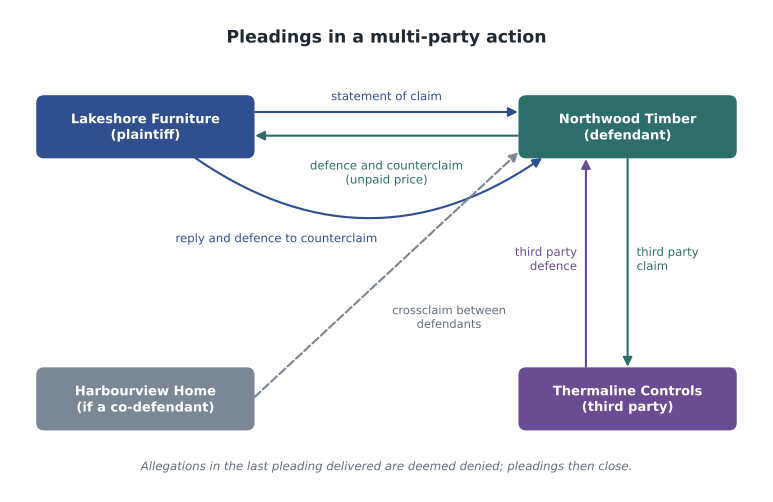
These devices promote efficiency and consistent results: the court decides all the related claims together, on the same evidence. But they also make litigation larger. Rule 5.05 and Rule 29.09 allow the court to order separate trials where joining claims would unduly complicate or delay the trial or cause undue prejudice.
What the review would change
The Civil Rules Review's anticipated early amendments include consolidated pleading rules and streamlined originating processes, and the Final Policy Report proposes that pleadings be accompanied or followed quickly by the key documents and evidence on which a party relies, an idea borrowed from systems where pleadings and evidence are exchanged up front. Under the current rules, pleadings remain a statement of facts, and evidence comes later.
Worked problem
Editing a weak paragraph
A first-year associate drafts this paragraph for Lakeshore's claim: "Northwood's salesman, Glen Ashby, a notoriously dishonest person, fraudulently lied about his product, as shown by his email of January 12 (attached), and Northwood is therefore liable under Tercon and Bhasin for all losses, which are enormous." Identify the problems and redraft.
Show solution
- Scandalous material: calling Ashby notoriously dishonest is irrelevant colour and could be struck under Rule 25.11.
- Evidence: attaching and relying on the email pleads evidence; state the representation instead.
- Particulars: a misrepresentation or fraud allegation requires full particulars under Rule 25.06(8): who, to whom, when, what was said and why it was false.
- Law and argument: citing Tercon and Bhasin is argument for a factum; plead the facts supporting each cause of action.
- Relief: "enormous" losses must be replaced by itemized losses and an amount in the prayer for relief (Rule 25.06(9)).
- Redraft: "On or about January 15, in a telephone call, Northwood's sales manager told Lakeshore's operations manager that Northwood's oak was the most stable on the market and that Northwood had never received a warping complaint. These statements were false; Northwood had received at least three warping complaints in the preceding year, as the sales manager knew."
Common mistakes
MistakePleading evidence by quoting documents and naming witnesses.
InsteadRule 25.06(1) requires material facts, not the evidence by which they will be proved.
MistakeAlleging fraud or misrepresentation in general terms.
InsteadRule 25.06(8) requires full particulars.
MistakeDenying everything in a defence, including facts known to be true.
InsteadRule 25.07 requires admitting undisputed facts and pleading your own version where it differs.
MistakeAssuming an amendment can add any new claim at any time.
InsteadAmendments are presumptive under Rule 26.01, but a new claim on new facts after the limitation period will usually be refused.
Practice problems
Work each problem on paper first, then reveal the answer to check.
What does Rule 25.06(1) require of a pleading?
Show answer
A concise statement of the material facts relied on, but not the evidence by which they are to be proved.
When must full particulars be pleaded?
Show answer
Where fraud, misrepresentation, breach of trust, malice or intent is alleged (Rule 25.06(8)).
When is a reply delivered?
Show answer
Only to respond to a matter raised in the defence that is not dealt with in the claim, not merely to deny the defence.
What is the test for leave to amend under Rule 26.01?
Show answer
Leave shall be granted unless prejudice would result that cannot be compensated by costs or an adjournment.
What is a third party claim?
Show answer
A defendant's claim against a non-party who is allegedly liable to the defendant for all or part of the plaintiff's claim, or on a related independent claim (Rule 29).
Summary and key terms
- Pleadings define the issues for discovery, motions and trial.
- Rule 25.06 requires concise material facts, not evidence; conclusions of law need supporting facts; fraud and misrepresentation need full particulars.
- A defence must admit undisputed facts, plead its own version and plead matters that would otherwise surprise.
- A reply responds only to new matters; pleadings close when all defences and replies are in or their time has expired.
- Pleadings can be struck under Rule 25.11 or Rule 21, usually with leave to amend; amendments are presumptive under Rule 26.01.
- Counterclaims, crossclaims and third party claims let related claims be heard together.
- Material facts
- The facts necessary to establish each element of a cause of action or defence.
- Particulars
- Further details of an allegation, required for fraud and similar claims or ordered on demand.
- Close of pleadings
- The point at which all defences and replies have been delivered or the time for them has expired.
- Counterclaim
- A claim by a defendant against the plaintiff in the same action.
- Crossclaim
- A claim by one defendant against a co-defendant.
- Third party claim
- A defendant's claim against a person not yet a party who may be liable to the defendant for the plaintiff's claim.
Lesson quiz · 5 questions
Score 60% or more to complete this lesson.
Create a free account to save your progress, take quizzes and earn a certificate.