
LAWC-201 · Lesson 1 of 12 · 23 min
Courts and jurisdiction
▶ Video coming soon A video version of this lesson is on the way.
Professor Tobias Renaud starts the first class of Civil Procedure by holding up a single sheet of paper. It is a statement of claim, he says, the document that starts most lawsuits in Ontario, and almost everything a litigator does for the next three or four years will flow from what is written on it and where it is filed. Renaud practised civil litigation in Corwin for eighteen years and sat for six of them as a deputy judge of the Small Claims Court. He tells the 2L class in the Lister Room that procedure is where rights go to live or die. 'You learned in first year what a duty of care is and when a contract is breached. This course is about how a client actually gets a remedy, and how a client loses a perfectly good claim by missing a deadline or filing in the wrong place.'
He writes a client on the board who will follow the class all term. Lakeshore Furniture Co., the Corwin furniture maker the class met in Contracts, bought white oak from Northwood Timber Ltd., a sawmill near Sudbury. The second load warped, Lakeshore recalled 140 dining tables from its biggest retail customer, and it lost the customer's orders for the year. In first year the question was whether Lakeshore had a claim. Now the questions are practical: which court, which procedure, how fast, against whom, at what cost and with what risk. All of the facts are fictional; the courts, statutes and rules are real.
The sources of civil procedure
Civil procedure in Ontario comes from three main sources. The first is the Courts of Justice Act, R.S.O. 1990, c. C.43, which creates the courts, sets their jurisdiction, provides for juries, interest and costs, and authorizes the rules. The second is the Rules of Civil Procedure, R.R.O. 1990, Reg. 194, a regulation made by the Civil Rules Committee and approved by the Attorney General. The Rules run to more than seventy numbered rules, each divided into rules and subrules, and they govern almost everything from how a claim is issued to how a judgment is enforced. The third source is the courts' own practice directions, the case law interpreting the Rules, and the inherent jurisdiction of the Superior Court to control its own process.
Rule 1.04(1) states the guiding principle: the Rules are to be liberally construed to secure the just, most expeditious and least expensive determination of every civil proceeding on its merits. Rule 1.04(1.1) adds proportionality: the court is to make orders and give directions that are proportionate to the importance and complexity of the issues and to the amount involved. Rule 2.01 adds a principle of forgiveness: a failure to comply with the Rules is an irregularity and does not render a proceeding a nullity, and the court may grant relief to secure the just determination of the real matters in dispute. Renaud tells the class to read these three rules before any other. 'When you cannot find the answer in the specific rule, these are the rules the judge will reach for.'
Other courts have their own rules. The Small Claims Court has the Rules of the Small Claims Court, O. Reg. 258/98. Family cases have the Family Law Rules. The Federal Court has the Federal Courts Rules. This course focuses on the Rules of Civil Procedure in the Superior Court of Justice, which is where most civil litigation in Ontario happens.
Ontario's civil courts
The Superior Court of Justice is Ontario's superior court of general jurisdiction. Its judges are appointed by the federal government under section 96 of the Constitution Act, 1867, and it has inherent jurisdiction to hear any civil matter unless a statute validly gives that matter exclusively to another court or tribunal. It sits in every region of the province. Associate judges, who were called masters until 2021, hear many procedural motions in Toronto, Ottawa and some other centres.
Two important branches sit inside the Superior Court. The Small Claims Court hears claims for money or the return of personal property up to a monetary limit, which rose from 35,000 dollars to 50,000 dollars on October 1, 2025. Many of its cases are heard by deputy judges, who are lawyers appointed for terms, and its rules are simpler, with no examinations for discovery and limited costs. The Divisional Court is the branch that hears judicial review of most provincial administrative decisions and certain appeals, including appeals from final orders of the Superior Court for 50,000 dollars or less and, with leave, appeals from interlocutory orders. A third branch, the Family Court, hears family matters in many parts of the province.
The Court of Appeal for Ontario hears appeals from final orders of the Superior Court that do not go to the Divisional Court, and appeals from the Divisional Court with leave. Above it is the Supreme Court of Canada, which hears civil appeals only with leave, granted when the case raises a question of public importance. The Ontario Court of Justice, which students visited in Criminal Law, is a provincial court; it hears criminal and some family matters but has no general civil jurisdiction.
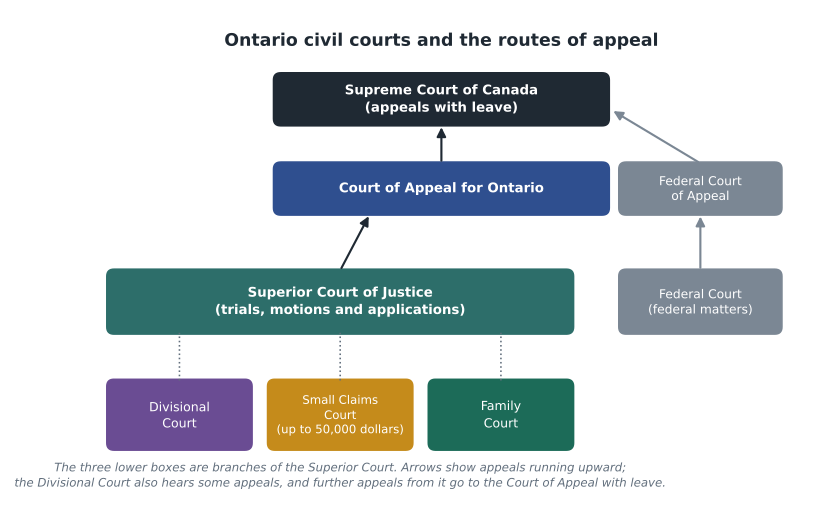
Beside the provincial system sits the Federal Court, created by Parliament under section 101 of the Constitution Act, 1867. It has only the jurisdiction federal statutes give it: claims against the federal Crown (which it shares concurrently with provincial superior courts in most cases), intellectual property, admiralty, judicial review of federal boards and tribunals, and immigration. Because its jurisdiction is statutory, a litigator must always check that the Federal Court can hear a claim before filing there. Lakeshore's claim against a private sawmill for warped lumber is a provincial matter of contract and property; it belongs in the Superior Court or the Small Claims Court.
Three routes for a money claim
For a claim for money, Ontario offers three routes, chosen mainly by the amount claimed. The first is the Small Claims Court, for claims up to 50,000 dollars. The second is the simplified procedure in Rule 76 of the Rules of Civil Procedure, which is mandatory for most actions claiming 200,000 dollars or less in money, property or both, excluding interest and costs. The third is the ordinary procedure for everything else, including claims for more than 200,000 dollars and claims for non-monetary relief such as an injunction or a declaration.
The simplified procedure was reformed on January 1, 2020. Its limit was raised from 100,000 dollars to 200,000 dollars, juries were removed from simplified procedure actions, oral discovery was limited to three hours per party, and trials were capped at five days, with much of the evidence in chief given by affidavit. Costs and disbursements a party may recover are capped. The aim is to make mid-sized claims affordable; the price is less discovery and no jury. A plaintiff who claims more than 200,000 dollars to escape Rule 76 takes a risk: if it recovers 200,000 dollars or less, the court may refuse costs or order costs against it under Rule 76.13.
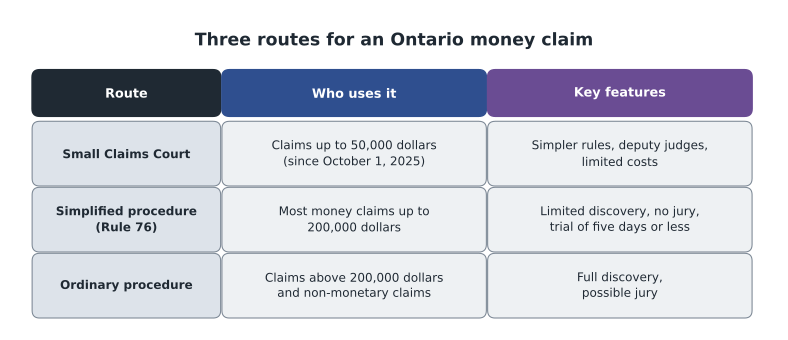
Renaud asks the class where Lakeshore's claim belongs. Theo Marchetti, who spent ten years as a litigation law clerk in Hamilton, answers first. 'Lost profit of 220,000 dollars, the recall at 38,000, the oak itself and the price difference. Easily over 200,000. Ordinary procedure.' Renaud agrees, then adds a caution: a plaintiff chooses the route based on what it claims in good faith, not on what it hopes to win, and inflated claims can be punished in costs.
Where to file: venue
Ontario is divided into counties, districts and regional municipalities, and the Superior Court has offices in each. Rule 13.1 governs which court office a proceeding is started in and when it can be moved. Until 2026, a plaintiff could generally start an action in any county it chose and name the place of trial, subject to a defendant's motion to transfer. Ontario Regulation 2/26 changed that. For proceedings commenced on or after February 1, 2026, Rule 13.1.01(2) requires that, unless a statute or rule names a particular county, the proceeding be commenced at a court office in a county with which there is a rational connection, and that county must be named in the originating process.
The rational connection is assessed using the factors in Rule 13.1.02(2)(b), which courts have long used on motions to transfer: where a substantial part of the events or omissions giving rise to the claim occurred, where a substantial part of the damages were sustained, where the subject matter is or was located, any local community's interest in the subject matter, the convenience of the parties, witnesses and the court, whether there are counterclaims, crossclaims or third party claims, any advantages or disadvantages of a place for a just, expeditious and least expensive determination on the merits, whether judges and court facilities are available in the other county, and any other relevant matter. Courts weigh these factors together rather than counting them, and Ontario judges have said repeatedly that forum shopping between counties is not appropriate.
The same regulation widened the court's power to move cases. Since January 6, 2026, any judge or associate judge may transfer a proceeding from their court location to any other location in Ontario on their own initiative, after a case conference. Previously only a regional senior judge could do so, and only within the region. Lakeshore could rationally connect its claim to Corwin, where the tables were built, finished and recalled and where the losses were felt; Northwood could point to the Sudbury district, where the oak was dried and shipped and where its witnesses work. A court would probably accept either, which is why the choice matters less than it would if Lakeshore had chosen Toronto for no reason except its lawyers' convenience.
Jurisdiction in three senses
The word jurisdiction is used in three different senses in civil procedure, and students often run them together. The first is subject-matter jurisdiction: whether this kind of court can hear this kind of claim at all. A Small Claims Court cannot award 60,000 dollars, and the Federal Court cannot hear a contract claim between two private sawmills. The second is territorial jurisdiction over the parties and the dispute: whether an Ontario court can hear a claim against a defendant in Michigan or Quebec, which is the subject of lesson 2. The third is the internal question of which court office within Ontario should hear it, the venue question just discussed.
There is a further distinction between a court having jurisdiction and choosing to exercise it. A court with territorial jurisdiction may still decline it under the doctrine of forum non conveniens if another forum is clearly more appropriate, and it may stay a proceeding that duplicates one elsewhere. Statutes may also send a dispute to an administrative tribunal or to arbitration. Under the Arbitration Act, 1991, a court must generally stay a court action brought in breach of an arbitration agreement; the Supreme Court considered the limits of that rule for standard form contracts in Uber Technologies Inc. v. Heller, 2020 SCC 16, which the class read in Contracts.
The Civil Rules Review
Renaud ends the first class with a warning: the Rules students are learning are being rewritten. In early 2024 the Chief Justice of the Superior Court and the Attorney General launched the Civil Rules Review, a working group of judges, lawyers and officials asked to propose a new set of rules. Its Phase 1 report in May 2024 described the problems: delay, cost and the gap between the Rules' promise of a just, expeditious and inexpensive determination and the reality of litigation that takes years. A Phase 2 consultation followed, and the working group released its Final Policy Report on December 15, 2025.
The Final Policy Report recommends a fundamentally different system: three tracks (an application track, a summary track for most claims between 50,000 and 500,000 dollars, and a trial track for the rest), pre-litigation protocols, early exchange of evidence in place of most traditional discovery, oral examinations capped at 90 minutes per party on the trial track, fixed timelines leading most two-party cases to a dispositive hearing within about two years of the close of pleadings, directions conferences to screen most motions, and stronger costs consequences. None of that is law yet.
On May 28, 2026, the Attorney General and the former Chief Justice of the Superior Court announced that the reforms would proceed in stages, beginning with targeted practical amendments before the larger structural changes. Some targeted amendments had already arrived: the venue and transfer changes and new appeal motion forms took effect in early 2026, and Ontario Regulation 275/26 made further changes on September 1, 2026, including certification that quotations in factums and expert reports are accurate and streamlined procedures in the Court of Appeal and Divisional Court. As of November 2026, the Rules of Civil Procedure in R.R.O. 1990, Reg. 194 remain the governing rules. This course teaches those rules and flags, in each lesson, what the review would change. 'Learn the current rules well,' Renaud says, 'because you will practise under them, and because you cannot understand a reform until you understand what it is reforming.'
Worked problem
Choosing the court and route for three claims
Three clients come to a Corwin firm in the same week. (a) A homeowner wants 42,000 dollars back from a contractor who abandoned a renovation. (b) A business wants 160,000 dollars for unpaid invoices and will need a few witnesses. (c) A franchisee wants an injunction stopping a franchisor from terminating its franchise, plus 900,000 dollars in damages. Where should each claim go?
Show solution
- Claim (a) is a money claim within the Small Claims Court's 50,000 dollar limit, which has applied since October 1, 2025. Small Claims Court is the natural choice: lower filing fees, no examinations for discovery and simpler rules. The client could sue in the Superior Court but would probably face Rule 76 and a costs risk.
- Claim (b) exceeds the Small Claims limit but is under 200,000 dollars, so Rule 76 (simplified procedure) is mandatory unless an exception applies. There will be no jury, oral discovery is limited to three hours per party, and the trial will be short.
- Claim (c) seeks an injunction and a large sum, so it proceeds under the ordinary procedure in the Superior Court. Because an injunction is equitable relief, the case will be tried without a jury.
- For each, the originating process must name a county with a rational connection to the claim under Rule 13.1.01(2), such as where the renovation, the unpaid work or the franchise is located.
Common mistakes
MistakeThinking the Divisional Court is a separate, lower court.
InsteadThe Divisional Court is a branch of the Superior Court of Justice; it hears judicial review and certain appeals, including appeals from final orders of 50,000 dollars or less.
MistakeCiting the Small Claims Court limit as 35,000 dollars.
InsteadThe limit rose to 50,000 dollars on October 1, 2025.
MistakeFiling in any county you like because the defendant can always move to transfer.
InsteadSince February 1, 2026, Rule 13.1.01(2) requires a county with a rational connection to the proceeding, named in the originating process.
MistakeTreating the Civil Rules Review's recommendations as the current law.
InsteadThe Final Policy Report (December 15, 2025) is a proposal; reforms are proceeding in stages, and Reg. 194 still governs.
Practice problems
Work each problem on paper first, then reveal the answer to check.
What principle does Rule 1.04(1) state?
Show answer
The Rules are to be liberally construed to secure the just, most expeditious and least expensive determination of every civil proceeding on its merits.
Which procedure applies to most claims for 200,000 dollars or less in the Superior Court?
Show answer
The simplified procedure in Rule 76, which is mandatory for most such claims and has no jury.
What did Ontario Regulation 2/26 change about venue?
Show answer
It requires proceedings commenced on or after February 1, 2026 to be started in a county with a rational connection to the claim, and lets any judge or associate judge transfer a proceeding on their own initiative.
What are the three senses of jurisdiction discussed in this lesson?
Show answer
Subject-matter jurisdiction, territorial jurisdiction over parties and disputes, and venue within the province.
When did the Civil Rules Review release its Final Policy Report?
Show answer
December 15, 2025; implementation is proceeding in stages.
Summary and key terms
- Ontario civil procedure comes from the Courts of Justice Act, the Rules of Civil Procedure (Reg. 194) and the case law and practice directions.
- The Superior Court of Justice is the court of general jurisdiction; the Small Claims Court and the Divisional Court are branches of it.
- Money claims go to Small Claims Court (up to 50,000 dollars since October 1, 2025), the simplified procedure (up to 200,000 dollars) or the ordinary procedure.
- Since February 1, 2026, proceedings must be commenced in a county with a rational connection to the claim.
- Rules 1.04 and 2.01 express the goals of a just, expeditious and inexpensive determination, proportionality and relief from irregularities.
- The Civil Rules Review has recommended a new system, but reforms are proceeding in stages and Reg. 194 still governs.
- Superior Court of Justice
- Ontario's superior court of general jurisdiction, with inherent jurisdiction over civil matters.
- Divisional Court
- A branch of the Superior Court that hears judicial review and certain appeals.
- Simplified procedure
- The streamlined procedure in Rule 76 for most claims of 200,000 dollars or less.
- Venue
- The court location within Ontario where a proceeding is started and heard.
- Rational connection
- The link between a county and a proceeding that Rule 13.1.01(2) requires for the place of commencement.
- Associate judge
- A judicial officer of the Superior Court who hears procedural motions; formerly called a master.
Lesson quiz · 5 questions
Score 60% or more to complete this lesson.
Create a free account to save your progress, take quizzes and earn a certificate.