
LAWC-201 · Lesson 11 of 12 · 22 min
Trial and appeal
▶ Video coming soon A video version of this lesson is on the way.
Professor Renaud tells the class that most of them will practise for years before they try a civil case to judgment, and that many civil litigators try only a handful in their careers. That makes trials more important, not less: the possibility of trial, and the predicted result, shapes every settlement. And when a case does go to trial, the rules of procedure, evidence and appeal decide not only who wins but whether the result will survive.
Getting to trial
An action reaches the trial list when a party sets it down for trial under Rule 48 by serving and filing a trial record, which contains the pleadings, any demand for particulars and particulars, any order respecting the trial, and a certificate that the party is ready for trial. Once an action is set down, a party may not initiate further motions or discovery without leave, except in limited circumstances, because the case is supposed to be ready. In many regions, the parties then attend a trial scheduling court or assignment court to fix a date, and in busy regions the wait for a civil trial can be long. A pre-trial conference under Rule 50, discussed in lesson 9, follows, and trial management orders may limit witnesses, require affidavit evidence in chief or set time limits.
Judge or jury
In Ontario, a civil action is tried by a judge alone unless a party delivers a jury notice. Section 108 of the Courts of Justice Act gives a party the right to a jury in most actions, but section 108(2) excludes claims for certain relief, including injunctions, declaratory relief, specific performance, partition, foreclosure, the rectification or cancellation of a written instrument, and other equitable relief, as well as claims against a municipality and certain other matters. Since 2020, actions under the simplified procedure in Rule 76 are tried without a jury. A civil jury in Ontario has six members, and a verdict requires the agreement of five of them.
The jury notice must be delivered before the close of pleadings under Rule 47.01. A party may move to strike out a jury notice under Rule 47.02, on the ground that the action is not one that may be tried by a jury or because the case is more appropriately tried by a judge alone, for example because of the complexity of the issues or the evidence. Civil juries are most common in personal injury actions arising from motor vehicle accidents, where defendants and their insurers often prefer juries. During the COVID-19 pandemic, when jury trials were suspended, many courts struck jury notices to prevent extreme delay, and in Louis v. Poitras, 2021 ONCA 49, the Court of Appeal upheld a motion judge's discretion to do so. Some reform proposals over the years have suggested abolishing or limiting civil juries; as of November 2026, they remain available under section 108.
Lakeshore v. Northwood is a claim for damages, so a jury would be available unless Lakeshore also seeks equitable relief such as rescission or specific performance. Most commercial parties prefer a judge alone in a case about moisture content, standard terms and limitation clauses, and either party could move to strike a jury notice on the ground that the issues are too technical. Renaud notes that the choice of a jury is a strategic decision for the client, made with the lawyer's advice, at the pleadings stage.
The structure of a trial
A civil trial follows a familiar sequence. The plaintiff's counsel makes an opening statement, setting out what the evidence will show. The plaintiff calls its witnesses, each examined in chief by the plaintiff's counsel and then cross-examined by the defendant's counsel, with re-examination limited to matters arising from the cross-examination. Documents and expert reports are proved through witnesses or by agreement, and admissions from the defendant's examination for discovery may be read in under Rule 31.11. When the plaintiff closes its case, the defendant may move for a non-suit, arguing that the plaintiff has led no evidence on which a properly instructed trier of fact could find in its favour; in a judge-alone trial, the defendant may have to elect whether to call evidence before the motion is decided. The defendant then presents its case in the same way, and the plaintiff may call reply evidence on matters raised for the first time in the defence case. Each side makes closing submissions, and in a jury trial the judge instructs the jury on the law in a charge.
Two evidentiary rules matter especially in civil trials. The rule in Browne v. Dunn (1893), an English case followed in Canada, requires a cross-examiner who intends to contradict a witness's evidence with other evidence to put the contradiction to the witness, giving the witness a chance to explain. And the burden of proof in civil cases is the balance of probabilities. In F.H. v. McDougall, 2008 SCC 53, the Supreme Court held that there is only one civil standard of proof, proof on a balance of probabilities, even for serious allegations such as fraud or sexual assault: the evidence must be scrutinized with care, and it must be clear, convincing and cogent enough to satisfy the balance of probabilities test, but there is no intermediate standard. Lakeshore must prove its misrepresentation claim to that standard, not to a higher one.
Judgment
At the end of a judge-alone trial, the judge gives reasons for judgment, orally or in writing, and a formal judgment is then signed and entered. Reasons must be sufficient to explain to the losing party why it lost and to permit meaningful appellate review. In F.H. v. McDougall, the Court said a trial judge's reasons need not respond to every argument, but they must show that the judge grappled with the substance of the live issues. After judgment, the parties make submissions on costs, often in writing, and the court fixes costs as lesson 10 described.
Final and interlocutory orders
Appeal routes in Ontario depend on whether the order is final or interlocutory. A final order finally disposes of the rights of the parties on a substantive issue, such as a judgment after trial, a summary judgment, or an order striking out a claim without leave to amend. An interlocutory order does not determine the real matter in dispute; it deals with a procedural or preliminary question, such as an order compelling answers to questions on discovery or refusing an adjournment. The classic test asks whether the order finally determines the real matter in dispute between the parties or any substantive right of a party. The distinction matters because the route and the need for leave differ.
Appeal routes
Under section 6(1)(b) of the Courts of Justice Act, an appeal lies to the Court of Appeal from a final order of a judge of the Superior Court, except an order from which an appeal lies to the Divisional Court. Under section 19(1)(a) and (1.2), an appeal lies to the Divisional Court from a final order of a judge of the Superior Court for a single payment of not more than 50,000 dollars, exclusive of costs, or periodic payments within set limits, or dismissing a claim for an amount within those limits. Under section 19(1)(b), an appeal lies to the Divisional Court from an interlocutory order of a judge of the Superior Court, but only with leave, which is granted under Rule 62.02(4) where there is a conflicting decision and it is desirable that leave be granted, or where there is good reason to doubt the correctness of the order and the proposed appeal involves matters of such importance that leave should be granted. Orders of associate judges are appealed to a judge of the Superior Court, or to the Divisional Court if final. Further appeals from the Divisional Court to the Court of Appeal require leave, and appeals to the Supreme Court of Canada require leave from that Court, granted when a case raises an issue of public importance.
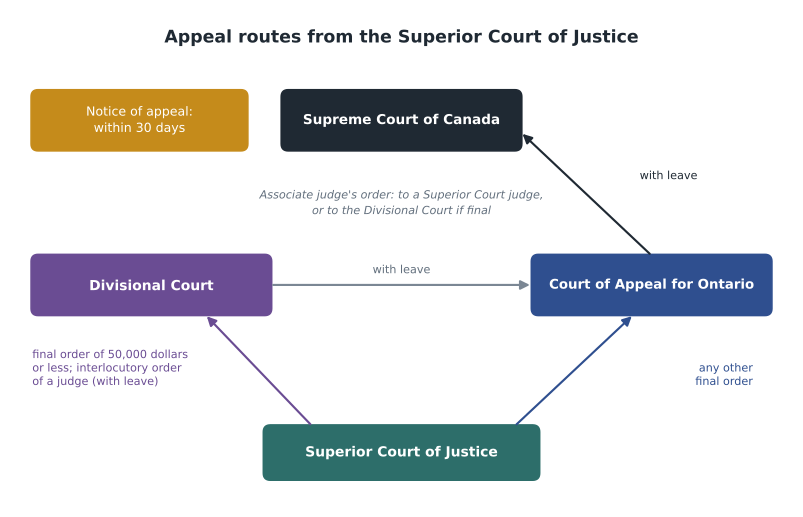
A notice of appeal must be served within 30 days after the making of the order appealed from under Rule 61.04, unless a statute provides otherwise. The appellant then perfects the appeal by filing the appeal book, the transcripts of evidence and a factum within the times set by the Rules. Under Rule 63.01, delivering a notice of appeal from an interlocutory or final order for the payment of money automatically stays the order, other than an order for support or for the payment of money in certain other cases; other orders are not stayed unless the court orders a stay. Since September 1, 2026, Ontario Regulation 275/26 has removed many hard-copy filing requirements in the Court of Appeal and Divisional Court, introduced a presumption that motions to review a single judge's order are decided in writing, and changed the times for motion materials. New appeal forms took effect on February 1, 2026.
Standards of review
An appeal is not a retrial. The appellate court reviews the trial judge's decision for error, applying standards of review set out by the Supreme Court in Housen v. Nikolaisen, 2002 SCC 33. On questions of law, the standard is correctness: the appellate court substitutes its own view if it disagrees. On findings of fact, including inferences of fact, the standard is palpable and overriding error: the appellate court intervenes only if the error is obvious and affected the outcome. On questions of mixed fact and law, applying a legal standard to the facts, the standard is also palpable and overriding error, unless the trial judge made an extricable error of law, such as applying the wrong test, which is reviewed for correctness.
Housen itself arose from a motor vehicle accident on a rural road in Saskatchewan. The trial judge found the municipality partly liable for failing to post a warning sign on a sharp curve; the Court of Appeal reversed. The Supreme Court, by a narrow majority, restored the trial judgment, holding that the trial judge's findings about what the municipality knew or ought to have known were findings of fact or mixed fact and law entitled to deference. The case stands for the principle that trial judges, who see and hear the witnesses, are best placed to find facts, and that repeated relitigation of factual issues on appeal is costly and undermines confidence in trials.
Other standards follow from these principles. The interpretation of a standard form contract is usually a question of law reviewed for correctness, while the interpretation of a negotiated contract is usually a question of mixed fact and law, as the class saw with Sattva Capital Corp. v. Creston Moly Corp., 2014 SCC 53, and Ledcor Construction Ltd. v. Northbridge Indemnity Insurance Co., 2016 SCC 37, in Contracts. Discretionary decisions, such as costs awards, are entitled to deference and will be set aside only if the judge erred in principle or the decision is plainly wrong. A jury's verdict will be set aside only if it is so plainly unreasonable and unjust that no jury reviewing the evidence as a whole and acting judicially could have reached it. Fresh evidence on appeal is admitted only in limited circumstances, under the test in Palmer v. The Queen, [1980] 1 S.C.R. 759, which requires that the evidence could not have been obtained with due diligence for trial, is relevant, is credible, and could reasonably have affected the result.
Lakeshore on appeal
Renaud asks the class to suppose the trial judge finds that Northwood's standard terms were never incorporated into the contract, awards Lakeshore 300,000 dollars, and finds the sales manager's statement was a negligent misrepresentation. Where does Northwood's appeal go, and what will it argue? The judgment is final and exceeds 50,000 dollars, so the appeal lies to the Court of Appeal as of right, with a notice of appeal due within 30 days, and the money judgment is automatically stayed while the appeal is pending. Northwood will try to frame its arguments as errors of law, for example that the judge applied the wrong test for incorporation by reference, because findings about what was said and sent will be reviewed only for palpable and overriding error. Lakeshore will argue that the judge's conclusions turned on credibility and the documents, and deserve deference. 'Appellate advocacy,' Renaud says, 'is mostly the art of turning facts into law.'
Worked problem
Finding the route and the standard
Identify the appeal route and standard of review: (a) a judge dismisses Lakeshore's claim after trial, finding the oak was not defective; (b) an associate judge orders Northwood to answer questions about its 2025 complaints; (c) a judge grants summary judgment dismissing a 40,000 dollar claim by a Lakeshore customer; (d) a judge refuses to strike a jury notice.
Show solution
- (a) A final order on a claim over 50,000 dollars: appeal to the Court of Appeal as of right within 30 days. The finding that the oak was not defective is a finding of fact, reviewed for palpable and overriding error (Housen).
- (b) An interlocutory order of an associate judge: appeal to a judge of the Superior Court. Discretionary discovery rulings receive deference.
- (c) A final order dismissing a claim of 50,000 dollars or less: appeal to the Divisional Court under section 19(1)(a). Hryniak treats summary judgment decisions as mixed fact and law, entitled to deference absent an extricable legal error.
- (d) An interlocutory order of a judge: appeal to the Divisional Court only with leave under Rule 62.02(4), which is rarely granted for jury notice rulings.
Common mistakes
MistakeAppealing every Superior Court final order to the Court of Appeal.
InsteadFinal orders for 50,000 dollars or less go to the Divisional Court under section 19.
MistakeTreating serious civil allegations as requiring proof beyond the balance of probabilities.
InsteadF.H. v. McDougall holds there is one civil standard, scrutinized with care.
MistakeAsking an appellate court to reweigh the evidence.
InsteadFindings of fact are reviewed only for palpable and overriding error (Housen).
MistakeDelivering a jury notice in a claim for an injunction.
InsteadSection 108(2) excludes claims for equitable relief from jury trial.
Practice problems
Work each problem on paper first, then reveal the answer to check.
How many jurors sit on an Ontario civil jury, and how many must agree?
Show answer
Six jurors; five must agree.
What did F.H. v. McDougall hold about the civil standard of proof?
Show answer
There is only one standard, the balance of probabilities; evidence must be clear, convincing and cogent, scrutinized with care.
Where does an appeal from a final Superior Court order for 30,000 dollars go?
Show answer
To the Divisional Court under section 19(1)(a) of the Courts of Justice Act.
What are the Housen standards of review?
Show answer
Correctness for questions of law; palpable and overriding error for findings of fact and mixed fact and law, unless an extricable legal error exists.
When must a notice of appeal be served?
Show answer
Within 30 days after the order appealed from (Rule 61.04).
Summary and key terms
- Actions are set down for trial under Rule 48, followed by a pre-trial conference and trial management.
- Juries are available under section 108 except for equitable and certain other claims and simplified procedure actions; six jurors, five must agree.
- Trials follow openings, examination and cross-examination, possible non-suit, defence evidence, reply and closings; Browne v. Dunn and the civil standard in F.H. v. McDougall apply.
- Final orders over 50,000 dollars go to the Court of Appeal; smaller final orders to the Divisional Court; interlocutory orders of judges to the Divisional Court with leave.
- Notices of appeal are due within 30 days; money judgments are stayed automatically; O. Reg. 275/26 streamlined appeal procedure from September 1, 2026.
- Housen sets correctness for law and palpable and overriding error for fact and mixed questions.
- Jury notice
- A pleading-stage notice requiring that an action be tried by a jury.
- Non-suit
- A motion at the close of the plaintiff's case that there is no evidence to support the claim.
- Final order
- An order that finally determines the real matter in dispute or a substantive right.
- Interlocutory order
- An order on a procedural or preliminary question that does not finally determine the dispute.
- Palpable and overriding error
- An obvious error that affected the outcome, the standard for reviewing findings of fact.
- Leave to appeal
- Permission from a court that is required before certain appeals can proceed.
Lesson quiz · 5 questions
Score 60% or more to complete this lesson.
Create a free account to save your progress, take quizzes and earn a certificate.