
LAWC-201 · Lesson 2 of 12 · 23 min
Jurisdiction over out-of-province defendants and forum non conveniens
▶ Video coming soon A video version of this lesson is on the way.
Professor Renaud adds a new party to the Lakeshore file. Northwood Timber Ltd. blames the warping on a faulty kiln controller, which it bought from Thermaline Controls Inc., a manufacturer in Grand Rapids, Michigan. Thermaline sells controllers across North America through its website and a sales agent based in Windsor, and it sent a technician to Northwood's mill once, two years ago, to install the unit. Meanwhile, Lakeshore's finished tables were sold in part through an online retailer in Montreal. 'Assume Lakeshore, or Northwood, wants to bring Thermaline into an Ontario action,' Renaud says. 'Can an Ontario court make a Michigan company answer here?'
This is the question of territorial jurisdiction, called jurisdiction simpliciter in Canadian conflict of laws. It is separate from the question of which law applies to the dispute and from the question of whether an Ontario judgment could be enforced in Michigan. Canadian courts answer it with a framework built in a series of Supreme Court of Canada decisions, most importantly Club Resorts Ltd. v. Van Breda, 2012 SCC 17.
The constitutional background
Before 1990, Canadian courts treated other provinces almost like foreign countries and followed traditional English rules that focused on the defendant's presence and consent. In Morguard Investments Ltd. v. De Savoye, [1990] 3 S.C.R. 1077, the Supreme Court held that, within a federation, courts must recognize and enforce judgments from other provinces where the original court properly took jurisdiction, and it introduced the requirement of a real and substantial connection between the dispute and the forum. In Hunt v. T&N plc, [1993] 4 S.C.R. 289, the Court held that this principle has a constitutional dimension: provincial courts' jurisdiction is limited by the requirement of a real and substantial connection. The test came to govern both when a court may assume jurisdiction and when other courts will enforce its judgments.
For two decades after Morguard, Ontario courts applied a flexible list of factors from Muscutt v. Courcelles (2002), a Court of Appeal decision. Critics said it was unpredictable. Van Breda replaced it with a more structured approach.
Three traditional bases
A court has jurisdiction over a defendant in three traditional ways. First, presence: a defendant served in the province, even briefly, is subject to its courts, and a corporation present in the province because it carries on business there may be served at its place of business. Second, consent: a defendant may agree in advance, by a forum selection clause, that the courts of a province will hear disputes. Third, attornment: a defendant who appears in the action and defends on the merits, rather than moving promptly to contest jurisdiction, submits to the court's jurisdiction. Ontario's Rule 17.06 lets a defendant served outside Ontario move to set aside service or stay the action on jurisdictional grounds without attorning, as long as the defendant does not take steps on the merits first. A defendant who files a defence and examines for discovery before raising jurisdiction will usually be found to have attorned.
Van Breda's presumptive connecting factors
Where none of the traditional bases applies, the plaintiff must show a real and substantial connection. Van Breda arose from two separate cases in which Canadians were injured or killed at resorts in Cuba. Justice LeBel, writing for a unanimous Court, held that in tort cases the plaintiff establishes jurisdiction by proving a presumptive connecting factor. He listed four: the defendant is domiciled or resident in the province; the defendant carries on business in the province; the tort was committed in the province; and a contract connected with the dispute was made in the province.
The list is not closed. Courts may recognize new presumptive factors by analogy, considering whether a proposed factor resembles the existing ones, how other courts treat it, and how it fits the principles of order, fairness and comity. But the Court warned against diluting the test. In particular, carrying on business requires an actual presence in the province, such as an office or regular visits; advertising or a website accessible in the province is not enough on its own. The Court also said that suffering damage in the province is not a presumptive factor, because it would make jurisdiction depend on wherever a plaintiff happens to feel the effects.
A presumptive factor is rebuttable. The defendant may show that the factor points only to a weak relationship between the forum and the subject matter of the litigation, for example where only a small part of a multi-province contract was performed in the province, or where a tort committed in the province is only a minor part of the claim. If no presumptive factor applies, or the presumption is rebutted, the court lacks jurisdiction. If a factor applies and is not rebutted, the court has jurisdiction over the claim and over closely related claims arising from the same facts.
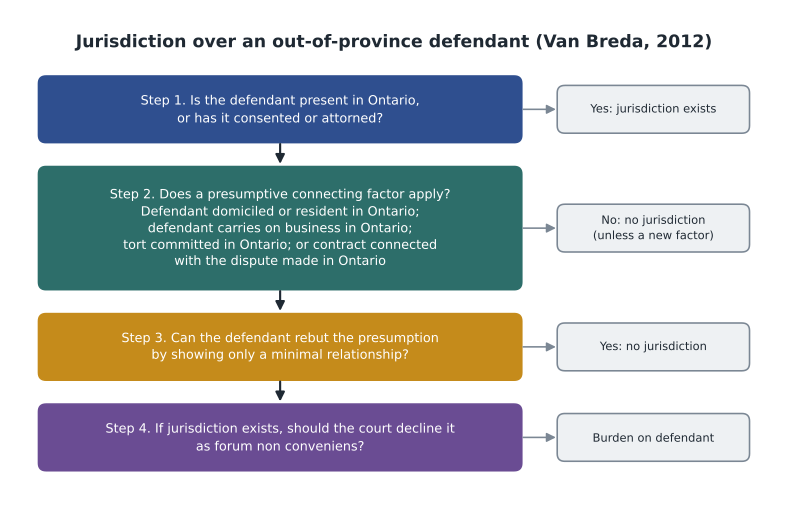
In Van Breda itself, the Court found that Ontario had jurisdiction in both cases: in one, because a contract connected with the dispute had been made in Ontario, an arrangement for a racquet sports professional to give lessons at the resort in exchange for accommodation; in the other, because the resort's management company carried on business in Ontario through its activities in the province. Applied to Thermaline, the question is whether any factor applies. Thermaline is not domiciled in Ontario. Whether it carries on business in Ontario depends on the facts about its Windsor agent and the technician's visit: a regular sales agent working in the province is far more than a website, and could satisfy the factor. The contract to sell and install the controller may have been made in Ontario if Northwood accepted Thermaline's offer from its mill. And if the claim is framed in negligence, the tort may have been committed in Ontario where the defective unit was installed and malfunctioned.
Jurisdiction in other kinds of claims
Van Breda was a tort case, but its approach has been applied to other claims. For contract claims, Ontario courts look at where the contract was made, where it was to be performed and where the defendant carries on business. For defamation on the internet, the tort is generally committed where the words are read, downloaded or heard, a principle the Supreme Court accepted in Haaretz.com v. Goldhar, 2018 SCC 28, discussed below. For claims against multiple defendants, a court that has jurisdiction over one defendant does not automatically have jurisdiction over every other defendant; each must be connected to the province or to the claim.
The Rules support this framework procedurally. Rule 17.02 lists situations in which an originating process may be served outside Ontario without leave, for example where the claim concerns a contract made in Ontario, a tort committed in Ontario, damage sustained in Ontario arising from a tort or breach of contract committed elsewhere, or a defendant ordinarily resident or carrying on business in Ontario. Rule 17.03 allows service outside Ontario with leave in other cases. The list in Rule 17.02 is broader than the Van Breda factors, including damage sustained in Ontario, so a plaintiff who serves without leave under Rule 17.02 must still be ready to prove a real and substantial connection if the defendant moves under Rule 17.06.
Forum non conveniens
Once jurisdiction is established, the defendant may ask the court to decline to exercise it because another forum is clearly more appropriate. Van Breda describes this as a separate inquiry: jurisdiction asks whether the court can hear the case, forum non conveniens asks whether it should. The defendant must identify another forum that has jurisdiction and show that it is clearly more appropriate. The burden is on the defendant, and the word clearly matters. The plaintiff's choice of forum is not displaced merely because the alternative is equally suitable or slightly better.
Courts consider a non-exhaustive list of factors: the locations of the parties and witnesses, the cost of transferring the case, the impact of a transfer on the conduct of the litigation or on related proceedings, the possibility of conflicting judgments, problems of recognizing and enforcing a judgment, the law that will govern the dispute, and the relative strengths of the connections of the two parties. The analysis is discretionary, and appellate courts defer to a motion judge's weighing of the factors unless there is an error of principle.
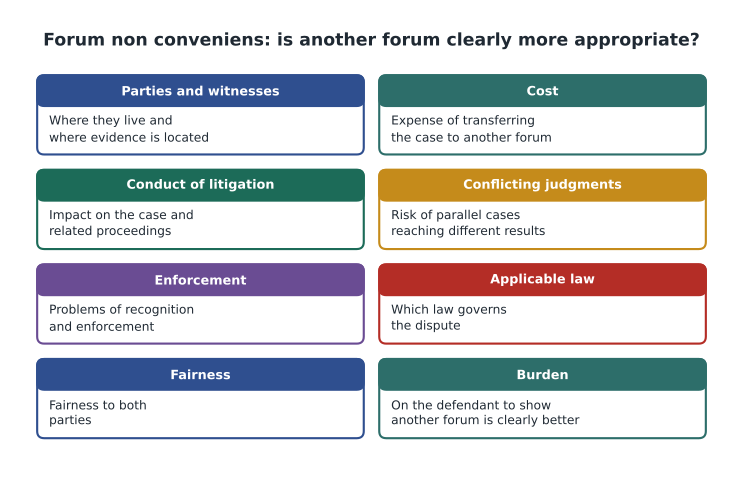
Haaretz.com v. Goldhar, 2018 SCC 28, shows how divided courts can be. Mitchell Goldhar, a Canadian businessman who owns a popular Israeli soccer team, sued the Israeli newspaper Haaretz over a 2011 online article criticizing his management of the club. About 200 to 300 people in Canada read the article, compared with about 70,000 in Israel. Ontario had jurisdiction, because defamation is committed where the words are read and the article was read in Ontario. But six judges held that Israel was clearly the more appropriate forum, given Goldhar's profile in Israel, the location of the newspaper and most witnesses, and the efficiency and fairness of an Israeli trial. Justice Côté wrote the lead reasons for three judges, and Justices Karakatsanis, Abella and Wagner each wrote concurring reasons, two of them proposing changes to the analysis for internet defamation. Chief Justice McLachlin and Justices Moldaver and Gascon dissented, finding the high threshold for moving the case had not been met because Goldhar's main concern was his Canadian reputation. The action was stayed. Haaretz illustrates that even when the Van Breda test is met easily, forum non conveniens can do real work.
Forum selection clauses
Commercial contracts often include a clause choosing the courts of a particular place. Canadian courts generally enforce such clauses unless the plaintiff shows strong cause not to, a test from Z.I. Pompey Industrie v. ECU-Line N.V., 2003 SCC 27. In Douez v. Facebook, Inc., 2017 SCC 33, the Supreme Court refused to enforce Facebook's clause requiring British Columbia users to sue in California over the use of their names and images in advertisements. A plurality held that, in a consumer contract of adhesion, strong cause could be shown by considering the inequality of bargaining power, the quasi-constitutional privacy rights at stake and the convenience and expense of litigating in California; another justice concurred on the ground that the clause was unenforceable as unconscionable. Douez tells students that forum selection clauses in standard form consumer contracts receive closer scrutiny than clauses negotiated between businesses.
Suppose Thermaline's terms of sale, printed on its invoice, said that all disputes must be heard in the courts of Michigan. Northwood is a business, and the term appeared on a commercial invoice, so a court would start with the Pompey test and expect Northwood to show strong cause. Whether the term was part of the contract at all is a question of contract formation, which the class studied with Northwood's own standard terms in Contracts.
Recognition and enforcement
A judgment is only useful if it can be enforced against the defendant's assets. Within Canada, an Ontario judgment can be registered or enforced in other provinces under reciprocal enforcement legislation or by an action on the judgment at common law, applying the Morguard principles. Foreign judgments are enforced at common law if the foreign court had a real and substantial connection with the dispute, the judgment is final and for a definite sum of money, and no defence such as fraud, breach of natural justice or public policy applies. In Chevron Corp. v. Yaiguaje, 2015 SCC 42, the Supreme Court held that a court asked to enforce a foreign judgment does not need a real and substantial connection between the defendant or the dispute and the enforcing province; it is enough that the foreign court properly had jurisdiction. Whether the defendant has assets in the province is a practical question, not a jurisdictional one.
For Lakeshore, the enforcement question is concrete. Northwood is an Ontario company with a mill and equipment in the province, so an Ontario judgment against it can be enforced at home. Thermaline's assets are in Michigan, so a judgment against Thermaline would have to be enforced through the Michigan courts. Before suing a foreign defendant, a careful lawyer asks not only whether the Ontario court has jurisdiction but whether a judgment would be worth anything.
Worked problem
Thermaline Controls and the Ontario court
Northwood wants to bring a third party claim against Thermaline Controls Inc. of Michigan in Lakeshore's Ontario action, alleging the kiln controller was defective. Thermaline has a sales agent in Windsor who visits Ontario customers several times a year, and it installed the unit at Northwood's mill near Sudbury. Thermaline's invoice says disputes must be heard in Michigan. Thermaline moves under Rule 17.06 to set aside service. Analyze.
Show solution
- Traditional bases: Thermaline was not served in Ontario and has not attorned, so long as it moved under Rule 17.06 before defending on the merits.
- Presumptive connecting factors: a regular sales agent visiting customers in the province is likely an actual presence and may satisfy carrying on business. The installation and malfunction in Ontario support the tort being committed in Ontario. The sale contract may have been made in Ontario.
- Rebuttal: Thermaline would argue its Ontario activity is minor and unrelated; the claim arises directly from equipment it sold and installed here, so rebuttal is unlikely.
- Forum non conveniens: Michigan would hear a product claim, but the witnesses to the warping, the mill and the related Lakeshore action are in Ontario, and splitting the case risks conflicting results. Thermaline is unlikely to show Michigan is clearly more appropriate.
- Forum selection clause: whether it was incorporated is a contract question; if it was, Northwood must show strong cause under Pompey, perhaps by pointing to the related Ontario proceeding and the risk of inconsistent findings. The outcome is uncertain.
Common mistakes
MistakeTreating a website accessible in Ontario as carrying on business in Ontario.
InsteadVan Breda requires an actual presence, such as an office or regular visits; advertising or a website alone is not enough.
MistakeTreating damage suffered in Ontario as a presumptive connecting factor.
InsteadVan Breda refused to recognize it, although Rule 17.02 still permits service outside Ontario without leave on that basis.
MistakeAsking whether Ontario is the most appropriate forum.
InsteadThe defendant must show the other forum is clearly more appropriate; ties go to the plaintiff's choice.
MistakeDefending on the merits first and contesting jurisdiction later.
InsteadTaking steps on the merits can amount to attornment; move promptly under Rule 17.06.
Practice problems
Work each problem on paper first, then reveal the answer to check.
Name the four presumptive connecting factors from Van Breda.
Show answer
Defendant domiciled or resident in the province; defendant carries on business there; tort committed there; a contract connected with the dispute made there.
What is the difference between jurisdiction simpliciter and forum non conveniens?
Show answer
The first asks whether the court can hear the case; the second asks whether it should decline because another forum is clearly more appropriate.
What test governs forum selection clauses?
Show answer
They are enforced unless the plaintiff shows strong cause (Pompey); Douez applied closer scrutiny to a consumer contract of adhesion.
What did Chevron v. Yaiguaje hold?
Show answer
A court enforcing a foreign judgment does not need a real and substantial connection between the defendant and the enforcing province.
Which rule allows a defendant served outside Ontario to contest jurisdiction?
Show answer
Rule 17.06, a motion to set aside service or stay the proceeding.
Summary and key terms
- Morguard and Hunt require a real and substantial connection between the forum and the dispute.
- Van Breda sets four presumptive connecting factors in tort cases; the list can grow by analogy, and presumptions can be rebutted.
- Carrying on business requires an actual presence; damage in the province is not a presumptive factor.
- Forum non conveniens is a separate, discretionary question, and the defendant must show another forum is clearly more appropriate (Haaretz).
- Forum selection clauses are enforced unless there is strong cause (Pompey), with closer scrutiny for consumer adhesion contracts (Douez).
- Before suing, consider whether a judgment can be enforced where the defendant's assets are (Chevron).
- Jurisdiction simpliciter
- A court's authority to hear a claim against a defendant, based on presence, consent, attornment or a real and substantial connection.
- Presumptive connecting factor
- A connection listed in Van Breda that presumptively establishes jurisdiction in a tort case.
- Attornment
- Submitting to a court's jurisdiction by taking steps to defend on the merits.
- Forum non conveniens
- The doctrine allowing a court with jurisdiction to decline it because another forum is clearly more appropriate.
- Forum selection clause
- A contract term choosing the courts that will hear disputes.
- Comity
- The respect courts of one jurisdiction give to the laws and judicial decisions of another.
Lesson quiz · 5 questions
Score 60% or more to complete this lesson.
Create a free account to save your progress, take quizzes and earn a certificate.