
LAWC-201 · Lesson 8 of 12 · 23 min
Pre-trial applications
▶ Video coming soon A video version of this lesson is on the way.
Most civil cases never reach trial, and many are decided or shaped by motions along the way. Professor Renaud calls this lesson the middle of the war. 'Pleadings draw the battle lines. Trial is the last battle. In between, the parties fight over whether there should be a battle at all, whether it can be fought on paper, and what each side must do or stop doing while they wait.' The title the catalogue gives this topic, pre-trial applications, is used loosely: in the language of the Rules, most of these requests are motions brought within an existing proceeding.
How motions work
Rule 37 governs motions. A party brings a motion by a notice of motion, stating the relief sought, the grounds and the evidence. The motion is heard by a judge or, for many procedural matters, an associate judge. Rule 37.02 sets out which motions associate judges may and may not hear: they hear most procedural motions, such as motions about pleadings, discovery and timetables, but not motions for summary judgment, injunctions, or matters that a statute or rule assigns to a judge. Evidence on motions is given by affidavit under Rule 39.01, and the opposing party may cross-examine on the affidavits under Rule 39.02. The parties file motion records and, for most substantive motions, factums setting out their legal arguments, which since the 2024 and 2026 amendments must include certifications about the authenticity of the authorities cited and the accuracy of quotations.
Motions cost money and time, and courts discourage unnecessary ones. Many regions require a case conference or a triage appearance before a long motion is scheduled. The Civil Rules Review's Final Policy Report proposes screening most interlocutory disputes at directions conferences, prescribed motion forms with strict page limits and a streamlined process for disclosure disputes and refusals, and the anticipated early amendments include criteria for materials filed on interlocutory motions.
Motions on the pleadings: Rule 21
Rule 21.01(1) allows a party to move before a judge for the determination, before trial, of a question of law raised by a pleading, where the determination may dispose of all or part of the action, substantially shorten the trial or result in a substantial saving of costs (Rule 21.01(1)(a)); or to strike out a pleading on the ground that it discloses no reasonable cause of action or defence (Rule 21.01(1)(b)). No evidence is admissible on a motion under clause (b): the court assumes the facts pleaded to be true. Rule 21.01(3) separately allows a defendant to move to stay or dismiss an action on the grounds that the court has no jurisdiction over the subject matter, another proceeding is pending between the same parties on the same subject matter, a party lacks legal capacity, or the action is frivolous, vexatious or otherwise an abuse of process.
The leading test comes from R. v. Imperial Tobacco Canada Ltd., 2011 SCC 42. Tobacco companies sued by the governments of British Columbia and by consumers brought third party claims against the federal government, alleging that Canada had negligently encouraged the use of low-tar cigarettes. The Supreme Court struck the third party claims. Chief Justice McLachlin, for the Court, held that a claim will be struck only if it is plain and obvious, assuming the facts pleaded to be true, that it discloses no reasonable cause of action; put another way, the claim has no reasonable prospect of success. The facts pleaded are assumed true unless they are manifestly incapable of being proven, and the court must read the claim generously, allowing for drafting deficiencies. But the motion to strike is an important tool for weeding out hopeless claims and for allowing the law to develop, and the approach must not be so timid that novel claims with no realistic chance proceed. The claims against Canada failed because the government's decisions were core policy decisions immune from negligence liability, and there was no sufficient proximity.
A Rule 21 motion is a narrow tool. It works when the defect is in the law, for example when the plaintiff claims damages for a tort that does not exist, or when a contract claim is brought against someone who was not a party to the contract. It does not work when the defendant's real argument is that the plaintiff cannot prove its facts. Northwood could not strike Lakeshore's misrepresentation claim by saying the sales manager never said what Lakeshore alleges; that is a factual dispute for summary judgment or trial.
Summary judgment: Rule 20
Summary judgment allows the court to decide a claim or defence without a full trial. Rule 20.04(2)(a) provides that the court shall grant summary judgment if it is satisfied that there is no genuine issue requiring a trial with respect to a claim or defence. In 2010, Ontario gave motion judges new powers in Rule 20.04(2.1) to weigh the evidence, evaluate the credibility of a deponent and draw any reasonable inference from the evidence, unless it is in the interest of justice for those powers to be exercised only at a trial, and in Rule 20.04(2.2) to order that oral evidence be presented, a procedure sometimes called a mini-trial.
In Hryniak v. Mauldin, 2014 SCC 7, the Supreme Court used these amendments to call for a culture shift in civil litigation. Justice Karakatsanis, for a unanimous Court, wrote that ensuring access to justice is the greatest challenge to the rule of law in Canada, that trials have become expensive and protracted, and that summary judgment should be an important tool for enhancing access to justice. There will be no genuine issue requiring a trial when the judge is able to reach a fair and just determination on the merits on a motion for summary judgment. That will be the case when the process allows the judge to make the necessary findings of fact, allows the judge to apply the law to the facts, and is a proportionate, more expeditious and less expensive means to achieve a just result.
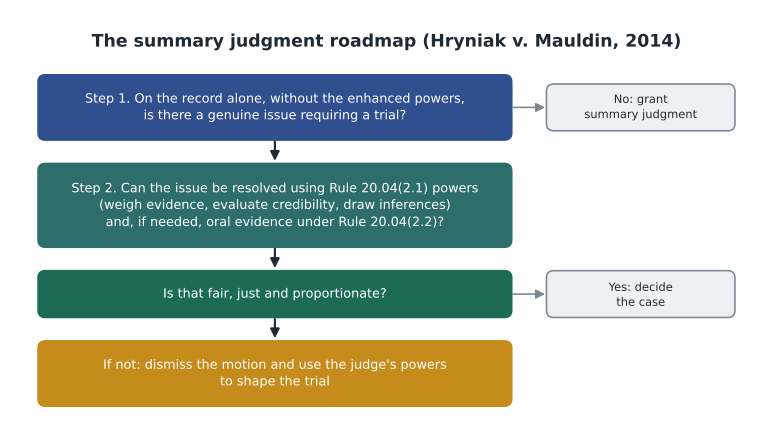
Hryniak set out a roadmap. The judge should first determine whether there is a genuine issue requiring a trial based only on the evidence before the court, without using the new fact-finding powers. If there appears to be a genuine issue, the judge should then determine whether the need for a trial can be avoided by using the powers under Rule 20.04(2.1) and (2.2), provided their use is not against the interest of justice. If summary judgment is refused, the judge should use the trial management powers in Rule 20.05 to shape the rest of the proceeding, for example by specifying facts that are not in dispute and setting a timetable, and should ideally remain seized of the case. The Court also held that a motion judge's decision under Rule 20 is a matter of mixed fact and law entitled to deference on appeal.
Hryniak itself involved an investment fraud. Mauldin and other American investors had transferred about 1.2 million US dollars for investment in a trading program and lost almost all of it. The motion judge granted summary judgment against Hryniak for civil fraud, and the Supreme Court upheld that result, finding the record sufficient to make the necessary findings. In a companion case decided the same day, Bruno Appliance and Furniture, Inc. v. Hryniak, 2014 SCC 8, the Court applied the same principles to a different investor's claim against Hryniak but reached the opposite result: the record there was not sufficient to support a finding of civil fraud, so the claim was sent to trial.
Partial summary judgment
After Hryniak, parties often moved for summary judgment on part of a case. The Ontario Court of Appeal has warned that partial summary judgment is a rare procedure. In Butera v. Chown, Cairns LLP, 2017 ONCA 783, it explained that partial summary judgment risks duplicative proceedings, inconsistent findings and delay, because the remaining issues still go to trial with overlapping evidence. It should be granted only where the issue can be readily bifurcated from the rest of the case and decided in a cost-effective way without risk of inconsistent findings. A defendant that wants to knock out one of several related claims usually does better to wait for trial.
For Lakeshore v. Northwood, Renaud asks whether Northwood could win summary judgment on the limitation of liability clause, arguing that its standard terms capped liability at the price of the affected load. The answer depends on whether the terms were incorporated into the contract, which turns on what the parties said and sent, and on whether Lakeshore's misrepresentation and honest performance claims are caught by the clause. With credibility contests about the January phone call and overlapping evidence on all the claims, a judge might well find the issue cannot be decided fairly in isolation, applying Butera.
Interlocutory injunctions
Sometimes a party needs immediate relief to prevent harm before the case is decided. An interlocutory injunction orders a party to do or refrain from doing something until trial. Section 101 of the Courts of Justice Act and Rule 40 authorize them. The test comes from RJR-MacDonald Inc. v. Canada (Attorney General), [1994] 1 S.C.R. 311: the moving party must show a serious question to be tried, that it will suffer irreparable harm if the injunction is refused, meaning harm that cannot be quantified in money or cured, and that the balance of convenience favours granting the injunction. For a mandatory interlocutory injunction, which requires a party to take positive action, R. v. Canadian Broadcasting Corp., 2018 SCC 5 requires a strong prima facie case, a higher threshold than a serious question. The moving party usually must give an undertaking to pay any damages the injunction causes if it turns out to have been wrongly granted.
Suppose Northwood, having given notice that it will not supply Lakeshore in 2027, proposes to sell its entire 2027 output to a competitor, and Lakeshore claims the July assurances amounted to a binding promise to supply. Lakeshore might seek an interlocutory injunction restraining the sale. It would struggle: lost sales and profits are usually compensable in damages, so irreparable harm is hard to show, and the balance of convenience would weigh Northwood's freedom to sell its product. Specialized orders exist for extreme cases: a Mareva injunction freezes a defendant's assets where there is a real risk they will be removed or dissipated to defeat a judgment, and an Anton Piller order permits the search and seizure of evidence that would otherwise be destroyed. The Supreme Court stressed the exceptional nature and safeguards of Anton Piller orders in Celanese Canada Inc. v. Murray Demolition Corp., 2006 SCC 36.
Other common motions
Security for costs is one. Under Rule 56.01, a defendant may move for an order that the plaintiff post security for the defendant's costs where, among other grounds, the plaintiff is ordinarily resident outside Ontario, has another proceeding for the same relief pending elsewhere, has unpaid costs orders against it, is a corporation or nominal plaintiff with good reason to believe it has insufficient assets in Ontario to pay costs, or the action appears frivolous and vexatious and the plaintiff lacks assets to pay costs. If Thermaline brought a claim in Ontario against Northwood, Northwood might seek security because Thermaline is resident in Michigan. The court has discretion, and will not order security that would prevent a meritorious claim from proceeding.
Other motions include motions to compel answers to refusals and undertakings, motions to amend pleadings, motions to add parties, motions for a determination of an issue before trial, motions under section 137.1 of the Courts of Justice Act to dismiss proceedings that limit debate on matters of public interest, which the class studied with 1704604 Ontario Ltd. v. Pointes Protection Association, 2020 SCC 22, in Torts, and motions to dismiss for delay. Under Rule 48.14, the registrar will dismiss an action for delay if it has not been set down for trial or terminated by the fifth anniversary of its commencement, unless a timetable has been set or the court orders otherwise; a plaintiff can move to set aside the dismissal by explaining the delay and showing no prejudice to the defendant.
Strategy
Renaud closes with strategy. Every motion should answer three questions: what will it achieve, what will it cost, and what will the judge think of the party bringing it? A motion to strike a claim that can easily be amended achieves little and annoys the court. A summary judgment motion that fails can add a year to the case and a costs award against the moving party. But a well-chosen motion can end a hopeless claim, force disclosure of the key document, or put real pressure on the other side to settle. Good litigators bring few motions and win most of them.
Worked problem
Choosing the right motion
For each situation, identify the best motion and the test. (a) Northwood says Lakeshore's claim for breach of the duty of honest performance fails in law because the contract allowed non-renewal. (b) Northwood says Lakeshore cannot prove the January phone call happened. (c) Lakeshore learns Northwood is moving its equipment and bank accounts to a related company in another province to avoid a judgment. (d) Thermaline sues Northwood in Ontario and Northwood worries it will never recover its costs.
Show solution
- (a) A Rule 21.01(1)(b) motion to strike, assuming the facts true: is it plain and obvious the claim has no reasonable prospect of success (Imperial Tobacco)? Bhasin and Callow suggest a claim for dishonesty in exercising a non-renewal right is viable, so the motion should fail.
- (b) This is a factual dispute, not a pleading defect. Northwood's tool is summary judgment under Rule 20, but credibility contests may require a trial unless the record lets the judge make findings fairly (Hryniak).
- (c) A Mareva injunction freezing assets, requiring a strong prima facie case and a real risk of removal or dissipation, with full and frank disclosure.
- (d) Security for costs under Rule 56.01, because Thermaline is ordinarily resident outside Ontario.
Common mistakes
MistakeFiling affidavits on a motion to strike under Rule 21.01(1)(b).
InsteadNo evidence is admissible; the facts pleaded are assumed true.
MistakeSeeking partial summary judgment on intertwined issues.
InsteadButera warns it is rare and risks duplication and inconsistent findings.
MistakeSeeking an injunction to protect lost profits.
InsteadHarm compensable in damages is usually not irreparable under RJR-MacDonald.
MistakeAssuming an associate judge can hear a summary judgment motion.
InsteadRule 37.02 reserves summary judgment and injunctions to judges.
Practice problems
Work each problem on paper first, then reveal the answer to check.
What is the Imperial Tobacco test on a motion to strike?
Show answer
Assuming the facts pleaded are true, is it plain and obvious that the claim discloses no reasonable cause of action, with no reasonable prospect of success?
When is there no genuine issue requiring a trial under Hryniak?
Show answer
When the judge can make a fair and just determination on the merits: finding the facts, applying the law, in a proportionate, more expeditious and less expensive way.
What powers does Rule 20.04(2.1) give the motion judge?
Show answer
To weigh the evidence, evaluate credibility and draw reasonable inferences, unless the interest of justice requires a trial.
What is the RJR-MacDonald test for an interlocutory injunction?
Show answer
A serious question to be tried, irreparable harm and a balance of convenience favouring the injunction.
When does Rule 48.14 dismiss an action for delay?
Show answer
If it has not been set down for trial or terminated by the fifth anniversary of commencement, unless a timetable or order applies.
Summary and key terms
- Motions under Rule 37 are decided on affidavit evidence, by judges or, for many procedural matters, associate judges.
- Rule 21 motions to strike assume the facts pleaded are true and ask whether the claim is plainly doomed (Imperial Tobacco).
- Summary judgment under Rule 20 should be granted where a fair and just determination is possible on the motion (Hryniak); partial summary judgment is rare (Butera).
- Interlocutory injunctions require a serious question, irreparable harm and balance of convenience (RJR-MacDonald); mandatory ones require a strong prima facie case.
- Security for costs, refusals motions, anti-SLAPP motions and dismissal for delay are other common tools.
- Choose motions strategically: few, well-founded and proportionate.
- Motion
- A request to the court for an order within an existing proceeding.
- Motion to strike
- A motion to remove a pleading that discloses no reasonable cause of action or defence.
- Summary judgment
- Judgment without a full trial where there is no genuine issue requiring a trial.
- Mini-trial
- Oral evidence heard on a summary judgment motion under Rule 20.04(2.2).
- Interlocutory injunction
- An order to do or refrain from doing something until the trial is decided.
- Security for costs
- An order requiring a plaintiff to post money or a bond to secure the defendant's costs.
Lesson quiz · 5 questions
Score 60% or more to complete this lesson.
Create a free account to save your progress, take quizzes and earn a certificate.