
LAWC-201 · Lesson 12 of 12 · 24 min
Capstone: a civil procedure problem
▶ Video coming soon A video version of this lesson is on the way.
For the final class, Professor Renaud returns to a file the cohort knows well. In first year, in Legal Research and Writing, Section B wrote memos on Ingram v. Corwin Plaza Holdings: Rosa Ingram, a Corwin dental hygienist, slipped on ice in the Corwin Plaza parking lot at about 7:40 a.m. on Wednesday, February 4, 2026, broke her right wrist and had surgery on February 10. She did not see a lawyer at Pardee & Lowe LLP until April 20, 2026, after the 60-day written notice period in section 6.1 of the Occupiers' Liability Act had passed, and notice was served on the owner, Corwin Plaza Holdings Inc., and the snow contractor, Northline Snow Services, by registered mail on April 22. The property manager had photographed the area and saved the security video the day after the fall, after Rosa's husband phoned him.
'Last year you asked whether the claim was barred,' Renaud says. 'This year you will run it.' The problem below imagines the file moving forward. Everything after November 2026 in it is hypothetical, and all names are fictional; only the statutes, rules and cases are real. Students have two hours, as on the December exam, and the instruction is the one Renaud has given all term: spot every issue first, then deal with each in the order a lawyer would face it, stating the rule, applying it and saying what you would do.
The problem
Rosa's surgeon reports that she has permanent loss of grip strength. Her claim for pain and suffering, lost income during her recovery, reduced earning capacity as a hygienist, physiotherapy and housekeeping help is valued by her lawyer at about 175,000 dollars. The associate on the file, who is new, drafts a statement of claim against Corwin Plaza Holdings only, intending to add Northline later once Northline's salting records are obtained. The claim is issued at the Superior Court office in the county that includes Corwin, served on Corwin Plaza Holdings, and does not mention the late notice.
Corwin Plaza Holdings delivers a defence. It denies negligence, pleads that it reasonably relied on its contractor, pleads that Rosa was wearing unsuitable footwear, and pleads that the action is barred by section 6.1 of the Occupiers' Liability Act because no written notice was given within 60 days. It also issues a third party claim against Northline for contribution and indemnity under its snow-clearing contract. Northline's third party defence says it salted the lot at 6:15 a.m., as its GPS logs will show, and that refreezing after salting is not its responsibility. Corwin Plaza Holdings also delivers a jury notice.
More than two years after the fall, Rosa's lawyers move to amend the claim to add Northline as a defendant. Corwin Plaza Holdings then moves for summary judgment dismissing the action on the ground of the late notice. Before the motions are heard, Corwin Plaza Holdings serves a Rule 49 offer to pay 60,000 dollars plus costs. Rosa wants to know whether she should accept, what will happen at trial, and what happens if she wins or loses.
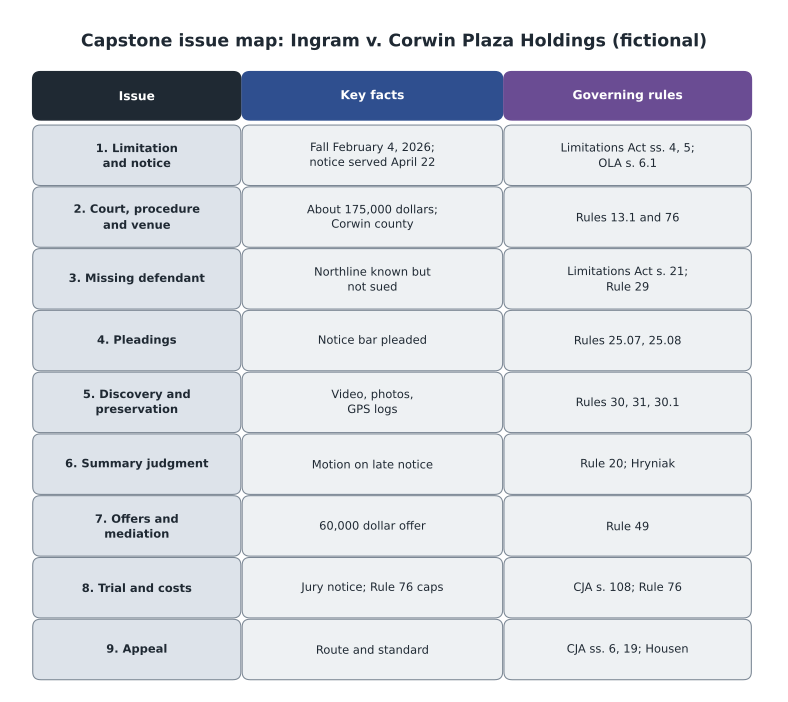
Step 1: deadlines
The model answer starts with time, because missed deadlines cannot be fixed. The basic limitation period under section 4 of the Limitations Act, 2002 is two years from discovery. Rosa knew of her injury, its cause and the occupier's role on the day she fell, so under section 5 her claim against Corwin Plaza Holdings was discovered on February 4, 2026, and the period expired on February 4, 2028. The claim had to be issued before then, and the problem assumes it was.
The section 6.1 notice is a separate requirement, not a limitation period. Written notice within 60 days was not given, so the claim is barred unless an exception applies. Section 6.1(6) provides that failure to give notice is not a bar if the judge finds there is a reasonable excuse for the failure and the defendant is not prejudiced in its defence. The first-year memos analyzed this using Crinson v. Toronto (City), 2010 ONCA 44, and Seif v. Toronto (City), 2015 ONCA 321, under the municipal notice provision on which section 6.1 is modelled: the question is whether, in all the circumstances, it was reasonable for the plaintiff not to give notice until she did, and ignorance of the requirement alone is not enough, though it may contribute with other factors such as the effects of injury and medication. On prejudice, Rosa's position is unusually strong: the defendant itself photographed the scene and saved the video the next day, and Northline was asked for its salting records immediately. Even if prejudice is presumed after a long delay, as some courts have held, the evidence rebuts it.
Step 2: court, procedure and venue
The claim, valued at about 175,000 dollars, exceeds the Small Claims Court limit of 50,000 dollars that has applied since October 1, 2025, so the Superior Court is the right court. Because it is a claim for money of 200,000 dollars or less, Rule 76 makes the simplified procedure mandatory. That has three important consequences: oral discovery is limited to three hours per party, the trial will be short with evidence in chief largely by affidavit, and there is no jury. Corwin Plaza Holdings' jury notice is therefore of no effect, and Rosa's lawyers should move to strike it under Rule 47.02 if it is not withdrawn. If Rosa's claim later grew beyond 200,000 dollars, the action could move to the ordinary procedure and a jury could become available; her lawyers should not inflate the claim to escape Rule 76, because Rule 76.13 allows costs sanctions if a plaintiff recovers less than the threshold.
The claim was issued in the county including Corwin, where the fall happened, where Rosa lives and was treated, and where both defendants operate. That easily satisfies the rational connection requirement in Rule 13.1.01(2), in force since February 1, 2026.
Step 3: the missing defendant
The decision to sue only Corwin Plaza Holdings was a serious mistake. Rosa knew of Northline from the start: her lawyers served section 6.1 notice on Northline by registered mail on April 22, 2026. Her claim against Northline was therefore discovered no later than then, and on the facts probably on the day of the fall once she knew a contractor cleared the lot. The motion to amend to add Northline is brought more than two years after both dates. Section 21(1) of the Limitations Act, 2002 bars adding a party after the limitation period against that party has expired. The misnomer exception in section 21(2) does not help, because Rosa did not name Northline by the wrong name; she did not name it at all. Rule 5.04(2) and Rule 26.01, which make amendments presumptive, cannot override the statute, because a limitation defence is a form of non-compensable prejudice.
The consequences are mitigated in practice. Northline is already a third party, brought in by Corwin Plaza Holdings, so its conduct will be examined and it will participate at trial. If Corwin Plaza Holdings is found liable to Rosa, it can recover contribution or indemnity from Northline in the third party claim. But Rosa cannot recover directly from Northline, so her recovery depends on Corwin Plaza Holdings being found liable. And if a judge found Corwin Plaza Holdings reasonably relied on a competent contractor and was not itself negligent, Rosa could lose against the only defendant she sued. The associate should report the error to the supervising lawyer immediately; the firm should notify its insurer, LAWPRO, of a potential claim, and the client must be told. Renaud tells the class that this is the hardest conversation in practice, and the most important one to have promptly and honestly.
Step 4: pleadings
Corwin Plaza Holdings pleaded the section 6.1 bar, as Rule 25.07 required, because it is a matter that would otherwise take the plaintiff by surprise. Rosa's lawyers should deliver a reply under Rule 25.08 pleading the facts supporting a reasonable excuse and lack of prejudice: the injury and surgery, the medication and its effects until mid-March, her husband's phone call to the property manager on February 5, the manager's photographs and preservation of the video, and the request to Northline for its records. These are new matters responding to the defence, which is exactly what a reply is for. Corwin Plaza Holdings' allegation about unsuitable footwear is a contributory negligence defence under the Negligence Act; Rosa's reply need not deny it, because it is deemed denied, but her evidence must address it.
Step 5: discovery
Rosa needs the security video, the property manager's photographs and emails, the snow-clearing contract and Northline's records, including its GPS logs and salt application records. Corwin Plaza Holdings must list its documents in its affidavit of documents under Rule 30.02, and Northline, as a third party, has discovery obligations in the third party proceeding and, under the Rules, may be examined by the plaintiff in many circumstances where it defends the main action. If Northline's records are not produced, Rosa can seek them from a non-party under Rule 30.10. The deemed undertaking in Rule 30.1 prevents her from using these records outside the action. Corwin Plaza Holdings will seek Rosa's medical records, employment and income records and social media posts showing her activities, and may request a defence medical examination under section 105 of the Courts of Justice Act and Rule 33. Under the simplified procedure, each party has three hours of oral discovery, so questions must be planned carefully.
Step 6: the summary judgment motion
Corwin Plaza Holdings' motion asks the court to decide the notice issue without a trial. Under Rule 20.04 and Hryniak v. Mauldin, 2014 SCC 7, summary judgment is appropriate where the judge can make a fair and just determination on the merits in a proportionate way. The notice question is suited to summary determination: the facts about Rosa's injury, medication, knowledge and the defendant's preservation of evidence can be proved by affidavits and medical records, with cross-examination, and the judge can use the Rule 20.04(2.1) powers to weigh evidence and assess credibility. The judge might find a reasonable excuse and no prejudice, dismissing the motion; Rosa could also ask the judge to determine the issue in her favour so it does not have to be tried again, although partial summary judgment must be approached cautiously under Butera v. Chown, Cairns LLP, 2017 ONCA 783. If the judge finds no reasonable excuse, the action against Corwin Plaza Holdings is dismissed. A dismissal would be a final order in a claim over 50,000 dollars, appealable to the Court of Appeal as of right within 30 days, and the standard of review would be deferential on the judge's findings of fact and mixed fact and law.
Step 7: the offer and settlement
Corwin Plaza Holdings' Rule 49 offer of 60,000 dollars plus costs puts pressure on Rosa. If she rejects it and recovers 60,000 dollars or less at trial, Rule 49.10(2) gives her partial indemnity costs only to the date of the offer and Corwin Plaza Holdings partial indemnity costs from that date, subject to the court's discretion under Rule 49.13 and the costs caps in Rule 76. Her lawyers should assess the risks honestly: a real risk of losing on notice, a risk that Corwin Plaza Holdings escapes liability by blaming Northline, against whom she has no direct claim, and the possibility of a reduction for contributory negligence, balanced against a strong injury claim. They should consider a counter-offer under Rule 49 at a figure Rosa would genuinely accept, which, if Rosa later beats it at trial, would entitle her to substantial indemnity costs from the offer date. Corwin is not one of the places where Rule 24.1 makes mediation mandatory, but private mediation, with Northline and its insurer at the table, may be the best way to reach a settlement, because the third party claim gives Northline a stake in the outcome.
Step 8: trial, judgment and costs
If the case is tried, it will be a short judge-alone trial under the simplified procedure. Rosa must prove negligence on a balance of probabilities, as F.H. v. McDougall, 2008 SCC 53 requires, through her own evidence, the video, the weather records and expert evidence about ice formation and salting, with expert reports served under Rule 53.03. Corwin Plaza Holdings will argue that it met the standard of care by hiring a competent contractor, and Northline will argue that it salted on time. The judge will decide liability, apportion fault among Corwin Plaza Holdings, Northline and Rosa if contributory negligence is found, assess damages and award prejudgment interest under section 128 of the Courts of Justice Act. Costs will follow the event under section 131 and Rule 57.01, adjusted for offers under Rule 49 and capped under Rule 76. If Rosa wins and Corwin Plaza Holdings does not pay, she can enforce the judgment under Rule 60, though a commercial landlord with insurance will almost certainly pay.
Step 9: appeal
A judgment after trial for more than 50,000 dollars would be appealed to the Court of Appeal under section 6(1)(b) of the Courts of Justice Act within 30 days; a judgment for 50,000 dollars or less, or one dismissing Rosa's claim if her claim were for that amount or less, would go to the Divisional Court under section 19. The appellate court would apply Housen v. Nikolaisen, 2002 SCC 33: correctness on questions of law, such as the interpretation of section 6.1, and palpable and overriding error on findings of fact, such as whether the lot was salted on time. Delivering a notice of appeal from a money judgment stays it automatically under Rule 63.01.
What Renaud looks for
Renaud ends the course with a list he says he will use to mark the exam. First, the deadlines, calculated correctly and early. Second, the right court and procedure, with the consequences of Rule 76 understood. Third, the parties, including the mistake about Northline and what it means. Fourth, the pleadings, including the reply. Fifth, discovery and preservation. Sixth, motions chosen and analyzed with the correct tests. Seventh, the economics: offers, costs, mediation and the client's real interests. Eighth, the appeal route and standard. And throughout, honesty about uncertainty and practical advice about what to do next. 'Civil procedure,' he says, 'is not a set of hoops. It is the machinery that turns a person's rights into a remedy. Run it well and your clients will never notice it. Run it badly and they will notice nothing else.'
Worked problem
A one-page plan for the first meeting
Assume you are meeting Rosa Ingram for the first time on April 20, 2026, as her lawyer did. Write the procedural to-do list that would have avoided the problems in the capstone.
Show solution
- Calendar the limitation date (February 4, 2028) and the earliest plausible discovery date for every potential defendant, and confirm the dates to Rosa in writing.
- Serve section 6.1 notice immediately on both the owner and the contractor, as the lawyer did on April 22, and gather evidence of a reasonable excuse and lack of prejudice.
- Identify every potential defendant (owner, snow contractor, property manager, any tenant responsible for the area) and sue all of them in the first statement of claim, removing any later if the evidence clears them.
- Send preservation letters for the video, photographs, contract and salting logs.
- Value the claim to choose the procedure (Small Claims, Rule 76 or ordinary), and name a county with a rational connection under Rule 13.1.01(2).
- Plan for early settlement: consider a Rule 49 offer once the medical evidence is clear.
Common mistakes
MistakeSuing one defendant and planning to add others later.
InsteadSection 21 of the Limitations Act bars adding a party after its limitation period; sue all plausible defendants within the period.
MistakeTreating a section 6.1 notice failure as fatal without analysis.
InsteadSection 6.1(6) allows the claim to proceed with a reasonable excuse and no prejudice to the defence.
MistakeForgetting that Rule 76 actions have no jury.
InsteadSince 2020, simplified procedure actions are tried by a judge alone.
MistakeHiding a file error from the supervising lawyer or client.
InsteadReport it promptly, notify the insurer and tell the client honestly.
Practice problems
Work each problem on paper first, then reveal the answer to check.
When did the limitation period for Rosa's claim against Corwin Plaza Holdings expire?
Show answer
On February 4, 2028, two years after the fall, when the claim was discovered.
Why can Rosa not add Northline as a defendant more than two years after the fall?
Show answer
Section 21(1) of the Limitations Act, 2002 bars adding a party after the limitation period against it has expired, and misnomer does not apply.
What is the effect of Rule 76 on Corwin Plaza Holdings' jury notice?
Show answer
Simplified procedure actions are tried without a jury, so the notice has no effect and can be struck.
What must Rosa show to overcome the late section 6.1 notice?
Show answer
A reasonable excuse for the failure and that the defendant is not prejudiced in its defence.
Where would an appeal from a 120,000 dollar judgment go?
Show answer
To the Court of Appeal under section 6(1)(b) of the Courts of Justice Act, within 30 days.
Summary and key terms
- Start every file with deadlines: limitation periods, notice requirements and the parties each applies to.
- Choose the court and procedure by the amount claimed; Rule 76 means limited discovery, a short trial and no jury.
- Sue all plausible defendants within the limitation period; section 21 prevents adding them later.
- Use the reply to plead facts answering new defences such as a notice bar.
- Analyze summary judgment under Hryniak and Butera, and offers under Rule 49 with the costs consequences in view.
- Know the appeal route and standard of review before trial, and handle mistakes promptly and honestly.
- Issue map
- A list of every procedural and substantive issue in a file, with the facts and rules for each.
- Reasonable excuse
- The justification required under section 6.1(6) of the Occupiers' Liability Act for late notice.
- Third party
- A person brought into an action by a defendant's claim for contribution or indemnity.
- Counter-offer
- A party's own Rule 49 offer made in response to the other side's offer.
- LAWPRO
- The insurer that provides professional liability insurance to Ontario lawyers.
- Simplified procedure action
- An action governed by Rule 76, for most claims of 200,000 dollars or less.
Lesson quiz · 5 questions
Score 60% or more to complete this lesson.
Create a free account to save your progress, take quizzes and earn a certificate.