
LAWC-201 · Lesson 3 of 12 · 22 min
Limitation periods
▶ Video coming soon A video version of this lesson is on the way.
Professor Renaud opens the class on limitation periods with a story he says every litigator has heard in some form. A client came to his old firm with a strong claim against an accountant and an even stronger set of documents. The claim was worth seven figures. It was also three weeks too late. 'There is no appeal from a limitation period,' he says. 'You can lose a motion and win at trial, and you can lose at trial and win on appeal. But if you miss a limitation period, the claim is gone, and the next call your client makes is to your insurer.'
A limitation period is a statutory deadline for starting a proceeding. It protects defendants from stale claims, when evidence has been lost and memories have faded; it encourages plaintiffs to sue diligently; and it gives everyone certainty that, at some point, old disputes are over. The Supreme Court of Canada described these rationales as certainty, evidentiary and diligence in M.(K.) v. M.(H.), [1992] 3 S.C.R. 6, and they shape how courts interpret limitation statutes.
The Limitations Act, 2002
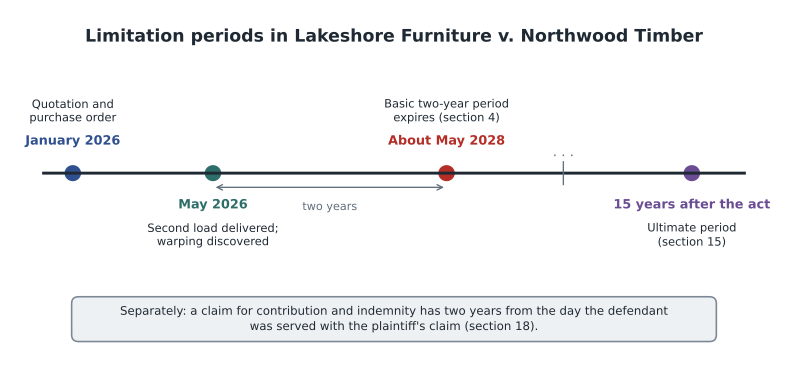
In Ontario, most civil claims are governed by the Limitations Act, 2002, S.O. 2002, c. 24, Sched. B, which came into force on January 1, 2004. It replaced a patchwork of periods that varied by cause of action with a general scheme. Section 4 sets the basic limitation period: unless the Act provides otherwise, a proceeding shall not be commenced in respect of a claim after the second anniversary of the day on which the claim was discovered. Section 15 sets the ultimate limitation period: no proceeding may be commenced after the fifteenth anniversary of the day on which the act or omission on which the claim is based took place, whatever the plaintiff knew. The basic period protects plaintiffs who did not know about their claims; the ultimate period protects defendants from claims that surface decades later.
The Act applies to claims to remedy an injury, loss or damage that occurred as a result of an act or omission. It does not apply to everything. Section 2 excludes, among other things, proceedings for judicial review and certain proceedings related to Aboriginal and treaty rights. Section 16 lists claims with no limitation period at all, including a proceeding for a declaration if no consequential relief is sought, a proceeding to enforce a court order, and claims based on sexual assault or other sexual misconduct and on certain assaults within relationships of intimacy, dependency or trust. Some other statutes set their own periods, which prevail where the Act says so.
Discovery
The two-year clock starts on the day the claim is discovered, as defined in section 5(1). A claim is discovered on the earlier of two days. The first is the day on which the person with the claim first knew all of the following: that the injury, loss or damage had occurred; that it was caused or contributed to by an act or omission; that the act or omission was that of the person against whom the claim is made; and that, having regard to the nature of the injury, loss or damage, a proceeding would be an appropriate means to seek to remedy it. The second is the day on which a reasonable person with the abilities and in the circumstances of the person with the claim first ought to have known of those matters. Section 5(2) adds a presumption: a person is presumed to have known of the matters on the day the act or omission took place, unless the contrary is proved. In practice, a plaintiff who sues more than two years after the event must lead evidence about when and how it discovered the claim.
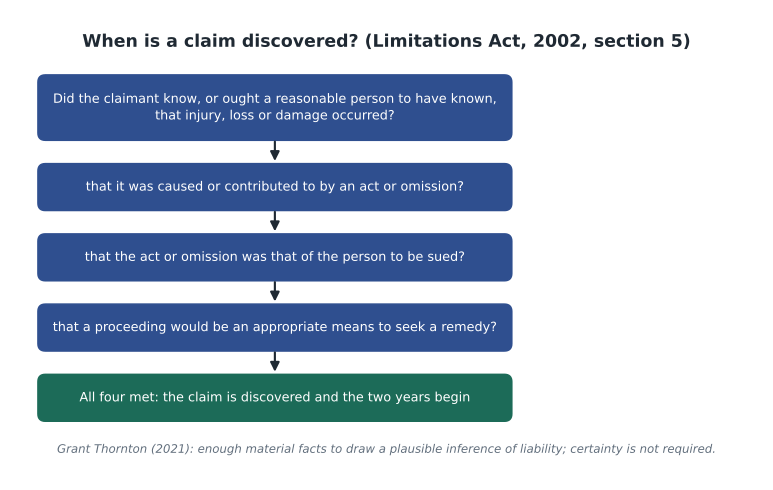
In Grant Thornton LLP v. New Brunswick, 2021 SCC 31, the Supreme Court explained how much knowledge is required under a discoverability provision worded like Ontario's. New Brunswick had guaranteed a loan to a company after relying on an audit by Grant Thornton. When the company failed, the province learned that the audited financial statements were wrong, but it waited for a further report before suing the auditors. The Court held that a claim is discovered when the plaintiff has knowledge, actual or constructive, of the material facts on which a plausible inference of liability on the defendant's part can be drawn. The plaintiff does not need certainty of liability, or knowledge of the precise extent of the harm, or knowledge that the defendant breached the standard of care. Mere suspicion or speculation is not enough, but once the plaintiff knows enough to draw a plausible inference, the clock is running. New Brunswick's claim was out of time.
The appropriate means element in section 5(1)(a)(iv) is distinctive to Ontario. Courts have held that a proceeding may not yet be an appropriate means while the defendant is genuinely attempting to fix the problem, for example by repairing a defect, so that suing would be premature. But the element is applied narrowly. It does not delay the clock simply because the plaintiff was negotiating, hoping for a voluntary payment, or unaware that a lawsuit was possible. Section 11 deals with one form of delay directly: if a person with a claim and the person against whom it is made agree to have an independent third party resolve the claim or assist them in doing so, the limitation period is suspended until the process ends.
Applying the rules to Lakeshore
Renaud puts the Lakeshore facts on the board. The second load was delivered in May, and Lakeshore discovered the warping once the finished furniture was in the retailer's showroom that month. Testing later confirmed the oak had been dried to about 13 percent moisture. When was the claim against Northwood discovered? Lakeshore knew in May that it had suffered loss, that the warping was caused by something wrong with the wood, and that Northwood supplied the wood. A plausible inference of liability against Northwood could be drawn then, even before the test results confirmed the moisture level. The safest date is the day in May that Lakeshore first saw the warping, so the basic period expires two years later, in May 2028. The contracts course noted the same date.
Two complications follow. First, Lakeshore's claim about the July assurances, the alleged breach of the duty of honest performance, rests on a later act and may have a later discovery date, perhaps October, when Northwood gave notice of non-renewal and Lakeshore learned the assurances had been false. Each claim has its own discovery analysis. Second, Northwood's standard terms might contain a clause shortening the limitation period. Under section 22, a limitation period under the Act can be varied or excluded only by agreement in certain circumstances. Section 22(5) allows business agreements, defined as agreements between parties who are not consumers, to vary or exclude the basic and ultimate periods; consumer agreements cannot shorten them. Whether Northwood's terms were incorporated into the contract at all is the issue the class analyzed in Contracts.
Claims for contribution and indemnity
When Lakeshore sues Northwood, Northwood will want to claim contribution or indemnity from Thermaline Controls, the controller manufacturer. Section 18 of the Act provides that, for a claim by one alleged wrongdoer against another for contribution and indemnity, the day on which the first alleged wrongdoer was served with the claim is deemed to be the day the act or omission took place. Combined with the presumption in section 5(2), this gives Northwood two years from the day it is served with Lakeshore's statement of claim to bring a third party claim or separate action against Thermaline, subject to the discovery rules. The Ontario Court of Appeal has held that this is a presumptive date, not an absolute one, so a defendant who could not reasonably have known of its claim over may rely on later discovery.
Adding parties after the limitation period
Section 21(1) provides that if a limitation period in respect of a claim against a person has expired, the claim shall not be pursued by adding or substituting the person as a party to any existing proceeding. This prevents a plaintiff from doing indirectly, by amending its claim, what it could not do by issuing a new one. Section 21(2) contains an exception for misnaming or misdescribing a person: a plaintiff who named the right defendant by the wrong name, for example a misspelled corporate name or the wrong corporate entity in a closely related group where the intended defendant knew it was the target, may correct the name. The misnomer doctrine is applied when the intended defendant would have known, on reading the claim, that it was the one being sued.
The interaction with discoverability matters in practice. If Lakeshore did not know, and could not reasonably have known, that Thermaline's controller caused the warping until Northwood disclosed it in its defence, Lakeshore may argue that its own claim against Thermaline was discovered later. Courts allow a plaintiff to add a defendant after two years from the incident if the plaintiff shows the claim against that defendant was not discovered until later, but the plaintiff must explain what it did to find the right defendants. A plaintiff who knew the controller's manufacturer from the start cannot rely on discoverability simply because it did not think to sue.
Special notice periods and other statutes
Some claims carry shorter deadlines than two years, and some require written notice long before suit. The class saw one in Legal Research and Writing: section 6.1 of the Occupiers' Liability Act requires written notice within 60 days to an occupier and any independent contractor for a claim arising from snow or ice on private property, subject to an exception for a reasonable excuse where the defendant is not prejudiced. The Municipal Act, 2001 requires notice to a municipality within ten days of an injury caused by the municipality's failure to maintain a road or sidewalk. The Crown Liability and Proceedings Act, 2019 requires 60 days' notice before suing the Ontario Crown in many cases. These notice provisions are not limitation periods, but missing one can be just as fatal.
Other statutes set their own limitation periods for particular claims, and the Limitations Act lists in its schedule the provisions that continue to apply. A litigator must therefore always check whether a specific statute governs before relying on the two-year rule. Federal law also has its own periods for some claims, such as those under maritime law. The general rule in Ontario practice is to calendar the earliest possible date and work back from it.
Incapacity, minors and suspension
The clock does not run against everyone equally. Under section 6, the limitation period does not run while a person with a claim is a minor, unless a litigation guardian has been appointed. Under section 7, it does not run while the person is incapable of commencing a proceeding because of a physical, mental or psychological condition, unless a litigation guardian has been appointed. The ultimate period in section 15 is also postponed in these cases and in cases of wilful concealment or wilful misleading by the defendant. These rules reflect the fairness rationale: a plaintiff who could not have sued should not be penalized for not suing.
Practice habits
Renaud ends with habits rather than doctrine. Calculate every limitation date at the first meeting, using the earliest plausible discovery date. Record it in two places. Send a letter to the client confirming the date and the consequences of missing it. If there is any doubt, issue the claim: a statement of claim can be served within six months of issue and amended later, while a missed deadline cannot be cured. And never let settlement discussions lull you, because negotiations alone do not stop the clock. The Law Society's insurer, LAWPRO, reports year after year that missed limitation periods are among the most common causes of negligence claims against Ontario lawyers.
Worked problem
Calculating three limitation dates
Lakeshore discovered warped tables on a day in May. Its lawyer serves the statement of claim on Northwood fourteen months later. In its defence, Northwood blames Thermaline's kiln controller, which Lakeshore had never heard of. What are the key dates?
Show solution
- Lakeshore v. Northwood: discovered in May when the warping appeared; the basic period expires two years later in May (section 4), subject to any valid contractual variation between businesses (section 22(5)).
- Northwood v. Thermaline: under section 18, the act or omission is deemed to occur on the day Northwood was served with Lakeshore's claim, so Northwood has two years from that service date to claim contribution and indemnity.
- Lakeshore v. Thermaline: Lakeshore may argue it did not know, and could not reasonably have known, of Thermaline's role until Northwood's defence; if accepted, its two years run from then. It must show diligence, and section 21 bars adding Thermaline if the period has expired.
- The ultimate period of fifteen years from the act or omission is far off for all three claims.
Common mistakes
MistakeWaiting for expert confirmation before treating a claim as discovered.
InsteadUnder Grant Thornton, the clock starts once the plaintiff knows facts supporting a plausible inference of liability.
MistakeAssuming settlement negotiations stop the clock.
InsteadOnly specific events, such as an agreement to use an independent third party under section 11, suspend the period.
MistakeAdding a new defendant by amendment after the period expires.
InsteadSection 21 bars it, except to correct a misnomer.
MistakeForgetting notice requirements because the two-year period has not expired.
InsteadShorter notice periods such as 60 days under the Occupiers' Liability Act or 10 days under the Municipal Act may expire first.
Practice problems
Work each problem on paper first, then reveal the answer to check.
What are the basic and ultimate limitation periods under the Limitations Act, 2002?
Show answer
Two years from discovery (section 4) and fifteen years from the act or omission (section 15).
What did Grant Thornton (2021) hold about discovery?
Show answer
A claim is discovered when the plaintiff knows, actually or constructively, the material facts on which a plausible inference of liability can be drawn.
When does a contribution and indemnity claim's period begin under section 18?
Show answer
It is deemed to begin on the day the first alleged wrongdoer was served with the plaintiff's claim.
Can business parties shorten the limitation period by contract?
Show answer
Yes, under section 22(5) business agreements may vary or exclude the periods; consumer agreements cannot.
What does section 21 prevent?
Show answer
Adding or substituting a party after the limitation period against that party has expired, except to correct a misnomer.
Summary and key terms
- Ontario's basic limitation period is two years from discovery; the ultimate period is fifteen years from the act or omission.
- Discovery under section 5 requires knowledge of the loss, its cause, the defendant's role and that a proceeding is an appropriate means; Grant Thornton requires facts supporting a plausible inference of liability.
- A plaintiff suing more than two years after the event must rebut the section 5(2) presumption.
- Contribution and indemnity claims run from service of the plaintiff's claim (section 18).
- Section 21 bars adding parties after expiry except for misnomer; business agreements may vary periods under section 22(5).
- Special notice periods, minors and incapacity, and other statutes can change the analysis.
- Limitation period
- A statutory deadline for commencing a proceeding.
- Discoverability
- The principle that a limitation period runs from when the claim was or ought to have been discovered.
- Ultimate limitation period
- The fifteen-year outer limit under section 15, running regardless of knowledge.
- Contribution and indemnity
- A claim by one wrongdoer against another for a share of, or all of, the liability.
- Misnomer
- Naming the intended party by the wrong name, which can be corrected after the limitation period.
- Business agreement
- An agreement between parties who are not consumers, which may vary limitation periods under section 22(5).
Lesson quiz · 5 questions
Score 60% or more to complete this lesson.
Create a free account to save your progress, take quizzes and earn a certificate.