
LAWC-201 · Lesson 6 of 12 · 21 min
Parties, joinder and class actions
▶ Video coming soon A video version of this lesson is on the way.
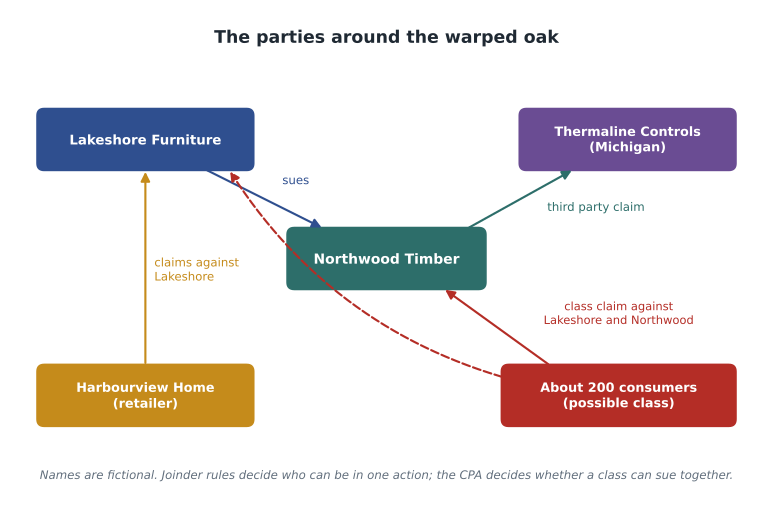
Professor Renaud draws a map on the whiteboard with Northwood Timber in the middle. Around it he writes every person who might have a claim connected with the warped oak: Lakeshore Furniture; Harbourview Home, the retailer that had to pull 140 tables from its showroom and lost sales; Thermaline Controls, the Michigan company that made the kiln controller; and, in a cloud at the edge, the customers who had already bought warped tables before the recall, perhaps two hundred households across Ontario, each with a claim worth a few thousand dollars. 'Who should be in the same lawsuit?' he asks. 'And what happens to the customers, none of whom will ever sue on their own for a 2,500 dollar table?'
The rules on parties answer the first question. The Class Proceedings Act, 1992 answers the second.
Joinder of claims and parties
Rule 5 governs joinder. Under Rule 5.01, a plaintiff may join in the same proceeding any claims it has against an opposing party. Under Rule 5.02(1), two or more persons who are represented by the same lawyer may join as plaintiffs where their claims arise out of the same transaction or occurrence or series of transactions or occurrences, a common question of law or fact may arise, or joinder may promote the convenient administration of justice. Under Rule 5.02(2), two or more persons may be joined as defendants on similar grounds, including where there is doubt as to which of them the plaintiff is entitled to relief against. A plaintiff who is unsure whether the warping was caused by Northwood's drying or by a trucking company's storage during delivery may sue both.
Rule 5.03 requires the joinder of every person whose presence is necessary to enable the court to adjudicate effectively and completely on the issues, and Rule 5.04 provides that a proceeding shall not be defeated by the misjoinder or non-joinder of a party and allows the court to add, delete or substitute parties at any stage, on terms, unless prejudice would result that could not be compensated by costs or an adjournment. Rule 5.04(2) is the procedural route for adding a defendant; as lesson 3 explained, section 21 of the Limitations Act, 2002 bars adding a party after the limitation period against that party has expired, except to correct a misnomer.
Joinder is not unlimited. Rule 5.05 allows the court to order separate hearings, require a party to elect between claims, or make other orders where joinder of multiple claims or parties may unduly complicate or delay the hearing or cause undue prejudice. Rule 6 allows the court to consolidate two or more proceedings, or have them heard together or one after another, where they have a question of law or fact in common or arise from the same transaction or occurrence. If Harbourview sues Lakeshore in one action while Lakeshore sues Northwood in another, a court would likely order the actions heard together.
Special kinds of parties
Some parties need special rules. Under Rule 7, a party under disability, which includes a minor and a person who is mentally incapable within the meaning of the Substitute Decisions Act, 1992 in respect of an issue in the proceeding, must commence, continue or defend a proceeding through a litigation guardian. The litigation guardian, often a parent for a minor, instructs the lawyer, and any settlement of a claim by or against a party under disability requires the court's approval under Rule 7.08, so that the court can protect the person's interests. The Children's Lawyer may act for minors in some cases, and the Public Guardian and Trustee may act for incapable adults.
Under Rule 8, a partnership may sue or be sued in the firm name, and Rule 8.06 lets a plaintiff who obtains judgment against the partnership enforce it against the partners in certain circumstances. Under Rule 9, an estate is represented by its estate trustee. Under Rule 10, the court may appoint a person to represent persons who are unborn, unascertained or not readily ascertained, for example in disputes about the interpretation of a trust. Under Rule 12, separate rules govern proceedings under the Class Proceedings Act, 1992. Under Rule 13, a person who is not a party may move for leave to intervene as an added party or as a friend of the court, which is common in public interest litigation.
Corporations face a particular rule. Rule 15.01(2) provides that a party to a proceeding that is a corporation shall be represented by a lawyer, except with leave of the court. A small business owner cannot appear in the Superior Court on behalf of the company without leave, although the Small Claims Court allows corporations to be represented by an authorized employee or a licensed paralegal. Courts grant leave sparingly, considering the corporation's means, the complexity of the case and whether the proposed representative can follow the rules.
Why class proceedings exist
The customers in Renaud's cloud illustrate a problem every legal system faces: many people suffer the same wrong, but each loss is too small to justify a lawsuit. Without a group procedure, the wrongdoer keeps the benefit of the wrong. In Western Canadian Shopping Centres Inc. v. Dutton, 2001 SCC 46, the Supreme Court identified three goals of class actions: judicial economy, by avoiding duplicate proceedings; access to justice, by making economical the prosecution of claims that would otherwise be too costly; and behaviour modification, by ensuring that wrongdoers do not ignore their obligations to the public. Ontario courts interpret the Class Proceedings Act, 1992, S.O. 1992, c. 6, generously in light of those goals, while insisting that the statutory criteria be met.
Certification
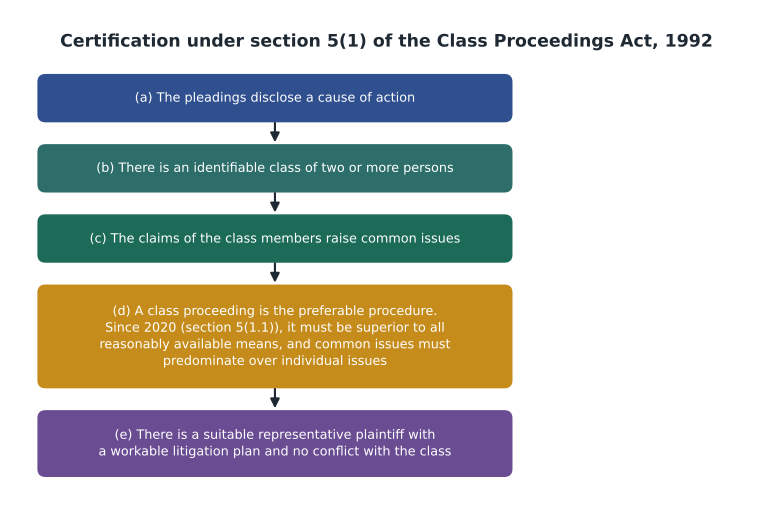
A class proceeding begins as an ordinary action by a proposed representative plaintiff on behalf of a proposed class. It becomes a class proceeding only when the court certifies it. Section 5(1) of the Act requires the court to certify a class proceeding if five requirements are met: the pleadings or notice of application disclose a cause of action; there is an identifiable class of two or more persons that would be represented by the representative plaintiff; the claims of the class members raise common issues; a class proceeding would be the preferable procedure for the resolution of the common issues; and there is a representative plaintiff who would fairly and adequately represent the interests of the class, has produced a plan for the proceeding that sets out a workable method of advancing it and notifying class members, and does not have, on the common issues, an interest in conflict with the interests of other class members.
The first requirement uses the same test as a motion to strike: the claim must not be plain and obvious to fail. For the other requirements, the representative plaintiff must show some basis in fact. In Hollick v. Toronto (City), 2001 SCC 68, a resident who sued the city over noise and pollution from a landfill on behalf of 30,000 neighbours was denied certification because a class proceeding was not the preferable procedure: the individual issues of how each resident was affected predominated, and a small claims fund and a provincial environmental process offered alternatives. In Pro-Sys Consultants Ltd. v. Microsoft Corporation, 2013 SCC 57, the Court confirmed that the some basis in fact standard is not a merits test but requires more than symbolic evidence, and that in price-fixing cases the plaintiff must offer a credible and plausible methodology for proving loss on a class-wide basis.
The 2020 amendments
Ontario amended the Act in 2020 through the Smarter and Stronger Justice Act, 2020, with most changes in force on October 1, 2020. The most significant change is section 5(1.1), which provides that a class proceeding is the preferable procedure only if it is superior to all reasonably available means of determining the entitlement of the class members to relief or addressing the impugned conduct of the defendant, including, as applicable, a quasi-judicial or administrative proceeding, the case management of individual claims in a civil proceeding, or any remedial scheme or program outside of a proceeding; and the questions of fact or law common to the class members predominate over any questions affecting only individual class members.
Superiority and predominance were familiar from American class action law, and the amendments were widely seen as raising the bar for certification in Ontario. Courts applying section 5(1.1) have refused certification where individual issues such as causation and damages would overwhelm the common issues, or where a regulatory compensation program or a voluntary recall offered a realistic alternative. Other 2020 amendments include section 29.1, which requires the court to dismiss a class proceeding for delay if the representative plaintiff has not taken specified steps, such as filing a final certification record, within one year of commencement, unless the parties agree to a timetable or the court orders otherwise; changes to the rules on carriage motions between competing class actions; a requirement that the court approve third party litigation funding agreements; and provisions on distribution and reporting of settlement funds.
Costs and funding
Ontario class actions differ from American ones in an important way: the losing party generally pays costs. A representative plaintiff who loses the certification motion may face a substantial costs award. The Class Proceedings Fund, administered by the Law Foundation of Ontario, can provide financial support for disbursements and indemnify representative plaintiffs against adverse costs, in exchange for a levy of ten percent of any award or settlement plus return of the funding. Private third party funders also finance some actions, subject to court approval since 2020. Section 31 of the Act allows the court to consider whether the case was a test case, raised a novel point of law or involved a matter of public interest in deciding costs. Class counsel usually act on a contingency basis, and their fees must be approved by the court.
After certification
Once a class proceeding is certified, class members must be given notice and an opportunity to opt out by a deadline. Those who do not opt out are bound by the result. The common issues are tried together, and if the class succeeds, individual issues such as each member's damages are resolved through procedures the court sets, which may include individual hearings, a claims process, or aggregate damages under section 24 where the defendant's liability can be reasonably determined without proof by individual members. Settlements require court approval under section 27.1 as fair, reasonable and in the best interests of the class. Most certified class actions settle.
The Lakeshore customers
Renaud asks whether the customers' claim against Lakeshore and Northwood could be certified. Sophie Tremblay-Hart points out that some of the tables were sold through a retailer in Montreal, which raises the difficult question whether an Ontario court should certify a national class that includes residents of Quebec, where a separate class action could be authorized under Quebec's own procedure. Arjun Mehta lists the common issues: whether the second load was defective, whether Northwood knew of the kiln problem, whether Lakeshore was negligent in not testing. Hannah Kowalczyk argues for the defendants: each household's damages depend on whether its table warped, how badly and whether it accepted Lakeshore's repair offer, so individual issues might predominate. And if Lakeshore launched a voluntary replacement program, a court applying section 5(1.1) could find that the program, not a class action, is the superior means of addressing the problem. 'That,' Renaud says, 'is why defendants now design recalls with one eye on certification.'
Worked problem
Assessing certification for the table buyers
A Corwin customer, Dana Fitzgerald, proposes to sue Lakeshore and Northwood on behalf of everyone in Canada who bought a table made with the May load. About 200 tables were sold before the recall, most in Ontario and about 30 in Quebec. Lakeshore offers every buyer a free replacement. Apply section 5 of the Class Proceedings Act, 1992.
Show solution
- Cause of action: breach of warranty under the Sale of Goods Act and consumer protection legislation against Lakeshore, and negligence against Northwood, are not plainly doomed.
- Identifiable class: buyers of tables made from the May load can be identified from Lakeshore's sales records.
- Common issues: whether the load was defective, whether the defect caused warping and whether either defendant was negligent are common.
- Preferable procedure: under section 5(1.1), the court must ask whether a class action is superior to all reasonably available means, including Lakeshore's replacement program, and whether common issues predominate over individual damages issues. The replacement offer weighs heavily against certification if it gives buyers full relief.
- Representative plaintiff: Fitzgerald must produce a workable litigation plan and show no conflict with other class members, such as those who already accepted replacements. Quebec buyers raise multi-jurisdictional issues.
Common mistakes
MistakeTreating certification as a decision on the merits.
InsteadCertification asks whether the claim can proceed as a class action; the some basis in fact standard is not a merits test (Pro-Sys).
MistakeIgnoring alternatives such as recalls and regulatory programs.
InsteadSince 2020, section 5(1.1) requires a class proceeding to be superior to all reasonably available means.
MistakeLetting a small corporation appear through its owner in the Superior Court.
InsteadRule 15.01(2) requires a lawyer unless the court grants leave.
MistakeSettling a minor's claim without the court.
InsteadRule 7.08 requires court approval of settlements involving parties under disability.
Practice problems
Work each problem on paper first, then reveal the answer to check.
What are the three goals of class actions identified in Dutton?
Show answer
Judicial economy, access to justice and behaviour modification.
List the five certification requirements in section 5(1).
Show answer
A cause of action, an identifiable class, common issues, a preferable procedure and a suitable representative plaintiff with a workable plan and no conflict.
What did section 5(1.1), added in 2020, require?
Show answer
That a class proceeding be superior to all reasonably available means and that common issues predominate over individual issues.
Who must act for a minor in an Ontario civil proceeding?
Show answer
A litigation guardian, and any settlement requires court approval under Rule 7.08.
What does Rule 5.04 permit?
Show answer
Adding, deleting or substituting parties at any stage unless non-compensable prejudice would result, subject to limitation periods.
Summary and key terms
- Rule 5 allows joinder of claims and parties arising from the same transactions or raising common questions, and Rules 5.05 and 6 manage complexity.
- Parties under disability act through litigation guardians, and their settlements need court approval.
- Corporations must be represented by a lawyer in the Superior Court unless the court grants leave.
- Class actions serve judicial economy, access to justice and behaviour modification (Dutton).
- Certification requires five elements; Hollick and Pro-Sys explain the some basis in fact standard.
- Since 2020, section 5(1.1) adds superiority and predominance, and section 29.1 requires dismissal for delay.
- Joinder
- Including multiple claims or parties in one proceeding.
- Litigation guardian
- The person who conducts a proceeding on behalf of a minor or incapable person.
- Class proceeding
- An action brought by a representative plaintiff on behalf of a class, certified under the Class Proceedings Act, 1992.
- Certification
- The court order allowing an action to proceed as a class proceeding.
- Common issues
- Issues of fact or law shared by all class members that can be decided together.
- Predominance
- The requirement, since 2020, that common issues outweigh individual issues for a class proceeding to be preferable.
Lesson quiz · 5 questions
Score 60% or more to complete this lesson.
Create a free account to save your progress, take quizzes and earn a certificate.