
LAWC-201 · Lesson 4 of 12 · 23 min
Commencing a proceeding and service
▶ Video coming soon A video version of this lesson is on the way.
Lakeshore has decided to sue. Professor Renaud asks the class to imagine they are the junior associate at Pardee & Lowe LLP, the Corwin firm the class met in Legal Research and Writing, and that the partner has handed them the Lakeshore file with a two-line note: 'Get it started. Get it served.' That instruction hides a series of choices, each with its own rules: what kind of proceeding to bring, which document starts it, how it is issued, who must be served and how, and what happens if the defendant does nothing.
Actions and applications
The Rules of Civil Procedure provide two kinds of civil proceedings in the Superior Court: actions and applications. An action is the default. It is started by a statement of claim or a notice of action, proceeds through pleadings and discovery, and ends in a trial with live witnesses if it does not settle or end earlier. An application is a faster, paper-based proceeding started by a notice of application and decided on affidavit evidence, usually at a single hearing, with cross-examinations on affidavits instead of examinations for discovery.
Rule 14.02 provides that every proceeding is to be commenced by statement of claim unless a statute or the Rules provide otherwise. Rule 14.05(3) lists cases in which a proceeding may be started by application, including the determination of rights that depend on the interpretation of a deed, will, contract or other instrument, the declaration of an interest in land, the approval of a sale or other transaction, and cases where it is unlikely there will be any material facts in dispute requiring a trial. Many statutes also say that a proceeding is to be brought by application. The test in practice is whether there are material facts in dispute: if credibility contests and conflicting accounts will need to be resolved, the court may convert an application into an action or direct the trial of an issue under Rule 38.10.
Lakeshore's claim involves disputed facts about what Northwood's sales manager said, what moisture level was delivered, and why. It belongs in an action. A dispute between Lakeshore and its landlord about the meaning of a renewal clause in a commercial lease, where the facts are agreed and only the interpretation is contested, might well proceed by application.
Starting an action
An action is commenced when the registrar issues the originating process. Rule 14.03(1) provides that the originating process is ordinarily a statement of claim, in Form 14A for a general claim. The statement of claim sets out the parties, the relief claimed, and the material facts on which the plaintiff relies; lesson 5 deals with how it is drafted. Where there is not enough time to prepare a statement of claim before a limitation period expires, Rule 14.03(2) permits the plaintiff to start the action by issuing a notice of action, a short document containing a brief statement of the nature of the claim, and then to file the statement of claim within 30 days after the notice of action is issued.
Issuing means that the registrar dates, signs and seals the document and assigns it a court file number. Ontario's Civil Claims Online portal allows lawyers and parties to issue statements of claim in many types of actions electronically, and the court's electronic filing systems allow later documents to be filed online. Filing fees are set by regulation. The date of issue matters for limitation purposes: a proceeding is commenced, and the limitation clock stops, when the originating process is issued, not when it is served.
Since February 1, 2026, the originating process must name a county with a rational connection to the proceeding, as lesson 1 explained. The statement of claim also names the place of trial. If the plaintiff wants a jury, a jury notice may be delivered under Rule 47.01 before the close of pleadings, subject to the exceptions discussed in lesson 11.
Time for service
Rule 14.08(1) requires a statement of claim to be served within six months after it is issued. Where an action is commenced by notice of action, both documents are served together within six months after the notice of action is issued. If the plaintiff cannot serve in time, it may move under Rule 3.02 to extend the time; courts consider whether the plaintiff tried diligently to serve and whether the defendant would be prejudiced by the extension, bearing in mind that an extension after the limitation period has expired deprives the defendant of its limitation defence. Lawyers commonly issue a claim close to the limitation date and then use the six months to investigate further, negotiate or prepare amendments.
Personal service and its alternatives
An originating process must be served personally or by an alternative to personal service permitted by Rule 16.03, unless the court orders substituted service. Rule 16.02 explains how personal service is made on different kinds of parties. On an individual, it is made by leaving a copy with the individual. On a corporation, it is made by leaving a copy with an officer, director or agent of the corporation, or with a person at any place of business of the corporation who appears to be in control or management of the place of business. On a municipality, the Crown, a partnership, a sole proprietorship, a minor or a person under disability, the Rule names the person to be served, such as the clerk of a municipality or the litigation guardian of a person under disability.
Rule 16.03 permits alternatives to personal service. The plaintiff's lawyer may serve the defendant's lawyer if the lawyer accepts service in writing. The document may be mailed to the defendant's last known address, but service is effective only when the defendant returns a signed acknowledgment of receipt card. For an individual, the document may be left at the individual's residence with an apparently adult member of the household and a copy mailed or couriered to the same place the next day. For a corporation, if the head office or principal place of business cannot be found at the address on record with the government, the document may be mailed or couriered to that address. Where none of these methods works, Rule 16.04 allows the court to order substituted service, for example by email, text message or social media, or to dispense with service, if it is satisfied that the method is likely to bring the document to the person's attention.
Once a party has been served with the originating process and has a lawyer of record, most later documents are served on the lawyer, often by email under Rule 16.05. A party acting in person gives an address for service, which may include an email address.
For Lakeshore, service on Northwood Timber is straightforward. The associate checks the corporate profile report for Northwood's registered office and its current directors, and arranges for a process server to deliver the claim to an officer or to the person in charge at the mill office. The process server then swears an affidavit of service, which becomes the proof of service the court will need if Northwood does not respond.
Service outside Ontario
Service on a defendant outside Ontario raises the jurisdictional issues in lesson 2 and some additional formalities. Rule 17.02 lists cases in which an originating process may be served outside Ontario without leave; Rule 17.03 permits service with leave in other cases. Rule 17.04 requires the originating process served outside Ontario without leave to disclose the facts and the specific provisions of Rule 17.02 relied on. Rule 17.05 governs the manner of service: where the defendant is in a country that is a party to the Hague Convention on the Service Abroad of Judicial and Extrajudicial Documents in Civil or Commercial Matters, service must be made through the central authority or by another method permitted by the Convention and not objected to by that country. Canada and the United States are both parties. In the United States, which does not object to service by agents, a plaintiff can usually retain a local process server; some other countries require service through their central authority, which can take months. Translation may also be required.
Time to defend
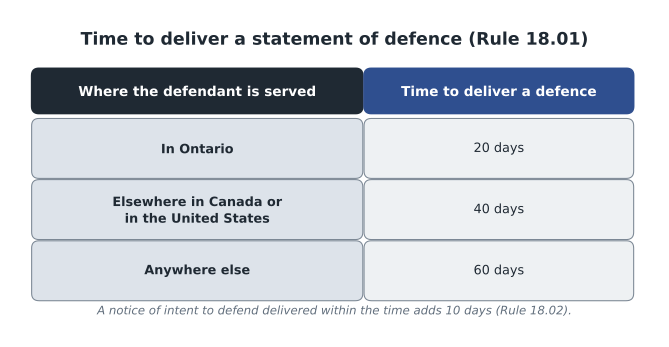
After service, the defendant has a fixed time to deliver a statement of defence. Under Rule 18.01, it is 20 days if the defendant is served in Ontario, 40 days if served elsewhere in Canada or in the United States, and 60 days if served anywhere else. Under Rule 18.02, a defendant who intends to defend may instead deliver a notice of intent to defend within the time for delivering a defence, which gives it an additional 10 days to deliver the defence itself. Lawyers routinely agree to extensions as a matter of professional courtesy, and the courtesy and good faith that the Law Society's Rules of Professional Conduct expect of lawyers generally mean warning a represented opponent before noting it in default.
Default proceedings
If a defendant fails to deliver a defence within the time allowed, the plaintiff may have the defendant noted in default under Rule 19.01, on filing proof of service. A defendant noted in default is deemed to admit the truth of all allegations of fact in the statement of claim, is not entitled to notice of most later steps, and may not deliver a defence or take other steps without leave of the court or the plaintiff's consent.
Default judgment then follows in one of two ways. Where the claim is for a debt or liquidated demand in money, the recovery of possession of land or personal property, or the foreclosure, sale or redemption of a mortgage, the registrar may sign default judgment on request under Rule 19.04. In other cases, including claims for unliquidated damages such as Lakeshore's lost profits, the plaintiff must move before a judge for judgment under Rule 19.05, and the judge will grant judgment only if the facts deemed admitted entitle the plaintiff to it, often with evidence on the quantum of damages. A default judgment is not automatic justice: the court must still be satisfied that the pleaded facts support the relief.
A defendant may move to set aside a noting in default or a default judgment under Rule 19.03 and Rule 19.08. In Mountain View Farms Ltd. v. McQueen, 2014 ONCA 194, the Ontario Court of Appeal summarized the factors a court considers on a motion to set aside a default judgment: whether the motion was brought promptly after the defendant learned of the judgment; whether there is a plausible excuse or explanation for the default; whether the defendant has an arguable defence on the merits; the potential prejudice to the moving party and to the respondent if the motion is granted or refused; and the effect of any order on the overall integrity of the administration of justice. These are not rigid tests; the court decides what is just in the circumstances.
Applications in brief
An application follows a different path. The applicant issues a notice of application, in Form 14E, which states the relief sought, the grounds and the evidence to be used, and sets a hearing date. It must be served at least ten days before the hearing date, or longer if served outside Ontario, along with the applicant's affidavits. The respondent delivers responding affidavits, the parties may cross-examine on the affidavits under Rule 39.02, and the application is argued on the record before a judge. If the judge finds material facts in dispute that cannot be resolved on the record, the judge may order a trial of an issue or direct that the application proceed as an action.
The pre-litigation stage
Renaud reminds the class that a lawsuit rarely starts with a statement of claim. Most begin with a demand letter, often with a deadline, and with a litigation hold, an instruction to the client to preserve documents and electronic records. Lakeshore must keep the warped tables, the moisture test results, emails with Northwood, and records of the recall and the lost Harbourview orders. Destroying evidence after litigation is reasonably anticipated can lead to adverse inferences or other sanctions. The Civil Rules Review's Final Policy Report recommends mandatory pre-litigation protocols for many claims, requiring parties to exchange key information before suing, but those protocols are not in force; for now, pre-litigation conduct is a matter of good practice, professional obligation and costs consequences.
Worked problem
Starting Lakeshore v. Northwood a week before the deadline
Assume the partner gives the associate the file a week before the two-year limitation period expires. The statement of claim is not drafted, Northwood's lawyers have agreed to accept service, and Thermaline Controls is in Michigan. What should the associate do?
Show solution
- Issue a notice of action under Rule 14.03(2) immediately, naming Northwood and stating briefly the nature of the claim, the relief and the county with a rational connection (for example, the county including Corwin). Issuing stops the limitation clock.
- File the statement of claim within 30 days after the notice of action is issued, and serve both within six months under Rule 14.08.
- Ask Northwood's lawyers to accept service in writing under Rule 16.03(2), and diarize the defence deadline: 20 days in Ontario, or 30 if Northwood delivers a notice of intent to defend.
- If Lakeshore also wants to sue Thermaline, consider whether service outside Ontario is permitted without leave under Rule 17.02 and how service will be made in Michigan under Rule 17.05; Thermaline will have 40 days to defend.
- Send Lakeshore a litigation hold letter so the evidence is preserved.
Common mistakes
MistakeThinking the limitation period stops when the claim is served.
InsteadThe proceeding is commenced, and the clock stops, when the originating process is issued.
MistakeMailing the claim to a corporation's office and treating it as served.
InsteadMail service is effective only when the defendant returns a signed acknowledgment of receipt card (Rule 16.03(4)).
MistakeAsking the registrar to sign default judgment for unliquidated damages.
InsteadOnly liquidated and certain other claims are signed by the registrar; unliquidated claims require a motion to a judge under Rule 19.05.
MistakeStarting an application when credibility is in dispute.
InsteadApplications suit cases without material facts in dispute; otherwise the court may convert the proceeding or order a trial of an issue.
Practice problems
Work each problem on paper first, then reveal the answer to check.
Within what time must a statement of claim be served?
Show answer
Within six months after it is issued (Rule 14.08(1)).
How is personal service made on a corporation?
Show answer
By leaving a copy with an officer, director or agent, or with a person at a place of business who appears to be in control or management (Rule 16.02(1)(c)).
How long does a defendant served in Ontario have to deliver a defence?
Show answer
Twenty days, or ten days more if it delivers a notice of intent to defend.
What are the effects of being noted in default?
Show answer
The defendant is deemed to admit the facts alleged, is not entitled to notice of most steps, and needs leave or consent to defend.
What factors from Mountain View Farms guide setting aside a default judgment?
Show answer
Promptness, a plausible explanation for the default, an arguable defence, prejudice to each side, and the integrity of the administration of justice.
Summary and key terms
- Proceedings are actions (by statement of claim or notice of action) or applications (by notice of application, decided on affidavits).
- A proceeding is commenced when the originating process is issued; a notice of action buys 30 days to file the statement of claim.
- The statement of claim must be served within six months, by personal service, an alternative under Rule 16.03, or substituted service.
- Service outside Ontario follows Rules 17.02 to 17.05 and, where it applies, the Hague Service Convention.
- The time to defend is 20, 40 or 60 days depending on where service is made, plus ten days with a notice of intent to defend.
- Default judgment requires a judge for unliquidated damages; Mountain View Farms guides motions to set it aside.
- Action
- A proceeding started by statement of claim or notice of action that ends in a trial if not resolved earlier.
- Application
- A proceeding started by notice of application and decided on affidavit evidence.
- Form 14C (notice of action)
- A short originating document used when there is not enough time to prepare a statement of claim.
- Personal service
- Delivering the document to the person, or to a specified representative of a corporation or other entity.
- Substituted service
- Service by a method the court orders because the usual methods are impractical.
- Noting in default
- The registrar's recording that a defendant failed to defend, with deemed admission of the facts pleaded.
Lesson quiz · 5 questions
Score 60% or more to complete this lesson.
Create a free account to save your progress, take quizzes and earn a certificate.