
LAWC-201 · Lesson 10 of 12 · 21 min
Costs and enforcing judgments
▶ Video coming soon A video version of this lesson is on the way.
Professor Renaud begins with two numbers. The first is what Lakeshore will spend on lawyers if Lakeshore v. Northwood goes to a two-week trial. With pleadings, an affidavit of documents of several thousand pages, examinations for discovery, two or three experts, motions, a pre-trial and the trial itself, the bill could easily run into the hundreds of thousands of dollars. The second is how much of that Lakeshore can expect to recover from Northwood if it wins. Even a complete victory usually recovers only part of what was spent. 'Costs,' he says, 'are the price of admission and the penalty for being wrong. You cannot advise a client about a lawsuit without explaining both.'
The costs principle
Ontario, like the rest of Canada and most common law jurisdictions outside the United States, follows a loser pays principle. Section 131(1) of the Courts of Justice Act provides that, subject to the provisions of an Act or rules of court, the costs of and incidental to a proceeding or a step in a proceeding are in the discretion of the court, and the court may determine by whom and to what extent the costs shall be paid. In practice, costs follow the event: the successful party is ordinarily entitled to a contribution to its legal costs from the unsuccessful party. Costs serve several purposes: partially indemnifying successful litigants, encouraging settlement, discouraging frivolous claims and defences, and discouraging inappropriate behaviour in the litigation.
Rule 57.01(1) lists factors the court may consider in exercising its discretion, in addition to the result and any written offers to settle. They include the principle of indemnity, including the experience of the lawyer, the rates charged and the hours spent; the amount of costs that an unsuccessful party could reasonably expect to pay; the amount claimed and the amount recovered; the apportionment of liability; the complexity of the proceeding; the importance of the issues; the conduct of any party that tended to shorten or to lengthen unnecessarily the duration of the proceeding; whether any step was improper, vexatious or unnecessary or taken through negligence, mistake or excessive caution; a party's denial of or refusal to admit anything that should have been admitted; and any other matter relevant to costs.
Scales of costs
Costs are awarded on scales defined in Rule 1.03. Partial indemnity costs are the usual award. Substantial indemnity costs are 1.5 times partial indemnity costs. Full indemnity costs cover all reasonable fees and disbursements. There is no fixed tariff for the hourly rates used in partial indemnity awards; Ontario abolished its costs grid in 2005, and courts now fix costs by reference to the factors in Rule 57.01 and the parties' costs outlines. As a rough practical matter, partial indemnity awards often recover something in the range of half to two thirds of a party's actual reasonable fees, though the result varies widely with the case.
Elevated costs, on a substantial or full indemnity scale, are reserved for special cases: where Rule 49.10 applies, where a contract between the parties provides for them, or where a party has engaged in reprehensible, scandalous or outrageous conduct in the litigation, such as making unfounded allegations of fraud or dishonesty. Losing a case is not misconduct, and courts do not award elevated costs simply because a claim or defence failed.
Fixing costs: Boucher
In Boucher v. Public Accountants Council for the Province of Ontario (2004), 71 O.R. (3d) 291, the Ontario Court of Appeal set out the governing approach to fixing costs. The court must not simply multiply the hours claimed by an hourly rate. The overall objective is to fix an amount that is fair and reasonable for the unsuccessful party to pay in the particular proceeding, rather than an amount fixed by the actual costs incurred by the successful litigant. The reasonable expectations of the losing party, often measured by its own costs outline, are relevant. A judge who fixes costs at the end of a hearing considers both sides' costs outlines and the Rule 57.01 factors and arrives at a global figure. Costs may instead be assessed by an assessment officer under Rule 58, a more detailed review, but most costs in the Superior Court are now fixed by the judge.
Costs are also awarded on motions. Under Rule 57.03, on the hearing of a contested motion, the court shall fix the costs of the motion and order them to be paid within 30 days, unless it is satisfied that a different order would be more just. This rule makes motions expensive for the losing side immediately, not just at the end of the case.
Special costs rules
Several special rules affect costs. Under the simplified procedure in Rule 76, the costs a party may recover are capped, and a plaintiff who recovers an amount within the jurisdiction of the Small Claims Court in a simplified procedure action may be denied costs. In the Small Claims Court, section 29 of the Courts of Justice Act limits costs, excluding disbursements, to 15 percent of the amount claimed or the value of the property sought, unless the court considers it necessary to penalize a party or a party's representative for unreasonable behaviour. Under Rule 57.07, the court may order a lawyer personally to pay costs where the lawyer has caused costs to be incurred without reasonable cause or to be wasted by undue delay, negligence or other default, a jurisdiction courts use sparingly. Self-represented litigants may receive costs for their time in appropriate cases, and public interest litigants may sometimes be relieved of adverse costs.
The leading case on self-represented litigants is Fong v. Chan (1999), 46 O.R. (3d) 330, where the Court of Appeal held that a self-represented litigant, whether or not a lawyer, may recover costs for time spent on the case, but only modestly and only where the litigant devoted time and effort to work ordinarily done by a lawyer and, as a result, gave up remunerative activity. Courts also award costs thrown away when a step is wasted, for example when a trial date is lost because one side was not ready or a motion is adjourned at the last minute. These orders are usually fixed on the spot and payable promptly, and they are one of the most practical ways judges enforce the duty in Rule 1.04 to run proceedings efficiently.
Costs can also be ordered against a party in advance as a condition of continuing, as with security for costs under Rule 56, discussed in lesson 8. In family and estates litigation, special principles apply; for example, in estates cases costs were once routinely paid out of the estate, but modern courts apply the loser pays principle unless the litigation was caused by the testator or was reasonably necessary to ensure the estate was properly administered.
Contingency fees
Many plaintiffs cannot afford to pay a lawyer by the hour, and Ontario permits contingency fee agreements, under which the lawyer is paid a percentage of the recovery and nothing if the case is lost. Contingency fee agreements are regulated by the Solicitors Act and its regulations, which require written agreements in a standard form for many retainers, disclosure to the client and, in some cases, court approval. A contingency fee agreement does not change the costs rules between the parties: the losing party pays costs to the winner, and the lawyer's fee comes out of the client's recovery under the agreement. A client on a contingency arrangement who loses may still be liable to pay the other side's costs, which is why adverse costs insurance and the Class Proceedings Fund exist.
Interest
A judgment for money carries interest. Section 128 of the Courts of Justice Act provides for prejudgment interest on a money judgment from the date the cause of action arose to the date of the order, at the prejudgment interest rate published quarterly by the government. Special rules apply to non-pecuniary damages in personal injury cases, which carry a different prescribed rate. Section 129 provides for postjudgment interest from the date of the order until payment, at the published postjudgment rate. The court has discretion under section 130 to vary the rate or the period of prejudgment interest, for example where the plaintiff delayed unreasonably. Interest on a long-running commercial claim can add a substantial amount to the judgment, which matters for Rule 49 comparisons and for settlement negotiations.
Enforcing a judgment
A judgment is an order to pay; it is not payment. If Northwood does not pay a judgment voluntarily, Lakeshore must enforce it. Rule 60 provides the tools, and Renaud stresses that the judgment creditor, not the court, must take the initiative.
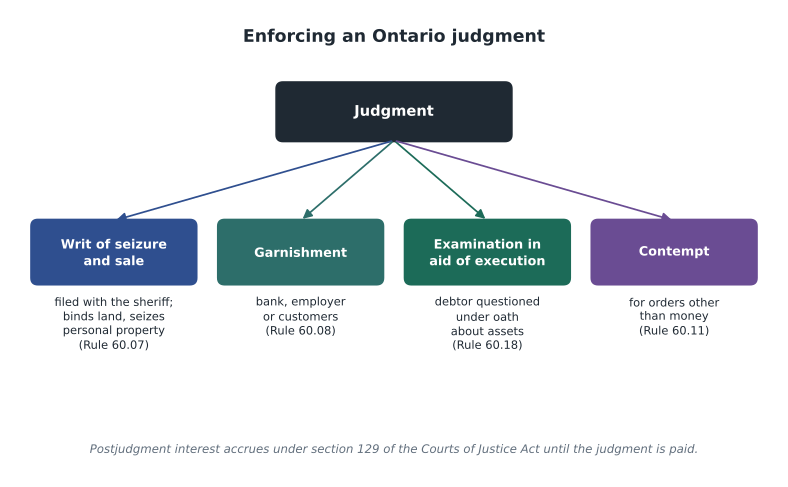
A writ of seizure and sale, issued under Rule 60.07 and filed with the sheriff of a county where the debtor has property, directs the sheriff to seize and sell the debtor's personal property and land to satisfy the judgment. Once filed, the writ binds the debtor's land in that county, so the debtor cannot sell or mortgage it without paying off the writ. A writ remains in force for six years and may be renewed. Certain property is exempt from seizure under the Execution Act, such as basic household furnishings and tools of a trade up to prescribed amounts.
Garnishment under Rule 60.08 allows the creditor to intercept money owed to the debtor by third parties, such as a bank account, a debt owed by a customer, or wages. A notice of garnishment is issued and served on the garnishee, who must pay the money into court or to the sheriff. Wages are partly protected: under the Wages Act, 80 percent of wages are exempt from garnishment for ordinary debts, a lower proportion for support orders, and the court may vary the exemption.
An examination in aid of execution under Rule 60.18 lets the creditor examine the debtor, or for a corporation an officer or director, under oath about the debtor's income and property, debts owed to the debtor, and dispositions of property. A debtor who fails to attend or answer may be held in contempt. Examinations are often the first step, because they tell the creditor where the assets are. For orders other than money, such as an injunction, Rule 60.11 allows a motion for contempt, which can lead to fines or imprisonment for wilful disobedience.
Other tools include the appointment of a receiver by the court under section 101 of the Courts of Justice Act to take control of a debtor's property or business, charging orders against certain interests, and enforcement in other provinces or countries where the debtor has assets, as discussed in lesson 2. If the debtor is insolvent, enforcement may be stayed by bankruptcy or insolvency proceedings under federal law, and the creditor becomes one unsecured creditor among many.
Advising Lakeshore
Renaud brings the lesson back to the client. Before Lakeshore commits to a two-week trial, it needs advice on what it might win, what it will spend, what it might recover in costs if it wins, what it might pay in costs if it loses, and whether Northwood can pay a judgment. Northwood is an operating sawmill with land, equipment and receivables, so a judgment is probably collectible. Thermaline, in Michigan, would require a separate enforcement step. Lakeshore's lawyers should prepare a realistic budget, explain the scales of costs and the effect of offers, and revisit the analysis at every major stage. 'The best litigation lawyers,' Renaud says, 'are the ones who tell their clients the truth about money.'
Worked problem
Estimating Lakeshore's net recovery
Suppose Lakeshore wins 300,000 dollars plus prejudgment interest at trial. Its actual reasonable legal fees and disbursements were 280,000 dollars. No Rule 49 offer applies. The judge fixes partial indemnity costs at 165,000 dollars. Northwood pays the judgment and costs. Roughly what does Lakeshore keep, and what would happen if it had lost?
Show solution
- If Lakeshore wins: it receives 300,000 dollars plus interest and 165,000 dollars in costs, and pays its lawyers 280,000 dollars, keeping roughly 185,000 dollars plus interest. Winning still leaves a gap between costs recovered and costs spent.
- If Lakeshore loses: it receives nothing, pays its own lawyers 280,000 dollars and likely pays Northwood's partial indemnity costs, perhaps a similar amount, for a total loss well above 400,000 dollars.
- Rule 49 offers could change both figures: a successful plaintiff's offer would raise costs to substantial indemnity after the offer date; a rejected reasonable defence offer could shift costs to Northwood.
- If Northwood did not pay, Lakeshore would file a writ of seizure and sale, garnish Northwood's receivables and examine an officer under Rule 60.18.
Common mistakes
MistakeTelling a client that winning means the other side pays all its legal bills.
InsteadPartial indemnity costs usually recover only part of actual fees; full indemnity is exceptional.
MistakeFixing costs by multiplying hours by rates.
InsteadBoucher requires a fair and reasonable amount for the losing party to pay, considering its reasonable expectations.
MistakeSeeking elevated costs simply because the other side lost.
InsteadElevated costs require Rule 49, a contractual term or reprehensible conduct in the litigation.
MistakeAssuming the court will collect the judgment.
InsteadThe creditor must enforce it using writs, garnishment and examinations under Rule 60.
Practice problems
Work each problem on paper first, then reveal the answer to check.
What does section 131 of the Courts of Justice Act provide?
Show answer
Costs are in the discretion of the court, which may determine by whom and to what extent they are paid.
What is the Boucher approach to fixing costs?
Show answer
Fix an amount that is fair and reasonable for the unsuccessful party to pay, rather than simply the actual costs incurred.
When are elevated costs awarded?
Show answer
Under Rule 49.10, under a contract, or for reprehensible, scandalous or outrageous conduct in the litigation.
What does a writ of seizure and sale do?
Show answer
It directs the sheriff to seize and sell the debtor's property and binds the debtor's land in that county; it lasts six years and may be renewed.
What is an examination in aid of execution?
Show answer
An examination of the debtor under oath about income, assets and dispositions of property, under Rule 60.18.
Summary and key terms
- Costs are discretionary under section 131 but generally follow the event, guided by the Rule 57.01 factors.
- Partial indemnity is the usual scale; substantial indemnity is 1.5 times partial; full indemnity is exceptional.
- Boucher requires a fair and reasonable amount for the losing party to pay; motion costs are usually fixed and payable within 30 days.
- Special rules apply in the simplified procedure, the Small Claims Court and to lawyers personally.
- Prejudgment and postjudgment interest accrue under sections 128 and 129 of the Courts of Justice Act.
- Judgments are enforced through writs of seizure and sale, garnishment, examinations in aid of execution and contempt.
- Costs
- The contribution one party is ordered to pay toward another party's legal fees and disbursements.
- Partial indemnity
- The usual scale of costs, covering part of a party's reasonable fees.
- Full indemnity
- Costs covering all of a party's reasonable fees and disbursements.
- Writ of seizure and sale
- An enforcement document directing the sheriff to seize and sell a debtor's property.
- Garnishment
- Intercepting money owed to a debtor by a third party to satisfy a judgment.
- Prejudgment interest
- Interest on a money award from when the claim arose until judgment.
Lesson quiz · 5 questions
Score 60% or more to complete this lesson.
Create a free account to save your progress, take quizzes and earn a certificate.