
LAWC-201 · Lesson 7 of 12 · 22 min
Discovery
▶ Video coming soon A video version of this lesson is on the way.
Professor Renaud asks how many students have ever been in a deposition. A few hands go up from those who watched American television. 'In Ontario we call it examination for discovery,' he says, 'and it is the stage where most civil cases are actually won or lost.' Discovery is the process by which each party obtains, before trial, the documents and information the other side has about the issues in the action. It exists to prevent trial by ambush, to narrow the issues, to obtain admissions and to promote settlement by letting both sides assess their real chances. It is also where much of the cost of litigation is spent.
The class works through discovery in Lakeshore v. Northwood, assuming pleadings have closed. Lakeshore wants Northwood's kiln logs, its records of warping complaints, its emails about the faulty controller and its internal messages about not renewing Lakeshore's account. Northwood wants Lakeshore's storage records, its finishing process documents, its communications with Harbourview and every document about its claimed lost profits.
The discovery plan and proportionality
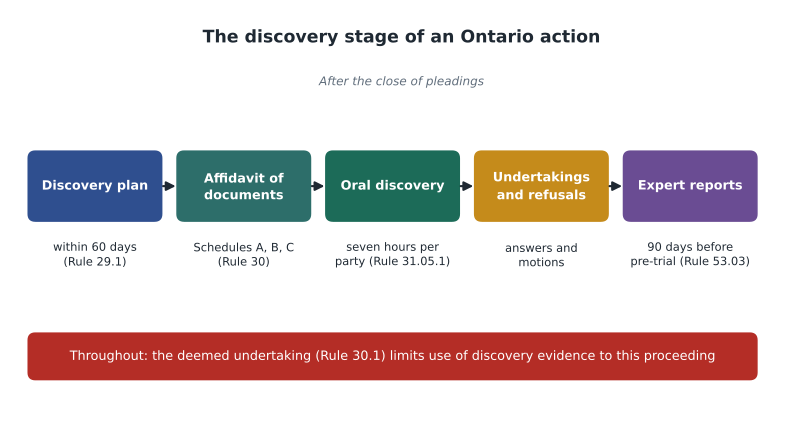
Rule 29.1.03 requires the parties to agree to a discovery plan within 60 days after the close of pleadings, or such longer period as they agree. The plan must address the intended scope of documentary discovery, dates for serving affidavits of documents, timing, costs and manner of production, the names of persons to be examined and the dates and length of examinations, and any other information intended to result in the expeditious and cost-effective completion of discovery. In preparing the plan, Rule 29.1.03(4) requires the parties to consult and have regard to the Sedona Canada Principles Addressing Electronic Discovery, a set of best-practice principles for electronic documents.
Rule 29.2 makes proportionality an explicit test. In deciding whether a party must answer a question or produce a document, the court shall consider whether the time required, the expense, the prejudice, the burden on the court and the availability of the information from other sources make the request unreasonable, and whether the request would unduly interfere with the orderly progress of the action or involve an excessive volume of documents. Proportionality is the counterweight to the broad definition of relevance: not every relevant document is worth its cost.
Documentary discovery
Under Rule 30.02(1), every document relevant to any matter in issue in an action that is or has been in the possession, control or power of a party shall be disclosed, whether or not privilege is claimed for it. Every such document shall be produced for inspection if requested, unless privilege is claimed. The test was narrowed in 2010 from 'relating to any matter in issue' to 'relevant to any matter in issue', and relevance is measured against the pleadings. Document has a broad meaning in Rule 30.01: it includes a sound recording, videotape, film, photograph, chart, graph, map, plan, survey, book of account and data and information in electronic form. Emails, text messages, social media posts, spreadsheets and metadata are all documents.
Each party serves an affidavit of documents, sworn by the party or, for a corporation, by an officer or employee with knowledge, listing in Schedule A the relevant documents it does not object to producing, in Schedule B the relevant documents it objects to producing on the grounds of privilege, with the grounds, and in Schedule C relevant documents that were formerly in its possession, control or power but are no longer, with an explanation. The lawyer must certify that the lawyer has explained to the deponent what relevant documents must be disclosed. Rule 30.07 imposes a continuing duty to disclose documents discovered later; a party that fails to disclose a document may not use it at trial without leave and may face costs or other sanctions.
Relevant documents in the hands of non-parties may be obtained with leave under Rule 30.10, if the document is relevant to a material issue and it would be unfair to require the moving party to proceed to trial without it. Lakeshore might want Thermaline's testing records for the controller model, if Thermaline is not a party.
Privilege
Privilege allows a party to withhold relevant documents from production. Solicitor-client privilege protects confidential communications between a lawyer and client for the purpose of seeking or giving legal advice. The Supreme Court treats it as nearly absolute and as a principle of fundamental justice. Litigation privilege protects documents created for the dominant purpose of existing or reasonably contemplated litigation, such as a lawyer's notes, a report commissioned to prepare for the lawsuit, or witness statements. In Blank v. Canada (Minister of Justice), 2006 SCC 39, the Supreme Court held that litigation privilege is distinct from solicitor-client privilege, applies to non-lawyers' documents created for litigation, and ends when the litigation and closely related proceedings end. In Lizotte v. Aviva Insurance Company of Canada, 2016 SCC 52, the Court held that litigation privilege is a class privilege that can be abrogated only by clear and explicit statutory language.
Settlement privilege protects communications made in an attempt to settle a dispute, so that parties can negotiate frankly. In Sable Offshore Energy Inc. v. Ameron International Corp., 2013 SCC 37, the Supreme Court held that the amounts of settlements reached with some defendants were protected from disclosure to remaining defendants, while the existence and terms other than amount of the settlement agreements had to be disclosed so the remaining defendants could adjust their positions. Lesson 9 returns to settlement.
For Lakeshore, the moisture test commissioned by its lawyer after the warping was discovered may attract litigation privilege if its dominant purpose was the anticipated lawsuit. But if Lakeshore commissioned the same test in the ordinary course to decide whether to use the remaining oak, the privilege claim would be weak. Facts are never privileged; only communications and documents are. Lakeshore cannot refuse to say what moisture level it found simply because its lawyer ordered the test.
Oral examinations for discovery
Rule 31 governs oral examination for discovery. Each party may examine each adverse party once, under oath, before a court reporter, about any matter in question in the action. A corporation is examined through an officer, director or employee it chooses, subject to the examining party's right to seek an order for a different representative, and the representative must inform themselves about the matters in issue. Since 2010, Rule 31.05.1 limits each party to a total of seven hours of oral examination of all other parties, regardless of the number of parties to be examined, unless the parties consent or the court orders otherwise. Under the simplified procedure, the limit is three hours.
Questions must be relevant to the issues in the pleadings, and a party is generally entitled to know the facts the other side relies on, the names of persons who might reasonably be expected to have knowledge of the transactions in issue, and the existence of insurance. The witness may not refuse to answer merely because the answer is information rather than personal knowledge; under Rule 31.06, the person being examined must answer questions within their knowledge or that of the party, and must inform themselves if necessary. When the witness cannot answer immediately, the lawyer may give an undertaking to find out and provide the answer later. When the lawyer objects that a question is improper, the question is a refusal. Undertakings and refusals charts are a staple of Ontario practice, and motions to compel answers to refusals are among the most common motions in the Superior Court.
Answers on discovery have consequences at trial. Under Rule 31.11, a party may read into evidence at trial any part of the evidence given on the examination for discovery of an adverse party as admissions, subject to the trial judge's discretion. A witness whose trial testimony differs from their discovery answers can be impeached with the transcript. A Northwood sales manager who said on discovery that he knew of three warping complaints will find it hard to say at trial that he knew of none.
Other discovery tools
Rule 32 permits inspection of property: Lakeshore might want to inspect Northwood's kiln and the replacement controller. Rule 33 and section 105 of the Courts of Justice Act permit the court to order a physical or mental examination of a party whose condition is in question, common in personal injury cases. Rule 35 provides for discovery by written questions in place of oral examination, a cheaper option rarely used. Rule 51 allows a party to request admissions of facts or documents; a party who unreasonably refuses to admit a fact later proven may be ordered to pay the costs of proving it.
The deemed undertaking
Rule 30.1.01 imposes a deemed undertaking: all parties and their lawyers are deemed to undertake not to use evidence or information obtained through documentary discovery, oral discovery, inspection, medical examinations or answers to written questions for any purpose other than the proceeding in which it was obtained. The undertaking does not apply to evidence that is filed with the court, given at a hearing or obtained independently. The court may order that it does not apply if the interest of justice outweighs any prejudice. The Supreme Court described the common law version of this rule in Juman v. Doucette, 2008 SCC 8, explaining that compulsory discovery is an intrusion on privacy justified only by the needs of the litigation, so the information should not be used for collateral purposes. Lakeshore cannot pass Northwood's complaint records to a reporter or use them to sue Northwood in another matter without the court's permission.
Electronic documents
Most relevant documents in modern litigation are electronic, and the volume is enormous. The Sedona Canada Principles encourage parties to meet and confer early, to preserve relevant electronically stored information once litigation is reasonably anticipated, to agree on reasonable search methods such as keywords and date ranges, to consider technology-assisted review, and to share the costs of disproportionate searches. A party that destroys or fails to preserve relevant documents, an act called spoliation, may face an adverse inference at trial. In 2026, the Supreme Court of Canada addressed the consequences of destroyed evidence in SS&C Technologies v. Bank of New York Mellon, 2026 SCC 29, which the class discussed in Torts. The practical lesson is to send litigation hold letters early and to document what was preserved.
Experts
Expert evidence is exchanged under Rule 53.03. A party intending to call an expert at trial must serve the expert's report on every other party not less than 90 days before the pre-trial conference, and a party intending to call a responding expert must serve that report not less than 60 days before the pre-trial conference; supplementary reports are due 30 days before. The report must include the expert's qualifications, the instructions given, the expert's opinion and reasons, the factual assumptions and research relied on, and a signed acknowledgment of the expert's duty in Form 53. Since September 1, 2026, under Ontario Regulation 275/26, the acknowledgment also confirms that quotations from authorities in the report are accurate. The duty, set out in Rule 4.1.01, is to provide opinion evidence that is fair, objective and non-partisan, related only to matters within the expert's expertise, and to provide additional assistance the court may reasonably require. It prevails over any obligation to the party who retained the expert.
The Supreme Court described the threshold for admitting expert evidence, including the expert's independence and impartiality, in White Burgess Langille Inman v. Abbott and Haliburton Co., 2015 SCC 23. In Moore v. Getahun, 2015 ONCA 55, the Ontario Court of Appeal held that lawyers may consult with experts and review draft reports to ensure they are clear and comply with the Rules, but must not interfere with the expert's duty of independence.
What the review would change
The Civil Rules Review identified discovery as a central cause of delay and cost. Its Final Policy Report proposes replacing most traditional discovery with an up-front exchange of the evidence each party relies on, a reliance-based approach to document production, and, on the trial track, oral examinations capped at 90 minutes per party with constrained objections and recorded examinations. The anticipated early amendments include reducing the burden of resolving refusals. None of these changes is in force, but Renaud tells the class to expect discovery to look very different within a few years.
Worked problem
Sorting Northwood's documents
Northwood's lawyer is preparing its affidavit of documents. Classify: (a) kiln temperature logs for May; (b) a 2025 email from a customer complaining of warping; (c) a report on the controller failure written by an engineer Northwood hired after Lakeshore's demand letter, to help its lawyers defend; (d) emails between Northwood's lawyer and its president giving advice on the claim; (e) a draft settlement letter to Lakeshore; (f) a spreadsheet of 2026 oak prices that was deleted when the sales manager's laptop was replaced in August.
Show solution
- Logs (a) and the complaint email (b) are relevant and not privileged: Schedule A, to be produced.
- The engineer's report (c) was created for the dominant purpose of anticipated litigation: Schedule B, litigation privilege, at least until the litigation ends (Blank). The underlying facts about the controller are not privileged.
- The lawyer's advice emails (d): Schedule B, solicitor-client privilege.
- The settlement letter (e) is protected by settlement privilege if it was part of genuine settlement efforts (Sable Offshore).
- The deleted spreadsheet (f) belongs in Schedule C with an explanation of when and how it left Northwood's possession; if it was deleted after litigation was anticipated, Lakeshore may seek an adverse inference.
Common mistakes
MistakeTreating facts as privileged because a lawyer learned them.
InsteadPrivilege protects communications and documents, not underlying facts.
MistakeExamining for discovery all day for each of several parties.
InsteadRule 31.05.1 limits each party to seven hours in total unless the parties consent or the court orders more.
MistakeUsing discovery documents in another lawsuit or giving them to the media.
InsteadThe deemed undertaking in Rule 30.1 forbids collateral use without a court order.
MistakeLeaving expert reports until shortly before trial.
InsteadRule 53.03 requires service at least 90 days (responding: 60 days) before the pre-trial conference.
Practice problems
Work each problem on paper first, then reveal the answer to check.
What is the test for documentary disclosure under Rule 30.02?
Show answer
Every document relevant to any matter in issue that is or has been in a party's possession, control or power must be disclosed.
What are Schedules A, B and C of an affidavit of documents?
Show answer
A: relevant documents produced; B: relevant documents withheld for privilege; C: relevant documents no longer in the party's possession.
How long may a party examine for discovery under Rule 31.05.1?
Show answer
Seven hours in total, unless the parties consent or the court orders otherwise; three hours under the simplified procedure.
What did Blank v. Canada (2006) hold about litigation privilege?
Show answer
It is distinct from solicitor-client privilege and ends when the litigation and closely related proceedings end.
What is the deemed undertaking?
Show answer
The rule that evidence obtained through discovery may be used only for the proceeding in which it was obtained, unless the court orders otherwise.
Summary and key terms
- Parties must agree a discovery plan within 60 days of the close of pleadings and consider the Sedona Canada Principles.
- Every relevant document in a party's possession, control or power must be disclosed in an affidavit of documents, with privileged documents listed in Schedule B.
- Solicitor-client, litigation (Blank, Lizotte) and settlement privilege (Sable Offshore) protect communications, not facts.
- Oral discovery is limited to seven hours per party; undertakings and refusals follow, and admissions can be read in at trial.
- The deemed undertaking bars collateral use of discovery evidence.
- Expert reports follow Rule 53.03 deadlines and the duty of fairness and independence; the review proposes replacing most discovery with early evidence exchange.
- Affidavit of documents
- A sworn list of a party's relevant documents, divided into Schedules A, B and C.
- Examination for discovery
- A pre-trial oral examination under oath of an adverse party.
- Undertaking
- A promise on discovery to provide information or documents later.
- Refusal
- An objection to answering a question on discovery, which may be challenged by motion.
- Litigation privilege
- Protection for documents created for the dominant purpose of litigation.
- Deemed undertaking
- The obligation not to use discovery evidence outside the proceeding.
Lesson quiz · 5 questions
Score 60% or more to complete this lesson.
Create a free account to save your progress, take quizzes and earn a certificate.