
LAWC-114 · Lesson 9 of 12 · 21 min
The duty to consult
▶ Video coming soon A video version of this lesson is on the way.
Professor Morningside opens with the facts of the case that defined this area. In the late 1990s, British Columbia transferred a tree farm licence covering much of Haida Gwaii, including old-growth forest of great importance to the Haida Nation, from one forestry company to another, Weyerhaeuser, and later renewed and replaced it. The Haida had claimed title to all of Haida Gwaii for decades, but their claim had never been tried or settled. They objected that the province was authorizing logging on land they claimed without consulting them. 'The province's answer,' she says, 'was essentially: prove your title first. Come back when you have won your case. The Supreme Court said no.'
Haida Nation: the foundation
In Haida Nation v. British Columbia (Minister of Forests) (2004), the Supreme Court of Canada unanimously held that the Crown has a duty to consult, and where appropriate accommodate, Aboriginal peoples when it contemplates conduct that might adversely affect a potential Aboriginal right or title, even before the right has been proved in court. Chief Justice McLachlin grounded the duty in the honour of the Crown. Treaties and litigation can take decades. If the Crown could treat unproven claims as if they did not exist, it could deplete the very resources the claims concern, so that by the time a nation proved its title there would be nothing left to protect. The honour of the Crown requires the Crown to respect potential rights while claims are being resolved.
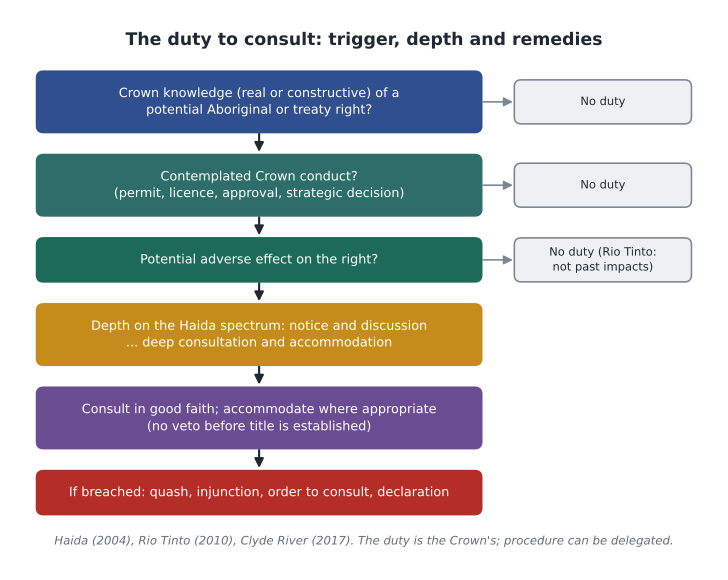
The duty arises when the Crown has knowledge, real or constructive, of the potential existence of the right or title and contemplates conduct that might adversely affect it. The content of the duty varies with the circumstances. At one end of the spectrum, where the claim to title is weak, the right is limited or the potential for infringement is minor, the Crown may only need to give notice, disclose information and discuss any issues raised. At the other end, where a strong prima facie case for the claim is established, the right and the potential infringement are of high significance to the Aboriginal peoples and the risk of non-compensable damage is high, deep consultation aimed at finding a satisfactory interim solution may be required, including the opportunity to make submissions, formal participation in the decision-making process and written reasons showing that concerns were considered.
Three further points from Haida have shaped every case since. First, consultation must be meaningful and in good faith on both sides; the Crown must intend to substantially address the nation's concerns, and the nation must not frustrate reasonable efforts or take unreasonable positions. Second, the duty does not give a veto: before title or a right is established, there is no duty to agree, though the Crown may have to accommodate by changing its plans, mitigating impacts or providing compensation. Third, the duty belongs to the Crown and cannot be delegated in its legal responsibility. Third parties such as forestry companies do not owe the duty and are not liable for failing to consult, though the Crown can delegate procedural aspects of consultation to them, and in practice companies do much of the engagement work. The Haida had a strong prima facie case and the logging could cause serious harm, so the province had a duty to consult substantially and possibly to accommodate.
In Taku River Tlingit First Nation v. British Columbia (2004), decided the same day, the Court held that a provincial environmental assessment of a mine road, in which the First Nation had participated fully for three and a half years and whose recommendations reflected many of its concerns, met the duty to consult, even though the First Nation remained opposed to the project. The duty requires a meaningful process, not a particular outcome.
The trigger: Rio Tinto
In Rio Tinto Alcan Inc. v. Carrier Sekani Tribal Council (2010), a First Nation argued that British Columbia had to consult before approving a contract under which BC Hydro would buy power from Rio Tinto's Kenney Dam, which had been built in the 1950s without consultation and had altered the Nechako River. The Supreme Court summarized the test for the duty's trigger in three elements: the Crown's knowledge, actual or constructive, of a potential Aboriginal claim or right; contemplated Crown conduct; and the potential that the contemplated conduct may adversely affect the claim or right. It held that the duty does not extend to past infringements: the contract would not cause any new adverse impact on the river, so it did not trigger consultation, though the First Nation could seek remedies for the historical impact in other ways.
Rio Tinto also held that 'Crown conduct' includes strategic, higher-level decisions, such as planning or structural changes to resource management, not just decisions that physically affect land. And it explained the role of tribunals: a regulatory body may have the power to consult on the Crown's behalf, or to decide whether the Crown has adequately consulted, depending on its statutory mandate.
Treaties and modern treaties
The duty applies to treaty rights too. In Mikisew Cree (2005), discussed in lesson 5, the Court held that the Crown must consult before taking up treaty lands in a way that affects treaty rights, though the content of the duty in that case was at the lower end because the road's impact was modest. In Beckman v. Little Salmon/Carmacks First Nation (2010), it held that the duty applies under a modern treaty, and that its content is shaped by the treaty's provisions. In Grassy Narrows (2014), it applied the duty to provincial forestry approvals under Treaty 3.
Regulators and the duty: Clyde River and Chippewas of the Thames
Many major projects are approved by independent regulators. In Clyde River (Hamlet) v. Petroleum Geo-Services Inc. (2017) and Chippewas of the Thames First Nation v. Enbridge Pipelines Inc. (2017), decided together, the Supreme Court held that the Crown can rely on a regulatory process to fulfil its duty to consult, if the regulator has the necessary procedural powers and remedial authority, and that the regulator's approval is itself Crown conduct that triggers the duty.
In Clyde River, the National Energy Board had authorized seismic testing for oil and gas in Baffin Bay and Davis Strait, affecting marine mammals on which the Inuit of Clyde River depended under treaty harvesting rights in the Nunavut Agreement. The consultation was deep in principle, but in practice the company's answers to technical questions were provided in a thousands-page document mostly in English, with no oral hearings and no participant funding, and the Board's reasons did not address the treaty rights. The Court held the consultation inadequate and quashed the authorization. In Chippewas of the Thames, the Board had reviewed Enbridge's application to reverse and expand Line 9, an existing pipeline. The First Nation had participant funding, filed evidence and made submissions, and the Board's reasons addressed its concerns and imposed conditions. The Court held the consultation adequate and upheld the approval.
Pipelines in the Federal Court of Appeal
Two major pipeline cases show the stakes. In Gitxaala Nation v. Canada (2016), the Federal Court of Appeal quashed the federal approval of the Northern Gateway pipeline, holding that in the final phase of consultation Canada had failed to engage meaningfully with the First Nations' concerns, acting more like a note-taker than a party in a genuine dialogue. In Tsleil-Waututh Nation v. Canada (Attorney General) (2018), the same court quashed the first approval of the Trans Mountain expansion, again because Canada's consultation fell short of meaningful two-way dialogue. Canada carried out a further round of consultation, re-approved the project, and in Coldwater First Nation v. Canada (2020), the court upheld the re-approval, emphasizing that the duty does not give a veto and that a nation's continuing opposition does not make consultation inadequate. The pipeline began operating in 2024.
Legislation and the duty
In Mikisew Cree First Nation v. Canada (Governor General in Council) (2018), the Mikisew argued that Canada should have consulted them before introducing omnibus legislation that changed federal environmental laws. The Supreme Court held that the duty to consult does not apply to the law-making process, because of parliamentary sovereignty, the separation of powers and parliamentary privilege. Several judges stressed that the honour of the Crown still applies and that legislation that adversely affects section 35 rights can be challenged after it is enacted. Fast-track legislation raises these questions directly: in 2025, Ontario enacted Bill 5, allowing the province to designate special economic zones exempt from certain laws, and Parliament passed Bill C-5, including the Building Canada Act, which allows designated national interest projects to be approved on an accelerated basis. Nine Ontario First Nations brought a constitutional challenge to both laws in the Ontario Superior Court in 2025, arguing that they undermine consultation and treaty rights. Students should check the status of that litigation.
Free entry mining
Mining claim systems are a current battleground. Under 'free entry' systems, a prospector can register a mineral claim online without any government decision-maker considering Indigenous rights. In Gitxaala v. British Columbia (Chief Gold Commissioner), the British Columbia Supreme Court held in 2023 that the province's Mineral Tenure Act regime breached the duty to consult, and gave the province eighteen months to fix it. In December 2025, the British Columbia Court of Appeal agreed that the regime breached the duty and went further on the role of the United Nations Declaration in British Columbia law, as lesson 10 explains. In Ontario, Grassy Narrows First Nation and, separately, six other First Nations brought court challenges in 2024 to Ontario's online mining claim registration system on similar grounds.
Municipalities, accommodation and remedies
Municipalities, as creatures of provincial statute, have generally been held not to owe the duty themselves; in Neskonlith Indian Band v. Salmon Arm (City) (2012), the British Columbia Court of Appeal held a city did not have to consult before issuing a development permit, though the province may still owe the duty. Accommodation can take many forms: altering routes, restricting timing, setting aside areas, monitoring, sharing revenue or paying compensation. When the duty is breached, courts can quash the approval, grant injunctions, order consultation or issue declarations. In practice, much consultation takes place through negotiated agreements such as impact benefit agreements between nations and companies, and consultation protocols between nations and governments.
Hannah, who worked in a regulator's office in Calgary, describes how consultation files looked from the inside: spreadsheets of letters, logs of meetings and capacity funding agreements. Professor Morningside says that is exactly what courts look at, and that the cases turn on whether the record shows real engagement with the nation's concerns or just paper. 'The Crown cannot consult by email and then say it listened,' she says. 'But nations also cannot refuse to engage and then say they were not consulted. Courts look at both sides.'
Worked problem
Assessing the depth of consultation
Ontario plans to issue an aggregate (gravel) permit for a pit two kilometres from a lake where members of the fictional Loon Narrows First Nation exercise treaty fishing rights and hold ceremonies. The nation has a well-documented treaty right, and the pit could affect water quality and access. How deep must consultation be, and what would adequate consultation look like?
Show solution
- Trigger: Ontario knows of the treaty right; issuing a permit is Crown conduct; it could adversely affect fishing and ceremonial use (Rio Tinto).
- Depth: the right is established by treaty and the potential impacts on water and access are significant, so consultation should be toward the deeper end (Haida; Mikisew 2005).
- Process: early notice, full information including hydrogeological studies, capacity funding, meetings, an opportunity to respond, and written reasons addressing the concerns (Clyde River).
- Accommodation: possible measures include buffers, monitoring, seasonal limits, a different site, or a reduced footprint.
- No veto: if Ontario consults meaningfully and accommodates reasonably, the permit can issue despite continuing objection (Taku River; Coldwater).
Common mistakes
MistakeSaying the duty to consult arises only after a right is proved in court.
InsteadIt arises when the Crown knows of a potential right and contemplates conduct that might adversely affect it (Haida).
MistakeTreating the duty as a veto.
InsteadBefore title is established there is no duty to agree; the duty requires meaningful consultation and appropriate accommodation.
MistakeHolding companies liable for failing to consult.
InsteadThe duty is the Crown's; procedural aspects can be delegated, but legal responsibility stays with the Crown.
MistakeClaiming the Crown must consult before introducing legislation.
InsteadMikisew (2018) held the duty does not apply to the law-making process, though the honour of the Crown still applies to the resulting law.
Practice problems
Work each problem on paper first, then reveal the answer to check.
What are the three elements that trigger the duty to consult?
Show answer
Crown knowledge of a potential right, contemplated Crown conduct, and potential adverse effect on the right (Rio Tinto).
Why did the Supreme Court quash the authorization in Clyde River?
Show answer
The consultation was inadequate: no oral hearings, no participant funding, inaccessible information and reasons that did not address treaty rights.
What did Coldwater (2020) decide?
Show answer
That the re-approval of the Trans Mountain expansion followed adequate consultation, and continuing opposition does not make consultation inadequate.
Does the duty apply to past infringements?
Show answer
No; Rio Tinto held it applies to contemplated conduct with new adverse impacts, though historical impacts may be remedied in other ways.
What did the courts decide about BC's free entry mining regime in Gitxaala?
Show answer
That it breached the duty to consult (BCSC 2023; BCCA 2025).
Summary and key terms
- Haida (2004) grounded the duty to consult in the honour of the Crown and applied it to unproven claims.
- The duty is triggered by Crown knowledge, contemplated conduct and potential adverse effect (Rio Tinto 2010).
- Its depth varies on a spectrum with the strength of the claim and the seriousness of the impact; there is no veto.
- Regulators can fulfil the duty if they have the right powers; Clyde River failed and Chippewas of the Thames succeeded (2017).
- Pipeline approvals were quashed for inadequate consultation (Gitxaala 2016; Tsleil-Waututh 2018) and later upheld (Coldwater 2020).
- The duty does not apply to law-making (Mikisew 2018); fast-track laws and free entry mining regimes are being challenged.
- Duty to consult
- The Crown's obligation to consult, and where appropriate accommodate, before conduct that may adversely affect Aboriginal or treaty rights.
- Accommodation
- Measures to avoid, minimize or compensate for adverse impacts on rights.
- Haida spectrum
- The range of consultation required, from notice to deep consultation, depending on the claim and impact.
- Constructive knowledge
- Knowledge the Crown is deemed to have because it ought reasonably to have known.
- Impact benefit agreement
- A negotiated agreement between a nation and a project proponent addressing impacts and benefits.
- Free entry
- A mineral tenure system allowing claims to be registered without a discretionary government decision.
Lesson quiz · 5 questions
Score 60% or more to complete this lesson.
Create a free account to save your progress, take quizzes and earn a certificate.