
LAWC-114 · Lesson 12 of 12 · 23 min
Capstone: a duty to consult problem
▶ Video coming soon A video version of this lesson is on the way.
The final lesson is Professor Morningside's take-home problem, which she describes as the kind of fact pattern a lawyer for a First Nation, a government or a company might actually see. She gives Section B a week to write an answer of no more than three thousand words, then walks through it issue by issue. Everyone and everything in the problem is fictional, including the First Nation, the company, the treaty described and the place names, though the legal framework is real and the treaty terms are modelled on the numbered treaties.
The problem
The Loon Narrows First Nation is an Anishinaabe nation in northern Ontario of about 1,400 members, about half of whom live on its reserve on Loon Lake. Its ancestors adhered to a numbered treaty in the early twentieth century. The written text of the treaty includes a cession clause and a promise that the nation's members may continue to pursue their usual vocations of hunting, trapping and fishing throughout the tract, subject to regulations and to the taking up of lands for settlement, mining, lumbering and other purposes. Loon Narrows's oral history describes the treaty as an agreement to share the land. Members hunt moose, trap, fish walleye and harvest wild rice throughout the Harrow River basin north of the reserve. The nation also asserts that it never ceded the Heron Point peninsula on the north shore of Loon Lake, where its historic summer village, burial grounds and ceremonial sites are located, and it filed an Aboriginal title claim to the peninsula in the Superior Court in 2023; the claim has not been tried.
In 2021, Ontario and Loon Narrows signed a Consultation Protocol. In it, Ontario agreed to give the nation at least ninety days to respond to any proposed decision affecting its rights, to provide capacity funding for technical review, to share information in plain language and to meet with chief and council before any major decision. The protocol states that it is not a treaty and that it does not create legally enforceable obligations.
Harrow Basin Lithium Corp., a mining company based in Toronto, has staked mining claims across forty square kilometres of the Harrow River basin through Ontario's online mining claim registration system, without any notice to Loon Narrows. In early 2026, it applied for an exploration permit for trenching and drilling. Ontario's ministry sent the nation an email with a link to the application, in English, and set a thirty-day comment period. Loon Narrows asked for ninety days and capacity funding, citing the protocol. The ministry said the permit was routine and issued it after thirty-five days, with conditions requiring the company to avoid known burial sites.
In June 2026, the company announced a proposed open-pit lithium mine and processing plant on the basin, with a forty-kilometre all-season road that would cross the Heron Point peninsula. The company held three community information sessions on the reserve, at which its consultants presented slides in English. The ministry attended one session but declined repeated requests to meet with chief and council, saying the company was handling engagement. The company has offered the nation jobs, training and a modest annual payment, and agreed to move one section of the road five hundred metres to avoid a known burial ground, but has refused to consider a route avoiding the peninsula entirely, which it says would add significant cost.
The basin has already been heavily affected: a hydroelectric dam built in the 1950s flooded part of the river, and forestry clear-cuts and logging roads now cover much of the territory south of the river. Loon Narrows's harvest studies show that moose numbers in the basin have fallen sharply over twenty years and that members must travel much further to hunt. In October 2026, the federal government designated the mine as a project of national interest under the Building Canada Act, with an accelerated approval timeline. Ontario has said it intends to issue the provincial approvals for the mine and road in early 2027. Loon Narrows's chief and council have voted to oppose the project as proposed. Several members, including some who want jobs, have spoken in favour of a negotiated agreement.
Advise Loon Narrows on its legal position and options.
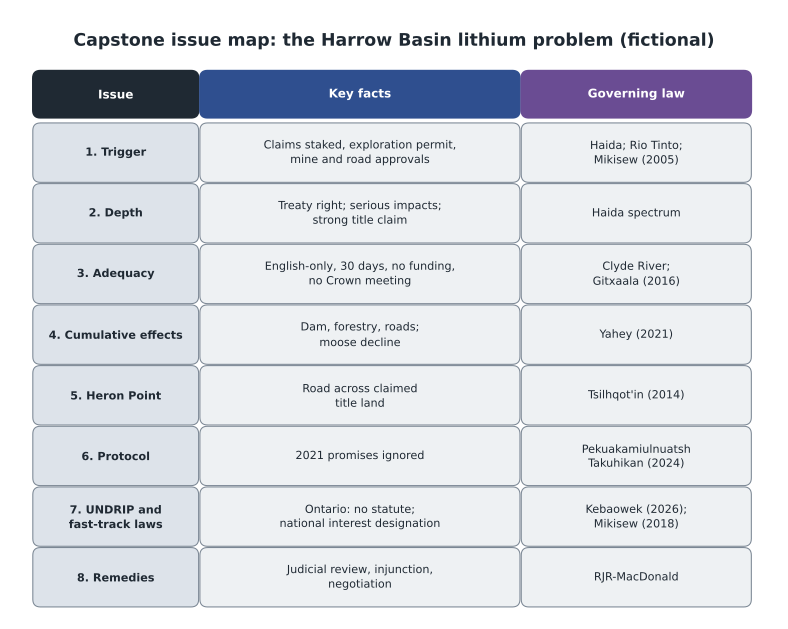
Issue 1: was the duty to consult triggered, and when?
Rule. The duty to consult arises when the Crown has real or constructive knowledge of a potential Aboriginal or treaty right and contemplates conduct that might adversely affect it (Haida; Rio Tinto). Taking up treaty lands in a way that affects treaty rights triggers the duty (Mikisew Cree 2005; Grassy Narrows). Crown conduct includes regulatory approvals and strategic decisions (Rio Tinto).
Application. Ontario plainly knows of the treaty harvesting rights and of the asserted title claim, which has been filed in court. The exploration permit is Crown conduct that could adversely affect harvesting in the basin through trenching, drilling and access. The registration of the mining claims themselves is a harder question: Ontario will argue that online registration is not a discretionary decision. But the Gitxaala litigation in British Columbia held that a comparable free entry regime breached the duty to consult, and First Nations have brought similar challenges to Ontario's system since 2024. The mine and road approvals are major Crown decisions with obvious potential impacts on harvesting and on the peninsula.
Conclusion. The duty was triggered by the exploration permit and will be triggered, at greater depth, by the mine and road approvals. Loon Narrows has a credible argument that the registration of the claims without notice also engaged the duty, though that issue is being litigated.
Issue 2: how deep is the duty?
Rule. The depth of consultation varies with the strength of the claim and the seriousness of the potential impact (Haida). Established treaty rights and serious, possibly irreversible impacts call for deep consultation, including meaningful participation, capacity support and written reasons (Haida; Clyde River).
Application. The harvesting rights are established by treaty, not merely asserted. An open-pit mine, a processing plant and an all-season road would have serious and long-lasting impacts on moose habitat, water and access, in a territory already heavily affected. The road would also cross the Heron Point peninsula, which is subject to a filed title claim with apparent evidence of historic village and burial sites, suggesting a reasonably strong prima facie claim there.
Conclusion. For the mine and road, the duty is at the deep end of the spectrum. Even for the exploration permit, the duty was more than notice: trenching and drilling in an important harvesting area called for meaningful engagement, at least at the middle of the spectrum.
Issue 3: was consultation adequate?
Rule. Consultation must be meaningful, in good faith, and responsive; the Crown must intend to substantially address the nation's concerns (Haida). Technical documents provided without support, no oral engagement, no funding and reasons that do not address rights have been held inadequate (Clyde River). The Crown cannot act as a note-taker (Gitxaala Nation 2016; Tsleil-Waututh 2018). Procedural aspects may be delegated to the company, but the Crown remains responsible (Haida). There is no veto, and a nation's continuing opposition does not make consultation inadequate (Taku River; Coldwater).
Application. For the exploration permit, the ministry gave an email link, English-only documents, thirty days instead of the ninety requested, no capacity funding and no meeting, and called the permit routine. That looks like the minimum end of the spectrum when more was required. For the mine and road, the process so far has been company information sessions with English slides, no ministry meeting with chief and council, and a refusal to consider the main alternative raised by the nation. The road realignment is a real accommodation, but limited. Ontario will point to the conditions on the exploration permit and to the continuing process, and will say the final approvals have not been made.
Conclusion. There is a strong argument that consultation on the exploration permit was inadequate, and that the process for the mine and road is so far falling short of deep consultation, particularly because the Crown has left engagement to the company and has not engaged directly with the nation's leadership or its concerns about the peninsula. Loon Narrows should document its requests and the responses carefully, because adequacy is judged on the record.
Issue 4: cumulative effects
Rule. Treaty rights can be infringed by the cumulative effects of many developments, even where no single approval is decisive (Yahey, BCSC 2021). When considering a new taking up, the Crown must consider the existing state of the territory and the nation's remaining ability to exercise its rights.
Application. The basin has been affected by a dam, forestry and roads; harvest studies show a sharp decline in moose and longer travel. A mine and road would add to those effects. Yahey is a trial decision from British Columbia, but its reasoning about the meaningful diminishment of treaty rights is persuasive and has been widely cited.
Conclusion. Loon Narrows should argue that the consultation must address cumulative effects, and that approvals adding to an already heavily disturbed territory may infringe the treaty right itself, requiring justification under Sparrow and Badger, not just consultation.
Issue 5: the Heron Point peninsula
Rule. Before title is established, the Crown must consult and accommodate; once title is established, it needs consent or justification (Tsilhqot'in). If the Crown proceeds without consent before title is established, it may later have to cancel a project if title is proved and continuation would unjustifiably infringe it (Tsilhqot'in). Occupation sufficient for title can be shown by regular and exclusive use, including village sites (Delgamuukw; Tsilhqot'in).
Application. The title claim is filed but untried. Evidence of a historic summer village, burials and ceremonial sites supports a strong claim to at least part of the peninsula. A road across it is exactly the kind of incursion that could later require cancellation if title is proved.
Conclusion. The peninsula strengthens the case for deep consultation and real accommodation, such as an alternative route, and gives Loon Narrows significant leverage. It may also support an application for an interlocutory injunction to stop road construction pending trial, discussed under remedies.
Issue 6: the 2021 Consultation Protocol
Rule. The honour of the Crown informs the Crown's conduct in agreements with Indigenous nations, even agreements that are not treaties (Pekuakamiulnuatsh Takuhikan, 2024). An agreement's statement that it is not legally enforceable does not end the analysis if the honour of the Crown is engaged, though it is relevant.
Application. Ontario agreed to ninety-day response periods, capacity funding, plain-language information and meetings with chief and council, and then did none of those things for the exploration permit, and has refused a meeting on the mine. Ontario will rely on the protocol's non-enforceability clause.
Conclusion. Even if the protocol cannot be enforced as a contract, Ontario's disregard of its own commitments is strong evidence that consultation was not meaningful or in good faith, and Loon Narrows can argue that the honour of the Crown required Ontario to act consistently with promises it made about how it would consult.
Issue 7: the Declaration and fast-track legislation
Rule. Ontario has no Declaration statute, and the Federal Court of Appeal held in Kebaowek (2026) that the federal Act does not itself implement the Declaration's articles; the BC Court of Appeal took a different view of BC's statute in Gitxaala (2025), now before the Supreme Court. The Declaration can still be used as an interpretive aid. The duty to consult does not apply to the law-making process (Mikisew 2018), but laws that adversely affect section 35 rights can be challenged once enacted.
Application. The federal national interest designation under the Building Canada Act and Ontario's fast-track legislation are already the subject of a constitutional challenge by nine Ontario First Nations. Loon Narrows could seek to join or support that litigation, and should argue that any decisions made under the accelerated process must still meet the constitutional duty to consult, which no statute can remove.
Conclusion. The Declaration is a supporting argument, not the main ground. The strongest grounds remain the duty to consult, the treaty and the honour of the Crown.
Issue 8: remedies and strategy
Judicial review. Loon Narrows can apply for judicial review of the exploration permit in the Divisional Court, seeking to quash it for inadequate consultation; it should act quickly, because delay can count against discretionary relief. It can seek judicial review of the mine and road approvals when they are made. Injunction. To stop road construction across the peninsula pending trial of the title claim, it could apply for an interlocutory injunction, which requires a serious issue to be tried, irreparable harm and a balance of convenience in its favour (RJR-MacDonald); harm to burial and ceremonial sites is classic irreparable harm.
Negotiation. Litigation gives leverage, but most disputes like this are resolved by agreement. Loon Narrows could negotiate an impact benefit agreement with the company and a consultation and accommodation agreement with Ontario covering an alternative route, environmental monitoring by the nation's own staff, revenue sharing, employment, equity participation and decision-making on future phases. Internal process matters: the nation's leadership has voted to oppose the project as proposed, while some members want an agreement; the nation's own decision-making processes and laws decide what position it takes, and outside lawyers must take instructions accordingly.
Professor Morningside ends the course where she began. 'Whose law? Which law? In this problem, the answer is at least three: Canadian constitutional law, the treaty, and Loon Narrows's own law about how it decides. A good lawyer for any party keeps all three in view.'
Worked problem
A short variation
Change the facts: Ontario met with chief and council four times, gave 120 days and capacity funding for an independent hydrology and wildlife review, and, after the review, required the road to bypass the peninsula and the company to fund nation-led monitoring. Loon Narrows still opposes the mine because of cumulative effects. Can it stop the approvals?
Show solution
- The process now looks like deep, meaningful consultation with real accommodation (Haida; Chippewas of the Thames).
- Continuing opposition alone does not make consultation inadequate, and there is no veto before title is proved (Coldwater).
- The peninsula concern has been accommodated by the bypass.
- The remaining argument is cumulative effects: if the mine would meaningfully diminish the treaty right, the approval may be an infringement requiring justification (Yahey; Sparrow; Badger).
- Success would depend on evidence about the remaining capacity to exercise the right, and Ontario's evidence on justification.
Common mistakes
MistakeArguing that Loon Narrows has a veto over the mine.
InsteadBefore title is proved there is no veto; the strongest arguments are inadequate consultation, cumulative effects and the title claim's leverage.
MistakeTreating the company's information sessions as the Crown's consultation.
InsteadThe Crown can delegate procedural aspects, but remains responsible and must engage meaningfully itself (Haida).
MistakeIgnoring the protocol because it says it is unenforceable.
InsteadThe honour of the Crown may still be engaged, and the protocol is evidence of what meaningful consultation required.
MistakeLeading with the Declaration as the main argument in Ontario.
InsteadOntario has no Declaration statute and Kebaowek (FCA 2026) limits the federal Act; use it as a supporting interpretive argument.
Practice problems
Work each problem on paper first, then reveal the answer to check.
Why is the duty at the deep end for the mine and road?
Show answer
Established treaty rights, serious long-lasting impacts on harvesting in an already disturbed territory, and a strong title claim to the peninsula.
What is the significance of Tsilhqot'in for the road across the peninsula?
Show answer
If title is later proved, a project begun without consent may have to be cancelled if continuing it would unjustifiably infringe title.
How can the 2021 protocol help Loon Narrows if it is not enforceable?
Show answer
It shows what Ontario itself committed to, and disregarding it suggests consultation was not meaningful or in good faith; the honour of the Crown may be engaged.
What test applies to an interlocutory injunction?
Show answer
A serious issue to be tried, irreparable harm and the balance of convenience (RJR-MacDonald).
Why must lawyers attend to the nation's internal decision-making?
Show answer
The nation decides its position through its own processes and laws; lawyers take instructions accordingly.
Summary and key terms
- Identify each Crown decision that triggers the duty: claims registration, exploration permit, mine and road approvals.
- Assess depth on the Haida spectrum, using the strength of treaty and title claims and the seriousness of impacts.
- Judge adequacy on the record: Crown engagement, information, time, funding, reasons and accommodation (Clyde River; Gitxaala 2016).
- Raise cumulative effects as a possible treaty infringement (Yahey) and use the title claim's Tsilhqot'in leverage.
- Use the honour of the Crown and the consultation protocol, and treat the Declaration as a supporting argument.
- Combine judicial review, injunctions and negotiation, following the nation's own decision-making.
- Consultation protocol
- An agreement setting out how a government will consult a nation.
- Exploration permit
- A provincial approval for early mineral exploration activities such as trenching and drilling.
- Interlocutory injunction
- A court order preserving the status quo until trial.
- Irreparable harm
- Harm that cannot be adequately compensated by damages.
- Impact benefit agreement
- A negotiated agreement between a nation and a proponent addressing impacts and benefits.
- National interest project
- A project designated for accelerated federal approval under the Building Canada Act.
Lesson quiz · 5 questions
Score 60% or more to complete this lesson.
Create a free account to save your progress, take quizzes and earn a certificate.