
LAWC-114 · Lesson 2 of 12 · 22 min
The Royal Proclamation, early treaties and colonial law
▶ Video coming soon A video version of this lesson is on the way.
Professor Morningside opens the second class with a photograph of a wampum belt: two parallel rows of purple beads on a white background. She explains that the Two Row Wampum, or Guswenta, is associated by the Haudenosaunee with an agreement with Dutch settlers in the seventeenth century. The two rows are often described as two vessels, a canoe and a ship, travelling side by side down the river of life, neither steering the other, linked by three rows of white beads representing peace, friendship and respect. Historians debate parts of the belt's early history, she tells Section B, but its meaning to the Haudenosaunee is not in doubt: a relationship between equals who keep their own laws.
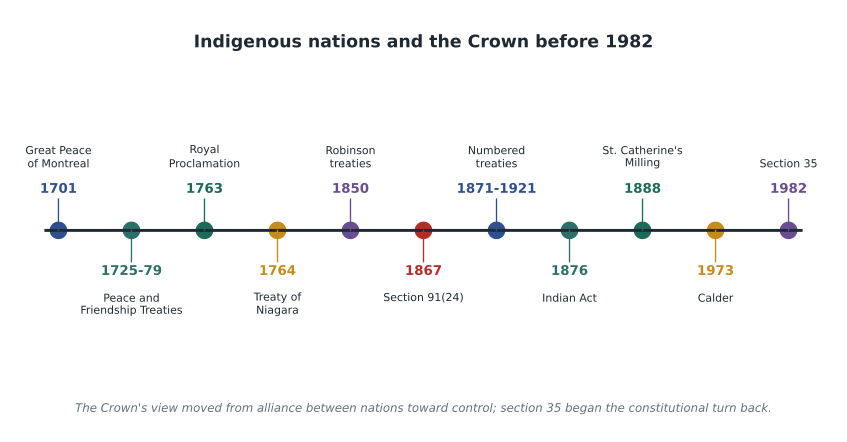
'Keep that image in mind,' she says. 'For the next three hundred years, you will watch the Crown's understanding of the relationship move from something like two vessels to the idea that there is only one ship and the Crown is steering it. A lot of modern Aboriginal law is the courts trying, unevenly, to undo that shift.'
Nations and alliances
When Europeans arrived in what is now Canada, the land was occupied and governed by many Indigenous nations with their own territories, laws and diplomatic practices. Early relations were shaped by trade and military alliances. The French and British both relied on Indigenous allies in their wars with each other, and both negotiated with Indigenous nations as political entities. The Great Peace of Montreal of 1701, concluded between New France and some forty Indigenous nations, is one example of the diplomacy of the period. In the Maritimes, the British and the Mi'kmaq, Wolastoqiyik (Maliseet) and Peskotomuhkati (Passamaquoddy) peoples concluded a series of Peace and Friendship Treaties between 1725 and 1779. These treaties did not cede land; they dealt with peace, trade and relations between the parties.
The Peace and Friendship Treaties are not just history. In R. v. Marshall (1999), the Supreme Court of Canada held that the treaties of 1760 and 1761 protected a right of the Mi'kmaq to hunt, fish and gather in order to trade for necessaries, and acquitted Donald Marshall Jr. of fishing eels and selling them without a licence. In a second set of reasons later the same year, often called Marshall II, the Court clarified that the right was limited to obtaining a moderate livelihood and remained subject to justified regulation. Disputes over moderate livelihood fisheries in Nova Scotia continue, and you will come back to Marshall in lesson 5.
The Royal Proclamation of 1763
After the Seven Years' War, France ceded most of its North American possessions to Britain in the Treaty of Paris of 1763. King George III issued the Royal Proclamation of October 7, 1763 to organize the new territories. Much of the Proclamation dealt with the governments of new colonies such as Quebec, but its best-known provisions concern Indigenous lands. The Proclamation described the 'several Nations or Tribes of Indians with whom We are connected, and who live under our Protection' and declared that they 'should not be molested or disturbed' in the possession of lands that had not been ceded to or purchased by the Crown.
The Proclamation reserved large areas west of the colonies for Indigenous nations and prohibited colonial governors from granting those lands. Most importantly for Canadian law, it prohibited private persons from purchasing land from Indigenous nations. If a nation wished to dispose of land, the land could be purchased only by the Crown, at a public meeting or assembly of the nation held for that purpose. This rule, that Indigenous land could be acquired only by the Crown and only with the consent of the nation in a public process, became the foundation of the treaty-making that followed.
Courts and scholars have read the Proclamation in different ways. In Calder v. British Columbia (1973), Justice Hall described it as having the force of a statute and called it an 'Indian Bill of Rights'. The Supreme Court has since said that Aboriginal rights do not depend on the Proclamation: they arise from the prior occupation of the land by Indigenous peoples, and the Proclamation recognized rights that already existed. The Proclamation is mentioned in section 25 of the Canadian Charter of Rights and Freedoms, which provides that the Charter shall not be construed so as to abrogate or derogate from Aboriginal, treaty or other rights, including any rights recognized by the Royal Proclamation of October 7, 1763.
The Treaty of Niagara, 1764
The Proclamation was a unilateral document of the Crown. Many Indigenous scholars, including John Borrows, emphasize what happened next. In the summer of 1764, Sir William Johnson, the British Superintendent of Indian Affairs, met at Niagara with representatives of some two dozen nations, by many accounts around two thousand chiefs. The Crown's promises were presented and accepted through the exchange of wampum belts, including a belt often called the Covenant Chain belt and the Twenty-Four Nations belt. On this view, the Proclamation's terms became binding as a treaty only when they were affirmed at Niagara according to Indigenous diplomatic protocol, and the Proclamation and the Treaty of Niagara should be read together as the foundation of a nation-to-nation relationship. Canadian courts have referred to the Treaty of Niagara, but its full legal significance is still debated.
Land surrenders in Upper Canada
After the American Revolution, the Crown needed land for Loyalist settlers moving north and for its Haudenosaunee allies who had lost their homes in New York. Between the 1780s and the 1860s, it concluded many land surrender treaties with Anishinaabe (Mississauga, Chippewa and other) nations in what became southern Ontario. These treaties typically recorded a cession of a defined tract in exchange for goods or annual payments, and often reserved small areas for the nations' continued use. The written texts were drafted by Crown officials in English, and historians have documented serious disputes about what was actually agreed, the adequacy of the boundaries, and whether the nations understood the written terms as permanent cessions. The Haldimand Proclamation of 1784 granted the Six Nations land along the Grand River, a grant that remains the subject of litigation and negotiation today.
In 1850, William Benjamin Robinson negotiated two treaties with Anishinaabe nations along the northern shores of Lake Huron and Lake Superior: the Robinson-Huron and Robinson-Superior treaties. They exchanged vast territories for lump-sum payments and annuities, reserved lands for the nations, and promised continued hunting and fishing rights over the ceded territory. The treaties also contained an augmentation clause promising to increase the annuities if the territory produced enough revenue. More than a century and a half later, the Supreme Court held in Ontario (Attorney General) v. Restoule (2024) that the Crown had breached that promise. You will study Restoule in lessons 5 and 8.
Confederation and the numbered treaties
At Confederation in 1867, section 91(24) of the Constitution Act, 1867 gave the federal Parliament exclusive legislative authority over 'Indians, and Lands reserved for the Indians'. Lesson 4 examines that power. Canada then acquired Rupert's Land and the North-Western Territory from the Hudson's Bay Company in 1870, and set out to open the prairies to settlement and to build a transcontinental railway. Between 1871 and 1921, the Crown concluded eleven numbered treaties covering much of what is now Ontario, Manitoba, Saskatchewan, Alberta and parts of British Columbia and the Northwest Territories.
The written texts of the numbered treaties contain broad cession clauses in which the nations 'cede, release, surrender and yield up' their rights to the land, in exchange for reserves, annuities, agricultural implements, schools and, in Treaty 6, a 'medicine chest' clause that many First Nations understand as a promise of health care. The treaties also promised the right to continue hunting, trapping and fishing throughout the surrendered territory, subject to regulation and to the Crown's right to 'take up' land for settlement, mining, lumbering and other purposes. Many First Nations' oral histories describe the treaties as agreements to share the land in peace, not to give it up. Lesson 5 examines how courts interpret treaties when the written text and the oral understanding diverge.
Colonial law and the doctrine of discovery
Colonial legal thinking often relied on ideas that are now widely rejected. The doctrine of discovery, which drew on fifteenth-century papal bulls and was developed in American law in Johnson v. M'Intosh (1823), held that European sovereigns acquired underlying title to lands their subjects 'discovered', leaving Indigenous nations with only a right of occupancy. Related ideas of terra nullius treated lands as legally empty if they were not occupied in ways Europeans recognized. In Tsilhqot'in Nation (2014), the Supreme Court said that the doctrine of terra nullius never applied in Canada, as confirmed by the Royal Proclamation. The Truth and Reconciliation Commission called on governments to repudiate concepts used to justify European sovereignty over Indigenous lands and peoples, such as the doctrine of discovery and terra nullius, and in 2023 the Vatican issued a statement repudiating the doctrine of discovery as part of Catholic teaching.
The leading Canadian case of the nineteenth century reflects the colonial view. In St. Catherine's Milling and Lumber Co. v. The Queen (1888), the Judicial Committee of the Privy Council considered whether Ontario or Canada owned timber on land surrendered in Treaty 3. The Privy Council described Indigenous title as 'a personal and usufructuary right, dependent upon the goodwill of the Sovereign', and held that when the title was surrendered, the benefit of the land passed to the province under section 109 of the Constitution Act, 1867. The Anishinaabe signatories of Treaty 3 were not parties to the case. For almost a century, St. Catherine's Milling was read as meaning that Indigenous rights in land existed only at the Crown's pleasure.
Calder and the turn
The modern law begins with Calder v. British Columbia (Attorney General) (1973). The Nisga'a Nation sought a declaration that their Aboriginal title to their traditional territory in the Nass Valley had never been lawfully extinguished. They lost on a technicality, but six of the seven judges who addressed the issue accepted that Aboriginal title had existed in law as a right arising from the Nisga'a's prior occupation of the land, independent of the Royal Proclamation. They split three to three on whether it had been extinguished by colonial land legislation before British Columbia joined Confederation. Justice Judson wrote that 'the fact is that when the settlers came, the Indians were there, organized in societies and occupying the land as their forefathers had done for centuries. This is what Indian title means.'
Calder led the federal government to adopt a comprehensive land claims policy that year, opening negotiations that produced the first modern treaties, beginning with the James Bay and Northern Quebec Agreement of 1975. It also set the stage for the constitutional recognition of Aboriginal and treaty rights in section 35 of the Constitution Act, 1982. Sophie Tremblay-Hart, who keeps asking how Quebec sees each doctrine, points out that the James Bay agreement was negotiated because Cree and Inuit communities went to court to stop the James Bay hydroelectric project, and won an interim injunction in 1973 before it was overturned on appeal. Professor Morningside nods: 'Litigation leverage is one of the reasons modern treaties exist. Keep that in mind when you get to the duty to consult.'
Why history matters in court
Historical evidence is central to Aboriginal law litigation. Courts deciding whether a right existed at contact, what a treaty meant to its signatories or whether the Crown acted honourably must reconstruct events from centuries ago. Trials can last years and involve historians, anthropologists, archaeologists and Elders giving oral history evidence. The Tsilhqot'in trial ran for 339 days. In Mitchell v. M.N.R. (2001), the Supreme Court cautioned that oral histories must still be useful and reasonably reliable, but must not be undervalued simply because they do not fit the categories of evidence developed for documentary records.
Hannah Kowalczyk, who worked in an oil and gas regulatory office in Calgary, asks whether that level of historical inquiry is a good way to resolve modern disputes. Professor Morningside says many judges have asked the same question, and that the Supreme Court has repeatedly said that negotiation, not litigation, is the better path to reconciliation. 'But negotiation happens in the shadow of the law,' she adds. 'Every negotiator knows what a court might do.'
Worked problem
Reading a historic land surrender
A First Nation in southern Ontario says that an 1805 surrender treaty, written by Crown officials in English, described a boundary running far inland, while the nation's oral history and the minutes of the council record agreement only to a narrow strip along the lakeshore. What questions would a lawyer ask?
Show solution
- Who drafted the text, in what language, and was it interpreted to the signatories?
- What do the council minutes, letters and other contemporaneous records say about the boundary?
- What does the nation's oral history say, and how reliable and useful is it under Mitchell v. M.N.R.?
- Did the Crown follow the Royal Proclamation's requirement of a public meeting and consent?
- Is the claim one for litigation, or for the federal specific claims process, which deals with breaches of historic treaties and the Crown's administration of lands and assets?
Common mistakes
MistakeSaying that Aboriginal rights come from the Royal Proclamation.
InsteadThey arise from prior occupation; the Proclamation recognized existing rights (Calder; later cases).
MistakeTreating all historic treaties as land cessions.
InsteadThe Peace and Friendship Treaties of the Maritimes did not cede land; they dealt with peace, trade and relations (Marshall).
MistakeCiting St. Catherine's Milling as the current law of Aboriginal title.
InsteadCalder, Delgamuukw and Tsilhqot'in replaced its "goodwill of the Sovereign" view; title is a sui generis interest grounded in prior occupation.
MistakeAssuming terra nullius applied in Canada.
InsteadThe Supreme Court said in Tsilhqot'in that it never applied here.
Practice problems
Work each problem on paper first, then reveal the answer to check.
What did the Royal Proclamation require before Indigenous land could be acquired?
Show answer
Purchase only by the Crown, at a public meeting of the nation held for that purpose, with the nation's consent.
Why is the Treaty of Niagara important to many scholars?
Show answer
It affirmed the Proclamation's promises through wampum and Indigenous protocol, making them part of a nation-to-nation treaty relationship.
What did the Privy Council say about Indigenous title in St. Catherine's Milling?
Show answer
That it was a personal and usufructuary right dependent on the goodwill of the Sovereign.
What did six judges agree on in Calder?
Show answer
That Aboriginal title existed in law as a right based on prior occupation; they split on extinguishment.
What did Marshall (1999) recognize?
Show answer
A Mi'kmaq treaty right under the 1760 to 1761 treaties to hunt, fish and gather to trade for necessaries, limited to a moderate livelihood.
Summary and key terms
- Early relations between the Crown and Indigenous nations were nation-to-nation alliances and treaties, including the Maritime Peace and Friendship Treaties.
- The Royal Proclamation of 1763 reserved lands and made the Crown the only lawful purchaser, at public meetings and with consent.
- The Treaty of Niagara (1764) affirmed the Proclamation's promises through Indigenous diplomatic protocol.
- Land surrender treaties, the Robinson treaties and the eleven numbered treaties followed, with disputed written terms.
- St. Catherine's Milling (1888) treated Indigenous title as dependent on the Crown's goodwill; Calder (1973) recognized title based on prior occupation.
- Terra nullius never applied in Canada (Tsilhqot'in), and the TRC called for repudiating the doctrine of discovery.
- Royal Proclamation of 1763
- The British proclamation that reserved lands to Indigenous nations and required Crown purchase with consent.
- Peace and Friendship Treaties
- Eighteenth-century treaties in the Maritimes dealing with peace and trade, without land cessions.
- Numbered treaties
- Eleven treaties concluded between 1871 and 1921 covering much of western and northern Canada.
- Doctrine of discovery
- The discredited colonial idea that European discovery gave underlying title to Indigenous lands.
- Terra nullius
- Land belonging to no one; a concept the Supreme Court said never applied in Canada.
- Augmentation clause
- The Robinson treaties' promise to increase annuities if revenues from the territory allowed.
Lesson quiz · 5 questions
Score 60% or more to complete this lesson.
Create a free account to save your progress, take quizzes and earn a certificate.