
LAWC-114 · Lesson 10 of 12 · 21 min
UNDRIP in Canada
▶ Video coming soon A video version of this lesson is on the way.
Professor Morningside hands out a single page with three short passages from the United Nations Declaration on the Rights of Indigenous Peoples. Article 3: 'Indigenous peoples have the right to self-determination.' Article 26(2): 'Indigenous peoples have the right to own, use, develop and control the lands, territories and resources that they possess by reason of traditional ownership or other traditional occupation or use, as well as those which they have otherwise acquired.' Article 32(2): states shall consult and cooperate in good faith with Indigenous peoples 'in order to obtain their free and informed consent prior to the approval of any project affecting their lands or territories and other resources'. She asks Section B one question: 'Is any of this Canadian law?' The honest answer, she tells them by the end of the class, is: it depends which court you ask, and the Supreme Court of Canada is about to decide.
The Declaration
The Declaration was adopted by the United Nations General Assembly on September 13, 2007, after more than twenty years of negotiation in which Indigenous peoples participated directly. One hundred and forty-four states voted in favour. Four voted against: Canada, the United States, Australia and New Zealand, all of which have since changed their positions. The Declaration has 46 articles. It affirms the right of Indigenous peoples to self-determination (article 3) and to autonomy or self-government in their internal and local affairs (article 4), and protects rights to culture, language, spirituality, education and health. It prohibits forced assimilation and the forcible removal of Indigenous peoples from their lands (articles 8 and 10). It recognizes rights to lands, territories and resources (article 26) and to redress, including restitution or compensation, for lands taken without free, prior and informed consent (article 28). Article 46 provides that nothing in the Declaration authorizes action that would dismember or impair the territorial integrity of sovereign states, and that its rights are subject to limitations determined by law that are non-discriminatory and strictly necessary to secure respect for the rights of others and to meet the just requirements of a democratic society.
A declaration of the General Assembly is not a treaty. It does not, on its own, bind states as a matter of international law in the way a ratified treaty does, though some of its provisions reflect existing human rights obligations or customary international law. Canadian courts have long held that international instruments that are not implemented by Canadian legislation can still be used to interpret Canadian law, under the presumption that legislation conforms to Canada's international obligations and values. The question in Canada is what Parliament and the British Columbia legislature added when they passed statutes about the Declaration.
Courts had already referred to the Declaration before any statute did. In Baker v. Canada (1999), a case not about Indigenous rights, the Supreme Court held that the values reflected in international human rights law may help inform the contextual approach to statutory interpretation and judicial review. Lower courts relied on that principle to treat the Declaration as relevant context in cases about consultation and Indigenous rights, while generally declining to treat it as creating free-standing obligations.
Free, prior and informed consent
Much of the debate centres on the phrase 'free, prior and informed consent', which appears in several articles, including article 19 (before adopting legislative or administrative measures that may affect Indigenous peoples) and article 32(2) (before approving projects affecting their lands and resources). Some read it as requiring consent, functioning as a veto. Others, including the federal government in its public statements, read it as requiring good faith processes aimed at obtaining consent, which is different from a right to block decisions. Many Indigenous nations and scholars argue that the veto framing misdescribes the concept, which is about the nation's right to decide through its own institutions and to be an actual decision-maker rather than a stakeholder. Professor Morningside cautions the class not to assume either reading is settled.
Canada's path to support
Canada voted against the Declaration in 2007, citing concerns about its provisions on lands and resources and on free, prior and informed consent. In 2010, Canada endorsed it as an aspirational document. In May 2016, the federal Minister of Indigenous and Northern Affairs announced at the United Nations that Canada was now a full supporter of the Declaration, without qualification, and intended to adopt and implement it in accordance with the Constitution. A private member's bill, Bill C-262, introduced by Cree MP Romeo Saganash to implement the Declaration, passed the House of Commons in 2018 but died in the Senate in 2019. The Truth and Reconciliation Commission had called on governments to adopt and implement the Declaration as the framework for reconciliation in Calls to Action 43 and 44.
British Columbia's Act
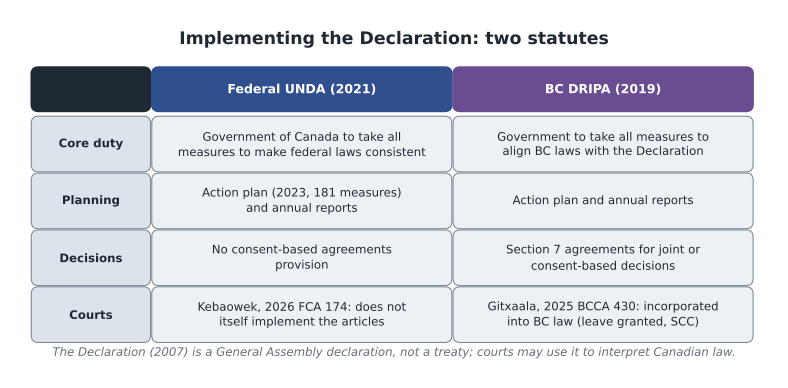
British Columbia was the first Canadian jurisdiction to legislate. Its Declaration on the Rights of Indigenous Peoples Act came into force in November 2019. Section 3 requires the government, in consultation and cooperation with the Indigenous peoples in British Columbia, to take all measures necessary to ensure the laws of British Columbia are consistent with the Declaration. The Act requires an action plan and annual reports, and section 7 allows the province to enter into agreements with Indigenous governing bodies for joint decision-making or for a decision to require the consent of the Indigenous governing body. The first such consent-based agreement was signed with the Tahltan Central Government in 2022 for the Eskay Creek mine. British Columbia's Interpretation Act was also amended to provide that every provincial Act and regulation must be construed as being consistent with the Declaration.
The federal Act
Parliament passed the United Nations Declaration on the Rights of Indigenous Peoples Act, which received royal assent on June 21, 2021. Its preamble and section 4 describe the Declaration as a universal international human rights instrument with application in Canadian law and state that the Act's purposes are to affirm it as such and to provide a framework for its implementation by the Government of Canada. Section 5 requires the Government of Canada, in consultation and cooperation with Indigenous peoples, to take all measures necessary to ensure that the laws of Canada are consistent with the Declaration. Section 6 required an action plan, which Canada released in June 2023 with 181 measures, and section 7 requires annual progress reports to Parliament. The Northwest Territories enacted its own implementation statute in 2023.
In the 2024 Reference on the federal child and family services Act, discussed in lesson 6, the Supreme Court described the Declaration as having been incorporated into the country's positive law by the federal Act, and referred to it in explaining the purpose of the child and family services legislation. Lower courts have since disagreed about what that statement means in practice.
Gitxaala: British Columbia's Act in court
In Gitxaala v. British Columbia (Chief Gold Commissioner), the Gitxaala Nation and Ehattesaht First Nation challenged British Columbia's free entry mineral tenure system, under which mineral claims could be registered online in their territories without consultation. At trial in 2023, the British Columbia Supreme Court held that the system breached the duty to consult, but that the Declaration Act did not implement the Declaration into British Columbia law in a way that courts could enforce, and that the Interpretation Act provision did not change that.
In December 2025, the British Columbia Court of Appeal, by a majority, agreed that the mineral tenure regime breached the duty to consult and went further on the Declaration. The majority held that, read together with the Interpretation Act, the Declaration Act incorporated the Declaration into British Columbia law, so that provincial laws must be interpreted consistently with it and courts can assess whether laws are consistent with it. A dissenting judge would have held that the Act does not give courts a mandate to assess consistency with the Declaration. The decision prompted a political crisis in British Columbia. In early 2026, the government announced it would amend the Act, then proposed instead to suspend key parts of it for three years while the Supreme Court considered the case, and then, after strong opposition from First Nations leaders, including some members of its own caucus, shelved the plan in April 2026. The province sought leave to appeal, and the Supreme Court of Canada granted it in 2026; a hearing was expected in 2027.
Kebaowek: the federal Act in court
At the federal level, the leading case is about a proposed near-surface disposal facility for low-level radioactive waste at Chalk River, Ontario, near the Ottawa River, in the unceded traditional territory of Kebaowek First Nation, an Algonquin Anishinaabe nation. The Canadian Nuclear Safety Commission licensed the project, finding that the Crown's duty to consult had been met. In February 2025, the Federal Court allowed Kebaowek's judicial review in part, holding that the federal Declaration Act meant that the Declaration's standards, including free, prior and informed consent as a process aimed at consent, had to inform the content of the duty to consult, and that the Commission had applied too narrow an approach. The court did not treat free, prior and informed consent as a veto.
In Canadian Nuclear Laboratories Ltd. v. Kebaowek First Nation (2026), released in October 2026, the Federal Court of Appeal reversed. It held that the federal Declaration Act creates a framework for implementing the Declaration and a process for bringing federal laws into line with it, but does not itself make the Declaration's articles, including those on free, prior and informed consent, part of federal law. The obligation to align laws belongs to the Government of Canada, and the Commission, a regulator with a narrower mandate, was not required to apply the Declaration in assessing consultation. The Commission had therefore not erred by applying the existing Haida framework. The decision sits uneasily with the British Columbia Court of Appeal's approach to the provincial Act, although the two statutes are worded differently.
Where things stand
Professor Morningside summarizes for Section B. The Declaration is not a treaty, and on its own it does not override Canadian law. Both the federal and British Columbia statutes commit governments to aligning their laws with it, through action plans and consultation. Courts can use the Declaration to interpret Canadian law, as they use other international instruments. Beyond that, the law is in flux: the British Columbia Court of Appeal has treated the provincial statute as incorporating the Declaration into provincial law, while the Federal Court of Appeal has held that the federal statute does not immediately implement it. The Supreme Court of Canada's decision in Gitxaala, when it comes, is likely to be one of the most important Aboriginal law decisions in decades.
Hannah asks whether implementing the Declaration means every project will need consent. Professor Morningside answers that this is the political question, and that the answer the statutes give so far is a process: consultation and cooperation, action plans and, in British Columbia, agreements that allow consent-based decision-making for particular decisions. 'Some governments are moving toward shared decision-making because they see it as better than decades of litigation,' she says. 'Some nations see consent as simply what self-determination means. And some industry voices worry about certainty. You will be practising in the middle of that debate.'
Worked problem
Using the Declaration in an argument
You act for the fictional Loon Narrows First Nation in a judicial review of an Ontario permit for Harrow Basin Lithium Corp.'s exploration program. Ontario has no Declaration statute. How can the Declaration be used?
Show solution
- Ontario has not legislated, so neither the federal nor the BC statute applies to an Ontario permit.
- The Declaration can still be used as an interpretive aid, under the presumption that legislation conforms to Canada's international commitments and values.
- The core legal argument remains the duty to consult under Haida and the treaty, with the Declaration's standards offered as context for the depth of consultation.
- Note the split: the Federal Court's 2025 Kebaowek approach was reversed by the Federal Court of Appeal in 2026, and Gitxaala is before the Supreme Court.
- Check for any Supreme Court decision in Gitxaala before relying on either line of authority.
Common mistakes
MistakeDescribing the Declaration as a binding treaty.
InsteadIt is a General Assembly declaration; its legal effect in Canada depends on implementing statutes and interpretive use.
MistakeSaying that free, prior and informed consent clearly means a veto in Canadian law.
InsteadIts meaning is contested; Canadian statutes so far implement it through processes, and courts have not adopted a veto.
MistakeAssuming the federal and BC statutes have the same effect.
InsteadThey are worded differently; the BCCA (2025) read BC's Act as incorporating the Declaration, while the FCA (2026) held the federal Act does not immediately implement it.
MistakeTreating the law as settled.
InsteadThe Supreme Court granted leave in Gitxaala in 2026, with a hearing expected in 2027.
Practice problems
Work each problem on paper first, then reveal the answer to check.
Which four states voted against the Declaration in 2007?
Show answer
Canada, the United States, Australia and New Zealand.
What does section 5 of the federal Declaration Act require?
Show answer
That the Government of Canada, in consultation and cooperation with Indigenous peoples, take all measures necessary to ensure federal laws are consistent with the Declaration.
What does section 7 of BC's Declaration Act allow?
Show answer
Agreements with Indigenous governing bodies for joint decision-making or consent-based decisions.
What did the BC Court of Appeal hold in Gitxaala (2025)?
Show answer
The mineral tenure regime breached the duty to consult, and the Declaration Act with the Interpretation Act incorporated the Declaration into BC law.
What did the Federal Court of Appeal hold in Kebaowek (2026)?
Show answer
The federal Act provides a framework but does not itself implement the Declaration's articles; the regulator properly applied the Haida framework.
Summary and key terms
- The Declaration (2007) affirms self-determination, rights to lands and resources, and free, prior and informed consent; Canada now fully supports it.
- A General Assembly declaration is not a treaty; courts may use it to interpret Canadian law.
- BC's Declaration Act (2019) and the federal Act (2021) require alignment of laws, action plans and reports; BC allows consent-based agreements.
- The BC Court of Appeal in Gitxaala (2025) held BC's Act incorporated the Declaration into BC law; the Supreme Court granted leave in 2026.
- The Federal Court of Appeal in Kebaowek (2026) held the federal Act does not immediately implement the Declaration.
- The meaning of free, prior and informed consent and the Declaration's legal force remain contested.
- UNDRIP
- The United Nations Declaration on the Rights of Indigenous Peoples, adopted in 2007.
- FPIC
- Free, prior and informed consent, a standard in several articles of the Declaration.
- UNDA
- The federal United Nations Declaration on the Rights of Indigenous Peoples Act (2021).
- DRIPA
- British Columbia's Declaration on the Rights of Indigenous Peoples Act (2019).
- Self-determination
- The right of peoples to freely determine their political status and pursue their development.
- Action plan
- The government plan required by the federal and BC Acts to implement the Declaration.
Lesson quiz · 5 questions
Score 60% or more to complete this lesson.
Create a free account to save your progress, take quizzes and earn a certificate.