
LAWC-114 · Lesson 4 of 12 · 21 min
Section 91(24), section 35 and who holds rights
▶ Video coming soon A video version of this lesson is on the way.
Professor Morningside starts the class with a jurisdiction puzzle. A First Nation-run child and family services agency on a reserve near Corwin has unionized employees, and the union wants to bargain under the Ontario Labour Relations Act. The agency says that because its clients are First Nations children, federal labour law applies. 'Section 91(24) or section 92?' she asks. Hannah Kowalczyk, who believes firmly in provincial autonomy, answers immediately: provincial. Theo Marchetti hesitates. The Supreme Court of Canada faced almost this exact problem in NIL/TU,O Child and Family Services Society v. B.C. Government and Service Employees' Union (2010), and, as Professor Morningside explains by the end of the class, Hannah was right.
Section 91(24): a federal head of power
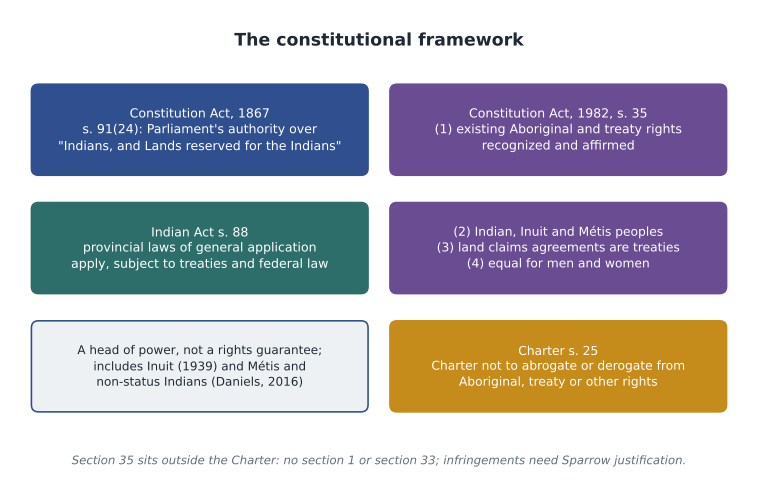
Section 91(24) of the Constitution Act, 1867 gives Parliament exclusive legislative authority over 'Indians, and Lands reserved for the Indians'. It is a head of power in the division of powers studied in LAWC-101, not a rights guarantee. It authorizes Parliament to legislate for Indigenous peoples and their lands, as it did in the Indian Act, but it does not oblige Parliament to do anything, and it does not by itself protect Indigenous peoples from federal law.
Who counts as an 'Indian' under section 91(24) is a constitutional question, and it is broader than the Indian Act's registration rules. In Reference re Eskimos (1939), the Supreme Court held that Inuit are 'Indians' within section 91(24). In Daniels v. Canada (Indian Affairs and Northern Development) (2016), the Court unanimously declared that Métis and non-status Indians are also 'Indians' under section 91(24). The Court explained that the term is a broad one that includes all Indigenous peoples in Canada, and that the declaration would end the jurisdictional ping-pong in which Ottawa and the provinces each said the other was responsible for Métis and non-status people. The Court declined to declare that Canada owed a fiduciary duty or a duty to negotiate, saying those were already recognized in other cases.
For Métis people, Daniels referred to the test in R. v. Powley for who is Métis for section 35 purposes, but emphasized that the 91(24) category is broader: it can include people who identify as Métis and are accepted by a Métis community, and non-status Indians, whose membership in the category depends on their connection to Indigenous peoples rather than on federal registration.
Provincial laws and Indigenous peoples
Section 91(24) does not mean that provincial laws never apply to Indigenous peoples or on reserves. Provincial laws of general application, such as traffic laws, family laws and labour laws, generally apply to Indigenous people and on reserves, unless they single out Indigenous peoples, conflict with federal law, or unjustifiably infringe section 35 rights. Section 88 of the Indian Act adds a federal rule: subject to treaties and federal laws, provincial laws of general application apply to 'Indians' in the province. Section 88 has been read as incorporating provincial laws by reference into federal law where they would otherwise not apply of their own force, and as giving treaty rights priority over provincial laws.
In NIL/TU,O, the Supreme Court held that labour relations are presumptively provincial, and that a First Nation child welfare agency was a provincially regulated undertaking because its normal and habitual activities were the delivery of provincial child welfare services under provincial law. The fact that its clients and staff were Indigenous, and that it was partly funded by Ottawa, did not make its labour relations federal. The Court applied the functional test that asks about the nature of the entity's operations, rather than asking first whether the entity touched the core of section 91(24).
In Tsilhqot'in Nation v. British Columbia (2014), the Court rejected the argument that the doctrine of interjurisdictional immunity prevents provincial laws from applying to Aboriginal title lands. Provincial laws of general application, such as the Forest Act, can apply to Aboriginal title land, but if they infringe Aboriginal rights or title they must meet the justification test from R. v. Sparrow, studied in lesson 7. In Grassy Narrows First Nation v. Ontario (Natural Resources) (2014), the Court held that Ontario, not just Canada, could 'take up' lands under Treaty 3 for forestry, subject to the duty to consult and the honour of the Crown. Ontario's power over its public lands under section 109 and section 92A meant that the province, as the government with authority over the land, held the treaty promises in that respect.
Section 35: recognition and affirmation
Section 35 of the Constitution Act, 1982 sits outside the Charter, in Part II, titled 'Rights of the Aboriginal Peoples of Canada'. Section 35(1) provides that 'the existing aboriginal and treaty rights of the aboriginal peoples of Canada are hereby recognized and affirmed.' Section 35(2) provides that the 'aboriginal peoples of Canada' include the Indian, Inuit and Métis peoples of Canada. Section 35(3) provides that treaty rights include rights that now exist by way of land claims agreements or may be so acquired, which brings modern treaties within section 35. Section 35(4) guarantees the rights equally to male and female persons; it was added by the 1983 constitutional amendment that also added section 35.1, which commits governments to hold a constitutional conference with Indigenous representatives before amending section 91(24) or section 35.
Because section 35 is not part of the Charter, section 1's reasonable limits clause and section 33's notwithstanding clause do not apply to it. But the Supreme Court held in R. v. Sparrow (1990) that section 35 rights are not absolute. Governments can infringe them if they can justify the infringement, under a test developed specifically for section 35, discussed in lesson 7. Sparrow also explained the word 'existing': rights that had been validly extinguished before April 17, 1982 were not revived, but rights that existed then are protected, and they are not frozen in the form in which they were exercised in 1982. A right to fish, for example, can be exercised with modern equipment.
Section 35 was the product of intense political advocacy. The original draft of the patriation package in 1980 contained an Aboriginal rights clause, which was dropped in November 1981 as part of the federal-provincial deal and then restored, with the word 'existing' added, after protests by Indigenous organizations. The first ministers' conferences held between 1983 and 1987 under the former section 37 tried and failed to agree on defining Aboriginal self-government in the Constitution, and the Charlottetown Accord of 1992, which would have recognized an inherent right of self-government, was defeated in a national referendum.
Section 25 of the Charter
Section 25 of the Charter provides that the Charter's guarantees must not be construed so as to abrogate or derogate from Aboriginal, treaty or other rights or freedoms that pertain to the Aboriginal peoples of Canada. In Dickson v. Vuntut Gwitchin First Nation (2024), the Supreme Court considered a residency requirement in the constitution of the Vuntut Gwitchin First Nation, a self-governing First Nation in Yukon, that required elected councillors to live on the nation's settlement land. Cindy Dickson, a citizen who lived in Whitehorse, argued that it violated her equality rights under section 15. A majority of the Court held that the Charter applied to the First Nation's government, that the requirement did infringe section 15, but that section 25 shielded the requirement because it protected the nation's interest in preserving its connection to the land and its distinct culture. The Court divided four to three, and the dissenting judges wrote about the importance of individual Charter rights for members of Indigenous communities. Professor Okafor-Lindqvist's Charter course examined Dickson in detail.
Who are the Aboriginal peoples of Canada?
Section 35 rights are collective rights held by Indigenous communities, though they are exercised by individual members. The question who can claim them arises in several ways. For First Nations, rights are usually held by a nation or community descended from the people who occupied the land at contact or who signed the treaty. Registration under the Indian Act is not the test for section 35 rights, though it is often evidence of membership.
In R. v. Desautel (2021), the Supreme Court considered Richard Desautel, a member of the Lakes Tribe of the Colville Confederated Tribes in Washington State, who shot an elk in British Columbia and was charged with hunting as a non-resident without a licence. The Court held that 'Aboriginal peoples of Canada' means the modern successors of Aboriginal societies that occupied what is now Canada at the time of European contact, and that this can include groups now located outside Canada. The Lakes Tribe was a successor of the Sinixt people, who had occupied territory in British Columbia, so Desautel could exercise an Aboriginal right to hunt there. The Court noted that the Crown's duty to consult such groups might be different in practice.
Métis rights and the Powley test
Métis peoples emerged as distinct communities with their own cultures, languages such as Michif and political institutions, especially in the Red River region and across the prairies, after European contact. In R. v. Powley (2003), the Supreme Court considered Steve and Roddy Powley, members of the Métis community of Sault Ste. Marie, Ontario, who shot a moose without a licence. The Court held that section 35 protects practices that were integral to a Métis community's distinctive culture before the time of effective European control, rather than before contact, because Métis communities arose after contact.
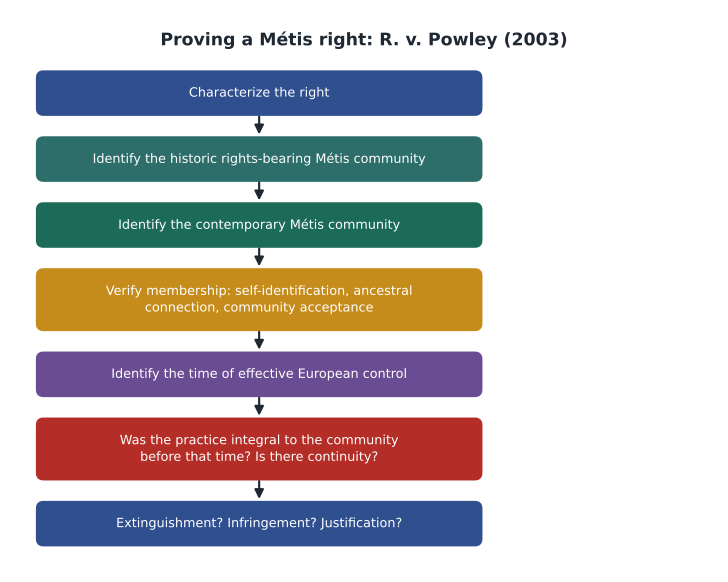
Powley sets out a test. The court must characterize the right, identify a historic rights-bearing Métis community and a contemporary Métis community that continues it, and verify the claimant's membership in that community. Membership has three elements: self-identification as Métis, an ancestral connection to the historic community, and acceptance by the modern community. The court then identifies the time of effective European control, asks whether the practice was integral to the community before then, and considers continuity, extinguishment and justification. The Powleys succeeded: the Sault Ste. Marie Métis community had a right to hunt for food.
Métis rights have become a major area of law and politics. In Manitoba Metis Federation v. Canada (2013), studied in lesson 8, the Court held that Canada had failed to implement the land grant promise in section 31 of the Manitoba Act, 1870 with the diligence the honour of the Crown required. Since 2019, Canada has signed self-government recognition agreements with several Métis governments, including the Métis Nation of Alberta, the Métis Nation of Ontario and Métis Nation-Saskatchewan. A federal bill to recognize those governments in legislation died on the order paper in 2025 after strong opposition from some First Nations, particularly in Ontario, who disputed the historic basis of some Métis communities recognized there. Questions of identity, including disputes about individuals falsely claiming Indigenous identity in academic and other positions, have also led some institutions to adopt verification processes developed with Indigenous communities.
Inuit rights
Inuit rights in Canada have largely been defined through modern treaties: the Inuvialuit Final Agreement (1984), the Nunavut Agreement (1993), which led to the creation of the territory of Nunavut in 1999, and the Nunavik and Nunatsiavut agreements in northern Quebec and Labrador. Together these four regions are known as Inuit Nunangat. Inuit organizations have long argued that federal and provincial policies have often been designed for First Nations and applied to Inuit without adjustment, and Canada adopted an Inuit Nunangat Policy in 2022 to address that.
Worked problem
Does a provincial law apply?
Ontario amends its Fish and Wildlife Conservation Act to close the walleye season on a lake for two years because the stock has collapsed. A member of a First Nation whose ancestors signed a treaty guaranteeing fishing rights in the area is charged for fishing during the closure. Outline the analysis.
Show solution
- Characterize the law: a provincial conservation law of general application, valid under the province's powers over natural resources and property.
- It does not single out Indigenous people, so it is not invalid for intruding on section 91(24).
- Interjurisdictional immunity does not shield section 35 rights from provincial law (Tsilhqot'in).
- Ask whether the law infringes the treaty right to fish; a total closure likely does.
- If it infringes, Ontario must justify it under Sparrow and Badger: a compelling and substantial objective such as conservation, consistency with the honour of the Crown, priority for the treaty right, minimal impairment and consultation.
Common mistakes
MistakeTreating section 91(24) as a rights guarantee.
InsteadIt is a federal head of power; section 35 is the rights provision.
MistakeAssuming provincial laws never apply on reserves.
InsteadProvincial laws of general application generally apply, subject to section 88, paramountcy and section 35 (NIL/TU,O; Tsilhqot'in).
MistakeUsing Indian Act registration as the test for section 35 rights.
InsteadRights are held by communities; membership is shown by connection to the rights-bearing community, and registration is only evidence.
MistakeApplying the Charter's section 1 to section 35 rights.
InsteadSection 35 is outside the Charter; infringements are judged under the Sparrow justification test.
Practice problems
Work each problem on paper first, then reveal the answer to check.
What did Daniels v. Canada (2016) declare?
Show answer
That Métis and non-status Indians are "Indians" under section 91(24).
What test did NIL/TU,O apply to labour relations of a First Nation child welfare agency?
Show answer
The functional test: the agency's normal and habitual activities were provincial child welfare services, so provincial labour law applied.
What does the word "existing" in section 35(1) mean, according to Sparrow?
Show answer
Rights not extinguished before 1982; they are protected in a flexible, not frozen, form.
What three elements show Métis community membership under Powley?
Show answer
Self-identification, ancestral connection to the historic community and acceptance by the modern community.
What did Desautel decide?
Show answer
That modern successors of Aboriginal societies that occupied Canada at contact can hold section 35 rights even if now located outside Canada.
Summary and key terms
- Section 91(24) gives Parliament authority over "Indians, and Lands reserved for the Indians"; it includes Inuit (1939) and Métis and non-status Indians (Daniels, 2016).
- Provincial laws of general application generally apply to Indigenous peoples, subject to section 88, paramountcy and section 35 justification.
- Interjurisdictional immunity does not protect section 35 rights from provincial laws (Tsilhqot'in); provinces can take up treaty lands (Grassy Narrows).
- Section 35 recognizes and affirms existing Aboriginal and treaty rights of Indian, Inuit and Métis peoples, including modern treaty rights.
- Charter section 25 shields Aboriginal, treaty and other rights from Charter claims (Dickson, 2024).
- Powley sets the test for Métis rights; Desautel extends section 35 to successor groups outside Canada.
- Section 91(24)
- The federal head of power over "Indians, and Lands reserved for the Indians".
- Section 88 of the Indian Act
- The provision applying provincial laws of general application to Indians, subject to treaties and federal laws.
- Section 35(1)
- The constitutional recognition and affirmation of existing Aboriginal and treaty rights.
- Section 25 of the Charter
- The shield preventing the Charter from abrogating or derogating from Aboriginal, treaty and other rights.
- Effective European control
- The point in time used in Powley to identify protected Métis practices.
- Inuit Nunangat
- The Inuit homeland in Canada, made up of four land claim regions.
Lesson quiz · 5 questions
Score 60% or more to complete this lesson.
Create a free account to save your progress, take quizzes and earn a certificate.