
LAWC-114 · Lesson 8 of 12 · 21 min
The honour of the Crown and fiduciary duty
▶ Video coming soon A video version of this lesson is on the way.
Professor Morningside puts two words on the board: 'trust' and 'honour'. 'Lawyers,' she says, 'like the first word because it comes with rules: duties of loyalty, accounting, compensation. Courts have increasingly preferred the second word because it is broader and harder to pin down. This lesson is about how the law moved from one to the other, and why it matters to a nation trying to enforce a promise.'
Guerin: the fiduciary duty
In the 1950s, the Musqueam Indian Band in Vancouver surrendered 162 acres of its reserve to the Crown so that the land could be leased to a golf club. The band had agreed to the surrender on terms discussed at a band meeting. The lease the Crown eventually signed was on terms much less favourable than those the band had approved, and the Crown did not go back to the band for approval. The band did not learn the actual terms until years later.
In Guerin v. The Queen (1984), the Supreme Court of Canada held the Crown liable. Justice Dickson held that the Indian Act's requirement that reserve lands be surrendered to the Crown before they could be sold or leased, which itself reflected the Royal Proclamation's policy of protecting Indigenous lands from exploitation, placed the Crown between the band and prospective purchasers or lessees. That role gave the Crown a discretion to decide what was in the band's best interests, and with it a fiduciary obligation to deal with the land for the band's benefit. Having been told the terms the band wanted, the Crown could not unilaterally sign a lease on worse terms; it should have returned to the band. The Court awarded ten million dollars in equitable compensation.
Guerin described the Crown's obligation as sui generis: not a private law trust, but a fiduciary relationship arising from the unique nature of Indian title and the history of the Crown's dealings with Indigenous peoples. Six years later, in Sparrow, the Court described the general relationship between the Crown and Aboriginal peoples as trust-like rather than adversarial, and made it part of the section 35 justification test.
Limits on the fiduciary duty
After Guerin and Sparrow, litigants argued that the Crown owed fiduciary duties in every dealing with Indigenous peoples. In Wewaykum Indian Band v. Canada (2002), two Kwakiutl bands claimed each other's reserves on Vancouver Island and sued Canada for breach of fiduciary duty in the way the reserves had been allocated in the early twentieth century. The Supreme Court rejected both claims and narrowed the doctrine. Justice Binnie held that the fiduciary duty does not exist at large; it attaches to a specific, cognizable Indian interest, over which the Crown has assumed discretionary control. Before a reserve is created, the Crown's duty is limited to the basic obligations of loyalty, good faith, full disclosure and acting with ordinary prudence in the band's best interests. Once a reserve is created, the Crown's duty expands to protecting and preserving the band's quasi-proprietary interest from exploitation.
In Manitoba Metis Federation (2013), the Court summarized the conditions. A fiduciary duty may arise where the Crown assumes discretionary control over a specific Aboriginal interest, which must be a communal interest in land with a sufficiently independent legal existence, not dependent on the Crown's own promises. Alternatively, an ad hoc fiduciary duty may arise in the ordinary private law way, from an undertaking by the Crown to act in the best interests of the beneficiaries, a defined class of vulnerable beneficiaries and a legal or substantial practical interest that will be affected. The Métis children in that case could not establish a fiduciary duty, because the land promised to them was not a pre-existing communal Aboriginal interest.
The honour of the Crown
The honour of the Crown is a broader principle. In Haida Nation v. British Columbia (Minister of Forests) (2004), studied in the next lesson, Chief Justice McLachlin said that the honour of the Crown is always at stake in its dealings with Aboriginal peoples. It arises from the Crown's assertion of sovereignty over a people who were already here, and from its de facto control of land and resources formerly in Indigenous control. It is not a mere incantation, she said, but a core precept that finds application in concrete practices.
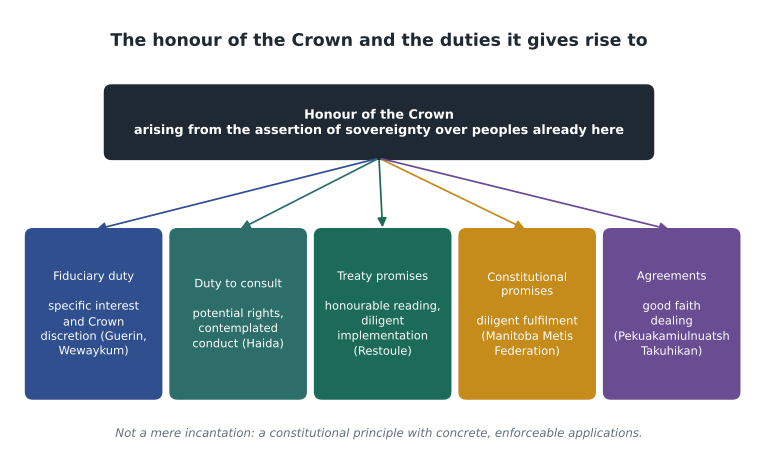
In Manitoba Metis Federation v. Canada (Attorney General) (2013), the Court explained that the honour of the Crown gives rise to different duties in different circumstances. Where the Crown assumes discretionary control over a specific Aboriginal interest, it gives rise to a fiduciary duty. Where the Crown contemplates conduct that may adversely affect asserted rights, it gives rise to the duty to consult. It informs the purposive interpretation of section 35 and requires honourable conduct in treaty negotiation and implementation. And, as the case decided, where the Crown makes a solemn constitutional promise to an Aboriginal group, it requires the Crown to act diligently to fulfil it.
Manitoba Metis Federation
When Manitoba joined Canada in 1870, after the Red River Resistance led by Louis Riel, section 31 of the Manitoba Act, 1870 provided that 1.4 million acres of land would be set aside 'towards the extinguishment of the Indian title' for the benefit of the families of the half-breed residents, to be divided among the children. The implementation took more than a decade, the land was distributed by random lottery rather than in family groups, and much of it was quickly sold to speculators, often for a fraction of its value, by the time the children were entitled to it. By the time the grants were made, the Métis had largely been displaced as settlement moved west.
The Supreme Court held, by a majority, that section 31 was a solemn constitutional obligation to the Métis people of Manitoba, an Aboriginal people, aimed at reconciling their interests with the assertion of Crown sovereignty. The honour of the Crown required Canada to implement it diligently and purposefully. Canada's persistent inaction and errors, over more than a decade, were not consistent with the honour of the Crown. The Court held that limitations laws and the doctrine of laches did not bar a declaration of that breach, because a declaration of constitutional wrongdoing serves the goal of reconciliation. It issued a declaration and left the parties to negotiate. Canada and the Manitoba Métis Federation signed a framework agreement in 2016 and later agreements recognizing the Métis government, including a self-government recognition and implementation agreement in 2021 and a self-government treaty signed in 2023.
Restoule and the treaties
Ontario (Attorney General) v. Restoule (2024), discussed in lesson 5, applied the honour of the Crown to the augmentation clause in the Robinson treaties. The Supreme Court held that the honour of the Crown required the Crown to exercise its discretion to increase the annuities diligently, and that freezing them for almost 150 years breached both the treaty and the honour of the Crown. The Court treated the honour of the Crown as a constitutional principle that courts must enforce, and held that, although the Crown had discretion over how much to increase the annuities, it could not refuse to exercise that discretion at all, and its exercise was subject to judicial review for honourable conduct. For the Robinson-Superior beneficiaries, it directed the Crown to determine compensation honourably within a set period, after engaging with them, and stated that the Crown's determination could be reviewed.
Equitable compensation: Southwind
When the Crown breaches a fiduciary duty, the usual remedy is equitable compensation. In Southwind v. Canada (2021), the issue was how to measure it. In 1929, Canada, Ontario and Manitoba built a dam that permanently flooded about 11,000 acres of the reserve of the Lac Seul First Nation in northwestern Ontario to generate hydroelectric power, without obtaining a surrender or paying compensation for decades. The trial judge awarded about thirty million dollars, based on the land's value for its uses at the time. The Supreme Court increased the potential award by holding that compensation must reflect what the Crown, acting as an honourable fiduciary, would have negotiated, including the land's value for hydroelectric development, which was the very purpose for which it was taken. It sent the case back to reassess compensation on that basis.
In Williams Lake Indian Band v. Canada (2018), the Court upheld a Specific Claims Tribunal decision that both the colonial government of British Columbia, for which Canada assumed responsibility after 1871, and Canada itself had breached fiduciary duties by failing to protect the band's village sites from settlers before a reserve was formally created. The Court emphasized the Tribunal's expertise and deferred to its findings.
Honour in agreements: Pekuakamiulnuatsh Takuhikan
In Quebec (Attorney General) v. Pekuakamiulnuatsh Takuhikan (2024), the Supreme Court applied the honour of the Crown to tripartite agreements funding a First Nation police force at Mashteuiatsh, in Quebec. The agreements were not treaties, and their funding terms were fixed for each term. But the First Nation had repeatedly run deficits to keep its police service operating, while Canada and Quebec refused to renegotiate funding in good faith. The Court held that the Crown's obligations under the agreements were informed by the honour of the Crown and that, by refusing to renegotiate seriously, the governments breached it, and upheld an award of damages to the First Nation for the deficits. The decision extends honourable dealing beyond treaties and the Constitution into the ordinary agreements through which governments fund Indigenous self-government and services.
Legislation and the honour of the Crown
Does the honour of the Crown constrain Parliament and the legislatures when they make laws? In Mikisew Cree First Nation v. Canada (Governor General in Council) (2018), the Court held that the duty to consult does not apply to the law-making process itself, because of parliamentary sovereignty, the separation of powers and parliamentary privilege. But several judges emphasized that the honour of the Crown continues to apply to legislation, and that legislation that is enacted without consultation and that adversely affects section 35 rights may still be challenged once it is enacted, under the justification test. Lesson 9 returns to this issue in the context of recent fast-track legislation.
Arjun asks how a lawyer can know in advance whether a particular promise attracts the honour of the Crown. Professor Morningside says that is the right question and the hardest one. The cases suggest the strongest claims involve explicit promises to Indigenous peoples in treaties or constitutional provisions, or the Crown taking control of specific Indigenous interests. 'Honour is not a free-floating duty to do what is nice,' she says. 'But the Supreme Court has made it clear, especially in Restoule and Pekuakamiulnuatsh, that it has teeth when governments make commitments and then ignore them.'
Worked problem
Fiduciary duty or honour of the Crown?
In 1965, the fictional Loon Narrows First Nation surrendered a lakeshore part of its reserve to the Crown for a cottage subdivision lease. Band council minutes record a requirement that rents be reviewed every ten years. The Crown signed a 99-year lease with fixed rent and no review. Analyze the Crown's liability.
Show solution
- A specific, cognizable Indian interest exists: surrendered reserve land, held for the band's benefit (Guerin; Wewaykum).
- The Crown had discretionary control over the lease terms, so a fiduciary duty arose.
- By signing on terms worse than those the band approved without returning to it, the Crown breached its duty, as in Guerin.
- The remedy is equitable compensation measured by what an honourable fiduciary would have obtained, including rent reviews (Southwind).
- The claim could be pursued in court or as a specific claim before the Specific Claims Tribunal, subject to the Tribunal's monetary cap.
Common mistakes
MistakeSaying the Crown owes a fiduciary duty in every dealing with Indigenous peoples.
InsteadA fiduciary duty requires a specific, cognizable Aboriginal interest and Crown discretionary control, or the elements of an ad hoc duty (Wewaykum; MMF).
MistakeTreating the honour of the Crown as a mere ideal.
InsteadIt gives rise to enforceable duties, as in MMF (diligent implementation), Restoule (treaty promises) and Pekuakamiulnuatsh Takuhikan (agreements).
MistakeAssuming limitations periods always bar historic claims.
InsteadMMF held that limitations and laches do not bar a declaration of a breach of the honour of the Crown.
MistakeMeasuring compensation for a flooded reserve by its value for traditional uses only.
InsteadSouthwind requires the value an honourable fiduciary would have negotiated, including the purpose for which the land was taken.
Practice problems
Work each problem on paper first, then reveal the answer to check.
Why did the Crown owe a fiduciary duty in Guerin?
Show answer
The surrender requirement gave it discretion over Musqueam land for the band's benefit, and it signed a lease on worse terms than the band had approved.
What limits did Wewaykum place on the fiduciary duty?
Show answer
It attaches only to a specific, cognizable Indian interest over which the Crown has assumed discretionary control.
What did MMF (2013) hold about section 31 of the Manitoba Act?
Show answer
It was a solemn constitutional obligation that the honour of the Crown required Canada to implement diligently, and Canada failed to do so.
How did Southwind change the measure of equitable compensation?
Show answer
Compensation must reflect what an honourable fiduciary would have negotiated, including the land's value for hydroelectric development.
What did Pekuakamiulnuatsh Takuhikan (2024) decide?
Show answer
That Canada and Quebec breached the honour of the Crown by refusing to renegotiate policing agreement funding in good faith, supporting damages.
Summary and key terms
- Guerin (1984) recognized a sui generis Crown fiduciary duty over surrendered reserve land.
- Wewaykum (2002) and MMF (2013) limited fiduciary duties to specific, cognizable interests under Crown discretionary control, or ad hoc duties.
- The honour of the Crown is always at stake and gives rise to fiduciary duties, consultation, honourable treaty implementation and diligent fulfilment of constitutional promises.
- MMF (2013) declared that Canada breached the honour of the Crown in implementing section 31 of the Manitoba Act.
- Southwind (2021) measures equitable compensation by what an honourable fiduciary would have negotiated.
- Restoule and Pekuakamiulnuatsh Takuhikan (2024) enforced honourable conduct in treaties and funding agreements.
- Fiduciary duty
- An obligation to act in another's best interests where one party has discretionary power over the other's interests.
- Cognizable Indian interest
- A specific Aboriginal interest, such as reserve land, to which a Crown fiduciary duty can attach.
- Honour of the Crown
- The constitutional principle requiring the Crown to act honourably in all dealings with Aboriginal peoples.
- Equitable compensation
- Monetary relief for breach of fiduciary duty, measured to restore what was lost.
- Laches
- An equitable defence based on unreasonable delay in bringing a claim.
- Declaratory relief
- A court order stating the parties' rights or that a wrong occurred, without ordering payment.
Lesson quiz · 5 questions
Score 60% or more to complete this lesson.
Create a free account to save your progress, take quizzes and earn a certificate.