
LAWC-114 · Lesson 5 of 12 · 22 min
Historic and modern treaties
▶ Video coming soon A video version of this lesson is on the way.
Professor Morningside asks Section B to read two documents before class: the official English text of a numbered treaty and an excerpt from the oral history of the treaty negotiations recorded by a First Nation's Elders' council. In the written text, the nation agrees to 'cede, release, surrender and yield up' all its rights to the land. In the oral history, the treaty commissioner says the Queen does not want the land, only to share it, and that the nation's way of life will continue 'as long as the sun shines, the grass grows and the rivers flow'. 'You are the judge,' she says. 'Which one is the treaty?'
What a treaty is
In R. v. Sioui (1990), the Supreme Court of Canada held that a 1760 document signed by General James Murray guaranteeing the Huron (Wendat) the free exercise of their religion and customs was a treaty, even though it was short and informal. The Court said that what characterizes a treaty is the intention to create obligations, the presence of mutually binding obligations and a certain measure of solemnity. Courts take a broad view of what counts as a treaty, because the parties to historic treaties did not share a legal culture or a language, and the Crown drafted the documents.
Treaties are not ordinary contracts and they are not international treaties in the modern sense. The Supreme Court has repeatedly described them as solemn agreements, sacred promises, and agreements whose interpretation must uphold the honour of the Crown. Treaty rights are protected by section 35 of the Constitution Act, 1982, and modern land claims agreements are included by section 35(3).
How courts interpret historic treaties
Courts have developed principles of treaty interpretation over several decades. In R. v. Simon (1985), the Court held that treaties should be given a fair, large and liberal construction in favour of the Indigenous signatories. In R. v. Badger (1996), it held that ambiguities in the written text must be resolved in favour of the Indigenous signatories, that the words must be interpreted as they would naturally have been understood by the Indigenous parties at the time, and that the Crown is presumed to intend to fulfil its promises. In R. v. Marshall (1999), Justice Binnie summarized the approach: courts must choose, from among the possible interpretations of the common intention of the parties, the one that best reconciles their interests at the time the treaty was made, while not altering the terms or exceeding what the words can reasonably bear.
Marshall shows how far context can go. The written text of the 1760 to 1761 treaty with the Mi'kmaq contained a 'truckhouse' clause, under which the Mi'kmaq promised to trade only at British truckhouses (trading posts). On its face, that was a restriction on the Mi'kmaq. But the Court, drawing on the historical record of the negotiations, held that the clause implied a right to continue to hunt, fish and gather in order to have things to trade, because the restriction would have been meaningless unless the Mi'kmaq had goods to bring. The right was limited to trade for 'necessaries', which the Court translated into modern terms as a moderate livelihood. Donald Marshall Jr., who had been charged with selling eels caught without a licence, was acquitted.
The reaction to Marshall was intense. Non-Indigenous fishers protested, and there was violence at Burnt Church (Esgenoôpetitj) in New Brunswick. In Marshall II, delivered a few months later on a motion for a rehearing, the Court refused to rehear the case but clarified that the treaty right was limited and could be regulated by the federal government for conservation and other compelling and substantial objectives. More than twenty-five years later, how Mi'kmaq and Wolastoqey nations can exercise a moderate livelihood fishery, and how it fits with federal fisheries management, remains contested and has led to further confrontations, negotiations and litigation.
Taking up lands and cumulative effects
The numbered treaties promised continued hunting, trapping and fishing throughout the ceded territory, but subject to the Crown's right to 'take up' lands for settlement, mining, lumbering and other purposes. In Mikisew Cree First Nation v. Canada (Minister of Canadian Heritage) (2005), Canada wanted to build a winter road through Wood Buffalo National Park, within Treaty 8 territory. The Supreme Court held that the Crown's right to take up lands is subject to the duty to consult, because taking up affects the treaty harvesting right. The road went ahead only after the consultation obligations were addressed. In Grassy Narrows (2014), the Court held that Ontario could take up lands under Treaty 3 for forestry, subject to the same duties.
What happens when no single taking up is decisive, but the total effect of many approvals leaves little land where treaty rights can meaningfully be exercised? In Yahey v. British Columbia (2021), the British Columbia Supreme Court held that the province had breached Treaty 8 by permitting so much industrial development, including forestry, oil and gas and roads, in the territory of the Blueberry River First Nations that the cumulative effects meaningfully diminished the nation's ability to exercise its treaty rights. The province did not appeal. In 2023, British Columbia and Blueberry River signed an agreement providing for restoration funding, protected areas, limits on new disturbance in key areas and joint land use planning. Yahey is a trial decision, but it is widely cited as showing that treaty promises can be broken by accumulation as well as by a single act.
Restoule: the augmentation clause
The Robinson-Huron and Robinson-Superior treaties of 1850 provided for annual payments to the Anishinaabe signatories and contained a promise that, if the ceded territory produced enough revenue to allow it without loss to the Crown, the annuities would be augmented from time to time. The annuities were increased once, in 1875, to four dollars per person, and never again. The beneficiaries sued Ontario and Canada in 2014.
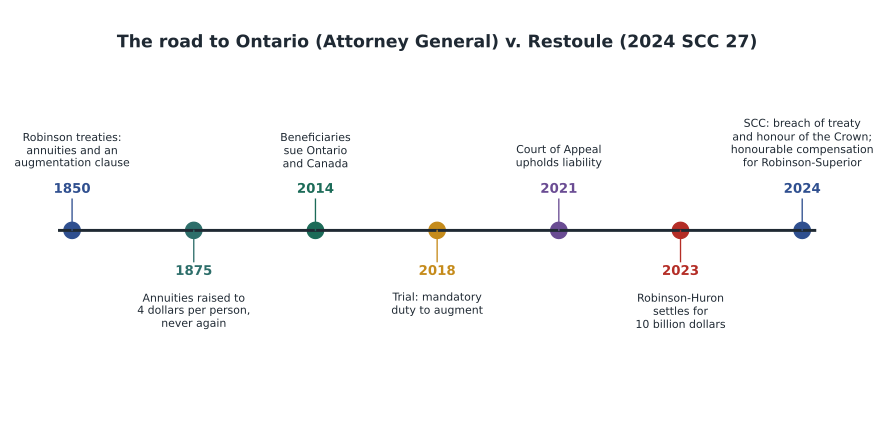
In Ontario (Attorney General) v. Restoule (2024), the Supreme Court of Canada unanimously held that the augmentation clause imposed a mandatory obligation on the Crown to consider, from time to time, whether it could increase the annuities, and to do so diligently and honourably. By freezing the annuities for nearly 150 years while the territory produced vast revenues from mining and forestry, the Crown had breached the treaties and the honour of the Crown. The Robinson-Huron claim had been settled in 2023 for ten billion dollars, shared by Canada and Ontario. For the Robinson-Superior claim, the Court declined to set compensation itself; it issued a declaration that the Crown had breached the treaty and directed the Crown to act honourably to determine the compensation owed, within a set time, after engaging with the Robinson-Superior beneficiaries. The Court emphasized that the Crown's treaty promises are not mere political commitments but enforceable obligations, and that the courts must hold the Crown to them.
Restoule is important for several reasons. It confirms that treaty promises about payments and revenue sharing are enforceable. It treats the honour of the Crown as central to treaty interpretation and to remedies. And it shows a court shaping a remedy around negotiation rather than imposing a sum, in keeping with the Supreme Court's repeated statement that reconciliation is best achieved by negotiation.
Treaty 6 and the medicine chest
Treaty 6, signed in 1876 at Fort Carlton and Fort Pitt in what is now Saskatchewan and Alberta, contains a clause promising that 'a medicine chest shall be kept at the house of each Indian Agent for the use and benefit of the Indians'. In Dreaver v. The King (1935), the Exchequer Court held that the clause entitled the Treaty 6 First Nations to all medicines, drugs and medical supplies they needed, free of charge. Later courts have taken narrower and broader views, and many Treaty 6 nations understand the clause as a promise of comprehensive health care. The clause illustrates how a few words in a written treaty can carry very different meanings depending on the context and the oral understanding.
Modern treaties
After Calder (1973), Canada adopted a comprehensive land claims policy for areas where Aboriginal title had not been dealt with by treaty. The first modern treaty was the James Bay and Northern Quebec Agreement (1975), concluded with the Cree and Inuit of northern Quebec after litigation over the James Bay hydroelectric project. Others include the Inuvialuit Final Agreement (1984), the Nunavut Agreement (1993), the Yukon Umbrella Final Agreement (1993) and the individual Yukon First Nation agreements that implement it, the Nisga'a Final Agreement (2000), and agreements in British Columbia negotiated through the British Columbia Treaty Commission process established in 1992, such as the Tsawwassen First Nation Final Agreement (2009) and the Maa-nulth First Nations Final Agreement (2011). More than two dozen modern treaties are now in force.
Modern treaties are long, detailed documents. They typically define settlement lands owned by the nation, often in fee simple or a similar form; set out harvesting rights over a larger area; provide capital transfers and resource revenue sharing; establish co-management boards for wildlife, land use and environmental assessment; and, in many cases, recognize law-making powers of the nation's government. They usually contain 'certainty' provisions in which the nation agrees that the treaty sets out its section 35 rights in full. Earlier agreements used extinguishment language; later ones use techniques such as modifying rights into the rights set out in the treaty or agreeing not to assert other rights.
The Supreme Court has said that modern treaties should be interpreted with more attention to their text than historic treaties, because they were negotiated by sophisticated parties with legal advice, often over many years. But the honour of the Crown still applies. In Beckman v. Little Salmon/Carmacks First Nation (2010), the Court held that the duty to consult applies as a matter of law even where a modern treaty does not expressly provide for it, though its content is shaped by the treaty. In First Nation of Nacho Nyak Dun v. Yukon (2017), the Court held that Yukon had not respected the land use planning process in the Umbrella Final Agreement when it changed a commission's final recommended plan for the Peel Watershed late in the process, and sent the matter back to the stage where Yukon had departed from the treaty.
Specific claims
Not every grievance about a historic treaty is litigated. Specific claims are claims by First Nations that Canada failed to fulfil a historic treaty obligation or mismanaged reserve lands or other assets. Canada assesses them under its specific claims policy and negotiates settlements. The Specific Claims Tribunal, created by statute in 2008, can make binding decisions on claims up to 150 million dollars that Canada has rejected or failed to resolve in time. First Nations organizations have long criticized the process as slow and controlled by the government whose conduct is in question. Large settlements, such as the 2018 settlement of the Williams Treaties litigation in Ontario, show that historic grievances remain live.
Worked problem
Interpreting a harvesting promise
A numbered treaty promises the right to "pursue their usual vocations of hunting, trapping and fishing" throughout the tract, subject to regulations and taking up. A treaty member uses a snowmobile and a high-powered rifle to hunt moose for her family on unoccupied Crown land and is charged under a provincial law requiring a licence. How would a court approach the treaty?
Show solution
- Treaty rights are interpreted liberally, with ambiguities resolved in favour of the First Nation (Simon, Badger).
- Rights are not frozen: modern methods such as snowmobiles and rifles are protected forms of an existing practice (Sparrow, Simon).
- Unoccupied Crown land not taken up for an incompatible use is generally land where the right can be exercised (Badger).
- A licensing requirement may infringe the right if it is unreasonable, imposes undue hardship or denies the preferred means of exercising it.
- If it infringes, the province must justify it, and must also respect any treaty priority recognized through section 88 of the Indian Act.
Common mistakes
MistakeReading a historic treaty like a commercial contract.
InsteadTreaties are solemn agreements interpreted liberally, with ambiguities resolved in favour of the Indigenous signatories and the honour of the Crown always at stake.
MistakeTreating the written English text as the whole treaty.
InsteadCourts consider oral promises, negotiations and context to find the common intention (Marshall).
MistakeAssuming the Crown may take up treaty land without limit.
InsteadTaking up triggers the duty to consult (Mikisew 2005) and cumulative effects can breach the treaty (Yahey).
MistakeTreating treaty payment promises as political commitments only.
InsteadRestoule (2024) held that the augmentation promise was an enforceable obligation the Crown breached.
Back to the two documents
Professor Morningside returns to the opening question. A court today would not simply choose one document. It would ask what the parties' common intention was, taking into account the written text, the record of the negotiations, the oral history, the parties' cultures and the circumstances, and would resolve ambiguities in favour of the First Nation, without rewriting the treaty beyond what its words can reasonably bear. Many First Nations reject the premise that the written cession clause reflects what they agreed to at all, and see the treaty relationship as an ongoing agreement to share the land. 'That disagreement,' she says, 'is at the centre of a lot of litigation and negotiation in this country, and you will not resolve it in an exam answer. But you can show that you understand the tools.'
Practice problems
Work each problem on paper first, then reveal the answer to check.
What are the hallmarks of a treaty under Sioui?
Show answer
An intention to create obligations, mutually binding obligations and a certain measure of solemnity.
What right did Marshall (1999) recognize, and how was it limited?
Show answer
A Mi'kmaq treaty right to harvest in order to trade for necessaries, limited to a moderate livelihood and subject to justified regulation.
What did Yahey v. British Columbia (2021) decide?
Show answer
That the cumulative effects of provincially authorized industrial development breached Treaty 8 rights of Blueberry River First Nations.
What did Restoule (2024) hold about the augmentation clause?
Show answer
It imposed a mandatory, enforceable obligation that the Crown breached by freezing annuities for nearly 150 years.
What did Beckman v. Little Salmon/Carmacks hold?
Show answer
The duty to consult applies even under a modern treaty that does not expressly provide for it, shaped by the treaty's terms.
Summary and key terms
- Treaties are solemn agreements identified by intention, mutual obligations and solemnity (Sioui).
- Historic treaties are interpreted liberally, ambiguities favour Indigenous signatories, and courts seek the common intention (Simon, Badger, Marshall).
- Taking up treaty lands triggers the duty to consult (Mikisew 2005; Grassy Narrows), and cumulative effects can breach treaties (Yahey 2021).
- Restoule (2024) enforced the Robinson treaties' augmentation promise and directed honourable negotiation of compensation.
- Modern treaties since 1975 define lands, harvesting, governance and certainty, and are read more closely to their text but with the honour of the Crown (Little Salmon, Nacho Nyak Dun).
- Specific claims address breaches of historic obligations through negotiation and the Specific Claims Tribunal.
- Treaty right
- A right arising from a treaty between the Crown and an Indigenous nation, protected by section 35.
- Moderate livelihood
- The limit on the Mi'kmaq treaty trade right recognized in Marshall.
- Taking up
- The Crown's treaty right to use lands for settlement, resource development and other purposes.
- Cumulative effects
- The combined impact of many developments on the exercise of rights.
- Modern treaty
- A comprehensive land claims agreement concluded since 1975 and protected by section 35(3).
- Specific claim
- A claim that Canada breached a historic treaty or mismanaged First Nation lands or assets.
Lesson quiz · 5 questions
Score 60% or more to complete this lesson.
Create a free account to save your progress, take quizzes and earn a certificate.