
LAWC-114 · Lesson 11 of 12 · 21 min
Indigenous peoples and the criminal justice system
▶ Video coming soon A video version of this lesson is on the way.
Professor Ruth Castellano, who teaches criminal law, joins Professor Morningside for this class, because the topic sits at the meeting point of their two courses. Professor Castellano opens with numbers. Indigenous people make up about five percent of the adult population of Canada. In recent annual reports, the federal Correctional Investigator has reported that Indigenous people account for roughly a third of people in federal custody, and Indigenous women for about half of federally sentenced women. 'Those figures have risen, not fallen, in the twenty-five years since the Supreme Court told judges to do something about it,' she says. 'This lesson is about what the law says, and why it has not been enough.'
Section 718.2(e)
In 1996, Parliament reformed the sentencing provisions of the Criminal Code. Section 718.2(e) now provides that a court imposing a sentence must take into consideration the principle that 'all available sanctions, other than imprisonment, that are reasonable in the circumstances and consistent with the harm done to victims or to the community should be considered for all offenders, with particular attention to the circumstances of Aboriginal offenders.' The phrase about victims and the community was added in 2015, but the core of the provision has been in force since 1996.
R. v. Gladue
Jamie Tanis Gladue, a young Cree woman, pleaded guilty to manslaughter for killing her common law partner in Nanaimo, British Columbia, in 1995. The sentencing judge gave her three years in prison and did not treat her Indigenous background as relevant because she was living off reserve. In R. v. Gladue (1999), the Supreme Court of Canada upheld her sentence on the facts, since she had by then been released on day parole, but explained section 718.2(e) in terms that have shaped sentencing ever since.
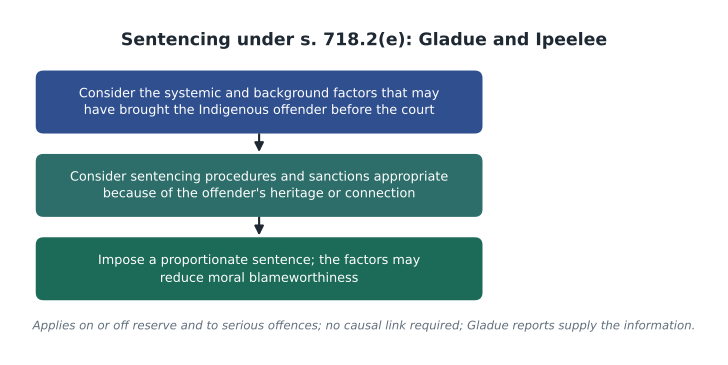
The Court held that section 718.2(e) is remedial. It was enacted to address the serious problem of overrepresentation of Aboriginal people in prisons, and to encourage judges to approach the sentencing of Aboriginal offenders differently, to achieve a truly fit and proper sentence. When sentencing an Aboriginal offender, a judge must consider the unique systemic or background factors that may have played a part in bringing the offender before the court, and the types of sentencing procedures and sanctions that may be appropriate because of the offender's Aboriginal heritage or connection. The provision applies to all Aboriginal offenders, on or off reserve, in cities or rural areas. It does not mean an automatic reduction of sentence, and the Court said that for more serious and violent crimes the sentence may often be similar to that for non-Indigenous offenders. That last remark caused confusion for more than a decade.
R. v. Ipeelee
In R. v. Ipeelee (2012), the Supreme Court revisited Gladue because courts had been applying it inconsistently and narrowly. Manasie Ipeelee, an Inuk man from Iqaluit, and Frank Ladue, a member of the Ross River Dena Council, had each breached long-term supervision orders by drinking alcohol. Justice LeBel, for the majority, held that courts had erred in several ways. Gladue principles apply to every sentencing involving an Indigenous offender, including for serious offences and breaches of long-term supervision orders; there is no category of offence to which they do not apply. Offenders need not show a direct causal link between the systemic factors and the offence; those factors are relevant because they provide context and may bear on the offender's moral blameworthiness. And applying Gladue is not reverse discrimination: it is an attempt to remedy a system that has treated Indigenous people unequally.
Ipeelee also required judges to take judicial notice of the history of colonialism, displacement and residential schools, and of how that history continues to translate into lower educational attainment, lower incomes, higher unemployment, higher rates of substance abuse and suicide and higher levels of incarceration for Indigenous peoples. The Court said these matters do not themselves justify a lesser sentence, but they provide the necessary context for understanding the information presented by counsel. Ladue's sentence was reduced; Ipeelee's was upheld.
Gladue reports and Gladue courts
To apply Gladue, judges need information about the person in front of them. Gladue reports, prepared by trained writers often working for Indigenous organizations such as Aboriginal Legal Services in Ontario, describe the offender's family and community history, the effects of residential schools and child welfare involvement, and the culturally appropriate options available, such as treatment programs, healing lodges or community supervision. Defence lawyers have a duty to present this information, and judges must ask for it if it is missing. Availability of Gladue writers varies widely across the country, and access remains uneven, especially outside large cities.
Some courts have specialized Gladue court lists, beginning with a court at Old City Hall in Toronto in 2001, where judges, Crown counsel and duty counsel with training and experience in Gladue principles hear cases involving Indigenous accused. Other courts use sentencing circles, in which community members, Elders, the victim and the offender participate in discussing an appropriate sentence. In R. v. Moses (1992), a judge of the Yukon Territorial Court described the use of a sentencing circle, and the practice has spread. The judge still imposes the sentence and must follow the Criminal Code.
Gladue beyond sentencing
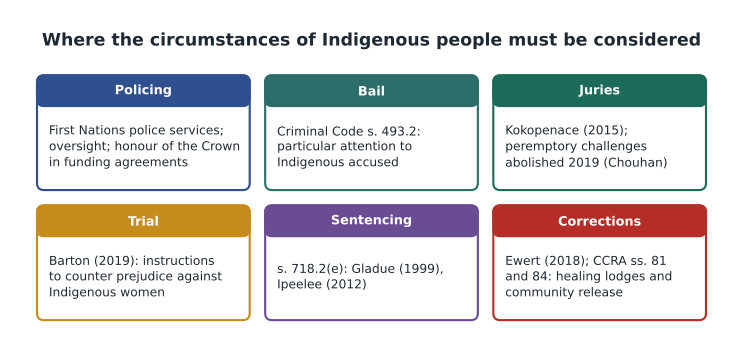
Gladue principles have spread beyond sentencing. Courts have applied them in bail decisions, and in 2019 Parliament added section 493.2 to the Criminal Code, requiring peace officers, justices and judges in interim release decisions to give particular attention to the circumstances of Aboriginal accused and of accused from vulnerable populations that are overrepresented in the criminal justice system. They have also been applied in extradition, dangerous offender proceedings, parole and some administrative decisions. In R. v. Anderson (2014), however, the Supreme Court held that Gladue does not require Crown prosecutors to consider an accused's Indigenous status when deciding whether to seek a mandatory minimum sentence; prosecutorial discretion is reviewable only for abuse of process.
Mandatory minimum sentences are in direct tension with Gladue, because they limit a judge's ability to consider alternatives to imprisonment. In 2022, Parliament repealed a number of mandatory minimums, partly because of their disproportionate effect on Indigenous and Black offenders. In 2026, Bill C-16 restored mandatory minimums that courts had struck down, with a new safety valve allowing judges to depart from a minimum that would be grossly disproportionate for the offender before the court, as Professor Castellano's course discussed. How that safety valve interacts with Gladue factors will be worked out in the cases.
Juries, trials and prejudice
Indigenous people are underrepresented on juries in many parts of Canada. In R. v. Kokopenace (2015), an Indigenous man from Grassy Narrows was convicted of manslaughter by a jury in Kenora, Ontario, where on-reserve residents were significantly underrepresented on jury rolls. A majority of the Supreme Court held that the state's duty under the Charter was to make reasonable efforts to compile a representative jury roll, not to guarantee a jury roll proportionate to the population, and that Ontario had met that duty. A report by former Supreme Court Justice Frank Iacobucci in 2013 had described the underrepresentation of First Nations people on Ontario juries as a crisis.
In 2018, a jury in Battleford, Saskatchewan acquitted a white farmer, Gerald Stanley, of second degree murder in the shooting death of Colten Boushie, a young Cree man from Red Pheasant First Nation. Defence counsel had used peremptory challenges to exclude visibly Indigenous prospective jurors. The case led Parliament, in 2019, to abolish peremptory challenges, under which lawyers could exclude prospective jurors without giving reasons. The Supreme Court upheld the abolition in R. v. Chouhan (2021).
In R. v. Barton (2019), the Supreme Court ordered a new trial on a manslaughter charge in the death of Cindy Gladue, a Métis and Cree woman, in an Edmonton hotel room. Among other errors, the trial had been marked by repeated references to her as a 'Native' woman and a 'prostitute'. Justice Moldaver held that trial judges should, in sexual assault cases involving Indigenous women, give instructions to counter prejudice against Indigenous women and girls, noting the reality of systemic biases in the justice system. Barton was later convicted of manslaughter at the retrial.
Policing and corrections
Relations between Indigenous communities and police have been strained for generations. The Ipperwash Inquiry, which examined the 1995 police shooting of Dudley George during an occupation at Ipperwash Provincial Park in Ontario, reported in 2007. In 2018, Ontario's Office of the Independent Police Review Director, in a report titled Broken Trust, found systemic racism in the Thunder Bay Police Service's investigations of the deaths of Indigenous people. First Nations police services, funded under federal and provincial agreements, have long reported underfunding; lesson 8's discussion of Pekuakamiulnuatsh Takuhikan (2024) shows the Supreme Court holding governments to the honour of the Crown in funding them.
In corrections, the Corrections and Conditional Release Act requires the Correctional Service of Canada to provide programs that address the needs of Indigenous offenders. Sections 81 and 84 allow agreements with Indigenous communities for the care and custody of offenders in community healing lodges and for release into Indigenous communities, although the Correctional Investigator has repeatedly criticized how little these provisions are used. In Ewert v. Canada (2018), the Supreme Court held that the Correctional Service breached its statutory duty to take all reasonable steps to ensure that the information it uses about offenders is accurate, by continuing to use psychological risk assessment tools without confirming that they were valid for Indigenous offenders.
Community-based justice
Alongside the formal court system, many Indigenous communities run their own justice programs. The federal Indigenous Justice Program, which grew out of the Aboriginal Justice Strategy begun in the early 1990s, funds community-based programs that offer diversion, restorative justice processes and support at sentencing and reintegration, often in partnership with provinces and territories. Referrals can come from police before charges, from Crown counsel after charges, or from judges at sentencing. These programs typically draw on the community's own values and processes, such as healing circles, mediation involving Elders and family, and plans for repairing harm. In 2021, the federal government committed to developing an Indigenous Justice Strategy with Indigenous partners to address systemic discrimination and overrepresentation, a commitment repeated in the 2023 action plan under the federal United Nations Declaration Act. Lawyers should know what programs exist in the communities their clients come from, because a referral can change the whole course of a case.
The MMIWG Inquiry and justice
The National Inquiry into Missing and Murdered Indigenous Women and Girls (2019), discussed in lesson 3, made many Calls for Justice directed at police and the justice system, including calls for culturally safe services, independent oversight and the protection of Indigenous women and girls from violence. Its findings form part of the context that judges, police and lawyers are expected to understand.
Daniel asks whether the problem can be solved inside the Canadian criminal justice system at all. Professor Morningside says many Indigenous scholars and communities argue it cannot, and that the long-term answer lies in Indigenous justice systems, including community courts, restorative processes under Indigenous law and, in some self-government agreements, Indigenous administration of justice. Professor Castellano adds that, in the meantime, lawyers have concrete duties: 'Get the Gladue report. Read it. Use it. Make the judge look at the person, not just the record.'
Worked problem
Preparing Gladue submissions
Your client, a 24-year-old member of the fictional Loon Narrows First Nation living in Corwin, pleads guilty to robbery. He grew up partly in foster care; his mother attended a residential school. A Gladue writer is available. What should your sentencing submissions cover?
Show solution
- Request a Gladue report covering family history, residential school and child welfare impacts, community ties and available programs.
- Present the systemic and background factors, without needing to prove they caused the robbery (Ipeelee).
- Explain how the factors bear on moral blameworthiness and what culturally appropriate, community-based options exist.
- Address proportionality and any mandatory minimum; Gladue applies to serious offences too.
- If a minimum applies, consider whether the 2026 safety valve for grossly disproportionate sentences is engaged.
Common mistakes
MistakeApplying Gladue only to Indigenous offenders who live on reserve.
InsteadIt applies to all Indigenous offenders, on or off reserve (Gladue).
MistakeRequiring the offender to prove the systemic factors caused the offence.
InsteadNo causal link is required; the factors provide context and may reduce moral blameworthiness (Ipeelee).
MistakeSaying Gladue does not apply to serious or violent offences.
InsteadIt applies to every sentencing of an Indigenous offender, though the result may differ for serious crimes (Ipeelee).
MistakeTreating Gladue as an automatic discount.
InsteadIt changes the analysis and the information considered, not by a fixed reduction; the sentence must still be proportionate.
Practice problems
Work each problem on paper first, then reveal the answer to check.
What does section 718.2(e) require?
Show answer
That all available sanctions other than imprisonment that are reasonable be considered, with particular attention to the circumstances of Aboriginal offenders.
What two things must a judge consider under Gladue?
Show answer
The systemic or background factors that may have brought the offender before the court, and appropriate sentencing procedures and sanctions given the offender's heritage or connection.
What did Ipeelee correct?
Show answer
The narrow application of Gladue: it applies to all offences, requires no causal link and is not reverse discrimination.
What does section 493.2 of the Criminal Code require?
Show answer
Particular attention to the circumstances of Aboriginal accused and overrepresented vulnerable groups in bail decisions.
What did Ewert v. Canada (2018) decide?
Show answer
CSC breached its duty to ensure accurate information by using risk tools not validated for Indigenous offenders.
Summary and key terms
- Indigenous people are heavily overrepresented in prisons, especially Indigenous women.
- Section 718.2(e) is remedial and requires particular attention to the circumstances of Aboriginal offenders (Gladue, 1999).
- Ipeelee (2012) held Gladue applies to all offences, requires no causal link and is not reverse discrimination.
- Gladue reports, Gladue courts and sentencing circles provide information and alternatives; section 493.2 extends attention to bail.
- Kokopenace (2015), the abolition of peremptory challenges (2019, upheld in Chouhan) and Barton (2019) address juries and trial prejudice.
- Ewert (2018) and CCRA sections 81 and 84 address corrections; mandatory minimums remain in tension with Gladue.
- Section 718.2(e)
- The Criminal Code sentencing principle requiring particular attention to the circumstances of Aboriginal offenders.
- Gladue factors
- The systemic and background factors affecting an Indigenous offender that a judge must consider.
- Gladue report
- A pre-sentence report describing an Indigenous offender's background and culturally appropriate options.
- Sentencing circle
- A process in which community members, the victim and the offender help shape a sentence.
- Peremptory challenge
- A former right to exclude a prospective juror without reasons, abolished in 2019.
- Healing lodge
- A correctional facility based on Indigenous values, run under a section 81 agreement with a community or by the Correctional Service.
Lesson quiz · 5 questions
Score 60% or more to complete this lesson.
Create a free account to save your progress, take quizzes and earn a certificate.