
LAWC-114 · Lesson 1 of 12 · 22 min
Indigenous legal orders
▶ Video coming soon A video version of this lesson is on the way.
Professor Corinne Morningside begins the first class of Indigenous Peoples and Canadian Law by asking Section B to put their casebooks away. She is Anishinaabe, grew up in a First Nation community in northwestern Ontario, and practised for twelve years at a small firm that represented First Nations in treaty claims, consultation disputes and child welfare matters before she joined the Brannock faculty. She writes two questions on the board: 'Whose law?' and 'Which law?' Then she asks the students what law governed the land under Ashgrove Hall five hundred years ago.
Arjun Mehta, who likes clear answers, says there was no law in the sense the course means: no statutes, no courts. Professor Morningside lets the answer sit for a moment and then disagrees. 'There were laws about who could hunt where, about how disputes were settled, about obligations between families and between nations, about how land and water were to be cared for. They were not written in statute books. Most of them were not written at all. But they were law, and many of them still are.' She tells the class that this course is about two things at once: how Canadian law has treated Indigenous peoples, and how Indigenous peoples' own legal orders continue to operate alongside it.
Daniel Whitecloud, who worked in band administration in northern Saskatchewan before law school, is in the room. Professor Morningside says, in front of everyone, that nobody in the class, including Daniel and including herself, speaks for any nation other than in the way any citizen speaks about their own community. Indigenous peoples in Canada include more than six hundred First Nations, dozens of Inuit communities and the Métis Nation, with many languages and many distinct legal traditions. 'If I hear anyone say what Indigenous people believe,' she says, 'I will ask which people, which community and how you know.'
Legal pluralism
Canadian law already lives with more than one legal tradition. Quebec's private law is civil law, drawn from the French tradition and codified in the Civil Code of Québec; the other provinces and the territories use the common law inherited from England. Federal statutes are drafted in both languages and must fit both traditions, a practice called bijuralism. Legal scholars use the term legal pluralism for the idea that more than one legal order can operate in the same territory at the same time.
Indigenous legal orders are a third set of traditions in Canada, and they are older than the other two. The Truth and Reconciliation Commission, whose final report was released in 2015, called Indigenous law one of the essential elements of reconciliation. Its Call to Action 50 asks governments to fund the establishment of Indigenous law institutes for the development, use and understanding of Indigenous laws. Calls to Action 27 and 28 ask law societies and law schools to ensure that lawyers learn about the history and legacy of residential schools, treaties and Aboriginal rights, Indigenous law and Aboriginal-Crown relations. This course exists partly because of those calls.
Canadian courts have acknowledged Indigenous legal orders in a number of ways. In Connolly v. Woolrich (1867), a Quebec court recognized the validity of a marriage celebrated according to Cree law, on the basis that Cree law had continued in force. In R. v. Van der Peet (1996), which you will read in lesson 7, the Supreme Court of Canada said that Aboriginal rights must be defined by taking into account both the common law and the Aboriginal perspective on the meaning of the right. In Delgamuukw v. British Columbia (1997), the Court accepted that oral histories can be admitted as evidence and placed on an equal footing with documentary evidence, and that Aboriginal title can be shown in part by proof of the claimant group's own law concerning land. In Tsilhqot'in Nation v. British Columbia (2014), the Court relied on the Tsilhqot'in people's own laws and practices to understand the extent of their occupation.
Sources of Indigenous law
John Borrows, an Anishinaabe legal scholar from the Chippewas of Nawash First Nation, has written widely on Indigenous law. In Canada's Indigenous Constitution (2010), he describes several sources from which Indigenous legal traditions draw. Sacred law is rooted in creation stories and teachings about the relationship between people and the Creator or the spiritual world. Natural law draws on observations of the natural world and the relationships it models, for example the way some teachings take lessons about responsibility from the behaviour of animals. Deliberative law comes from persuasion, discussion and consensus in councils, families and gatherings. Positivistic law consists of proclamations, rules and regulations made by those with authority, such as rules announced by leaders or recorded in wampum belts. Customary law develops from practices repeated over time until they are accepted as binding.
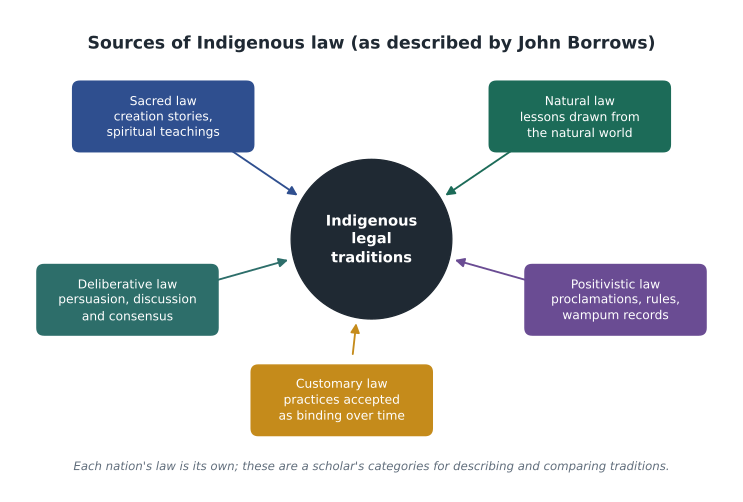
Borrows stresses that these are categories used to describe and compare, not a single system shared by every Indigenous nation. Each nation's law has its own content, its own institutions and its own ways of changing. Haudenosaunee law is associated with the Great Law of Peace and with the Confederacy's council structure; many Coast Salish and Northwest Coast nations govern important matters through the feast or potlatch, where names, rights and responsibilities are publicly witnessed and validated; Cree and Anishinaabe legal traditions are often expressed through stories, teachings about relationships and the responsibilities of kinship; Inuit law includes principles known as Inuit Qaujimajatuqangit, which the Government of Nunavut has used as guiding principles in its policies. A responsible lawyer does not generalize from one of these to the others.
Indigenous law is also not a relic. The Canadian state tried hard to suppress it. The Indian Act at different times banned the potlatch and other ceremonies (from 1884 until the ban was removed from the Act in 1951), replaced traditional governments with elected band councils on a model chosen by Ottawa and took children away to residential schools where speaking their languages was forbidden. Despite that, Indigenous legal orders survived in families and communities, and many nations are now revitalizing them openly, writing them down where the community decides that is appropriate and applying them in community institutions.
How to find and learn Indigenous law
Common law students learn law by reading judicial decisions. Indigenous laws are found in different places: stories and teachings held by Elders and Knowledge Keepers, ceremonies, songs, place names, oral histories, the practices of families and clans, and, increasingly, written laws enacted by Indigenous governments. Hadley Friedland and Val Napoleon, legal scholars who worked together on the Accessing Justice and Reconciliation Project with the Indigenous Bar Association and the University of Victoria in the early 2010s, developed a method that adapts the familiar case brief to stories.
The method asks the same questions a common law student asks of a reported case. What is the issue the story addresses? What decision or response does the story describe? What were the reasons for it? What procedural steps were followed, and who was involved in deciding? What legal principles can be stated from it? The researcher then tests those principles against other stories and against the knowledge of community members, because a single story, like a single case, can be misread. Napoleon and Friedland emphasize that stories are records of legal reasoning about real problems, such as how to respond when someone becomes dangerous to the community, how to resolve a dispute over resources or how to restore relationships after harm.
Learning Indigenous law raises questions that learning the common law usually does not. Who has authority to share particular teachings, and under what protocols? Some knowledge is held by particular families or societies and is not public. Some stories are told only at certain times of year or in certain settings. Researchers working with communities follow ethical frameworks, and many communities assert control over their own information through principles such as OCAP (ownership, control, access and possession), developed by the First Nations Information Governance Centre. A lawyer who wants to rely on a community's law in court should work with that community, not lift a passage from a book.
Indigenous law in practice today
Indigenous laws operate today in several overlapping ways. First, they govern life within communities, in matters such as family relationships, naming, resource use, and the resolution of disputes, whether or not Canadian law takes notice. Second, many First Nations have enacted written laws under federal statutes such as the First Nations Land Management Act framework (now the Framework Agreement on First Nation Land Management Act, 2022), which allows signatory nations to make their own land codes in place of the Indian Act's land provisions. Third, modern treaties and self-government agreements, which you will study in lessons 5 and 6, recognize law-making powers that sit alongside federal and provincial law. Fourth, the federal Act respecting First Nations, Inuit and Métis children, youth and families, upheld by the Supreme Court in 2024, affirms Indigenous jurisdiction over child and family services and gives Indigenous laws in that field the force of federal law.
Universities have begun to teach Indigenous law directly. The University of Victoria launched a joint degree in Canadian common law and Indigenous legal orders (the JD/JID) in 2018, in which students study Indigenous laws in field schools with partner communities. Other law schools offer courses, intensive programs and land-based learning. Professor Morningside tells Section B that the goal of this course is more modest: to make them lawyers who recognize that Indigenous legal orders exist, who know how Canadian law has treated Indigenous peoples, and who know when they are out of their depth and need to listen.
Common law, Indigenous law and the Constitution
Section 35(1) of the Constitution Act, 1982 recognizes and affirms 'the existing aboriginal and treaty rights of the aboriginal peoples of Canada'. Section 35(2) defines the Aboriginal peoples of Canada to include the Indian, Inuit and Métis peoples. Much of this course is about how the courts have interpreted those words. One recurring criticism of the case law is that it has tended to translate Indigenous relationships to land and community into common law categories such as rights, title and fiduciary duties, rather than recognizing Indigenous legal orders on their own terms. Another view, associated with Borrows and others, is that section 35 can be read as protecting Indigenous peoples' continuing ability to make and apply their own laws, and that Canada's constitution is itself partly Indigenous because it was formed through treaty relationships.
Theo Marchetti, the mature student who spent ten years as a litigation clerk, asks the practical question: in a courtroom in Corwin next year, will any of this matter? Professor Morningside answers with examples. A lawyer representing a First Nation in a consultation dispute will need to understand how the nation makes decisions, because the Crown must consult the right people in the right way. A family law lawyer may face an Indigenous law on child and family services that has paramountcy over provincial law. A criminal lawyer must prepare Gladue information about an Indigenous client's background and community. A corporate lawyer negotiating an impact benefit agreement for a mine will deal with a nation's own decision-making processes. 'You will meet Indigenous law in practice,' she says, 'whether you recognize it or not.'
Worked problem
Briefing a story as a legal source
A Knowledge Keeper shares, with the community's permission, a story about a hunter who repeatedly took more than his family needed from a shared hunting area. After warnings from his relatives, the family heads met, and the hunter was required to give part of his harvest to families who had gone without, and to hunt under an uncle's guidance for a season. Apply the Napoleon and Friedland questions.
Show solution
- Issue: how should a community respond when one person takes more than a fair share of a shared resource?
- Decision: the hunter had to share his harvest with families in need and hunt under supervision for a season.
- Reasons: the response aimed to restore the balance between families and to teach responsibility, not simply to punish.
- Procedure: relatives warned him first; the decision was made collectively by family heads.
- Principles: shared resources carry obligations to others; responses to harm favour restoration and teaching; decisions are made by those with standing in the kinship system.
- Test the principles against other stories and community knowledge before relying on them.
Common mistakes
MistakeSpeaking of "Indigenous law" as if it were one system shared by all Indigenous peoples.
InsteadEach nation has its own legal traditions; scholars' categories describe and compare them but do not merge them.
MistakeAssuming Indigenous law is only historical.
InsteadIndigenous legal orders operate today in communities, in written land codes and laws, in modern treaties and under federal statutes such as the child and family services Act.
MistakeTreating any published story as freely usable legal evidence.
InsteadKnowledge is governed by community protocols; lawyers should work with the community that holds the law.
MistakeAssuming Canadian courts have always ignored Indigenous law.
InsteadConnolly v. Woolrich (1867), Van der Peet, Delgamuukw and Tsilhqot'in all took account of Indigenous law or perspectives, though often through common law categories.
Looking ahead
The rest of the course moves roughly through history and doctrine. Lessons 2 to 4 cover the Royal Proclamation, the Indian Act and residential schools, and the constitutional framework of sections 91(24) and 35. Lessons 5 and 6 cover historic and modern treaties and self-government. Lessons 7 and 8 cover Aboriginal rights and title, and the honour of the Crown and fiduciary duty. Lessons 9 and 10 cover the duty to consult and the United Nations Declaration on the Rights of Indigenous Peoples. Lesson 11 turns to criminal justice, and lesson 12 is a problem about a proposed lithium mine near the fictional Loon Narrows First Nation, which will run through several lessons as a hypothetical. Loon Narrows and the mining company in the problem, Harrow Basin Lithium Corp., are fictional; the law they raise is real.
Professor Morningside ends the first class by returning to her two questions. 'Whose law? Which law? For most of Canadian history, the answer the courts gave was: ours, and only ours. The law has moved, slowly and unevenly. Your job as lawyers is to know where it stands now, and to understand why it took so long to get here.'
Practice problems
Work each problem on paper first, then reveal the answer to check.
What does legal pluralism mean?
Show answer
More than one legal order operating in the same territory at the same time, as with civil law, common law and Indigenous legal orders in Canada.
Name the sources of Indigenous law that John Borrows describes.
Show answer
Sacred, natural, deliberative, positivistic and customary law.
What did Delgamuukw say about oral histories?
Show answer
They can be admitted as evidence and placed on an equal footing with documentary evidence.
Which TRC Call to Action asks for Indigenous law institutes?
Show answer
Call to Action 50.
What questions does the Napoleon and Friedland method ask of a story?
Show answer
The issue, the decision, the reasons, the procedure and the principles, then testing against other stories and community knowledge.
Summary and key terms
- Indigenous legal orders are distinct, living traditions that predate and continue alongside the common law and civil law.
- Borrows describes sacred, natural, deliberative, positivistic and customary sources of Indigenous law.
- The Napoleon and Friedland method briefs stories for issues, decisions, reasons, procedures and principles.
- Courts have taken account of Indigenous law in Connolly v. Woolrich, Van der Peet, Delgamuukw and Tsilhqot'in.
- TRC Calls to Action 27, 28 and 50 call for legal education about Indigenous peoples and for Indigenous law institutes.
- Indigenous laws operate today in communities, land codes, modern treaties and federally recognized child and family laws.
- Indigenous legal order
- The laws, institutions and processes by which a particular Indigenous nation governs itself.
- Legal pluralism
- The coexistence of more than one legal order in the same territory.
- Bijuralism
- The coexistence of the common law and the civil law in Canadian federal law.
- Deliberative law
- Law made through persuasion, discussion and consensus in councils or gatherings.
- OCAP
- First Nations principles of ownership, control, access and possession over their own information.
- Section 35
- The provision of the Constitution Act, 1982 that recognizes and affirms existing Aboriginal and treaty rights.
Lesson quiz · 5 questions
Score 60% or more to complete this lesson.
Create a free account to save your progress, take quizzes and earn a certificate.