
LAWC-114 · Lesson 7 of 12 · 22 min
Aboriginal rights and title
▶ Video coming soon A video version of this lesson is on the way.
Professor Morningside starts with a fishing net. In 1984, Ronald Sparrow, a member of the Musqueam Indian Band, was charged under the federal Fisheries Act with fishing in the Fraser River with a drift net longer than his food fishing licence allowed. He admitted the facts and argued that he was exercising an existing Aboriginal right to fish, protected by section 35. His case became the first major Supreme Court of Canada decision on section 35, and most of the doctrine in this lesson follows from it.
Aboriginal rights: R. v. Sparrow
In R. v. Sparrow (1990), the Supreme Court held that the Musqueam had an Aboriginal right to fish for food, social and ceremonial purposes, that the right had not been extinguished by decades of federal fisheries regulation, and that the right had to be interpreted flexibly so as to permit its evolution over time. The Court held that before 1982 a right could be extinguished only by legislation showing a clear and plain intention to do so; regulation of a right, however detailed, is not extinguishment. After 1982, section 35 protects existing rights from extinguishment by ordinary legislation.
Sparrow also established that section 35 rights are not absolute. The Crown can infringe them, but only if it can justify the infringement. The Court described the relationship between the Crown and Aboriginal peoples as trust-like rather than adversarial, and said that section 35 imposes a standard of conduct on government. The case was sent back for a new trial to determine whether the net length restriction infringed the right and, if so, whether it was justified.
The Van der Peet test
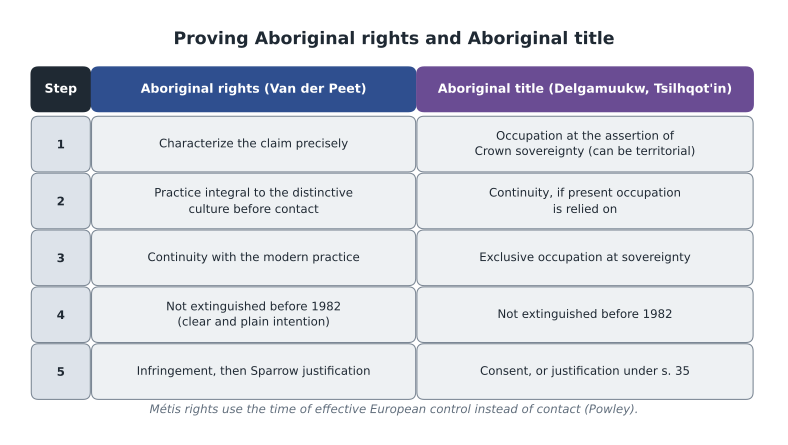
Sparrow did not say how a court should decide whether a particular Aboriginal right exists. The Court answered that question in R. v. Van der Peet (1996). Dorothy Van der Peet, a member of the Stó:lō Nation, sold ten salmon caught under a food fishing licence and was charged with selling fish without a commercial licence. The Court held that to be an Aboriginal right, an activity must be an element of a practice, custom or tradition integral to the distinctive culture of the Aboriginal group claiming the right, and the practice must have existed before contact with Europeans. Modern practices that have continuity with pre-contact practices are protected, even if their form has evolved.
Chief Justice Lamer's majority set out several factors. The court must characterize the claimed right precisely, by looking at the nature of the action, the regulation challenged and the practice relied on. The practice must have been of central significance to the group's culture, a defining feature, not something incidental. It must be distinctive, though not necessarily unique. The court must take into account the perspective of the Aboriginal group, framed in terms cognizable to the Canadian legal system. On the facts, the Court found that exchanging fish for money or goods was not integral to Stó:lō culture before contact, so there was no Aboriginal right to sell fish.
Van der Peet has been heavily criticized. Justices L'Heureux-Dubé and McLachlin dissented, arguing that the majority's test froze rights at contact and required courts to separate 'authentic' practices from those influenced by Europeans. Scholars have argued that the test asks what Indigenous people did rather than what their laws allowed them to do, and that it treats culture as a list of practices. In R. v. Gladstone (1996), decided the same day, the Court did find a commercial right: the Heiltsuk had a right to trade herring spawn on kelp commercially, because the evidence showed trade in the product on a large scale before contact. Because a commercial right has no internal limit, the Court held that the Crown's obligation to give priority to it was more flexible than for a food fishing right.
Later cases have applied and refined the test. In Mitchell v. M.N.R. (2001), the Court held that Grand Chief Michael Mitchell of Akwesasne had not proved an Aboriginal right to bring goods across the Canada-US border for trade without paying customs duties, because the evidence of pre-contact trade across the St. Lawrence was too limited. In R. v. Sappier; R. v. Gray (2006), the Court recognized a right of Mi'kmaq and Wolastoqey communities to harvest timber for domestic uses, emphasizing that the relevant question is how the practice was integral to the community's way of life, and that a practice need not be a 'core' identity marker. In Lax Kw'alaams Indian Band v. Canada (2011), the Court held that a claim to a commercial fishery for all species could not be supported by evidence of a pre-contact trade in one product, eulachon grease, and stressed the importance of characterizing the claim precisely at the outset.
Justification
The justification test from Sparrow has two stages. First, the Crown must show a compelling and substantial legislative objective. Conservation of a resource is the clearest example. In Gladstone, the Court said that objectives such as economic and regional fairness and the historical reliance of non-Indigenous fishers can, in the right circumstances, be compelling and substantial. Second, the Crown must show that the infringement is consistent with its fiduciary duty and the honour of the Crown. Relevant questions include whether the Aboriginal right was given priority after conservation, whether there was as little infringement as possible, whether fair compensation was available in cases of expropriation, and whether the Aboriginal group was consulted.
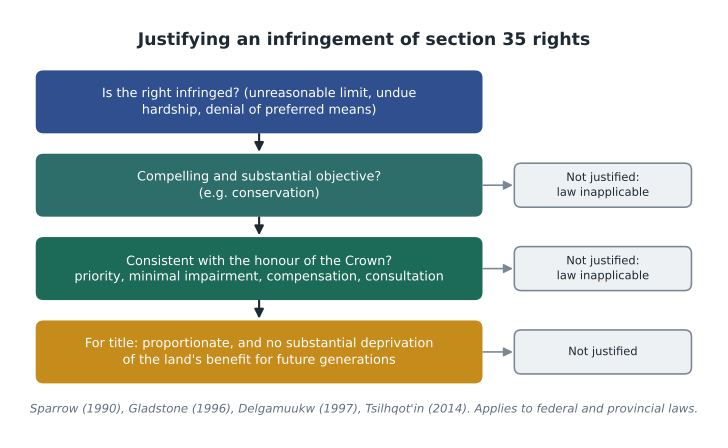
The same framework applies to treaty rights (R. v. Badger, 1996) and to Aboriginal title, with the additions discussed below. It applies to provincial as well as federal laws. If the Crown cannot justify the infringement, the law does not apply to the extent of the infringement, or the government action is unlawful.
Aboriginal title: Delgamuukw
Aboriginal title is a particular kind of Aboriginal right: a right to the land itself. After Calder (1973) recognized that title existed in law, the Supreme Court explained its content and how to prove it in Delgamuukw v. British Columbia (1997), a claim by Gitxsan and Wet'suwet'en hereditary chiefs to more than fifty-eight thousand square kilometres in northern British Columbia. The trial judge had dismissed much of the oral history evidence; the Supreme Court ordered a new trial on that basis, which never took place.
Chief Justice Lamer held that Aboriginal title is a sui generis interest in land. It is held communally, it is inalienable except to the Crown, and its source is the prior occupation of the land by the Aboriginal group. Title gives the right to exclusive use and occupation of the land for a variety of purposes, which need not be traditional practices. But Delgamuukw also recognized an 'inherent limit': title lands cannot be used in a way that is irreconcilable with the nature of the group's attachment to the land, so as to destroy its value for future generations. To prove title, a group must show that it occupied the land before the Crown asserted sovereignty; that, if it relies on present occupation as proof of pre-sovereignty occupation, there is continuity between them; and that its occupation was exclusive at sovereignty. Infringements of title must be justified, and the justification will usually require consultation and compensation.
Tsilhqot'in Nation
For seventeen years after Delgamuukw, no court declared Aboriginal title anywhere in Canada. In R. v. Marshall; R. v. Bernard (2005), the Supreme Court rejected title claims in Nova Scotia and New Brunswick, holding that seasonal use of particular areas for hunting and gathering did not amount to the regular and exclusive occupation needed for title. Many observers concluded that title would be confined to village sites and intensively used plots.
Tsilhqot'in Nation v. British Columbia (2014) changed that. The Tsilhqot'in, a semi-nomadic people in the interior of British Columbia, challenged forestry licences issued by the province in their territory. After a 339-day trial, the trial judge found they had proved title to a large area, but could not make a declaration because of the way the claim was pleaded. The British Columbia Court of Appeal adopted a narrow 'postage stamp' view of occupation. The Supreme Court unanimously restored the trial judge's findings and, for the first time, declared Aboriginal title, to about 1,750 square kilometres.
Chief Justice McLachlin held that occupation sufficient for title can be territorial: it is established by regular and exclusive use of tracts of land for hunting, fishing or other resource exploitation, judged from the perspective of the Aboriginal group and with due regard to its way of life, size and the character of the land. Title confers ownership rights similar to fee simple, including the right to decide how the land will be used, to enjoy its economic benefits and to manage it proactively, subject to the inherent limit that it cannot be used in ways that would substantially deprive future generations of its benefit.
The Court also explained what happens when government wants to use title land. Before title is established, the Crown owes a duty to consult and accommodate (lesson 9). Once title is established, the Crown must obtain the consent of the title holders or justify the incursion under section 35, which requires compliance with the procedural duty to consult, a compelling and substantial objective and consistency with the Crown's fiduciary obligation, including proportionality. If the Crown begins a project without consent before title is established, it may later be required to cancel the project if title is proved and continuation would unjustifiably infringe it. Provincial laws of general application can apply to title land, subject to justification; interjurisdictional immunity does not apply. The Court added that title lands, once declared, are no longer Crown lands under provincial forestry legislation.
Title and private land
The most contested recent question is what happens when Aboriginal title is claimed over land that has been granted in fee simple to private owners. In Cowichan Tribes v. Canada (Attorney General) (2025), the British Columbia Supreme Court declared Cowichan Aboriginal title to part of a claimed area on the south arm of the Fraser River in what is now Richmond, including land held in fee simple by Canada and the City of Richmond, whose Crown grants it declared defective and invalid as against the title holders. The court did not invalidate private fee simple titles but held that the Crown has a duty to negotiate reconciliation of title with private interests. All parties have appealed, and the appeal was not expected to be heard before 2027. In June 2026, the trial judge dismissed an application by a private landowner to reopen the trial as an abuse of process.
In New Brunswick, the Court of Appeal took a different view in J.D. Irving, Limited v. Wolastoqey Nation (2025), holding that a court cannot declare Aboriginal title over privately held land, and that the remedy for title lands that have been granted to private parties lies in compensation from the Crown. The Supreme Court of Canada declined to hear an appeal in May 2026, which leaves the decision binding in New Brunswick without endorsing its reasoning. And in The Nuchatlaht v. British Columbia (2026), the British Columbia Court of Appeal overturned a trial decision that had found title to only part of the claim area and declared Nuchatlaht title to the entire claimed area on Nootka Island, and held that the provincial Forest Act and Park Act did not apply to those lands; British Columbia sought leave to appeal to the Supreme Court.
Hannah, from Calgary, asks whether this means homeowners could lose their houses. Professor Morningside answers carefully. 'Every court that has looked at it has avoided taking homes from private owners. Cowichan did not invalidate private titles. The real fights are about what the Crown owes title holders for land it gave away, whether courts can declare title over privately held land at all, and how governments will negotiate. That is exactly the kind of question the Supreme Court may eventually have to decide.'
Worked problem
Characterizing a claimed right
A member of the fictional Loon Narrows First Nation is charged under a provincial law for selling wild rice harvested from a lake in the nation's territory without a commercial licence. The nation says its members have always harvested and traded wild rice. Outline how a court would analyze an Aboriginal rights claim.
Show solution
- Characterize precisely: a right to harvest wild rice for sale, not a general right to trade.
- Ask whether harvesting and exchanging wild rice was integral to the community's distinctive culture before contact, using archaeological, historical and oral history evidence (Van der Peet; Delgamuukw).
- Check continuity with the modern practice; modern methods and markets do not defeat continuity.
- Consider whether a treaty right covers the activity, which may be a stronger basis.
- If a right exists and the licensing law infringes it, the province must justify the infringement, including priority and consultation (Sparrow, Gladstone).
Common mistakes
MistakeTreating regulation of a right as extinguishment.
InsteadBefore 1982, extinguishment required a clear and plain intention; regulation is not extinguishment (Sparrow).
MistakeAssuming Aboriginal title is limited to village sites.
InsteadOccupation can be territorial, based on regular and exclusive use of tracts of land (Tsilhqot'in).
MistakeSaying title holders can do anything with title land.
InsteadTitle is subject to the inherent limit protecting the land's benefit for future generations.
MistakeStating that courts have settled how title applies to private fee simple land.
InsteadCowichan (BCSC 2025, under appeal) and Wolastoqey (NBCA 2025) diverge; the issue is unresolved.
Practice problems
Work each problem on paper first, then reveal the answer to check.
What is the Van der Peet test?
Show answer
An activity must be an element of a practice, custom or tradition integral to the distinctive culture of the group before contact, with continuity to the modern practice.
What are the two stages of Sparrow justification?
Show answer
A compelling and substantial objective, and consistency with the Crown's fiduciary duty and honour, considering priority, minimal impairment, compensation and consultation.
What must a group prove to establish Aboriginal title?
Show answer
Sufficient occupation at the assertion of sovereignty, continuity if relying on present occupation, and exclusive occupation.
What did Tsilhqot'in add about government use of title land?
Show answer
Once title is established, the Crown needs the group's consent or must justify the incursion under section 35, including proportionality.
How did Wolastoqey (NBCA 2025) differ from Cowichan (BCSC 2025)?
Show answer
It held that courts cannot declare title over private land, with compensation from the Crown as the remedy; Cowichan declared title including over some Crown-granted fee simple land.
Summary and key terms
- Sparrow (1990) held that existing rights are protected flexibly, that extinguishment before 1982 required clear and plain intention, and that infringements must be justified.
- Van der Peet (1996) requires a practice integral to the group's distinctive culture before contact; Gladstone, Sappier and Lax Kw'alaams refined it.
- Justification requires a compelling and substantial objective and consistency with the honour of the Crown, including priority and consultation.
- Delgamuukw (1997) defined title as a sui generis, communal, inalienable right to exclusive use and occupation, proved by occupation at sovereignty.
- Tsilhqot'in (2014) declared title for the first time, accepted territorial occupation and required consent or justification.
- Title over private land is unsettled: Cowichan (2025, under appeal), Wolastoqey (2025, leave denied 2026) and Nuchatlaht (2026) point in different directions.
- Aboriginal right
- A practice, custom or tradition integral to a group's distinctive culture before contact, protected by section 35.
- Aboriginal title
- A sui generis communal right to exclusive use and occupation of land, grounded in prior occupation.
- Sui generis
- Unique; of its own kind, not fitting ordinary property categories.
- Inherent limit
- The restriction that title land cannot be used in ways that destroy its value for future generations.
- Clear and plain intention
- The standard required for extinguishment of Aboriginal rights before 1982.
- Justification
- The test the Crown must meet to infringe section 35 rights lawfully.
Lesson quiz · 5 questions
Score 60% or more to complete this lesson.
Create a free account to save your progress, take quizzes and earn a certificate.