
LAWC-114 · Lesson 6 of 12 · 21 min
Self-government and Indigenous jurisdiction
▶ Video coming soon A video version of this lesson is on the way.
Professor Morningside begins this class with a quotation that she attributes to an Elder she worked with in her years of practice, without naming him: 'We did not ask anyone for permission to govern ourselves before they came. We should not need permission now.' Then she asks the question the courts and governments have struggled with for fifty years: if Indigenous nations governed themselves before the Crown arrived, what legal space do they occupy now, inside a federation where all legislative power is supposedly divided between Parliament and the provinces?
The problem of jurisdiction
Sections 91 and 92 of the Constitution Act, 1867 divide legislative power between Parliament and the provincial legislatures. Read literally, they leave no room for a third order of government. In the nineteenth and twentieth centuries, Canadian law treated Indigenous governance as a matter Parliament could regulate under section 91(24), which it did through the Indian Act's band councils. At Six Nations of the Grand River, for example, Canada imposed an elected council under the Indian Act in 1924, displacing the Haudenosaunee Confederacy council, which continues to operate and to claim authority. Many nations have similar histories of traditional governments that were displaced but never disappeared.
Indigenous nations and many scholars argue that the right of self-government is inherent: it comes from the nations' own existence as self-governing peoples before contact, not from any grant by the Crown, and it is among the 'existing aboriginal rights' that section 35 recognizes and affirms. The Royal Commission on Aboriginal Peoples, which reported in 1996, concluded that the inherent right of self-government is protected by section 35 and that Aboriginal governments form one of three orders of government in Canada. In 1995, the federal government adopted the Inherent Right Policy, recognizing the inherent right of self-government as an existing Aboriginal right under section 35, to be implemented through negotiated agreements.
What the courts have said
The Supreme Court of Canada has never squarely decided whether section 35 protects a general right of self-government. In R. v. Pamajewon (1996), two First Nations in Ontario argued that they had a right to regulate high-stakes gambling on their reserves free of the Criminal Code. The Court assumed without deciding that section 35 could include self-government claims, but held that such claims must be framed specifically and must meet the Van der Peet test: the specific activity must have been integral to the distinctive culture of the community before contact. Large-scale, high-stakes gambling was not. Pamajewon has been widely criticized for requiring self-government to be proved activity by activity, as if a nation must show that it historically regulated each modern subject.
Lower courts have gone further. In Campbell v. British Columbia (Attorney General) (2000), the British Columbia Supreme Court upheld the self-government provisions of the Nisga'a Final Agreement against a challenge that they created an unconstitutional third order of government. Justice Williamson held that a limited right of self-government survived the assertion of British sovereignty and Confederation, that sections 91 and 92 did not divide all governmental power, and that the Nisga'a treaty could therefore recognize Nisga'a law-making power protected by section 35. The decision was not appealed to the Supreme Court.
In Reference re An Act respecting First Nations, Inuit and Métis children, youth and families (2024), the Supreme Court again declined to decide whether section 35 includes an inherent right of self-government, including over child and family services. But it upheld a federal statute that 'affirms' that right, as discussed below, and said that Parliament can take steps to implement Canada's commitments to reconciliation by recognizing Indigenous jurisdiction, without the Court first deciding the constitutional question.
Paths to self-government
Because the constitutional question has not been settled in court, Indigenous self-government in Canada has developed mainly through legislation and negotiated agreements, each with its own scope. Professor Morningside sketches the main paths on the board.
First, most First Nations still govern under the Indian Act, through chief and council elected under the Act, under the First Nations Elections Act (2014), or under custom election codes. Band councils can make by-laws on a list of subjects in the Act, but have no general law-making power.
Second, sectoral legislation lets nations opt out of parts of the Indian Act in particular fields. Under the Framework Agreement on First Nation Land Management, now implemented by a 2022 federal statute of the same name, more than one hundred First Nations have adopted their own land codes, replacing the Indian Act's land management provisions and giving them law-making power over their reserve lands. The First Nations Fiscal Management Act (2005) lets nations adopt property tax and financial administration laws and borrow through a First Nations Finance Authority. The Anishinabek Nation Education Agreement, in force in 2017, recognized jurisdiction over education on reserve for participating Anishinabek First Nations in Ontario.
Third, stand-alone self-government agreements, implemented by federal and sometimes provincial legislation, recognize broader powers for particular nations: early examples include the Sechelt Indian Band Self-Government Act (1986) and the Westbank First Nation Self-Government Agreement (2005). Fourth, many modern treaties include self-government chapters, like the Nisga'a Final Agreement and the self-government agreements of eleven Yukon First Nations that accompany their land claims agreements. Under the Nisga'a agreement, the Nisga'a Lisims Government makes laws on subjects such as culture, language, lands and citizenship, with rules about which law prevails when Nisga'a and federal or provincial laws conflict.
Fifth, Parliament has begun to affirm Indigenous jurisdiction in particular fields by statute, most importantly in child and family services. Sixth, many nations exercise jurisdiction based on their inherent authority through their own laws and institutions, whether or not any Canadian statute recognizes it, for example in governing ceremonies, citizenship, resource stewardship or dispute resolution. These paths overlap: a nation may have a land code under federal legislation, assert inherent jurisdiction over citizenship and negotiate a treaty at the same time.
The child and family services Act
An Act respecting First Nations, Inuit and Métis children, youth and families came into force on January 1, 2020. It responded to the overrepresentation of Indigenous children in care and to the Truth and Reconciliation Commission's Calls to Action. The Act does two main things. First, it sets national standards that apply to everyone providing child and family services to Indigenous children, including provincial agencies: services must be provided in accordance with the best interests of the child, cultural continuity and substantive equality, with priority given to preventive care and to placement with family and community. Second, section 18 affirms that 'the inherent right of self-government recognized and affirmed by section 35 of the Constitution Act, 1982 includes jurisdiction in relation to child and family services'.
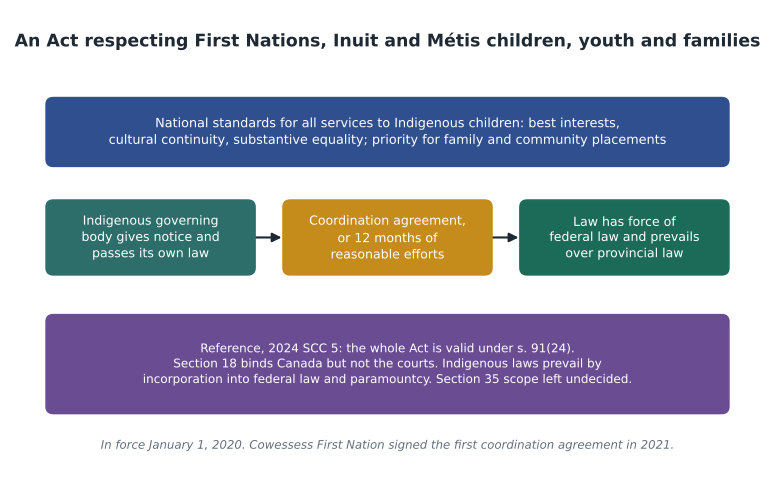
An Indigenous governing body can give notice of its intention to exercise that jurisdiction and pass its own law. If it enters into a coordination agreement with Canada and the province, or after twelve months of reasonable efforts to reach one, sections 21 and 22 give its law the force of federal law and provide that it prevails over conflicting provincial laws. Cowessess First Nation in Saskatchewan was the first nation to sign a coordination agreement, in 2021, and many others have since given notice or enacted laws.
Quebec challenged the Act in a reference to the Quebec Court of Appeal, which upheld most of it but held that sections 21 and 22 were unconstitutional because Parliament could not unilaterally amend the Constitution by declaring the scope of section 35 and giving Indigenous laws priority over provincial laws. In February 2024, the Supreme Court unanimously held the entire Act constitutional under section 91(24). The Court held that section 18 is a statement of Parliament's position on the scope of section 35, which binds the federal government but does not bind the courts or amend the Constitution. Sections 21 and 22 are valid because Parliament can incorporate Indigenous laws by reference into federal law, and federal laws prevail over conflicting provincial laws under the doctrine of paramountcy. The Court described the Act as a step toward reconciliation and toward implementing the United Nations Declaration on the Rights of Indigenous Peoples.
Sophie points out that the Supreme Court's reasoning means Indigenous laws prevail over provincial law because Parliament says so, not because of their own authority. Professor Morningside agrees that this is the catch. 'The Reference gives real practical power to Indigenous child and family laws. But it does it by routing Indigenous jurisdiction through federal legislation. Many nations would say their laws apply because they are their laws. The Court left that question for another day.'
The Charter and Indigenous governments
If Indigenous governments exercise public power, does the Charter apply to them? In Dickson v. Vuntut Gwitchin First Nation (2024), studied in lesson 4 and in the Charter course, a majority of the Supreme Court held that the Charter applied to the Vuntut Gwitchin government because it exercised governmental authority under its self-government agreement and federal and territorial legislation. But section 25 shielded its residency requirement for councillors from the section 15 challenge, because the requirement protected the nation's distinct interests. The decision means Indigenous governments are subject to Charter standards, while section 25 gives room for collective interests rooted in Indigenous difference. How that balance will work across other governance choices, such as citizenship rules, is not yet clear.
Self-government in practice
Self-government agreements and sectoral arrangements are not only about law-making power. They also involve money, administration and accountability. Nations take on responsibility for delivering programs such as education, health and housing, usually with fiscal transfer agreements that set out federal funding. Critics, including many nations, say federal funding often falls short of what is needed to deliver services comparable to those elsewhere, and that federal policies have at times tied recognition to extinguishment-like certainty terms. Supporters point to nations that have used land codes and fiscal powers to build economies, attract investment and govern their lands effectively.
Theo asks what a lawyer practising in Corwin would actually see. Professor Morningside lists examples: a real estate deal for a long-term lease on reserve land governed by a land code instead of the Indian Act; a family law case in which a First Nation's child and family law prevails over Ontario's Child, Youth and Family Services Act; a business that must comply with a nation's environmental or business licensing law; an employment dispute involving a First Nation government. 'In each of those,' she says, 'step one is the same: find out which nation, what agreement or law, and what it says. Do not assume the Indian Act applies, and do not assume it does not.'
Worked problem
Whose child welfare law applies?
The fictional Loon Narrows First Nation in northern Ontario enacted a child and family services law in 2024 after giving notice under the federal Act and making reasonable efforts for twelve months to reach a coordination agreement, without success. An Ontario children's aid society wants to place a Loon Narrows child with a non-Indigenous foster family in Corwin, contrary to the nation's law, which requires placement with extended family or community members first. Which law governs the placement?
Show solution
- The federal Act's national standards apply in any event: best interests, cultural continuity and placement priorities favouring family and community.
- Because Loon Narrows gave notice and made reasonable efforts for twelve months, its law has the force of federal law under section 21.
- Under section 22 and the doctrine of paramountcy, the nation's law prevails over conflicting provisions of Ontario's Child, Youth and Family Services Act (Reference 2024 SCC 5).
- The society must follow the nation's placement priorities, subject to the Act's provisions on the child's best interests.
Common mistakes
MistakeStating that the Supreme Court has recognized an inherent right of self-government under section 35.
InsteadIt has not decided the question; Pamajewon set a narrow test, and the 2024 Reference upheld a federal statute affirming the right without deciding its constitutional status.
MistakeAssuming all First Nations govern under the Indian Act.
InsteadMany use land codes, fiscal powers, self-government agreements or modern treaties, and many exercise inherent jurisdiction.
MistakeSaying Indigenous child welfare laws prevail over provincial laws because of section 35.
InsteadUnder the Reference, they prevail because Parliament gave them the force of federal law and paramountcy applies.
MistakeAssuming the Charter never applies to Indigenous governments.
InsteadDickson held it applied to a self-governing First Nation, with section 25 protecting distinct collective interests.
Practice problems
Work each problem on paper first, then reveal the answer to check.
What did Pamajewon require for a self-government claim?
Show answer
That it be framed specifically and meet the Van der Peet integral-to-the-distinctive-culture test for the particular activity.
What did Campbell v. British Columbia (2000) decide?
Show answer
That the Nisga'a treaty's self-government provisions were valid because a limited right of self-government survived and sections 91 and 92 did not exhaust governmental power.
What two main things does the federal child and family services Act do?
Show answer
Sets national standards for services to Indigenous children and affirms Indigenous jurisdiction, giving Indigenous laws the force of federal law with priority over provincial laws.
Why did the Supreme Court uphold sections 21 and 22 of that Act?
Show answer
Parliament can incorporate Indigenous laws into federal law by reference, and federal law prevails over conflicting provincial law under paramountcy.
Name two sectoral routes out of the Indian Act.
Show answer
Land codes under the Framework Agreement on First Nation Land Management Act and fiscal laws under the First Nations Fiscal Management Act.
Summary and key terms
- Indigenous nations assert an inherent right of self-government; Canada's 1995 policy recognizes it as a section 35 right to be implemented by agreement.
- The Supreme Court has not decided the scope of a section 35 self-government right; Pamajewon (1996) required specific, activity-based claims.
- Campbell (2000) upheld the Nisga'a treaty's self-government provisions.
- Self-government operates through the Indian Act, sectoral legislation, self-government agreements, modern treaties and affirmed federal jurisdiction.
- The 2024 Reference upheld the federal child and family services Act, under which Indigenous laws prevail over provincial laws by paramountcy.
- Dickson (2024) applied the Charter to a self-governing First Nation, with section 25 shielding its residency rule.
- Inherent right of self-government
- The right of Indigenous nations to govern themselves, arising from their prior existence as self-governing peoples.
- Inherent Right Policy
- Canada's 1995 policy recognizing the inherent right as a section 35 right to be implemented by negotiation.
- Land code
- A First Nation's own law governing its reserve lands, replacing Indian Act land provisions.
- Coordination agreement
- An agreement among an Indigenous governing body, Canada and a province about child and family services.
- Paramountcy
- The rule that valid federal law prevails over conflicting provincial law.
- Custom election code
- A First Nation's own rules for selecting leadership outside the Indian Act election rules.
Lesson quiz · 5 questions
Score 60% or more to complete this lesson.
Create a free account to save your progress, take quizzes and earn a certificate.