
LAWC-114 · Lesson 3 of 12 · 21 min
The Indian Act, residential schools and their legacy
▶ Video coming soon A video version of this lesson is on the way.
Professor Morningside warns Section B at the start of this class that it covers difficult material, including the residential school system, and that students who need to step out may do so without explanation. She also tells them where the Indian Residential Schools crisis line can be reached, as the Faculty does whenever the topic is taught. Then she puts a copy of the Indian Act on the screen. 'This is still a federal statute in force today,' she says. 'Most Canadians have never read it. Most First Nations people live with it every day.'
What the Indian Act is
The first Indian Act was passed by Parliament in 1876, consolidating earlier colonial and federal laws about 'Indians' and reserves. It was enacted under the federal power over 'Indians, and Lands reserved for the Indians' in section 91(24) of the Constitution Act, 1867. The Act has been amended many times, most significantly in 1951 and 1985, but it remains the main federal statute governing registered First Nations people and reserve lands, except where nations have moved out from under parts of it through land codes, self-government agreements or modern treaties.
The Act does several things. It defines who is entitled to be registered as an 'Indian', a status that carries certain rights and benefits, such as tax exemptions for property situated on a reserve under section 87. It defines 'bands' and 'reserves' and provides that reserve lands are held by the Crown for the use and benefit of bands, so that First Nations cannot sell or mortgage reserve land in the ordinary way. It creates a system of band councils elected under rules set by the Act, unless a band uses a custom election system. It gives the federal Minister broad powers over band affairs, wills and estates of registered persons living on reserve, and the management of band money. Historically it did much more.
A statute of control and assimilation
The policy goal of nineteenth and early twentieth century Indian legislation was assimilation. In 1920, Duncan Campbell Scott, the deputy superintendent general of Indian Affairs, told a parliamentary committee that the object was to continue until there was not a single Indian in Canada who had not been absorbed into the body politic. The Act pursued that goal in many ways. 'Enfranchisement' provisions encouraged, and at times compelled, registered Indians to give up their status in exchange for the vote and other rights of citizenship; until 1960, First Nations people could not vote in federal elections without losing status. Elected band councils on a model chosen by Ottawa displaced many traditional governments. The Minister could depose chiefs and councillors.
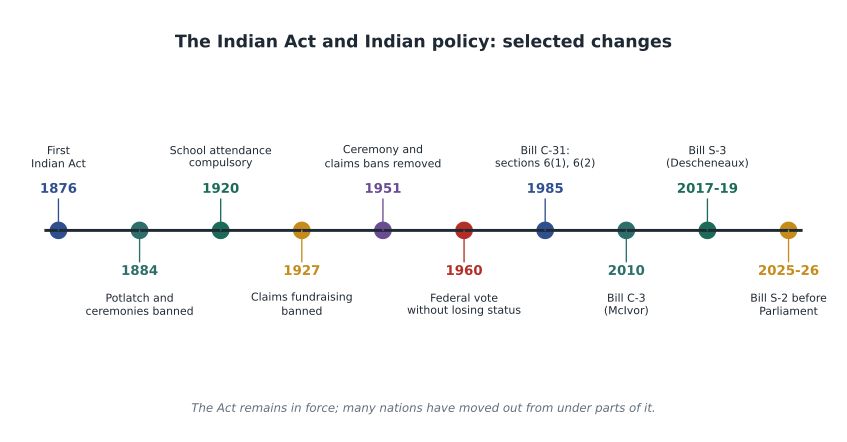
Amendments in 1884 banned the potlatch of the Northwest Coast and, later, other ceremonies such as the Sun Dance on the prairies; the bans were removed from the Act in 1951. A pass system introduced as a matter of policy after 1885, without statutory authority, required many prairie First Nations people to obtain a pass from an Indian agent to leave the reserve. From 1927 to 1951, the Act made it an offence to raise money or retain a lawyer to pursue a claim on behalf of a band without the government's consent, which effectively blocked land claims litigation for a generation. When the Nisga'a went to court in Calder in the late 1960s, they were among the first to pursue a title claim after that provision was removed.
Status and sex discrimination
For more than a century, the Act's registration rules discriminated against First Nations women. Under the rule that became section 12(1)(b), a registered woman who married a man without status lost her own status, and her children were not registered. A registered man who married a woman without status kept his status, and his wife and children gained it. The women affected also lost the right to live on reserve and to participate in band life.
In Attorney General of Canada v. Lavell (1974), the Supreme Court held that the rule did not violate the equality guarantee in the Canadian Bill of Rights. Sandra Lovelace, a Wolastoqey woman from Tobique, took her case to the United Nations Human Rights Committee, which found in 1981 that Canada had violated her right to enjoy her culture in community with others under the International Covenant on Civil and Political Rights. After the Charter's equality rights came into force in 1985, Parliament passed Bill C-31, which restored status to many women and their children and created the current categories: section 6(1) and section 6(2).
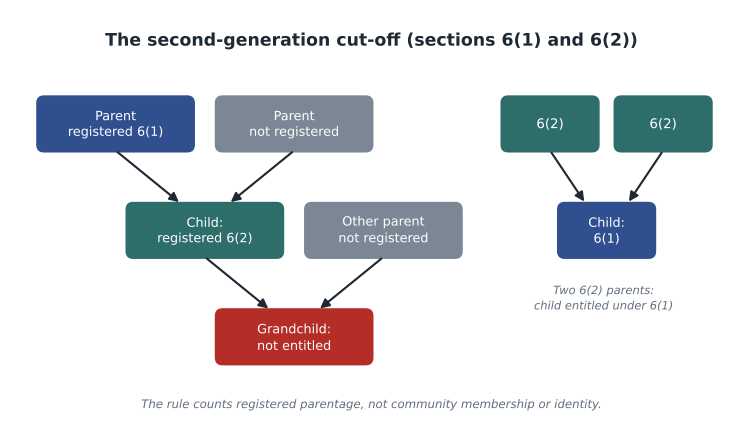
Bill C-31 left residual discrimination, because it introduced what is called the second-generation cut-off. A person with one parent registered under section 6(1) and one parent who is not registered is registered under section 6(2). A person registered under 6(2) who has a child with a non-registered person cannot pass on status to that child. The cut-off falls more heavily on descendants of women who had lost status, because of how restored status was classified.
Litigation has forced a series of further amendments. In McIvor v. Canada (2009), the British Columbia Court of Appeal held that the scheme discriminated on the basis of sex, and Parliament responded with Bill C-3 in 2010. In Descheneaux c. Canada (2015), the Superior Court of Quebec found further sex-based discrimination, leading to Bill S-3, passed in 2017 with its broadest provisions in force in 2019. In 2025 the federal government introduced Bill S-2 to address remaining inequities, including enfranchisement and some aspects of the second-generation cut-off; as of mid-2026 it was before a House of Commons committee, and students should check its current status. Many First Nations argue that the deeper problem is that Ottawa, not the nations themselves, decides who belongs, and the Act does allow bands to adopt their own membership codes under section 10, separate from federal registration.
Residential schools
From the 1880s until the last federally supported schools closed in the 1990s, more than 150,000 First Nations, Inuit and Métis children attended residential schools run by churches under agreements with the federal government. Attendance was made compulsory for many First Nations children by a 1920 amendment to the Indian Act, and Indian agents and police removed children from their families. The schools aimed to separate children from their languages, cultures and families. Children were punished for speaking their languages. Many experienced physical, emotional and sexual abuse, malnutrition and disease. Thousands died; the Truth and Reconciliation Commission documented more than three thousand deaths, and research by the National Centre for Truth and Reconciliation has identified more names since.
Survivors brought thousands of lawsuits against Canada and the churches beginning in the 1990s. In Blackwater v. Plint (2005), the Supreme Court held Canada and the United Church vicariously liable for abuse by a dormitory supervisor at the Alberni Indian Residential School. Class actions across the country led to the Indian Residential Schools Settlement Agreement, approved by courts in 2006 and 2007, the largest class action settlement in Canadian history at the time. It provided a Common Experience Payment to every former student, an Independent Assessment Process for claims of serious abuse, funding for healing programs and commemoration, and the creation of the Truth and Reconciliation Commission.
Prime Minister Stephen Harper apologized in the House of Commons in June 2008. The Truth and Reconciliation Commission, chaired by Justice Murray Sinclair, held hearings across Canada from 2009 and released its final report in 2015, concluding that the system was part of a policy of cultural genocide, and issuing 94 Calls to Action. In 2021, Tk'emlúps te Secwépemc announced that ground-penetrating radar had identified what are believed to be about two hundred potential unmarked graves at the former Kamloops Indian Residential School, and other nations have since announced similar findings at other sites. In July 2022, Pope Francis apologized in Canada for the role of members of the Catholic Church. In October 2022, the House of Commons unanimously passed a motion recognizing what happened in residential schools as genocide. The National Day for Truth and Reconciliation, September 30, became a federal statutory holiday in 2021.
Related settlements followed for other harms. The Federal Indian Day Schools settlement (McLean v. Canada), approved in 2019, compensated people who attended federally operated day schools. In Brown v. Canada (2017), the Ontario Superior Court held Canada liable for failing to take reasonable steps to preserve the cultural identity of First Nations children removed from their families and placed with non-Indigenous families during the Sixties Scoop, and a national settlement followed.
Child welfare and Jordan's Principle
The removal of Indigenous children did not end with the schools. Indigenous children remain heavily overrepresented in child welfare systems. In 2016, the Canadian Human Rights Tribunal held, in a complaint brought by the First Nations Child and Family Caring Society and the Assembly of First Nations, that Canada discriminated against First Nations children by underfunding child and family services on reserve and by failing to implement Jordan's Principle, which requires that First Nations children get the services they need without delays caused by disputes between governments over who pays. The Tribunal later ordered compensation, and a final settlement agreement on compensation was approved by the Tribunal and the Federal Court in 2023. Negotiations on long-term reform of the program have continued since. Parliament's 2019 Act respecting First Nations, Inuit and Métis children, youth and families, upheld in 2024, is studied in lesson 6.
The MMIWG Inquiry
The National Inquiry into Missing and Murdered Indigenous Women and Girls released its final report, Reclaiming Power and Place, in June 2019. It found that the violence amounted to a race-based genocide of Indigenous peoples, especially targeting women, girls and 2SLGBTQQIA people, and issued 231 Calls for Justice directed at governments, police, the justice system, industry and Canadians generally. Governments have released action plans in response, and progress on the Calls for Justice is regularly reviewed. The report's findings bear directly on lesson 11, on criminal justice.
Legacy in law
Arjun asks how this history fits a law course rather than a history course. Professor Morningside answers in three ways. First, the Indian Act is current law, and lawyers advising First Nations, people who live on reserve or businesses dealing with reserve lands must know it, from section 87 tax exemptions to the restrictions on seizing reserve property in section 89. Second, the history is legally relevant evidence: courts use it in Gladue sentencing (lesson 11), in assessing fiduciary duties (lesson 8) and in interpreting treaties (lesson 5). Third, the Truth and Reconciliation Commission's Calls to Action include obligations for the legal profession itself, including Call 27, which asks law societies to ensure that lawyers receive cultural competency training. The Law Society of Ontario and other law societies have adopted requirements and programs in response.
Daniel Whitecloud says quietly that his grandmother attended a residential school and rarely spoke about it. Professor Morningside thanks him and moves the discussion back to the law, as she said she would, without asking him to say more. She notes for the class that many students and colleagues they will work with have family histories like his, and that a lawyer's competence includes knowing that.
Worked problem
Tracing entitlement to registration
Mary was born in 1940, registered, and married a man without status in 1962, losing her status. Her son Paul was born in 1965. Paul had a daughter, Leah, in 1995 with a non-registered woman. How would the post-1985 amendments affect them, in general terms?
Show solution
- Bill C-31 (1985) restored Mary's status under section 6(1).
- Paul, with one 6(1) parent and one non-registered parent, was registered under section 6(2) after 1985.
- Leah, as the child of a 6(2) parent and a non-registered parent, would originally have fallen under the second-generation cut-off.
- McIvor and Bill C-3 (2010) addressed this kind of sex-based disparity for grandchildren of women who lost status, so Leah may now be entitled.
- Check the current Act, including Bill S-3 and the status of Bill S-2, and the band's own membership code under section 10 if it has one.
Common mistakes
MistakeTreating the Indian Act as historical legislation that has been repealed.
InsteadIt remains in force, amended many times, and governs registration, reserves and band governance except where nations have moved out from under parts of it.
MistakeAssuming registration under the Indian Act defines who is First Nations.
InsteadRegistration is a federal legal category; nations' own citizenship laws and membership codes, and people's identities, are distinct.
MistakeDescribing residential schools as an education policy with some abuses.
InsteadThe TRC found the system was part of a policy of cultural genocide; abuse and neglect were widespread and thousands of children died.
MistakeAssuming Lavell ended sex discrimination in the Act.
InsteadLavell upheld it; Lovelace, Bill C-31, McIvor, Descheneaux and later bills addressed it in stages, and issues remain.
Practice problems
Work each problem on paper first, then reveal the answer to check.
What did the 1927 amendment to the Indian Act prohibit?
Show answer
Raising money or retaining a lawyer to pursue a band's claim without government consent; it was removed in 1951.
What is the second-generation cut-off?
Show answer
A person registered under section 6(2) cannot pass status to a child whose other parent is not registered.
What did the Indian Residential Schools Settlement Agreement provide?
Show answer
Common Experience Payments, an Independent Assessment Process for serious abuse, healing and commemoration funding, and the TRC.
What did the Canadian Human Rights Tribunal find in 2016?
Show answer
Canada discriminated against First Nations children by underfunding child and family services on reserve and failing to implement Jordan's Principle.
How many Calls for Justice did the MMIWG Inquiry issue?
Show answer
231.
Summary and key terms
- The Indian Act (1876) still governs registration, reserves and band governance, and was historically an instrument of assimilation.
- Past provisions banned ceremonies (1884 to 1951) and claims fundraising (1927 to 1951) and tied the vote to loss of status until 1960.
- Sex discrimination in registration was upheld in Lavell, condemned in Lovelace and addressed in stages by Bills C-31, C-3, S-3 and S-2.
- More than 150,000 children attended residential schools; the IRSSA, the TRC (2015) and apologies followed.
- The CHRT found discrimination in First Nations child welfare funding and Jordan's Principle (2016).
- The MMIWG Inquiry (2019) issued 231 Calls for Justice.
- Indian Act
- The federal statute governing registered First Nations people, bands and reserves since 1876.
- Enfranchisement
- The historical process by which registered Indians gave up, or were made to give up, status.
- Section 6(1) and 6(2)
- The two categories of registration created by Bill C-31 in 1985.
- IRSSA
- The Indian Residential Schools Settlement Agreement, approved in 2006 and 2007.
- Jordan's Principle
- The rule that First Nations children must receive needed services without delays caused by jurisdictional disputes.
- Membership code
- A band's own rules for membership, adopted under section 10 of the Indian Act.
Lesson quiz · 5 questions
Score 60% or more to complete this lesson.
Create a free account to save your progress, take quizzes and earn a certificate.