
LAWC-113 · Lesson 9 of 12 · 22 min
Co-ownership
▶ Video coming soon A video version of this lesson is on the way.
When Walter dies, Ferncliffe Farm will pass to Ruth and Colin under their mother's will, which leaves the remainder 'to my children Ruth and Colin in equal shares'. The siblings get along, mostly, but they do not agree about the farm. Ruth, who lives in Corwin and runs the produce stand, wants to keep the farm in the family and lease the fields. Colin, a teacher in Ottawa with two young sons, would like to sell; a developer has already asked him about the frontage along the Severn Road. Professor Asante uses the siblings to teach the law of co-ownership: how two or more people can own the same land at the same time, what happens when one of them dies, and how they can end the arrangement when they disagree.
Two forms of co-ownership
The common law recognizes two main forms of concurrent ownership: joint tenancy and tenancy in common. (A third, coparcenary, is obsolete, and the tenancy by the entireties for married couples does not exist in Ontario.) Both give each co-owner the right to possess the whole property; neither co-owner can exclude the other from any part of it. The differences lie in the nature of the shares and in what happens on death.
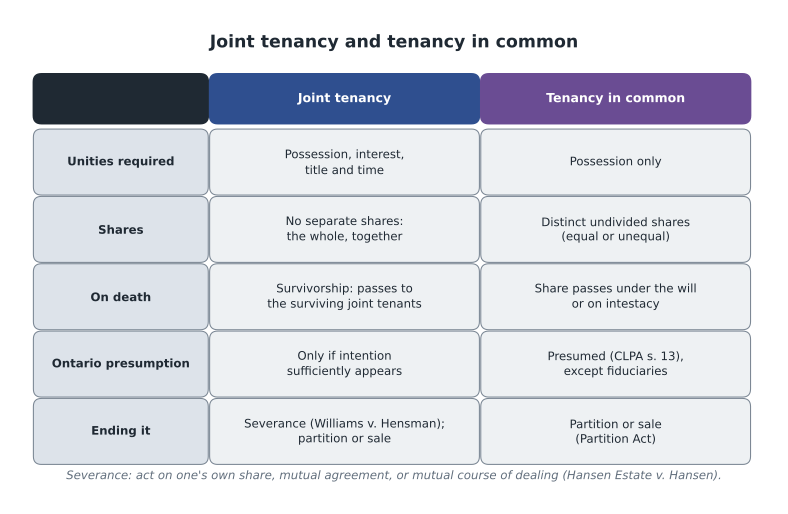
In a joint tenancy, the co-owners together own the whole as a single unit, and none of them has a distinct share. Each joint tenant's interest is identical. The defining feature is the right of survivorship: when a joint tenant dies, their interest simply disappears, and the surviving joint tenants continue to own the whole. The deceased's interest does not pass under their will or on intestacy, and it does not form part of their estate. When only one joint tenant remains, that person owns the property alone.
A joint tenancy requires the four unities. Unity of possession means each co-owner is entitled to possess the whole. Unity of interest means each has an identical interest, of the same kind and size. Unity of title means they acquired their interests by the same document. And unity of time means their interests vested at the same moment. If any unity is missing, there is no joint tenancy.
In a tenancy in common, each co-owner has a distinct, undivided share, which may be equal or unequal: one co-owner might hold three quarters and the other one quarter. Only unity of possession is required. There is no right of survivorship. When a tenant in common dies, their share passes under their will or on intestacy like any other property.
The presumption in Ontario
At common law, a grant to two or more people was presumed to create a joint tenancy, because the courts favoured keeping land in a single unit. Equity preferred tenancy in common, which it saw as fairer, and in some situations, such as business partners or people contributing unequally to the price, equity would treat the legal joint tenants as holding beneficially as tenants in common.
Ontario reversed the common law presumption by statute. Section 13 of the Conveyancing and Law of Property Act provides that where land is granted or devised to two or more persons, they take as tenants in common and not as joint tenants, unless an intention sufficiently appears that they are to take as joint tenants. The section does not apply to executors, trustees and others holding land in a fiduciary capacity, who always hold as joint tenants so that the administration of the trust survives the death of one of them. In practice, a deed or will that wants to create a joint tenancy in Ontario says so expressly: 'as joint tenants and not as tenants in common'.
Words of severance point to a tenancy in common. Phrases such as 'in equal shares', 'equally', 'share and share alike' or 'to be divided between' show that each co-owner is to have a distinct share. Margaret's will leaves the farm 'to my children Ruth and Colin in equal shares', so Ruth and Colin will hold as tenants in common, each with an undivided half interest. If Colin dies before Ruth, his half will pass under his own will, probably to his wife and sons, not to Ruth.
Joint tenancy and estate planning
Many spouses, and some parents and children, hold their homes and bank accounts as joint tenants, precisely because survivorship lets the property pass outside the will, avoiding estate administration tax and delay. As lesson 3 explained, when the joint tenancy arises from a gratuitous transfer, Pecore v. Pecore asks whether the transferor intended the survivor to take beneficially. Between spouses, section 14 of the Family Law Act treats property held as joint tenants as evidence of an intention to own it jointly.
Two special rules affect survivorship. If joint tenants die in circumstances that make it impossible to tell who died first, such as a car accident, Ontario's Succession Law Reform Act provides that the property is treated as if they had held it as tenants in common, so that each estate takes a share. And courts will not allow a joint tenant who unlawfully kills the other to benefit from survivorship; equity imposes a constructive trust so that the killer does not profit from the crime.
Severance
A joint tenancy can be converted into a tenancy in common by severance. The classic statement comes from Page Wood V.-C. in Williams v. Hensman (1861), 1 J & H 546, who identified three methods. First, a joint tenant may act on their own share, for example by selling or transferring it to a third party. The transfer destroys the unities of title and time for that share, so the buyer becomes a tenant in common with the remaining joint tenants (who stay joint tenants among themselves if there were more than two). Second, all the joint tenants may agree to hold as tenants in common. The agreement need not be enforceable as a contract; it is the shared intention that severs. Third, the joint tenants may engage in a course of dealing sufficient to show that the interests of all were mutually treated as constituting a tenancy in common.
The third method is the one most often litigated, typically after a death when the deceased's estate wants a share and the survivor wants the whole. In Hansen Estate v. Hansen, 2012 ONCA 112, the Ontario Court of Appeal held that a course of dealing can sever a joint tenancy without a concluded agreement: the question is whether the parties' conduct, taken as a whole, shows that they mutually treated their interests as separate shares. The court emphasized that the inquiry is intensely factual, and later decisions, such as Gorecki Estate v. Gorecki, 2015 ONCA 845, have stressed that the conduct must show a mutual intention; one co-owner's private plans are not enough. A joint tenant who simply makes a will leaving their 'half' to someone else does not sever, because a will speaks only at death, and by then survivorship has already operated.
Rights and duties between co-owners
Because each co-owner is entitled to possess the whole property, a co-owner who lives in the property alone does not, as a general rule, owe the others rent, unless they have excluded the others from possession, which is called ouster. A co-owner who collects rent from third parties, such as a tenant farmer, must account to the others for their share. A co-owner who pays more than their share of necessary expenses, such as property taxes, insurance or mortgage payments, can generally claim contribution from the others, often when the property is sold. A co-owner who makes improvements may receive credit for the increase in value they created, but cannot force the others to pay for improvements they did not want.
Ruth asks, through Asante, whether she could live in the farmhouse after Walter's death without paying Colin anything. The answer is probably yes, so long as she does not exclude Colin, but if she leases the fields to a neighbour, she must account to Colin for half the rent, and both must share the taxes.
Partition and sale
When co-owners disagree, any one of them can ask the court to end the co-ownership. Ontario's Partition Act allows a joint tenant or tenant in common to apply for an order for partition, which divides the land physically between the co-owners, or for sale, with the proceeds divided according to their interests. Partition in kind is rarely practical for a house; for a farm, it may be possible to divide the land, but it is often not, because of severance rules under the Planning Act and because dividing a farm can destroy its value.
Ontario courts treat partition or sale as a prima facie right of a co-owner. In Davis v. Davis, [1954] OR 23 (CA), the Court of Appeal held that a co-owner is entitled to an order unless the other co-owner shows sufficient reason to refuse it, and later cases have described the narrow grounds as malice, oppression or vexatious conduct by the applicant. The court has discretion over the terms, including who conducts the sale and how expenses and credits are accounted for.
Family law adds a layer. For a matrimonial home, the Family Law Act gives both spouses an equal right to possession regardless of who holds title and prevents either from selling or mortgaging the home without the other's consent or a court order. Partition proceedings involving a matrimonial home are often deferred until property issues between the spouses are resolved.
Co-ownership agreements
Asante tells the class that most co-ownership disputes could be avoided with a written agreement signed at the outset. A good co-ownership agreement deals with how decisions are made and what happens if the owners deadlock; who may occupy the property and when, which matters for a family cottage; how taxes, insurance, repairs and improvements are shared, and what happens if one owner does not pay; whether either owner may sell or mortgage their share, often subject to a right of first refusal for the other; and how the property will be valued and divided if one owner wants out. Agreements often waive or limit the right to seek partition under the Partition Act, though courts may still consider whether such a waiver should be enforced. For family property passing between generations, lawyers increasingly recommend holding the property through a trust or a corporation, which makes it easier to manage and to pass on without forcing a sale.
The siblings' options
Asante lays out the options for Ruth and Colin once they inherit. They will be tenants in common, each with a half interest. Colin can sell his half interest to the developer, who would then become Ruth's co-owner, a prospect Ruth would hate. Colin can also apply under the Partition Act for partition or sale; given the prima facie right, a court would likely order a sale unless the land can sensibly be divided, perhaps by severing the road frontage, and planning approvals would be needed for that. Ruth can try to buy Colin out. The siblings could also sign a co-ownership agreement, deciding how the farm will be managed, who may live there, how expenses are shared and giving each a right of first refusal if the other wants to sell, which would keep a developer out.
Hannah Kowalczyk asks what would have happened if Margaret's will had said 'to Ruth and Colin as joint tenants'. Asante answers that the siblings would then hold as joint tenants, and if Colin died first, Ruth would own the whole farm by survivorship, leaving Colin's sons with nothing from it, unless Colin had severed the joint tenancy by selling his interest or by agreement with Ruth before his death. That, he says, is why the drafting choice matters so much.
Worked problem
A cottage left "jointly"
A father's will leaves his cottage "to my daughters Nina and Paula jointly". Nina later tells Paula she wants her half to go to her own children and makes a will leaving "my half of the cottage" to them, but Paula never agrees and nothing else changes. Nina dies. Who owns the cottage?
Show solution
- Section 13 presumes a tenancy in common unless an intention to create a joint tenancy sufficiently appears.
- "Jointly", without words of severance, is often read as showing that intention; assume a joint tenancy.
- Check the three Williams v. Hensman methods: Nina did not transfer her interest, there was no mutual agreement, and there was no course of dealing showing mutual treatment as tenants in common (Hansen; Gorecki).
- A will does not sever, because it takes effect only at death, when survivorship has already operated.
- Paula owns the whole cottage by survivorship; Nina's children take nothing from it.
Common mistakes
MistakeApplying the common law presumption of joint tenancy in Ontario.
InsteadSection 13 of the Conveyancing and Law of Property Act presumes a tenancy in common, except for trustees and executors.
MistakeThinking a will can sever a joint tenancy.
InsteadSurvivorship operates at death, before the will takes effect; severance must happen during life.
MistakeSaying a co-owner in sole occupation always owes rent.
InsteadEach co-owner may possess the whole; rent is owed generally only on ouster, though rents from third parties must be shared.
MistakeTreating partition or sale as purely discretionary.
InsteadA co-owner has a prima facie right; refusal requires reasons such as malice, oppression or vexatious conduct (Davis v. Davis).
Practice problems
Work each problem on paper first, then reveal the answer to check.
What are the four unities of a joint tenancy?
Show answer
Possession, interest, title and time.
What is the right of survivorship?
Show answer
On a joint tenant's death, their interest ends and the surviving joint tenants own the whole, outside the will.
What are the three methods of severance in Williams v. Hensman?
Show answer
An act operating on one's own share, mutual agreement, and a course of dealing showing mutual treatment as a tenancy in common.
What happens under the Succession Law Reform Act if joint tenants die and the order of death cannot be determined?
Show answer
The property is treated as if they held it as tenants in common.
What can a co-owner ask for under the Partition Act?
Show answer
Partition of the land in kind or sale with division of the proceeds, which courts grant unless there is malice, oppression or vexatious conduct.
Summary and key terms
- Joint tenants own the whole together with the right of survivorship; tenants in common hold distinct undivided shares that pass on death.
- Joint tenancy requires the four unities: possession, interest, title and time.
- Ontario presumes a tenancy in common unless an intention to create a joint tenancy sufficiently appears (s. 13), except for fiduciaries.
- Severance occurs by an act on one's own share, mutual agreement, or a mutual course of dealing (Williams v. Hensman; Hansen Estate).
- Co-owners share possession; rents from third parties must be accounted for and expenses can be shared.
- The Partition Act gives co-owners a prima facie right to partition or sale (Davis v. Davis).
- Joint tenancy
- Co-ownership in which the owners hold the whole together, with the right of survivorship.
- Tenancy in common
- Co-ownership in which each owner holds a distinct undivided share that passes on death.
- Right of survivorship
- The rule that a deceased joint tenant's interest passes automatically to the survivors.
- Words of severance
- Words such as "in equal shares" that show an intention to create a tenancy in common.
- Severance
- The conversion of a joint tenancy into a tenancy in common.
- Ouster
- The exclusion of one co-owner from possession by another.
Lesson quiz · 5 questions
Score 60% or more to complete this lesson.
Create a free account to save your progress, take quizzes and earn a certificate.