
LAWC-113 · Lesson 3 of 12 · 23 min
Gifts, bailment and fixtures
▶ Video coming soon A video version of this lesson is on the way.
Professor Asante opens with three short scenes from the Holloway file. In the week before she died, Margaret Holloway, in a hospital bed at Corwin General, unpinned a sapphire brooch that had belonged to her mother and pressed it into the hand of her granddaughter Emma, saying 'This is yours when I'm gone.' Two years before that, Margaret had added her son Colin's name to her savings account at the local credit union so that he could pay her bills; the account now holds about forty thousand dollars, and Colin says it is his. And in the autumn, Walter took his restored 1951 tractor to Corwin Tractor Repair for an engine overhaul; the shop sent the engine to a rebuilder in another town, where it was destroyed in a fire. Each scene raises a question about how personal property moves from one person to another, temporarily or for good.
The lesson then turns to the line between personal property and land. In 2024 Margaret sold the old schoolhouse across the road from the farm, which she had used as a craft studio, to a young couple named Priya and Sam Delaney. When the Delaneys moved in, the wood stove, a set of shelves bolted to the wall, a chandelier and a cast-iron garden statue had all been taken away by Margaret's helpers. Whether those items belonged to the Delaneys depends on whether they were fixtures, which pass with the land, or chattels, which do not.
Gifts of personal property
A gift is a voluntary transfer of property without consideration. Once a gift is complete, the donor cannot take it back; until it is complete, the donor can change their mind, and a promise to make a gift in the future is not enforceable unless it is made by deed or supported by consideration, as students learned in Contracts. Three elements are needed for a valid gift inter vivos (between living people): an intention to give, acceptance by the donee, and delivery. Acceptance is usually presumed when the gift is beneficial, so the disputes almost always concern intention and delivery.
Intention is a question of fact. The donor must intend to transfer ownership now, not merely to allow the donee to use the thing or to make a gift later. Courts look at the donor's words and conduct at the time, and later statements carry less weight. Delivery means handing over possession. It can be actual (physically handing over the thing), constructive (handing over the means of control, such as the only key to a box or the keys and ownership papers for a car) or symbolic in limited cases. A gift of a chattel can also be made by deed, without delivery. The delivery rule has old roots. In Cochrane v. Moore (1890), the English Court of Appeal confirmed that a gift of a chattel by word of mouth requires delivery, and in Re Cole, [1964] Ch 175, a husband who brought his wife into a furnished house and told her 'It's all yours' was held not to have made a gift of the furniture, because nothing was handed over and the furniture stayed where it had always been.
Gifts in contemplation of death
Margaret's gift of the brooch was not meant to take effect immediately; she said it would be Emma's 'when I'm gone'. A gift that is to take effect on death would normally have to be made by will, with the formalities of Ontario's Succession Law Reform Act. The common law makes one exception, the donatio mortis causa. It requires that the gift be made in contemplation of the donor's death in the near future, from a specific cause or a recognized peril; that the donor deliver the thing, or the means of controlling it, to the donee; and that the gift be conditional on death, so that it is revoked if the donor recovers or takes it back. Courts treat these gifts with caution because they bypass the safeguards of a will.
On Margaret's facts, she was in hospital with a terminal illness and died a week later; she handed the brooch itself to Emma; and her words show that the gift was conditional on her death. Asante tells the class that this is a strong donatio mortis causa, and that Emma does not need to rely on the will at all. If Margaret had instead told Emma that the brooch was in a drawer at the farmhouse and that Emma should have it, without handing anything over, the gift would almost certainly fail for lack of delivery.
Gratuitous transfers and the presumption of resulting trust
Colin's claim to the savings account depends on a different set of rules. When one person transfers property to another without receiving anything in return, or puts property into joint names, equity asks whether the transferor intended a gift or meant the recipient to hold the property for the transferor. In Pecore v. Pecore, 2007 SCC 17, a father put his mutual funds and bank accounts into joint names with his adult daughter, who helped him with his finances. When he died, his daughter's ex-husband argued that the accounts formed part of the father's estate. Rothstein J., for the majority, held that when a parent makes a gratuitous transfer to an adult child, the law presumes a resulting trust: the child holds the property for the parent, or the parent's estate, unless the child proves on a balance of probabilities that the parent intended a gift. The older presumption of advancement, which presumed a gift, now applies only to transfers to minor children. In Pecore itself, the evidence showed that the father intended his daughter to take the accounts on his death by survivorship, so she kept them. The companion case, Madsen Estate v. Saylor, 2007 SCC 18, went the other way on its facts.
Applying Pecore, Colin must prove that Margaret meant to give him the right of survivorship to the account, not merely to let him pay her bills as a convenience. The credit union's account opening form, any statements Margaret made, who paid into and drew from the account and whether Margaret's will mentions the account will all be evidence. Between spouses in Ontario, section 14 of the Family Law Act applies the presumption of resulting trust as if the spouses were not married, except that property held in the names of spouses as joint tenants is evidence that they intended to own it jointly.
Bailment
A bailment arises when one person, the bailor, delivers possession of a chattel to another, the bailee, for a limited purpose, on the understanding that the chattel will be returned or dealt with as the bailor directs. Leaving a car with a mechanic, a coat with a cloakroom attendant, a ring with a jeweller or a tractor with a repair shop all create bailments. The bailee has possession but not ownership. A bailment can exist without a contract, as when a finder holds a lost item for its true owner, but most bailments are also contracts.
The bailee must take reasonable care of the goods in all the circumstances, and older distinctions between gratuitous bailments and bailments for reward have largely been absorbed into that standard. If the goods are lost or damaged while in the bailee's possession, the burden shifts to the bailee to show that the loss happened without its negligence, because the bailee is the one who knows what happened. The bailee must also not use the goods for unauthorized purposes and must return them on demand at the end of the bailment.
The leading Ontario case on sub-bailment is Punch v. Savoy's Jewellers Ltd. (1986), 54 OR (2d) 383 (CA). Mrs. Punch left a valuable ring with a jeweller for repair. The jeweller sent it to another jeweller, who returned it by registered mail through a carrier, declaring a low value; the ring disappeared. The carrier relied on a limitation of liability in its terms. The Court of Appeal held that the jewellers and the carrier were liable to the owner: each was a bailee or sub-bailee who had to account for the ring, none could prove the loss occurred without negligence, and the owner was not bound by a limitation clause she had never agreed to.
Walter's tractor engine raises the same issues. Corwin Tractor Repair was a bailee for reward and became responsible for the engine's safety when it sent the engine to the rebuilder, who became a sub-bailee. Unless the rebuilder can show that the fire happened without its negligence, Walter can likely recover from both, and any limitation clause between the shop and the rebuilder will not bind him unless he agreed to it. Ontario's Repair and Storage Liens Act gives repairers a lien over articles they repair for the amount of their unpaid bill, which is why a repair shop can lawfully refuse to release a tractor until it is paid.
Parking lots illustrate the line between bailment and licence. If a driver parks, locks the car and keeps the keys, there is usually only a licence to occupy a space. If the driver hands over the keys so that the attendant can move the car, there is usually a bailment, as the Ontario Court of Appeal found in Heffron v. Imperial Parking Co. (1974), 3 OR (2d) 722, where a car and its contents were stolen from a lot. The court also held that a ticket clause excluding liability did not protect the operator in the circumstances.
Fixtures: when chattels become land
A fixture is a chattel that has been attached to land in such a way that it becomes part of the land. Fixtures pass with the land when it is sold or mortgaged unless the parties agree otherwise, and they belong to the owner of the land, not to the person who installed them. The question arises in sales, mortgages, leases, insurance claims and disputes between secured creditors.
The Ontario starting point is Stack v. T. Eaton Co. (1902), 4 OLR 335 (Div Ct), which set out a series of propositions still cited across Canada. Articles not otherwise attached to the land than by their own weight are not part of the land unless the circumstances show that they were intended to be part of it. Articles affixed to the land, even slightly, are part of the land unless the circumstances show they were intended to remain chattels. The circumstances to be considered are the degree and object of the annexation, which must be patent for all to see. The intention of the person who affixed the article is relevant only so far as it can be presumed from the degree and object of annexation. And the burden of proving that an article has a different character from the one the presumption gives it lies on the person who asserts it.
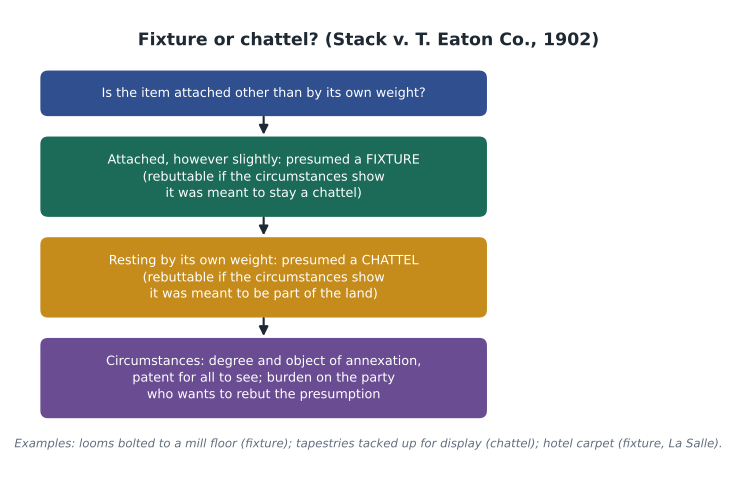
The degree of annexation asks how firmly the item is attached and how much damage removal would cause. The object of annexation asks why it was attached: to improve the land permanently, or simply to use or enjoy the item as a chattel. In Holland v. Hodgson (1872), looms bolted to the floor of a mill passed to the mortgagee. In Leigh v. Taylor, [1902] AC 157 (HL), valuable tapestries tacked to a wall for display remained chattels, because the object was to enjoy them as tapestries. In La Salle Recreations Ltd. v. Canadian Camdex Investments Ltd. (1969), 4 DLR (3d) 549 (BCCA), wall-to-wall carpeting installed in a hotel was held to be a fixture, because it was attached to improve the hotel as a building, which meant that the carpet seller lost its claim to the carpet when the hotel's mortgagee took over.
Tenants are treated more generously. A tenant may remove trade fixtures, and domestic and ornamental fixtures, that it installed, so long as it does so before the end of the tenancy, or within a reasonable time after, and repairs the damage. Secured lenders who finance goods that become fixtures can protect their priority by registering under Ontario's Personal Property Security Act, which has special rules for fixtures.
The schoolhouse items
Asante asks the class to classify the items removed from the schoolhouse. The wood stove was connected to the chimney with a flue pipe and sat on a brick hearth built for it; most students conclude it was a fixture, both because it was attached and because its object was to heat the building. The bolted shelves are presumed fixtures because they were attached, and Margaret's helpers would have to show they were meant to remain chattels, which seems unlikely for shelves built to fit the wall. The chandelier is the kind of item agreements of purchase and sale often mention expressly, and Asante tells the class to check the agreement first: in Ontario, the standard form lists included chattels and excluded fixtures, and the parties' agreement governs. The garden statue rested on its own weight on a gravel bed, so it is presumed to be a chattel unless the circumstances show it was part of a landscape design meant to stay with the land.
Worked problem
Colin and the joint account
Margaret added Colin, her adult son, as a joint owner of her savings account two years before her death so that he could pay her bills. She never said anything else about the account. Colin claims it by survivorship; Ruth says it belongs to the estate. Who is likely to succeed?
Show solution
- The transfer into joint names was gratuitous: Colin gave nothing for it.
- Under Pecore v. Pecore, a gratuitous transfer to an adult child triggers the presumption of resulting trust.
- Colin bears the burden of proving, on a balance of probabilities, that Margaret intended him to take the account by survivorship.
- The evidence points to convenience: he was added to pay her bills, and she said nothing about a gift.
- Unless other evidence emerges (bank forms, statements, the will), Colin holds the account on resulting trust for the estate, which Ruth and Colin share under the will.
Common mistakes
MistakeTreating a promise to give as a completed gift.
InsteadA gift of a chattel is complete only with intention, acceptance and delivery (or a deed); a bare promise is unenforceable.
MistakePresuming that a parent's transfer to an adult child is a gift.
InsteadPecore presumes a resulting trust for adult children; the presumption of advancement applies only to minor children.
MistakePutting the burden on the bailor to prove negligence.
InsteadOnce goods are lost in the bailee's possession, the bailee must show the loss occurred without its negligence.
MistakeDeciding fixtures by what the person who installed the item privately intended.
InsteadIntention is judged objectively from the degree and object of annexation, as patent for all to see (Stack v. T. Eaton Co.).
Practice problems
Work each problem on paper first, then reveal the answer to check.
What are the elements of a donatio mortis causa?
Show answer
A gift in contemplation of impending death, delivery of the thing or the means of control, and a condition that it takes effect only on death.
What did Re Cole decide?
Show answer
Words of gift without delivery did not transfer the furniture in a house, because nothing was handed over.
What did Punch v. Savoy's Jewellers decide about sub-bailees?
Show answer
Each bailee and sub-bailee had to account for the lost ring and could not rely on a limitation clause the owner never agreed to.
What are the two presumptions in Stack v. T. Eaton Co.?
Show answer
Items resting by their own weight are presumed chattels; items attached, however slightly, are presumed fixtures; either presumption can be rebutted by the circumstances.
Why was the carpet in La Salle Recreations a fixture?
Show answer
It was attached to improve the hotel as a building, so the object of annexation made it part of the land.
Summary and key terms
- A gift inter vivos needs intention, acceptance and delivery (actual, constructive or by deed).
- A donatio mortis causa is a gift in contemplation of death, with delivery, conditional on death.
- Gratuitous transfers to adult children are presumed to create a resulting trust (Pecore v. Pecore).
- A bailee must take reasonable care and bears the burden of disproving negligence when goods are lost (Punch v. Savoy's Jewellers).
- Fixtures pass with land; Stack v. T. Eaton Co. presumes attached items are fixtures and items resting by their own weight are chattels.
- The degree and object of annexation decide close cases; tenants may remove trade, domestic and ornamental fixtures.
- Gift inter vivos
- A gift between living people, complete on intention, acceptance and delivery.
- Donatio mortis causa
- A gift made in contemplation of death, conditional on the donor's death.
- Presumption of resulting trust
- The presumption that a gratuitous transferee holds property for the transferor unless a gift is proved.
- Bailment
- The delivery of possession of a chattel for a limited purpose, on terms that it will be returned or dealt with as directed.
- Fixture
- A chattel attached to land so that it becomes part of the land.
- Trade fixture
- A fixture installed by a tenant for its business, which the tenant may remove at the end of the tenancy.
Lesson quiz · 5 questions
Score 60% or more to complete this lesson.
Create a free account to save your progress, take quizzes and earn a certificate.