
LAWC-113 · Lesson 8 of 12 · 22 min
Adverse possession
▶ Video coming soon A video version of this lesson is on the way.
Since 1985, a page-wire fence has run along the east side of Ferncliffe Farm, separating the Holloways' hayfield from the land of their neighbour, Gordon Fraser. A survey commissioned last year, when Walter applied for a farm loan, shows that the fence is not on the boundary. For most of its length, it sits about six metres inside the Holloways' land, so a strip roughly six metres wide and four hundred metres long has been fenced in with Fraser's pasture for about forty years. Fraser and, before him, his father have grazed cattle on the strip and kept the fence in repair. Nobody in either family knew about the error until the survey. Professor Asante asks the class whether the strip still belongs to the Holloways.
The idea of adverse possession
Adverse possession allows a person who has possessed someone else's land for long enough, in the right way, to defeat the true owner's title. Technically, the possessor does not receive a transfer of the owner's title. Rather, limitations legislation bars the owner from suing to recover the land after a set period and then extinguishes the owner's title, leaving the possessor with a possessory title good against everyone, as Asher v. Whitlock recognized (lesson 2).
The doctrine is often described as legalized theft, and students tend to dislike it. Asante offers the usual justifications. It quiets titles by preventing stale claims based on old documents, after evidence has disappeared. It protects people who have relied on a long-standing situation, built their lives around it and invested in the land. It encourages owners to keep an eye on their land and rewards productive use. And, in many real cases like the Holloway fence, it corrects for honest boundary mistakes that both families have lived with for decades.
The statute
In Ontario, the Real Property Limitations Act governs. An action to recover land must be brought within ten years after the right to bring it first accrued, which in an adverse possession case means ten years after the owner was dispossessed or discontinued possession. At the end of the period, the owner's right and title to the land are extinguished. Section 16 of the Act lists certain public lands against which no title can be acquired by possession, including waste or vacant Crown land and road allowances, and longer periods apply to claims by the Crown. Other statutes add further exemptions.
The ten years must be continuous. A possessor can add their own possession to that of a predecessor from whom they took over, a process called tacking, so long as there is no gap. If the true owner retakes possession or the possessor acknowledges the owner's title in writing before the period runs out, the clock starts again.
The elements: Masidon Investments v. Ham
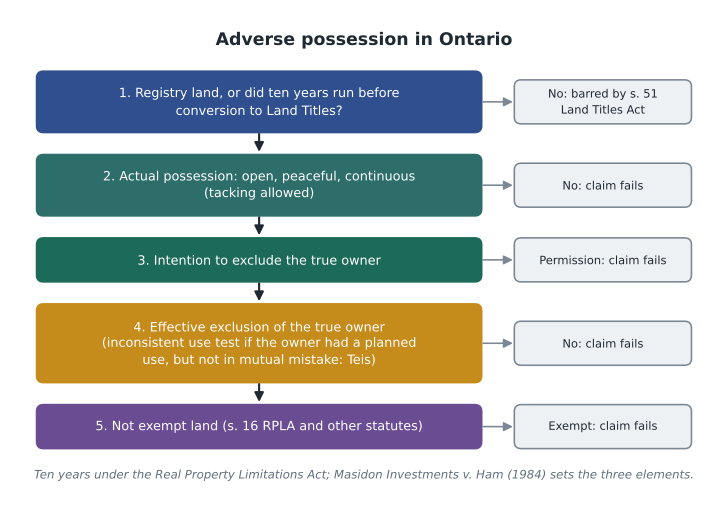
Ontario courts apply the three-part test stated by the Court of Appeal in Masidon Investments Ltd. v. Ham (1984), 45 OR (2d) 563 (CA). The claimant must show, for the whole statutory period, (1) actual possession of the land; (2) an intention to exclude the true owner from possession; and (3) effective exclusion of the true owner. The possession must also be open and notorious, so that a reasonably attentive owner would notice it; peaceful, not taken by force; continuous; and exclusive, not shared with the owner. The burden is on the claimant, and courts require clear evidence, because the doctrine takes land away from its registered owner.
What counts as actual possession depends on the land. For a suburban backyard, fencing and treating the area as part of the yard may be enough. For wild or rural land, occasional activities such as cutting wood, hunting or walking are usually not enough, because they are consistent with the owner's own occasional use. Fencing is strong evidence, but not conclusive: a fence built to keep animals in may not show an intention to exclude the owner.
The inconsistent use test and its limits
In Masidon itself, the claimant used a vacant parcel for recreation, including landing a small plane. The true owners were land developers who intended to develop the property in the future and did not need it in the meantime. The Court of Appeal held that the claim failed: the claimant's use was not inconsistent with the owners' intended use, because the owners planned to hold the land until development and the claimant's activities did not interfere with that plan. This is the inconsistent use test, which grew out of earlier cases such as Keefer v. Arillotta (1976), 13 OR (2d) 680 (CA). The idea is that an owner who has a particular future use in mind is not really dispossessed by someone whose activities leave that future use untouched.
The inconsistent use test makes adverse possession much harder, and courts have limited it. In Teis v. Ancaster (Town) (1997), 35 OR (3d) 216 (CA), the Teis family had for many years used a strip of land along the boundary of their property, believing it was theirs; the town, which owned the strip, also did not know where the true line was. The Court of Appeal held that the inconsistent use test does not apply where both parties are mistaken about the boundary. An owner who does not even know it owns the strip cannot have a planned use for it, so there is nothing for the claimant's use to be inconsistent with, and the claimant's own mistaken belief that the land was theirs supplies the intention to exclude. Teis is the leading authority for mutual mistake cases, which are the most common kind of boundary dispute.
Land Titles: the bar in section 51
As lesson 7 explained, section 51 of the Land Titles Act provides that no title adverse to the registered owner can be acquired by length of possession or by prescription once land is registered in Land Titles. This is one of the most important practical rules in Ontario property law. For land that has always been in Land Titles, adverse possession is not available at all. For land converted from the Registry system, the question is whether the full ten-year period had run before the conversion. If it had, the possessor's rights crystallized before conversion and are preserved; Land Titles Conversion Qualified parcels are guaranteed subject to such rights. If it had not, the possessor cannot complete the period afterwards.
Kosicki v. Toronto (City)
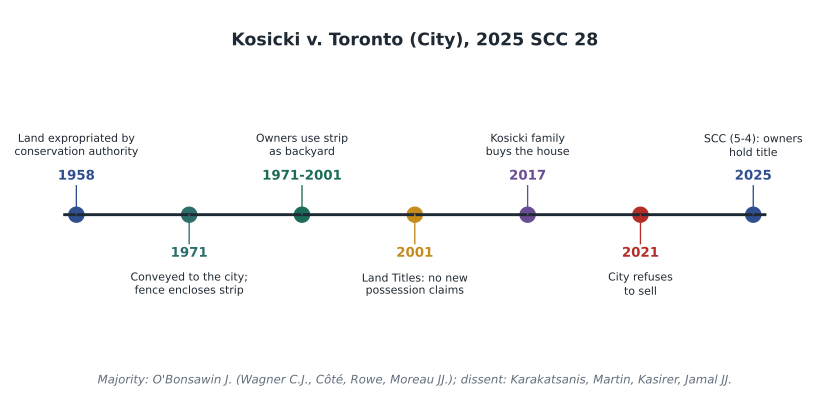
The Supreme Court considered adverse possession of public land in Kosicki v. Toronto (City), 2025 SCC 28, decided on September 19, 2025. Pawel Kosicki and Megan Munro bought a Toronto home in 2017. Its fenced backyard included a strip of land that, they later learned, was city parkland. The land had been expropriated by the regional conservation authority in 1958 and conveyed to the city in 1971, and at around that time a fence was put up enclosing the strip within the private yard. Successive owners had used the strip as part of their backyard ever since. When the city refused to sell them the strip, the owners applied for a declaration that they owned it by adverse possession. The parcel had been brought into Land Titles in 2001, so the question was whether a claim had ripened before then.
The application judge found that the traditional elements of adverse possession were met, but dismissed the claim on public policy grounds. The Court of Appeal upheld the dismissal, holding that adverse possession could not run against municipal land used by the public, such as parkland, unless the municipality had waived its rights or acquiesced in the private use, a public benefit test the city had argued for.
A five to four majority of the Supreme Court, in reasons by O'Bonsawin J. joined by Wagner C.J. and Côté, Rowe and Moreau JJ., allowed the appeal and declared the owners entitled to the strip. The majority held that recognizing a new common law immunity for municipal parkland would conflict with the Real Property Limitations Act. Section 16 lists the public lands exempt from adverse possession, and the legislature had added other exemptions over time without including municipal parkland. Creating a judge-made exemption would defeat that legislative choice and would retroactively take away possessory title that claimants had already acquired. The majority rejected the public benefit test, observing that requiring a municipality's consent would effectively nullify adverse possession against such land. Because the elements of adverse possession had been met for the full ten years before the land entered Land Titles in 2001, the owners had acquired title.
Karakatsanis, Martin, Kasirer and Jamal JJ. dissented. They would have held that the public benefit test remains part of the common law alongside the statute, that the common law can recognize the distinct character of municipal public land, and that the majority's approach risks privatizing public assets, especially green space in dense cities. Asante tells the class that the decision has prompted calls for legislative change, and that students should check whether the province has amended the Act since the decision before relying on it for municipal land.
The Holloway fence
Asante walks the class through the strip. First, the land system: Ferncliffe Farm was converted to Land Titles in 2002. Fraser's possession began in 1985, so ten years would have run by 1995, well before conversion, if the elements were met. Second, actual possession: the Frasers grazed cattle on the strip and maintained the fence, the ordinary use an owner would make of pasture. Third, intention to exclude: both families believed the fence was the boundary, so under Teis the Frasers' belief that the strip was theirs supplies the intention, and the inconsistent use test does not apply. Fourth, effective exclusion: the fence kept the Holloways out of the strip for the whole period. The possession was open, peaceful and continuous, and the Frasers can tack the father's possession to the son's.
Arjun Mehta concludes that the Frasers almost certainly acquired title to the strip before 2002, and that their rights survived conversion. Theo Marchetti points out that the Holloways' only hope would be evidence that the fence was a cattle fence put up by agreement, with both families knowing it was not the true line, in which case the Frasers' use would be by permission and not adverse. Asante agrees that permission defeats adverse possession, and says that is why lawyers interview elderly neighbours and look for old letters in these cases. He adds that, practically, the families might be wise to agree on the fence line and register a boundary agreement or a transfer, rather than litigate.
Proving possession in practice
Adverse possession cases are won and lost on evidence. Lawyers gather old surveys and reference plans, aerial photographs from provincial and municipal archives (which can show where fences and tree lines stood decades ago), tax and assessment records, receipts for fencing materials, and affidavits from neighbours and former owners who remember how the land was used. Courts look for clear, consistent evidence covering the whole ten-year period, and gaps or ambiguous uses, such as occasional mowing or storing a canoe, often defeat claims. Because the burden is on the claimant, and because the claimant is asking a court to take land from the registered owner, judges scrutinize the evidence carefully. For the Holloways, the 1985 fence is visible in aerial photographs from the 1990s, which is exactly the kind of evidence the Frasers would use.
Adverse possession and Indigenous land
Daniel Whitecloud asks whether adverse possession has ever been used against First Nations reserve land. Asante explains that reserve lands are federal lands set apart under the Indian Act, and that provincial limitations statutes cannot extinguish an interest in reserve land, which is a matter of federal jurisdiction. Courts have also been reluctant to allow limitations defences to defeat claims arising from the Crown's obligations to Indigenous peoples. Lesson 11 returns to the relationship between private titles and Aboriginal title.
Worked problem
A garden shed on the line
In 2012, Ruth's neighbour in Corwin built a garden shed and planted a hedge that encroached three metres onto Ruth's city lot, believing the hedge marked the boundary. Ruth's lot has been in Land Titles since 2000. Ruth only discovered the encroachment this year. Has the neighbour acquired title to the strip?
Show solution
- Identify the land system first: the lot has been in Land Titles since 2000.
- Section 51 of the Land Titles Act bars acquiring title by possession against a registered owner after registration.
- The neighbour's possession began in 2012, after registration, so no period could ripen before conversion.
- It does not matter that the other elements (actual possession, intention, exclusion under Teis) might be met.
- The neighbour has no title; Ruth can require removal, though the parties may negotiate a boundary agreement.
Common mistakes
MistakeApplying adverse possession to land that has always been in Land Titles.
InsteadSection 51 of the Land Titles Act bars it; for converted land, ask whether the full period ran before conversion.
MistakeApplying the inconsistent use test to every case.
InsteadTeis v. Ancaster holds it does not apply where both parties were mistaken about the boundary.
MistakeTreating permitted use as adverse possession.
InsteadUse by the owner's permission is not adverse and cannot found a claim.
MistakeSaying adverse possession can never run against municipal parkland.
InsteadKosicki v. Toronto (City), 2025 SCC 28, rejected a judge-made exemption; only statutory exemptions apply.
Practice problems
Work each problem on paper first, then reveal the answer to check.
What are the three elements of adverse possession from Masidon Investments v. Ham?
Show answer
Actual possession, an intention to exclude the true owner, and effective exclusion of the true owner, all for the full statutory period.
What is the limitation period for recovering land in Ontario?
Show answer
Ten years from when the right to recover first accrued, under the Real Property Limitations Act.
Why did the Supreme Court majority in Kosicki reject the public benefit test?
Show answer
A judge-made immunity for municipal parkland would conflict with the statute, which lists exempt public lands, and would retroactively remove title already acquired.
What is tacking?
Show answer
Adding the possession of successive possessors together to make up the statutory period, so long as there is no gap.
What did Teis v. Ancaster decide?
Show answer
The inconsistent use test does not apply where both parties were mistaken about the boundary.
Summary and key terms
- Adverse possession bars and extinguishes an owner's title after ten years of qualifying possession under the Real Property Limitations Act.
- Masidon requires actual possession, intention to exclude and effective exclusion, open, peaceful and continuous for the whole period.
- The inconsistent use test applies where an owner has a planned future use, but not in mutual mistake cases (Teis v. Ancaster).
- Section 51 of the Land Titles Act bars new adverse possession claims after registration; claims that ripened before conversion survive.
- Kosicki v. Toronto (City), 2025 SCC 28 (5-4) held that municipal parkland is not immune unless a statute says so.
- Permission defeats adverse possession; successive possessors can tack their periods together.
- Adverse possession
- Acquiring a possessory title to land by possessing it, without permission, for the statutory period.
- Tacking
- Combining the possession of successive possessors to complete the statutory period.
- Inconsistent use test
- The requirement that a claimant's use be inconsistent with the true owner's intended future use of the land.
- Mutual mistake
- A situation in which both parties are mistaken about the location of a boundary.
- Possessory title
- Title arising from possession, good against all but a person with a better right.
- Section 51 bar
- The Land Titles Act rule that no title by possession or prescription can be acquired against a registered owner.
Lesson quiz · 5 questions
Score 60% or more to complete this lesson.
Create a free account to save your progress, take quizzes and earn a certificate.