
LAWC-113 · Lesson 11 of 12 · 23 min
Aboriginal title
▶ Video coming soon A video version of this lesson is on the way.
Professor Asante begins this lesson differently. He asks Daniel Whitecloud whether he would be willing to open the class, and Daniel describes the territory his own Cree community in northern Saskatchewan lives on, covered by one of the numbered treaties, and the long gap between what his grandparents understood the treaty to mean and what governments have said it means. Asante then puts up a map of Ontario showing the historical treaties that cover most of the province, and a map of British Columbia, where most land was never covered by treaty. 'Every acre we have talked about this term,' he says, 'including Ferncliffe Farm, was Indigenous land before it was anyone's fee simple. This lesson is about how the common law has recognized, and failed to recognize, that fact.'
The lesson distinguishes three different legal interests that are often confused. Reserve lands are lands set apart for the use and benefit of a First Nation under the Indian Act and treaties; the legal title is held by the federal Crown. Treaty rights are rights set out in historical and modern treaties, including rights to hunt, fish and harvest, and the lands promised under them. And Aboriginal title is a property interest arising from a group's occupation of land before the Crown asserted sovereignty, which exists independently of any treaty or statute. This lesson focuses on Aboriginal title, the most property-like of the three.
From the Royal Proclamation to Calder
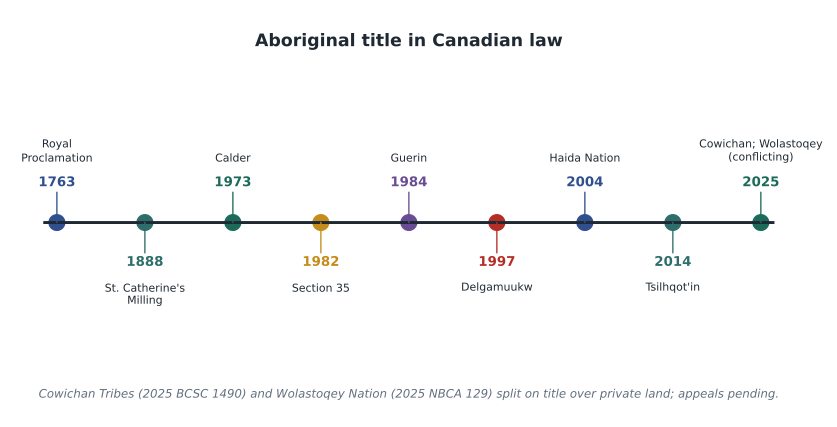
The Royal Proclamation of 1763, issued after Britain acquired New France, reserved lands to Indigenous nations and provided that their lands could be acquired only by the Crown, through public agreements, not by private purchase. Much of Ontario was later the subject of treaties negotiated under that policy, from the Upper Canada land surrenders and the Robinson treaties of 1850 to the numbered treaties of the north. Indigenous parties understood many of these agreements as treaties of peace, friendship and shared use, not simple sales, and that difference in understanding drives much current litigation.
For most of the next two centuries, Canadian courts treated Indigenous interests in land as weak. In St. Catherine's Milling and Lumber Co. v. The Queen (1888), 14 App Cas 46, the Privy Council described the interest of the Saulteaux in lands covered by Treaty 3 as 'a personal and usufructuary right, dependent upon the good will of the Sovereign'. The case was really a contest between Ontario and the federal government over timber revenues; the Indigenous parties were not heard.
The modern law begins with Calder v. British Columbia (Attorney General), [1973] SCR 313. The Nisga'a Nation sought a declaration that their Aboriginal title to their lands in the Nass Valley had never been lawfully extinguished. They lost on a technical point, but six of the seven judges recognized that Aboriginal title existed as a legal right based on the Nisga'a's prior occupation of the land; they split evenly on whether it had been extinguished. Calder led the federal government to begin negotiating modern land claims agreements, including, eventually, the Nisga'a Final Agreement of 2000.
Section 35 and Guerin
Section 35(1) of the Constitution Act, 1982 recognizes and affirms 'the existing aboriginal and treaty rights of the aboriginal peoples of Canada'. Two years later, in Guerin v. The Queen, [1984] 2 SCR 335, the Musqueam Band sued the federal Crown for leasing reserve land to a golf club on terms far worse than the band had agreed to. The Supreme Court held the Crown liable for breach of fiduciary duty. Dickson J. described the Indigenous interest in reserve land and in traditional lands as the same in nature: a sui generis interest, unlike any interest in English property law, with two key features. It is inalienable except to the Crown, and the Crown, when it takes a surrender, must act in the Indigenous people's best interests. In R. v. Sparrow, [1990] 1 SCR 1075, the Court held that section 35 protects existing rights from unjustified infringement, setting out a test the Crown must meet to justify limiting them.
Delgamuukw
Delgamuukw v. British Columbia, [1997] 3 SCR 1010, brought by the Gitxsan and Wet'suwet'en hereditary chiefs, set out the framework for Aboriginal title. The trial had relied heavily on written evidence and had given little weight to oral histories; the Supreme Court ordered a new trial, holding that oral histories must be placed on an equal footing with documentary evidence. Lamer C.J. then described Aboriginal title in detail. It is a right to the land itself, not merely to engage in particular activities. It includes the right to exclusive use and occupation and to use the land for a variety of purposes, not limited to traditional ones. It is held communally. It is inalienable except to the Crown. And it is subject to an inherent limit: the land cannot be used in ways irreconcilable with the nature of the group's attachment to it.
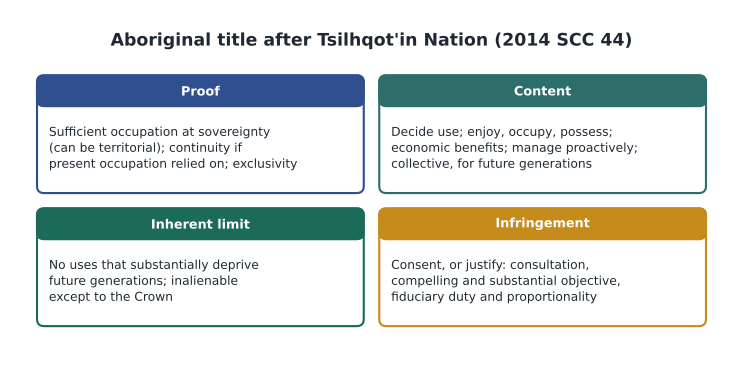
To prove title, a group must show that it occupied the land before the Crown asserted sovereignty; that, if it relies on present occupation as proof, there is continuity between present and pre-sovereignty occupation; and that its occupation at sovereignty was exclusive, meaning that it had the intention and capacity to retain exclusive control. Delgamuukw also held that Aboriginal title could be infringed by governments only if the infringement was justified, and said that the Crown's duty to consult would vary with the circumstances and could in some cases require the consent of the title holders.
Haida Nation and the duty to consult
Proving title takes years of litigation. In Haida Nation v. British Columbia (Minister of Forests), 2004 SCC 73, the province had renewed a tree farm licence on Haida Gwaii over the Haida Nation's objection while the Haida's title claim was unresolved. The Supreme Court held that the honour of the Crown requires the Crown to consult, and where appropriate accommodate, when it has knowledge of the potential existence of an Aboriginal right or title and contemplates conduct that might adversely affect it. The depth of consultation depends on the strength of the claim and the seriousness of the potential impact. The duty belongs to the Crown; third parties such as forestry companies do not owe it, though the Crown can delegate procedural aspects to them. Courts have generally held that municipalities, as creatures of provincial statute, do not themselves owe the duty, though the province does when it authorizes municipal action.
Tsilhqot'in Nation
In Tsilhqot'in Nation v. British Columbia, 2014 SCC 44, the Supreme Court for the first time declared that Aboriginal title existed over a specific area: about 1,750 square kilometres of the Tsilhqot'in Nation's territory in central British Columbia. The province had issued commercial logging licences on the land in the 1980s, and the Tsilhqot'in had blockaded and then sued. The Court of Appeal had accepted title only over small, intensively used sites such as village sites. McLachlin C.J., for a unanimous Court, rejected that narrow view. Occupation sufficient to ground title can be territorial: regular and exclusive use of tracts of land for hunting, fishing and other resource use, assessed from the perspective of the Indigenous group and of the common law, is enough for a semi-nomadic people.
The Court described the rights that title confers as similar to those of a fee simple owner: the right to decide how the land will be used; to enjoy and occupy it; to possess it; to its economic benefits; and to use and manage it proactively. Those rights are held collectively for present and future generations, so title land cannot be alienated except to the Crown or used in ways that would substantially deprive future generations of its benefit. Once title is established, the Crown must obtain the group's consent to use the land or, without consent, justify the incursion: it must show that it discharged its duty to consult and accommodate, that its action served a compelling and substantial objective, and that the action is consistent with its fiduciary duty, including that it is proportionate. Provincial laws of general application, such as forestry laws, apply to title land, subject to the section 35 limits.
Aboriginal title and private land
Tsilhqot'in involved Crown land. Since 2025, Canadian courts have confronted the much harder question of how Aboriginal title relates to land that has since been granted in fee simple to private owners. In Cowichan Tribes v. Canada (Attorney General), 2025 BCSC 1490, decided in August 2025 after one of the longest trials in Canadian history, the British Columbia Supreme Court declared that the Cowichan Tribes hold Aboriginal title to part of the lands of their traditional village of Tl'uqtinus on the Fraser River, in what is now Richmond. The claim area included lands held by Canada, by the City of Richmond and by private owners. The court declared Canada's and the city's fee simple titles to parts of the title lands defective and invalid. It did not invalidate the private fee simple titles, but it held that the Crown must negotiate, in good faith and consistent with the honour of the Crown, how those private interests are to be reconciled with the Cowichan's title, with possible outcomes including the Crown buying back land, compensation or other arrangements.
Later in 2025, the New Brunswick Court of Appeal took a different view in JD Irving Ltd. v. Wolastoqey Nation, 2025 NBCA 129, a claim to a large part of New Brunswick. It held that a declaration of Aboriginal title cannot extend to privately held lands, because it would create two irreconcilable competing ownership rights in the same land; the Wolastoqey could seek a declaration over Crown lands, and for private lands only a finding of title that could ground claims for compensation against the Crown. Appeals in both cases are under way, and the Supreme Court of Canada will likely have to resolve the conflict. Asante tells the class that the issue is the most important unresolved question in Canadian property law, and that they should check the status of the appeals before relying on either decision.
Ontario has its own recent example of an Indigenous land claim against privately and municipally held land, though based on treaty rather than Aboriginal title. In Chippewas of Saugeen First Nation v. South Bruce Peninsula (Town), the trial judge held in 2023 that part of Sauble Beach on Lake Huron had been wrongly excluded from the Saugeen reserve by a faulty survey after an 1854 treaty, and the Court of Appeal dismissed the appeals by the town, the province and area landowners in 2024 ONCA 884. In August 2025 the Supreme Court of Canada declined to hear the town's appeal. The case illustrates how historical treaty promises and surveys can still change who holds land today.
Reconciliation and UNDRIP
Parliament enacted the United Nations Declaration on the Rights of Indigenous Peoples Act in 2021, committing the federal government to align its laws with the Declaration, which speaks of free, prior and informed consent for projects affecting Indigenous lands. British Columbia enacted its own Declaration on the Rights of Indigenous Peoples Act in 2019. Courts have begun to consider these statutes in interpreting the law, though their exact legal effect is still developing.
The Holloway files
Asante returns to Pike Lake. Severn Township, which holds the lake lot as a park, wants to build a boat launch and needs a provincial permit to alter the shoreline. A First Nation whose treaty harvesting rights include the lake has written to the province objecting that the launch would disturb a fish spawning area. Hannah Kowalczyk asks whether the township must consult. Asante answers that the province, which issues the permit, owes the duty to consult when it contemplates conduct that might adversely affect treaty rights; the depth of consultation will depend on the strength of the rights and the seriousness of the impact. The township is not itself the Crown, but it will have to work with the province's consultation process, and the permit may be delayed or conditioned if consultation is inadequate.
Sophie Tremblay-Hart asks whether anyone could claim Aboriginal title to Ferncliffe Farm itself. Asante says that in southern Ontario, most land is covered by historical treaties that the Crown regarded as surrenders, so title claims of the Tsilhqot'in kind are less common than claims about how treaties were made and implemented. But he reminds the class of the Sauble Beach case and of the Algonquin land claim in eastern Ontario, where the Algonquins of Ontario assert that their land was never surrendered, and says that a responsible property lawyer in Canada must understand the history beneath every title, not just the register above it.
Worked problem
Applying the Tsilhqot'in test
A First Nation claims Aboriginal title to a river valley where its ancestors hunted, fished and maintained seasonal camps for centuries, and from which they excluded neighbouring groups except by permission. The province issues a mining exploration permit in the valley without consulting. What must the Nation prove, and what must the province do?
Show solution
- Proof: sufficient occupation at the assertion of Crown sovereignty, which can be territorial (regular and exclusive use of tracts for resource use), judged from the Indigenous and common law perspectives.
- Continuity, if present occupation is relied on, and exclusivity at sovereignty, shown by the intention and capacity to control the land, including by granting permission to others.
- Before title is proved, the honour of the Crown requires consultation proportionate to the strength of the claim and the seriousness of the impact (Haida Nation).
- After title is declared, the province needs the Nation's consent or must justify the infringement: consultation, a compelling and substantial objective and consistency with its fiduciary duty, including proportionality (Tsilhqot'in).
- Issuing the permit without consultation is likely a breach of the duty to consult, which may lead a court to quash or suspend the permit.
Common mistakes
MistakeTreating Aboriginal title, reserve lands and treaty rights as the same thing.
InsteadReserve lands are set apart under the Indian Act; treaty rights come from treaties; Aboriginal title arises from pre-sovereignty occupation.
MistakeSaying Aboriginal title is limited to village sites.
InsteadTsilhqot'in holds that territorial use, regular and exclusive, can ground title.
MistakeSaying the duty to consult arises only after title is proved.
InsteadHaida Nation requires consultation when the Crown knows of a potential right and contemplates adverse conduct.
MistakeStating that Aboriginal title now automatically overrides private fee simple titles.
InsteadCowichan Tribes and Wolastoqey Nation reached conflicting answers in 2025, and appeals are pending.
Practice problems
Work each problem on paper first, then reveal the answer to check.
What did Calder decide?
Show answer
Six judges recognized that Aboriginal title existed as a legal right based on prior occupation; they split evenly on extinguishment.
What are the elements of proof of Aboriginal title under Delgamuukw and Tsilhqot'in?
Show answer
Sufficient occupation before sovereignty, continuity if present occupation is relied on, and exclusivity at sovereignty.
What rights does Aboriginal title confer according to Tsilhqot'in?
Show answer
The right to decide how the land is used, to enjoy, occupy and possess it, to its economic benefits and to manage it proactively, held collectively for future generations.
What must the Crown show to justify infringing established title without consent?
Show answer
That it consulted and accommodated, had a compelling and substantial objective, and acted consistently with its fiduciary duty, including proportionality.
How did Cowichan Tribes and Wolastoqey Nation differ?
Show answer
Cowichan declared title over lands including private parcels and required negotiation; Wolastoqey held declarations cannot extend to private land, allowing only findings and compensation.
Summary and key terms
- Aboriginal title arises from occupation before Crown sovereignty and is distinct from reserve lands and treaty rights.
- Calder (1973) recognized Aboriginal title; section 35 (1982) constitutionally protects existing Aboriginal and treaty rights.
- Guerin described the interest as sui generis and inalienable except to the Crown, with a Crown fiduciary duty.
- Delgamuukw set the test (occupation, continuity, exclusivity) and the content of title, including the inherent limit.
- Haida Nation requires consultation before title is proved; Tsilhqot'in made the first title declaration and requires consent or justification.
- In 2025, Cowichan Tribes and Wolastoqey Nation split on whether title can be declared over private land; appeals are pending.
- Aboriginal title
- A collective, constitutionally protected interest in land arising from pre-sovereignty occupation.
- Sui generis
- Unique; not fitting into existing categories of property law.
- Inherent limit
- The rule that title land cannot be used in ways that would substantially deprive future generations of its benefit.
- Duty to consult
- The Crown's obligation, grounded in the honour of the Crown, to consult and accommodate when its conduct may affect Aboriginal or treaty rights.
- Section 35
- The provision of the Constitution Act, 1982 that recognizes and affirms existing Aboriginal and treaty rights.
- Royal Proclamation of 1763
- The British proclamation reserving lands to Indigenous nations and requiring that they be acquired only by the Crown.
Lesson quiz · 5 questions
Score 60% or more to complete this lesson.
Create a free account to save your progress, take quizzes and earn a certificate.