
LAWC-113 · Lesson 12 of 12 · 23 min
Capstone: solving a property problem
▶ Video coming soon A video version of this lesson is on the way.
The final lesson is Professor Asante's take-home problem, modelled on the kind of question that appears on a first-year property exam. He gives Section B a week to write an answer, then goes through it with them issue by issue. The facts are fictional. Asante's instructions are the ones he gives every year: identify each claim and each party, state the governing rule with its authority, apply it to the facts, and reach a conclusion a client could act on. 'Do not tell me property law is complicated,' he says. 'Tell me who owns what.'
The problem
Agnes Pruitt owned Larchmere, a cottage property on Wren Lake in Ontario, from 1966 until her death three years ago. The property was in the Registry system until it was converted to Land Titles (LTCQ) in 2003. Her will left Larchmere 'to my brother Hugh for his lifetime, and after his death to my nieces Clara and Dana jointly.'
Facts about the property. (1) Larchmere's only road access is a gravel track across the neighbouring Ostrander property. Agnes and her guests drove it every summer from 1966 onward. In the Ostranders' files is a 1972 letter from Agnes thanking old Mr. Ostrander 'for letting us use your lane again this year.' There is no later correspondence. The Ostranders' land was converted to Land Titles in 2003. The new owner of the Ostrander land has threatened to close the track. (2) Since 1988, the dock and boat shed of the neighbour on the other side, Paul Moreau, have extended about four metres onto Larchmere's shore land. Both Agnes and Moreau believed the boundary ran from an old stone cairn, which a recent survey shows is in the wrong place. Moreau has used and maintained the shed and the land under it continuously. (3) A 1985 deed by which Agnes bought a small additional parcel contains two covenants given to the seller, who still owns the adjoining lot: Agnes promised for herself and her successors to 'maintain the shared seawall' along both lots, and 'not to build any structure exceeding one storey' on Larchmere. The covenants were registered in 1985, without a stated duration.
Facts about the people. (4) In 2024, Hugh, as life tenant, had two hundred mature white pines on the property cut and sold to a sawmill for a substantial sum. Larchmere had never been run as a timber operation. (5) In 2025, Clara, needing money, sold and transferred 'all my interest in Larchmere' to her friend Ivo, who registered the transfer. Dana did not know. (6) Last summer, Hugh's grandson Felix, staying at the cottage as Hugh's guest, found an antique silver locket lodged in the rafters of the boathouse. Hugh took the locket and kept it in the cottage. (7) Hugh died last month. His will leaves everything to Felix. Dana wants to add a second storey to the cottage and asks who now owns Larchmere, whether she can stop the track being closed, whether she can get the shore land back from Moreau, whether she must maintain the seawall, who gets the locket and what can be done about the pines.
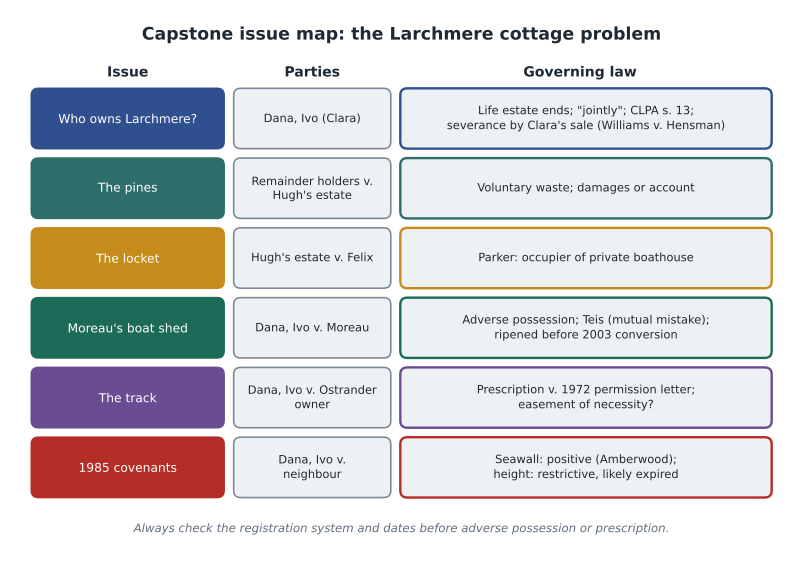
Issue 1: who owns Larchmere now?
Rule. A gift to one person for life and then to others creates a life estate followed by a remainder; the remainder vests in possession when the life tenant dies (lesson 4). Under section 13 of the Conveyancing and Law of Property Act, a devise to two or more persons creates a tenancy in common unless an intention to create a joint tenancy sufficiently appears (lesson 9). A joint tenancy, including a joint tenancy in a vested remainder, is severed when one joint tenant acts on their own share, for example by transferring it to a third party (Williams v. Hensman).
Application. Agnes's will gave Hugh a life estate and Clara and Dana a vested remainder. The word 'jointly', used without words of severance, is the kind of language courts often treat as showing an intention to create a joint tenancy, so the better view is that Clara and Dana took the remainder as joint tenants. A student who argues that 'jointly' merely means 'together' and does not displace the statutory presumption should note the point; on that reading they were tenants in common from the start, and the result below is the same. In 2025, Clara transferred all her interest to Ivo. That transfer acted on her share, destroying the unities of title and time for it, and severed the joint tenancy. Ivo took Clara's undivided half interest as a tenant in common with Dana. Dana's lack of knowledge does not matter; severance by alienation does not require the other joint tenant's consent.
Conclusion. On Hugh's death last month, the life estate ended and the remainder vested in possession. Larchmere is now owned by Dana and Ivo as tenants in common, each with an undivided half interest. Clara has no interest. Felix, Hugh's heir, takes nothing in the land, because Hugh's life estate ended with his life. If Dana and Ivo cannot agree on how to use the property, either may apply under the Partition Act for partition or sale, which a court would generally order (Davis v. Davis).
Issue 2: the pines
Rule. A life tenant must not commit voluntary waste. Cutting mature timber for sale is voluntary waste unless the instrument makes the life tenant unimpeachable for waste or the land was already managed for timber when the life estate began; estovers allow only wood for fuel and repairs (lesson 4). The remainder holders may recover damages, or an account of profits, from the life tenant or the life tenant's estate.
Application. Agnes's will says nothing about waste, and Larchmere was never run as a timber operation. Hugh cut two hundred mature pines and sold them; that was not estovers. The cutting was voluntary waste. In 2024, when the cutting occurred, the remainder was held by Clara and Dana; the claim for waste is a claim for damage to the inheritance, and Clara's 2025 transfer of 'all my interest in Larchmere' likely carried her share of the claim to Ivo, though a careful answer notes that whether the transfer assigned an accrued claim for damages is a question of interpretation.
Conclusion. Dana and Ivo (and Clara, if she kept the accrued claim) can claim against Hugh's estate for the value of the timber or the loss in value of the land, subject to the Limitations Act, 2002, which generally gives two years from discovery to sue.
Issue 3: the locket
Rule. A finder acquires rights good against everyone except the true owner and anyone with a prior right (Armory v. Delamirie). Under Parker v. British Airways Board, an occupier has rights superior to a finder over things attached to or in a building, and over loose things in a building if, before the find, the occupier manifested an intention to control the building and the things in it (lesson 2).
Application. Felix was a lawful visitor, not a trespasser or employee, so his claim as finder is not excluded outright. But the locket was lodged in the rafters of a private boathouse, a building the life tenant occupied and controlled and to which the public had no access. Hugh, as occupier, plausibly had a prior manifested control over the boathouse and its contents; the facts resemble the hayloft in the Holloway file far more than the airport lounge in Parker. The occupier at the time of the find was Hugh, the life tenant in possession, not the remainder holders, whose interest was not yet in possession. Hugh's rights in the locket, as personal property, pass under his will.
Conclusion. As between Felix and Hugh, Hugh had the better claim, but Hugh's will leaves everything to Felix, so Felix takes the locket through the estate anyway. Dana and Ivo have no claim to it, because they were not in possession when it was found. Whoever holds it must take reasonable steps to find the true owner, and should check whether its age makes it subject to any heritage requirements.
Issue 4: the Moreau dock and boat shed
Rule. Under the Real Property Limitations Act, an owner's title is extinguished if a possessor has actual possession, with an intention to exclude the owner, and effectively excludes the owner, for ten continuous years (Masidon Investments v. Ham). The inconsistent use test does not apply where both parties were mistaken about the boundary (Teis v. Ancaster). Section 51 of the Land Titles Act bars acquiring title by possession after registration, but rights that ripened before conversion survive (Kosicki v. Toronto (City), 2025 SCC 28) (lesson 8).
Application. Larchmere was in the Registry system until 2003. Moreau's possession began in 1988, so ten years ran by 1998, before conversion. He built and maintained a boat shed on the strip and used it continuously; that is actual possession appropriate to shoreline land. Both he and Agnes mistakenly believed the cairn marked the boundary, so under Teis his belief supplies the intention to exclude and the inconsistent use test does not apply. Agnes was effectively excluded from the land under the shed. Nothing suggests permission.
Conclusion. Moreau very likely acquired possessory title to the land under the shed by 1998, and his rights survived conversion in 2003. Dana and Ivo cannot recover it. A complete answer notes that the part of the dock that extends over the water may sit on the bed of the lake, which in Ontario generally belongs to the Crown and is governed by provincial rules, so adverse possession against Larchmere does not resolve rights over the water itself.
Issue 5: the track across the Ostrander land
Rule. An easement can arise by prescription after twenty years of open, continuous use as of right, without permission, under the Real Property Limitations Act or the doctrine of lost modern grant, but prescription cannot run against land in Land Titles after registration. An easement of necessity may be implied when land was severed from a common owner's holding and left without access (lesson 10).
Application. Agnes used the track from 1966 until her death, far longer than twenty years before the Ostrander land entered Land Titles in 2003. The difficulty is the 1972 letter thanking Mr. Ostrander for 'letting us use your lane again this year', which shows that the use was by permission at least then. Use by permission is not use as of right. The question is whether the permissive character continued: if the Ostranders gave annual permission, or permission was understood to continue, there is no prescriptive easement. If, after 1972, Agnes used the track openly as of right for a full twenty years before 2003, for example from 1973 to 1993, with no further requests and no acknowledgement of permission, an argument for prescription remains, but the earlier permission makes it weaker, because courts infer that permissive use continues unless something changes. The alternative is an easement of necessity: a title search may show that Larchmere and the Ostrander land were once held by a common owner who severed Larchmere without access, in which case an easement of necessity would have been implied at the severance and binds the new owner.
Conclusion. Dana and Ivo's position on the track is uncertain on prescription because of the 1972 letter, and their best argument may be an easement of necessity if the chain of title shows a common owner. They should order a full title search immediately and, while it proceeds, seek to negotiate a registered right of way.
Issue 6: the 1985 covenants
Rule. At law, the burden of a covenant does not run with freehold land. In equity, a restrictive covenant runs if it is negative in substance, benefits identifiable land of the covenantee, was intended to run and the later owner has notice (Tulk v. Moxhay). Positive covenants do not run in Ontario (Amberwood v. Durham Condominium Corp. No. 123). Under the Land Titles Act, a restrictive covenant registered without a stated period generally expires forty years after registration, and the Conveyancing and Law of Property Act allows a court to modify or discharge restrictive covenants (lesson 10).
Application. The promise to 'maintain the shared seawall' is positive: it requires work and expense. It bound Agnes personally, but its burden does not run to Dana and Ivo, whatever the deed says about successors. The covenant 'not to build any structure exceeding one storey' is restrictive and benefits the adjoining lot still owned by the original covenantee, so it was capable of running in equity, and registration gave notice. But it was registered in 1985 without a stated duration, so it has likely expired under the forty-year rule. Even if it had not, Dana could apply to discharge or modify it if circumstances have changed.
Conclusion. Dana and Ivo need not maintain the seawall, though they may wish to agree with the neighbour to share costs. The one-storey covenant has very likely expired, and a second storey will depend instead on the township's zoning bylaw and building permit rules, and on Ivo's agreement as co-owner.
What a strong answer looks like
Asante ends the term with a checklist. A strong answer classifies each interest before analyzing it. It identifies every party, including those who are easy to forget, such as Ivo and Hugh's estate. It checks the land registration system and its dates before discussing adverse possession or prescription. It states each rule with its leading authority and applies it to the specific facts, using the facts that cut both ways. It flags what further information would change the answer, such as the chain of title for the track or the exact wording of the covenants. And it ends with conclusions a client could act on: who owns what, what to do next and what it might cost. Theo Marchetti, who spent a decade as a law clerk, says that is exactly what a senior lawyer wants on their desk on a Monday morning. Asante agrees, and wishes the class good luck with their exams.
Worked problem
A short variation
Change one fact: Clara did not sell her interest to Ivo. Instead, Clara died in 2025, a year before Hugh, leaving a will giving everything to her son Max. Who owns Larchmere after Hugh's death?
Show solution
- Treat the remainder as held by Clara and Dana as joint tenants (the word "jointly").
- Joint tenants of a vested remainder have the right of survivorship, even before the remainder vests in possession.
- Clara did not sever during her life; a will does not sever because survivorship operates at death.
- On Clara's death, her interest passed to Dana by survivorship, so Max takes nothing from Larchmere.
- On Hugh's death, Dana owns Larchmere alone in fee simple. (If "jointly" did not displace section 13, Clara's half would instead pass to Max as tenant in common.)
Common mistakes
MistakeAnalyzing adverse possession or prescription without checking the registration system and conversion date.
InsteadAlways check whether the land is in Land Titles and whether the full period ran before conversion (s. 51; Kosicki).
MistakeForgetting that a life estate ends with the life tenant.
InsteadNothing in the land passes under the life tenant's will; the remainder vests in possession on death.
MistakeTreating every covenant in a deed as binding on successors.
InsteadSeparate positive covenants (do not run) from restrictive ones (may run in equity, may have expired).
MistakeEnding with "it depends".
InsteadSay what it depends on, what further facts to get and what result follows from each likely answer.
Practice problems
Work each problem on paper first, then reveal the answer to check.
Why did Clara's transfer to Ivo matter?
Show answer
It severed the joint tenancy, making Ivo a tenant in common with Dana for Clara's half.
Why can Felix not claim any interest in the land itself?
Show answer
Hugh held only a life estate, which ended at his death; nothing in the land passed under his will.
What fact most weakens the prescriptive easement over the track?
Show answer
The 1972 letter showing that the use was by permission, which is not use as of right.
Why can Dana not recover the shore land from Moreau?
Show answer
His possession under a mutual boundary mistake ran for ten years before the 2003 conversion, so title ripened before the Land Titles bar applied.
Why is the seawall covenant not binding on Dana and Ivo?
Show answer
It is positive, and the burden of positive covenants does not run with freehold land in Ontario (Amberwood).
Summary and key terms
- Classify each interest first: life estate, remainder, chattel, easement, covenant.
- A remainder vests in possession when the life tenant dies; the life tenant's will cannot pass the land.
- Severance by alienation converts a joint tenancy into a tenancy in common without the other co-owner's consent.
- Check registration systems and dates before adverse possession and prescription; mutual mistake removes the inconsistent use test.
- Permission defeats prescription; easements of necessity depend on a common owner and the chain of title.
- Positive covenants do not run; restrictive covenants may run, may expire after forty years in Land Titles and can be discharged.
- IRAC
- Issue, rule, application, conclusion: a method for organizing legal analysis.
- Chain of title
- The sequence of transfers by which land passed from the Crown to the current owner.
- Severance by alienation
- Ending a joint tenancy for one share by transferring it to someone else.
- Accrued claim
- A right to sue that has already arisen, such as a claim for waste already committed.
- Lakebed
- The bed of a lake, which in Ontario is generally owned by the Crown when the lake is navigable.
- Boundary agreement
- An agreement between neighbours fixing the location of their common boundary, often registered on title.
Lesson quiz · 5 questions
Score 60% or more to complete this lesson.
Create a free account to save your progress, take quizzes and earn a certificate.