
LAWC-113 · Lesson 2 of 12 · 23 min
Possession and finders
▶ Video coming soon A video version of this lesson is on the way.
In the second week of the term, Professor Asante tells the class about Liam Brandt. Liam is twenty, the hired hand who has helped Walter Holloway run Ferncliffe Farm since Margaret's death. While moving bales in the hayloft, he found a gold pocket watch wedged behind a beam, its case engraved with the initials J.A.M. and the year 1912. Nobody in the Holloway family recognizes it. Liam handed it to Walter, who put it in a drawer and now says it belongs to the farm. Ruth Holloway, who will own the farm with her brother when Walter dies, says it should go to the estate. Liam would like it back. Asante asks the class who has the best claim, and warns them that the answer will be 'it depends' until they learn what it depends on.
The same week brings two more finds. A customer at the farm's roadside produce stand, which Ruth runs on summer weekends, found a diamond ring on the gravel in front of the stand and turned it in to her. And a man with a metal detector, who had walked into the Holloways' woodlot without permission, dug up a clay jar containing eleven silver coins from the 1850s before Walter chased him off. The three finds raise the main questions in the law of possession: what possession is, why it matters, and how courts decide between a finder and the occupier of the place where something was found.
Possession as the root of title
The common law protects possession even when the possessor is not the owner. A person in possession of a thing has a title good against everyone except someone with a better, earlier title. This is the principle of relative title: the question in a property dispute is never who owns the thing in an absolute sense, but which of the parties before the court has the better right to it.
Possession has two elements: physical control (factum) and an intention to possess (animus possidendi). Physical control depends on the nature of the thing. For a watch, it means holding it or keeping it somewhere you control. For a large tract of land, it may mean fencing, farming or building, the kind of use an owner would make. Intention means an intention to exclude others and treat the thing as your own, at least for the time being.
For land, the classic illustration is Asher v. Whitlock (1865), LR 1 QB 1. A man enclosed a piece of waste land, built a cottage on it and lived there without any title. He left the cottage by will to his widow, and after her death their daughter's husband claimed it. The court held that the possessor's heirs had a better right than a later intruder, even though neither had title from the true owner. Possession itself gave a title good against everyone except the true owner. This idea underlies adverse possession, which lesson 8 covers.
Wild animals and first possession
For things that belong to no one, such as wild animals, the common law gives ownership to the first person to take possession. In Pierson v. Post (1805), a New York case every property student reads, Post was hunting a fox with hounds when Pierson, knowing the fox was being pursued, killed it and carried it off. The majority held that Post had no property in the fox because pursuit alone is not possession; a hunter must at least mortally wound or trap the animal so as to deprive it of its natural liberty. A dissenting judge would have deferred to the custom of hunters. The rule favours a clear, easily applied test over fairness to the person who did most of the work.
Courts have sometimes followed a trade's custom instead. In Ghen v. Rich (1881), a Massachusetts court held that a whaler who killed a whale with a marked bomb lance owned it, even though the whale sank and washed ashore days later, because the custom of the Cape Cod whale fishery recognized the killer's claim. And in Popov v. Hayashi (2002), a California trial court divided the proceeds of a record-breaking home run baseball between two fans: one had the ball in his glove when a crowd knocked him down, and the other picked it up from the ground. Asante uses the baseball case to show that courts will sometimes look for a fair solution when the first-possession rule gives an unsatisfying answer.
The finder's rule: Armory v. Delamirie
The starting point for found chattels is Armory v. Delamirie (1722), 1 Str 505. A chimney sweep's boy found a jewel and took it to a goldsmith's shop to have it valued. The goldsmith's apprentice removed the stones and offered the boy a small sum, which he refused; the shop returned the empty socket. The court held that the finder, although not the owner, had a property in the jewel good against everyone except the true owner, and could recover its value from the goldsmith. Because the goldsmith would not produce the stones, the jury was directed to assume they were of the finest quality and to award damages accordingly. That presumption against a wrongdoer who destroys or withholds evidence is still applied.
Armory settles the contest between a finder and a later taker. If Walter had simply taken the watch from Liam, Liam would have the better claim against Walter as a mere taker. The harder question is what happens when the finder competes with the occupier of the land where the thing was found.
Finder versus occupier
The English cases on finders and occupiers are not easy to reconcile. In Bridges v. Hawkesworth (1851), a customer found a bundle of banknotes on the floor of a shop. The shopkeeper advertised for the owner, who never appeared, and then refused to hand them back to the customer. The court held for the finder: the notes were never in the shopkeeper's custody, and the public part of a shop is not a place where the occupier controls everything lying about. In South Staffordshire Water Co. v. Sharman, [1896] 2 QB 44, workmen cleaning out a pool on the company's land found two gold rings in the mud. The company, as owner and occupier of the land, won: things in or attached to land are in the possession of the occupier, who has the right to control the land and everything in it. And in Elwes v. Brigg Gas Co. (1886), a prehistoric boat buried six feet underground belonged to the landowner rather than to the lessee who found it while digging.
In Hannah v. Peel, [1945] KB 509, a soldier billeted in a requisitioned house found a brooch in a crack on top of a window frame. The owner of the house had never lived in it and did not know the brooch was there. The court held for the soldier, because the owner had never been in possession of the house, let alone the brooch.
Parker v. British Airways Board
The modern restatement comes from Parker v. British Airways Board, [1982] QB 1004 (CA). Mr. Parker, a passenger waiting in the airline's executive lounge at Heathrow, found a gold bracelet on the floor. He handed it to an airline employee, with his name and address, asking that it be returned to him if the owner did not claim it. The owner never did, and the airline sold the bracelet and kept the money. Parker sued and won.
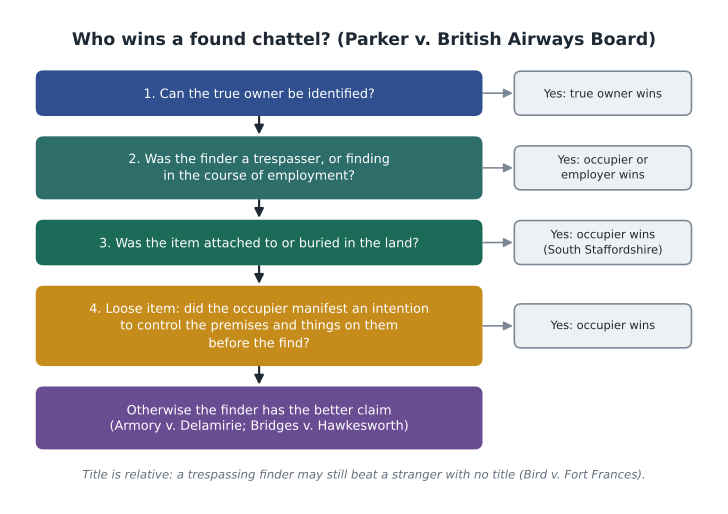
Donaldson L.J. set out a series of propositions. A finder acquires rights by taking the thing into their care and control, but acquires no rights if they were a trespasser, and a finder who finds in the course of employment or as an agent holds the item for the employer or principal. A finder's rights are good against everyone except the true owner and anyone with a prior right. An occupier of land has rights superior to a finder over things in or attached to the land, whether or not the occupier knew they were there. An occupier of a building has rights superior to a finder over things lying loose on or in the building only if, before the find, the occupier manifested an intention to exercise control over the building and the things in it. And an occupier who does manifest that intention takes on a duty to take reasonable steps to find the true owner.
Applying those propositions, the Court of Appeal held that British Airways had not manifested a sufficient intention to control lost articles in the lounge. Restricting entry to first-class passengers was about security and comfort, not about taking charge of things left behind. Parker therefore had the better claim.
A Canadian case: Bird v. Fort Frances
Ontario's best-known finder case is Bird v. Town of Fort Frances, [1949] OR 292 (HC). A twelve-year-old boy crawled into the space under a poolroom, where he had no right to be, and found a can containing a large sum in banknotes. The police took the money, and after no owner came forward the town claimed it. The occupier of the poolroom did not claim it. McRuer C.J.H.C. held that the boy's possession, although he was a trespasser, gave him a better right to the money than the town, which had no title of its own. The case is often contrasted with Parker's proposition that a trespassing finder acquires no rights. Asante explains that the difference lies in who is competing: a trespasser cannot win against the occupier whose land he entered, but his possession can still be good against a stranger, such as a police force or municipality with no claim of its own.
Employees, duties and statutes
An employee who finds something in the course of employment generally finds it for the employer, as the workmen in South Staffordshire did. In City of London Corp. v. Appleyard, [1963] 2 All ER 834, workmen demolishing a building found a safe containing banknotes built into a wall; the court held that the city, as owner, prevailed over the demolition company and the workmen.
A finder who takes possession becomes a bailee for the true owner and must take reasonable care of the thing and reasonable steps to find the owner. A finder who keeps an item knowing that the owner could reasonably be found, intending to deprive them of it, risks committing theft under the Criminal Code. Many police services and municipalities have procedures for found property, and some statutes deal with particular categories, such as heritage laws that regulate archaeological sites and artifacts. Under Ontario's Ontario Heritage Act, archaeological fieldwork requires a licence, and the province has authority over significant archaeological sites. The ancient common law doctrine of treasure trove, which gave the Crown gold and silver deliberately hidden by an unknown owner, has rarely been applied in Canada and its status here is uncertain.
Resolving the Holloway finds
Asante takes the class back to the three finds. The watch was found in the hayloft, inside a barn on a working farm that the Holloways occupy and control. It was not buried, but it was lodged behind a beam in a private building to which the public has no access. Arjun Mehta argues that the farm, through Walter as the occupier entitled to possession during his life, manifested control over the barn and everything in it; this is not an airport lounge open to hundreds of travellers. Theo Marchetti adds that Liam found the watch while working, so even on Parker's own terms he found it for his employer. Most of the class concludes that Walter, as occupier, has the better claim against Liam, subject to any claim by the true owner, and that Ruth's interest as a future owner gives her no present right to possession. Asante adds that whoever keeps the watch must take reasonable steps to find J.A.M. or his heirs.
The ring at the produce stand is closer to Bridges v. Hawkesworth and Parker: it was lying loose on gravel in an area open to the public, and Ruth had done nothing to show she took charge of lost articles. Unless she can point to such a manifestation, the customer who found it has the better claim, and Ruth holds it for them while she looks for the owner. The silver coins were buried in the woodlot, so under Elwes and South Staffordshire the occupier's claim is strong whatever the finder did, and the metal detectorist was a trespasser, which defeats his claim against the Holloways under Parker. Hannah Kowalczyk wonders whether the coins could be archaeological artifacts subject to the heritage rules. Asante says that depends on their age and significance and on what the province decides, which is why a careful lawyer would call the provincial heritage office before anyone sells them.
Worked problem
The ring at the produce stand
A customer finds a diamond ring on the gravel in front of Ruth's roadside produce stand and gives it to Ruth, who keeps it. No owner comes forward. Who has the better claim, Ruth or the customer?
Show solution
- Identify the true owner first: unknown, so the contest is between finder and occupier.
- The customer was lawfully on the premises and not an employee, so Parker's exclusions for trespassers and employees do not apply.
- The ring was lying loose, not buried or attached, so the occupier wins only by showing a prior manifested intention to control the premises and things on them.
- An open-air stand on public gravel, with no policy on lost property, looks like the shop floor in Bridges v. Hawkesworth or the lounge in Parker.
- Conclusion: the customer has the better claim; Ruth holds the ring as a bailee and should take reasonable steps to find the owner.
Common mistakes
MistakeAsking who "owns" a found item in an absolute sense.
InsteadTitle is relative: ask which party before the court has the better right, subject to the true owner.
MistakeSaying the occupier always wins.
InsteadFor loose items on premises, the occupier wins only if it manifested an intention to control the premises and things on them before the find (Parker).
MistakeSaying a trespassing finder can never win.
InsteadA trespasser loses to the occupier, but his possession may still beat a stranger with no title, as in Bird v. Fort Frances.
MistakeTreating pursuit as possession of a wild animal.
InsteadPierson v. Post requires capture or mortal wounding that deprives the animal of its natural liberty, unless a recognized custom applies.
Practice problems
Work each problem on paper first, then reveal the answer to check.
What did Armory v. Delamirie decide?
Show answer
A finder has a title good against everyone except the true owner and can recover the item's value from someone who takes it; where the item is withheld, its value is presumed to be the highest.
Why did Parker succeed against British Airways?
Show answer
The airline had not manifested an intention to control lost articles in the lounge before the find, so the finder's claim prevailed.
Who wins when an item is found buried in land?
Show answer
The occupier of the land, whether or not it knew the item was there (Elwes v. Brigg Gas; South Staffordshire Water v. Sharman).
What duties does a finder have?
Show answer
A finder is a bailee for the true owner, must take reasonable care of the item and reasonable steps to find the owner.
What are the two elements of possession?
Show answer
Physical control appropriate to the thing (factum) and an intention to possess and exclude others (animus possidendi).
Summary and key terms
- Possession gives a title good against everyone except a person with a better, earlier title (relative title).
- Possession requires physical control and an intention to possess; wild animals belong to the first person to capture them (Pierson v. Post).
- A finder prevails against later takers (Armory v. Delamirie).
- Occupiers prevail over finders for things in or attached to land, and for loose items only if they manifested control (Parker).
- Trespassers and employees acting in the course of employment generally lose to the occupier or employer.
- A trespassing finder may still beat a stranger with no title (Bird v. Fort Frances).
- Relative title
- The principle that a court decides which party has the better right, not who owns a thing absolutely.
- Animus possidendi
- The intention to possess and exclude others.
- Finder
- A person who takes a lost item into their care and control.
- Occupier
- The person in possession and control of land or premises.
- Manifest intention to control
- Conduct before a find showing that an occupier takes charge of premises and things on them, which defeats a finder of loose items.
- Treasure trove
- An old common law doctrine giving the Crown hidden gold or silver whose owner is unknown; its status in Canada is uncertain.
Lesson quiz · 5 questions
Score 60% or more to complete this lesson.
Create a free account to save your progress, take quizzes and earn a certificate.