
LAWC-113 · Lesson 4 of 12 · 22 min
Estates and interests
▶ Video coming soon A video version of this lesson is on the way.
Margaret Holloway's will gives Ferncliffe Farm 'to my husband Walter for his lifetime, and after his death to my children Ruth and Colin in equal shares.' Professor Asante tells the class that in one sentence Margaret has created two estates in the same land: a life estate for Walter and a remainder in fee simple for Ruth and Colin. Walter, who is seventy-four, wants to know what he can do with the farm. Can he cut and sell the timber in the woodlot? Can he rent the fields to a neighbour? Can he mortgage the farm to pay for a new roof on the farmhouse? Ruth and Colin want to know whether they can stop him. To answer, the class needs the doctrine of estates, the oldest and strangest part of property law.
Tenure: all land is held of the Crown
English land law grew out of feudalism. After 1066, the Crown was treated as the owner of all land in England, and everyone else held land 'of' the Crown, directly or through intermediate lords, in return for services. The doctrine of tenures describes how land is held. Over the centuries the services became obsolete. The statute Quia Emptores (1290) stopped the creation of new layers of feudal lordship, so that a person who sold land put the buyer in the seller's own place in the feudal ladder. The Tenures Abolition Act of 1660 swept away most remaining incidents of tenure. By the time English law came to Ontario, tenure had largely become a formality.
It is not entirely a formality in Canada. The Crown is still said to hold the underlying, or radical, title to all land, and every private estate is held of the Crown. That idea has mattered in Aboriginal title cases, where the Supreme Court has said that Crown sovereignty brought radical title, but that radical title is burdened by pre-existing Aboriginal title (lesson 11). When an owner dies without a will and without relatives entitled to inherit, the land passes to the Crown, a modern remnant of feudal escheat.
Estates: interests measured by time
The doctrine of estates describes what interest a person holds in land, and an estate is measured by time: how long the holder's interest will last. The largest estate is the fee simple, which can last forever because it passes to the holder's heirs or to whoever the holder transfers it to, and it ends only if the holder dies without a will and without heirs. The fee simple is what people mean when they say they own their house. The fee tail, which passed only to the holder's lineal descendants, has been abolished in Ontario; any attempt to create one now gives a fee simple. The life estate lasts for the life of the holder, or for the life of another person in the case of a life estate pur autre vie. Leasehold estates, which began as personal rather than real property, last for a fixed period or a periodic term.
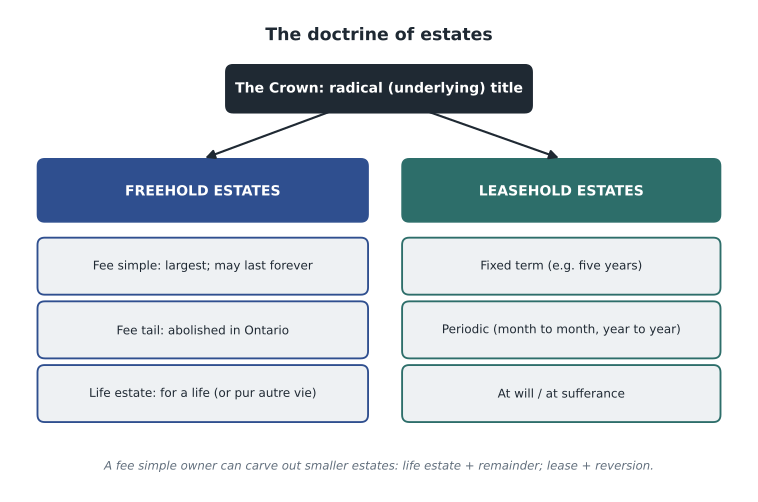
An owner in fee simple can carve smaller estates out of the fee. When Margaret gave Walter a life estate, the rest of the fee did not disappear. It passed, as a remainder, to Ruth and Colin. A remainder is a future interest that takes effect in possession when the prior estate ends, and lesson 6 covers future interests in detail. When an owner grants a lease, the owner keeps the reversion: the right to possession when the lease ends. At every moment, the full fee simple is held by someone, even if it is divided between a present interest and future interests.
Words of limitation and words of purchase
At common law, a grant of a fee simple required the words 'and his heirs'. In a grant 'to A and his heirs', the words 'to A' are words of purchase, identifying who takes, and 'and his heirs' are words of limitation, defining the estate A takes. A's heirs took nothing directly; they could inherit only if A still held the land at death. Without the magic words, a grant 'to A' gave only a life estate.
Ontario abolished that trap long ago. Under the Conveyancing and Law of Property Act, a conveyance without words of limitation passes the fee simple, or the whole of whatever estate the grantor had, unless a contrary intention appears. For wills, the Succession Law Reform Act provides that a devise of real property without words of limitation passes the fee simple or the whole of the testator's interest, unless the will shows a contrary intention. So a modern grant 'to Ruth' gives Ruth a fee simple. Asante warns the class that older deeds in Ontario's registry records still use the traditional words, and that a lawyer searching title on a nineteenth-century farm will see grants 'to A, his heirs and assigns forever'.
The fee simple and repugnancy
Because the fee simple is the largest estate, it carries the full power to sell, give away or leave the land by will. Courts have long refused to let a grantor give someone a fee simple and then take away its essential features. A gift over that would take effect only if the donee failed to dispose of the property is void for repugnancy. In Re Walker (1925), 56 OLR 517 (CA), a husband left his estate to his wife and provided that if any part remained undisposed of at her death, it should go to his relatives. The Court of Appeal held that the wife took absolutely; the gift over was repugnant to the absolute interest she had been given and was void. Asante tells the class that Re Walker is a trap for anyone drafting a will without understanding estates: if a testator wants a spouse to have the use of property for life with the rest going to the children, the will must give a life estate, perhaps with a power to encroach on capital, not an absolute gift followed by a gift over.
Margaret's lawyer avoided that trap. Walter has a life estate, not a fee simple, so the gift of the remainder to the children is valid.
The life estate
A life tenant is entitled to possession of the land and to the income it produces for life. Walter can live in the farmhouse, farm the land or rent it out and keep the rent. He can sell or mortgage his life estate, but he can give only what he has: a buyer or lender takes an interest that ends when Walter dies. That is why lenders rarely lend on the security of a life estate alone, and why a life tenant who wants to raise money against the whole farm usually needs the remainder holders to sign as well. Ontario's Settled Estates Act allows a court, in some circumstances, to authorize the sale, lease or mortgage of land held in succession when that would benefit everyone interested.
In return, a life tenant must keep the land in the condition in which it was received, so that it passes to the remainder holders intact. The life tenant must pay the property taxes and the interest on any existing mortgage, though not the principal, and must not commit waste. The law of waste distinguishes four kinds. Voluntary waste is a positive act that damages the land or reduces its value, such as demolishing buildings, opening new mines or cutting timber for sale. Permissive waste is a failure to make repairs or to prevent deterioration. Ameliorating waste changes the character of the land but increases its value, such as replacing a barn with a better building; courts rarely give remedies for it. Equitable waste is malicious or wanton destruction, for which even a life tenant who is 'unimpeachable for waste' remains liable.
Timber is the classic case. At common law a life tenant may cut wood for fuel and repairs on the land, known as estovers, but cutting mature timber for sale is voluntary waste unless the land was already being managed as a timber operation when the life estate began, or the instrument creating the life estate allows it. A will can make a life tenant 'without impeachment for waste', which allows ordinary cutting and changes, but even then not wanton destruction.
Asante applies the rules to Walter's questions. He can rent the fields to a neighbour and keep the rent, because the income belongs to the life tenant. He can cut firewood for the farmhouse and timber to repair the barn. Selling the mature maples in the woodlot would likely be voluntary waste, because Margaret's will does not make him unimpeachable for waste and the woodlot was not run as a commercial timber operation; Ruth and Colin could seek an injunction and damages. A new roof on the farmhouse is a repair the life tenant would normally pay for, though the parties may agree to share the cost of a major capital improvement. And Walter cannot mortgage the whole farm on his own; he can mortgage only his life estate.
Leasehold estates
A lease gives the tenant exclusive possession of land for a term, in return for rent. Leasehold estates come in four kinds: a fixed-term tenancy for a definite period, such as five years; a periodic tenancy that renews automatically from period to period (week to week, month to month or year to year) until one party gives proper notice; a tenancy at will, which either party can end at any time; and a tenancy at sufferance, which arises when a tenant stays on after the lease ends without the landlord's agreement.
The distinction between a lease and a licence matters. A licence is a personal permission to use land that does not create an interest in it. In Street v. Mountford, [1985] AC 809, the House of Lords held that an agreement granting exclusive possession for a term at a rent is a lease, whatever the parties call it; the label cannot turn a lease into a licence. Canadian courts generally follow the same approach, looking at the substance of the arrangement.
A lease is both an estate in land and a contract. In Highway Properties Ltd. v. Kelly, Douglas and Co., [1971] SCR 562, the anchor tenant of a shopping centre abandoned its lease, and the landlord retook possession. Under the old property rules, retaking possession was treated as accepting a surrender of the lease, which ended the landlord's right to future rent. Laskin J. held that the landlord could instead treat the abandonment as a repudiation of the contract and recover damages for the loss of the benefit of the lease over its remaining term, applying ordinary contract principles. The decision marked a shift toward treating commercial leases like other contracts.
Residential tenancies in Ontario are governed by the Residential Tenancies Act, 2006, which displaces much of the common law. It gives tenants security of tenure, so that a landlord can end a tenancy only for reasons and by procedures the Act allows; regulates rent increases for most units; and sends disputes to the Landlord and Tenant Board. Commercial tenancies remain largely a matter of contract and the Commercial Tenancies Act. The upper-year Real Estate Transactions course returns to leasing in more detail.
Legal and equitable estates
Alongside the legal estates, equity recognizes equitable interests, most importantly the interest of a beneficiary under a trust. A trustee may hold the legal fee simple while a beneficiary holds the equitable interest. Margaret's will names Ruth as executor and estate trustee, so Ruth holds Margaret's property, including the remainder interest in the farm and the bank balances, in trust until the estate is administered and the property is distributed. Colin's claim to the joint account in lesson 3 turned on whether he held the account in trust for the estate. Equitable interests can be estates measured by time too, which is why a will can give someone an equitable life interest in a fund of money.
Daniel Whitecloud asks whether Walter could simply refuse to leave if Ruth and Colin tried to sell the farm after his death. Asante answers that Walter's interest ends at the moment of his death, so the question will never arise for Walter himself, but that it would arise if Walter sold his life estate to a buyer: the buyer's interest would also end when Walter died, however long that took, and the buyer would then have to give up possession to Ruth and Colin.
Worked problem
Walter sells his life estate
Walter, the life tenant of Ferncliffe Farm, sells his life estate to a neighbour, Dale Forsythe, for a lump sum and moves to an apartment in Corwin. Two years later Walter dies. Forsythe claims he can stay on the farm because he bought it. Is he right?
Show solution
- Walter held a life estate measured by his own life.
- A life tenant can transfer the life estate, but the transferee takes an estate pur autre vie measured by Walter's life, not the buyer's.
- Forsythe therefore held the farm only for as long as Walter lived.
- On Walter's death the life estate ended, and the remainder in fee simple vested in possession in Ruth and Colin.
- Forsythe must give up possession; he has no claim against Ruth and Colin, though he may have a claim against Walter's estate if Walter misrepresented what he was selling.
Common mistakes
MistakeThinking a grant "to Ruth" without "and her heirs" gives only a life estate in Ontario today.
InsteadThe Conveyancing and Law of Property Act and the Succession Law Reform Act pass the fee simple without words of limitation unless a contrary intention appears.
MistakeGiving someone an absolute interest and then a gift over of "whatever remains".
InsteadThe gift over is void for repugnancy (Re Walker); use a life estate, perhaps with a power to encroach.
MistakeAssuming a life tenant can mortgage the whole farm.
InsteadA life tenant can mortgage only the life estate; the remainder holders must join to mortgage the fee.
MistakeTreating a written "licence" with exclusive possession at a rent as a licence.
InsteadSubstance governs: exclusive possession for a term at a rent is a lease (Street v. Mountford).
Practice problems
Work each problem on paper first, then reveal the answer to check.
What is the difference between tenure and estate?
Show answer
Tenure describes how land is held (of the Crown); estate describes the size of the interest held, measured by time.
What are the four kinds of waste?
Show answer
Voluntary (positive harmful acts), permissive (failure to repair), ameliorating (changes that increase value) and equitable (wanton destruction).
What did Re Walker decide?
Show answer
A gift over of whatever the donee failed to dispose of was repugnant to an absolute gift and void; the wife took absolutely.
What did Highway Properties v. Kelly, Douglas change?
Show answer
A landlord can treat a tenant's abandonment as repudiation and recover damages for the lost benefit of the lease over its remaining term.
Which costs must a life tenant pay?
Show answer
Property taxes, ordinary repairs and interest (not principal) on existing mortgages.
Summary and key terms
- All land is held of the Crown (tenure); private interests are estates measured by time.
- The fee simple is the largest estate; the fee tail is abolished in Ontario; life estates last for a life.
- In Ontario, conveyances and devises pass the fee simple without words of limitation unless a contrary intention appears.
- A gift over of what remains after an absolute gift is void for repugnancy (Re Walker).
- Life tenants take possession and income but must pay taxes and mortgage interest and must not commit waste.
- Leases give exclusive possession for a term; they are both estates and contracts (Highway Properties); residential tenancies are governed by the Residential Tenancies Act, 2006.
- Doctrine of tenures
- The principle that all land is held of the Crown, which retains radical title.
- Fee simple
- The largest estate in land, potentially lasting forever and freely transferable.
- Life estate
- An estate lasting for the life of the holder or another person (pur autre vie).
- Words of limitation
- Words that define the size of the estate granted, as opposed to words identifying who takes.
- Waste
- Conduct by a limited owner, such as a life tenant, that damages or alters the land to the prejudice of those entitled after.
- Reversion
- The interest a grantor keeps after granting a smaller estate, such as a lease.
Lesson quiz · 5 questions
Score 60% or more to complete this lesson.
Create a free account to save your progress, take quizzes and earn a certificate.