
LAWC-113 · Lesson 10 of 12 · 22 min
Easements, covenants and condominiums
▶ Video coming soon A video version of this lesson is on the way.
For as long as anyone can remember, the Holloways have reached their Pike Lake lot by a dirt lane that crosses the neighbouring Brennan farm. Margaret's father used it with a horse and wagon in the 1950s; Walter drives a truck down it every summer. No document grants the right of way. Last fall, the Brennans sold their farm to a numbered company that plans a subdivision and has put a locked gate across the lane. Separately, the Delaneys, who bought the old schoolhouse from Margaret in 2024, want to run a pottery studio and shop there, but a 1978 deed contains a covenant that the property 'shall be used for residential purposes only'. Professor Asante uses both problems to teach servitudes: rights that one landowner holds over another's land.
What is an easement?
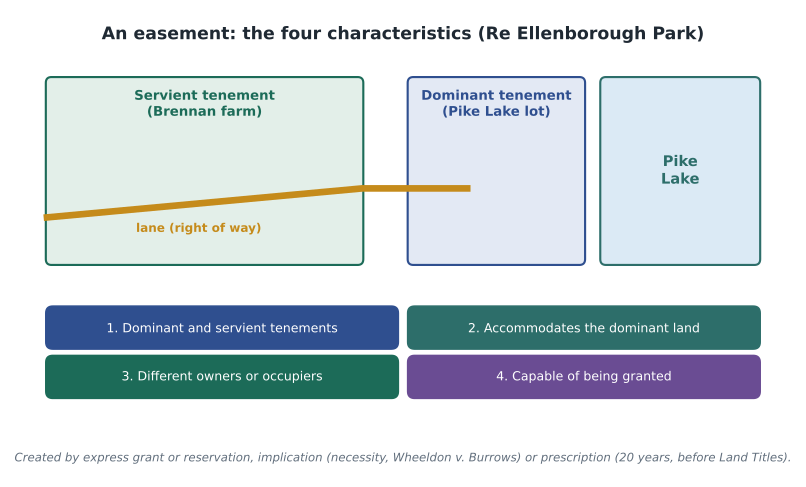
An easement is a right attached to one parcel of land, the dominant tenement, to use or restrict the use of another parcel, the servient tenement. A right of way, a right to run a drain or pipe, a right to light and a right of support are typical easements. Easements are property rights, not personal permissions: they pass automatically with the dominant land to each new owner and bind each new owner of the servient land. A personal permission to cross land, by contrast, is a licence, which generally does not bind a buyer of the servient land.
The leading statement of an easement's characteristics comes from Re Ellenborough Park, [1956] Ch 131 (CA). The owners of houses around a private park in Weston-super-Mare had been granted 'the full enjoyment' of the park as a pleasure ground, and the question was whether that right was an easement. The Court of Appeal held that it was, and adopted four requirements: there must be a dominant and a servient tenement; the easement must accommodate the dominant tenement, meaning it must benefit the land itself, not merely its owner personally; the dominant and servient owners must be different persons; and the right must be capable of forming the subject matter of a grant, meaning it must be sufficiently definite and of a kind the law recognizes. The right to use a garden as a communal amenity for the houses around it met all four.
A related interest, the profit à prendre, gives a right to take something from another's land, such as timber, gravel, fish or game. Unlike an easement, a profit can exist without a dominant tenement. Ontario's oil and gas leases and some timber rights are analyzed as profits, as students will see in the upper-year Natural Resources course.
How easements are created
An easement can be created expressly, by a deed that grants an easement over the grantor's land or reserves one when the grantor sells part of their land. Express easements should describe the route and purpose precisely, and in Ontario they are registered on title.
An easement can also be implied. When an owner sells part of their land and the part sold, or the part kept, has no access except across the other, the law implies an easement of necessity, based on the presumed intention of the parties at the moment of the severance. Necessity is judged strictly: the land must be inaccessible, not merely less convenient, and the easement lasts only as long as the necessity. Courts may also imply easements to give effect to the common intention of the parties about a particular use of the land. And under the rule in Wheeldon v. Burrows (1879), when an owner sells part of their land, the buyer takes the benefit of quasi-easements that the owner was using over the retained land at the time, so long as they were continuous and apparent, necessary for the reasonable enjoyment of the part sold, and in use at the time of the sale.
Finally, an easement can arise by prescription, from long use. In Ontario, the Real Property Limitations Act provides that a right of way or other easement enjoyed openly, continuously and without permission for twenty years cannot be defeated, and courts also recognize the doctrine of lost modern grant, a legal fiction that a grant was made and lost. Use by permission is not enough, and the use must be as of right: open, not secret, and not by force. Like adverse possession, prescription cannot operate against land registered in Land Titles; section 51 of the Land Titles Act bars it. For converted land, the twenty years must have been completed before conversion.
The lane to Pike Lake
Asante walks the class through the lane. No document grants the easement, so the Holloways must rely on implication or prescription. Implication would require that the lake lot and the Brennan farm were once owned by the same person, and the class does not yet know the chain of title; Asante says that a title search back to the original Crown patent might reveal a common owner and an easement of necessity, because the lake lot appears to have no road access. Prescription looks more promising. The Holloways have used the lane openly, continuously and without asking permission since at least the 1950s, far longer than twenty years. The Brennan farm was converted to Land Titles in 2002, so the twenty-year period was complete long before conversion. If the use was as of right and not by permission, the Holloways have a prescriptive easement that binds the new owner, and the locked gate is an unlawful obstruction.
Arjun Mehta asks what would happen if old Mr. Brennan had once told Margaret's father 'Of course you can use the lane, neighbour.' Asante says that is the question the case will turn on. If the use began, and continued, by permission, it was not as of right, and no easement arose by prescription. Courts look carefully at the evidence, because neighbourly courtesy is common in rural Ontario, and the law does not want to punish it by turning every kindness into a permanent easement.
Scope and extinguishment
An easement's scope is limited by its terms or, for an implied or prescriptive easement, by the use that gave rise to it. A right of way used by a farm wagon can usually be used by a farm truck, because the purpose is the same, but it may not support heavy commercial traffic to a new subdivision; the dominant owner cannot overburden the servient land. The servient owner may use the land in any way that does not substantially interfere with the easement, which is why a gate can sometimes be acceptable if the dominant owner is given a key.
Easements end by express release, by merger when the same person comes to own both parcels, by the end of a necessity in the case of an easement of necessity, or by abandonment. Abandonment requires a clear intention to give up the easement permanently, and courts rarely find it from non-use alone. In Ontario, the court also has statutory power under the Conveyancing and Law of Property Act to modify or discharge certain restrictions on land.
Covenants: promises about land
A covenant is a promise in a deed about the use of land. A positive covenant requires the owner to do something, such as maintain a fence, repair a shared driveway or contribute to the cost of a private road. A restrictive covenant prevents the owner from doing something, such as building more than one house, cutting trees or using the land commercially.
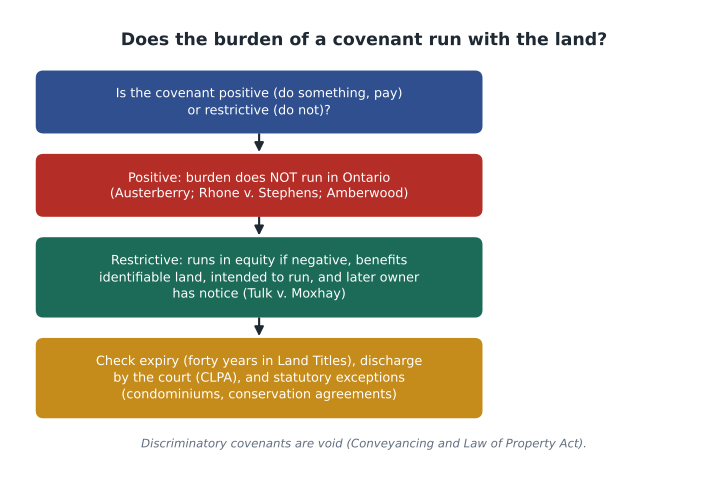
The difficult question is whether a covenant binds the people who later buy the land. At law, the benefit of a covenant can pass to the covenantee's successors, but the burden does not run with freehold land: a buyer of the burdened land is not bound by a promise they never made. The classic authority is Austerberry v. Corporation of Oldham (1885).
Equity developed an exception for restrictive covenants. In Tulk v. Moxhay (1848), the owner of Leicester Square in London sold the garden in the middle, and the buyer promised to keep it as a garden open to the residents of the surrounding houses. A later buyer, who knew of the covenant, planned to build on it. The Court of Chancery granted an injunction, holding that a person who takes land with notice of a restrictive covenant is bound in conscience to respect it. Later cases refined the requirements: the covenant must be negative in substance; it must be made to benefit identifiable land retained by the covenantee; the original parties must have intended it to run with the land; and the later owner must have notice, which registration provides in Ontario.
Positive covenants do not run
Equity never extended Tulk v. Moxhay to positive covenants, because enforcing them would require a later owner to spend money on a promise they never made. The House of Lords confirmed that rule in Rhone v. Stephens, [1994] 2 AC 310, where a covenant to maintain a roof did not bind a later owner. Ontario followed in Amberwood Investments Ltd. v. Durham Condominium Corp. No. 123 (2002), 58 OR (3d) 481 (CA). A developer had promised to share the cost of maintaining facilities used by two condominium projects, and the question was whether that promise bound the developer's successor. The Court of Appeal held that the burden of a positive covenant does not run with freehold land in Ontario, declined to adopt exceptions such as the benefit-and-burden doctrine, and said that any change was for the legislature. Lawyers work around the rule by requiring each buyer to sign a new covenant with each sale, by using easements, by registering statutory agreements with municipalities, and above all by using condominium law, which lets positive obligations bind every owner.
The schoolhouse covenant
The 1978 covenant that the schoolhouse 'shall be used for residential purposes only' is restrictive in substance, so it can run in equity if the other requirements are met. The class asks whom it benefits. The deed shows that it was given to the Holloways, who then owned the farm across the road, apparently to protect the farm from commercial development. If the covenant was intended to benefit the farm and was registered, it could bind the Delaneys. But several doors may be open to them. Under the Land Titles Act, a restrictive covenant registered without a stated duration generally expires forty years after registration, and the covenant dates from 1978. The Conveyancing and Law of Property Act allows a court to modify or discharge a restrictive covenant in appropriate cases, such as where changes in the neighbourhood have made it obsolete. And Ruth and Colin, as the future owners of the farm, might simply agree to release it. Sophie Tremblay-Hart notes that the Delaneys would also need to check the township's zoning bylaw, which may forbid a shop regardless of the covenant.
Condominiums
A condominium is a statutory form of ownership created under Ontario's Condominium Act, 1998. The land and buildings are divided into units, which owners hold individually, and common elements, such as hallways, roofs, grounds and recreation facilities, which the unit owners hold together as tenants in common in proportion to shares set out in the declaration. A condominium corporation, governed by a board elected by the owners, manages the common elements and collects common expenses. The declaration, by-laws and rules bind every owner, including positive obligations to pay common expenses and maintain units, which is what the common law of covenants cannot do. Disputes about records, pets, vehicles, noise and some other matters go to the Condominium Authority Tribunal, an online tribunal established in 2017. Ruth's daughter Emma, who rents a condominium unit in Corwin, has learned this the hard way after a dispute about a bicycle on her balcony.
Conservation agreements
Margaret had hoped to protect the woodlot permanently. Asante explains that Ontario's Conservation Land Act allows an owner to grant a conservation easement or covenant to a conservation body, such as a land trust or conservation authority, and that such an agreement runs with the land and binds future owners even though the conservation body owns no neighbouring land. It is a statutory exception to the requirement of a dominant tenement and to the rule that positive covenants do not run. If Ruth and Colin want to keep Margaret's wish alive, a conservation easement over the woodlot is the tool they would use.
Worked problem
The shared road covenant
In 1995 the owner of two cottage lots sold one to Kim, and Kim promised in the deed to pay half the cost of maintaining the private road serving both lots. Kim sold her lot in 2015 to Lee, whose deed says nothing about the road. Can the owner of the other lot make Lee pay half the cost of grading the road?
Show solution
- Classify the covenant: a promise to pay maintenance costs is positive, not restrictive.
- At law, the burden of a covenant does not run with freehold land (Austerberry v. Oldham).
- In equity, Tulk v. Moxhay allows only restrictive covenants to run.
- In Ontario, positive covenants do not run, and the Court of Appeal declined to adopt exceptions (Amberwood v. Durham Condominium Corp. No. 123).
- Lee is not bound by Kim's covenant unless Lee signed a new covenant or another device (an easement with conditions, a road agreement, a condominium) applies.
Common mistakes
MistakeCalling every permission to cross land an easement.
InsteadAn easement must meet the Ellenborough Park requirements and benefit land; a personal permission is a licence.
MistakeClaiming a prescriptive easement over land that has always been in Land Titles.
InsteadSection 51 of the Land Titles Act bars prescription after registration.
MistakeAssuming positive covenants bind later owners in Ontario.
InsteadAmberwood confirms they do not; only restrictive covenants run in equity, unless a statute provides otherwise.
MistakeTreating a court-ordered discharge as the only way out of an old covenant.
InsteadCheck expiry under the Land Titles Act, a release by the benefited owners and whether the covenant ever met the Tulk v. Moxhay requirements.
Practice problems
Work each problem on paper first, then reveal the answer to check.
What are the four characteristics of an easement in Re Ellenborough Park?
Show answer
A dominant and servient tenement; the easement accommodates the dominant tenement; different owners; and the right is capable of forming the subject matter of a grant.
What are the requirements of the rule in Wheeldon v. Burrows?
Show answer
A quasi-easement that was continuous and apparent, necessary for reasonable enjoyment of the part sold, and in use at the time of the sale.
What did Tulk v. Moxhay decide?
Show answer
A buyer who takes land with notice of a restrictive covenant is bound in equity to observe it.
What did Amberwood v. Durham Condominium Corp. No. 123 decide?
Show answer
The burden of a positive covenant does not run with freehold land in Ontario; reform is for the legislature.
How do condominiums solve the positive covenant problem?
Show answer
The Condominium Act makes the declaration, by-laws and rules, including obligations to pay common expenses, binding on every owner.
Summary and key terms
- An easement is a right over servient land that benefits dominant land; it must meet the four Ellenborough Park requirements.
- Easements arise by express grant or reservation, by implication (necessity, common intention, Wheeldon v. Burrows) or by prescription (twenty years, before Land Titles registration).
- Easements cannot be overburdened and end by release, merger, end of necessity or (rarely) abandonment.
- Restrictive covenants can bind later owners in equity (Tulk v. Moxhay); positive covenants cannot in Ontario (Amberwood).
- Condominiums, under the Condominium Act, 1998, let positive obligations bind every owner.
- Conservation easements under the Conservation Land Act bind future owners without a dominant tenement.
- Dominant tenement
- The land that benefits from an easement or restrictive covenant.
- Servient tenement
- The land burdened by an easement or restrictive covenant.
- Prescription
- The acquisition of an easement by long, open use as of right.
- Profit à prendre
- A right to take something, such as timber or gravel, from another's land.
- Restrictive covenant
- A promise not to do something on land, which can run with the land in equity.
- Common elements
- The parts of a condominium owned by all unit owners as tenants in common.
Lesson quiz · 5 questions
Score 60% or more to complete this lesson.
Create a free account to save your progress, take quizzes and earn a certificate.