
LAWC-113 · Lesson 5 of 12 · 22 min
Conditions, determinable interests and public policy
▶ Video coming soon A video version of this lesson is on the way.
Margaret Holloway loved the narrow lot on Pike Lake where she had learned to swim. Her will gives it 'to Severn Township so long as it is used as a public park.' A second clause leaves twenty thousand dollars to her granddaughter Emma 'on condition that she does not marry before the age of twenty-five'. A third sets up a scholarship at Brannock for 'a student from Severn Township who is a member of the United Church of Canada and who intends to farm.' Professor Asante tells the class that each clause tries to control the future with words, and that property law has detailed rules for deciding when such words work, what happens when the event they describe occurs, and when the law refuses to enforce them at all.
Determinable interests
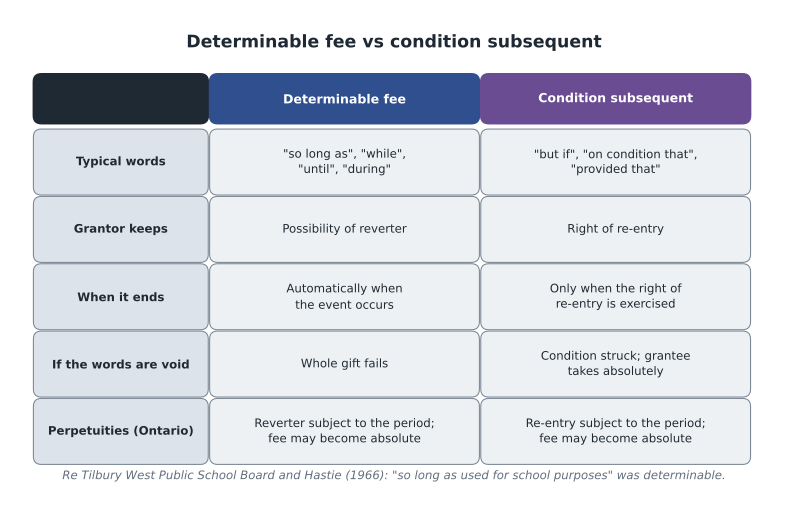
A grantor can give a fee simple that is limited to last only until a particular event happens. Such an interest is called a determinable fee. The words of limitation describe the natural boundary of the estate, using words that express duration such as 'so long as', 'while', 'until' or 'during'. A grant 'to the Township so long as the land is used as a park' gives the township an estate that lasts exactly as long as the land is used as a park and no longer. If the park use stops, the township's estate ends automatically, without anyone having to do anything, and the land returns to the grantor or the grantor's successors under what is called a possibility of reverter.
In Re Tilbury West Public School Board and Hastie, [1966] 2 OR 20 (HC), land had been granted to a school board for so long as it was used for school purposes. When the school closed, the court held that the board's estate had ended and the land reverted to the heirs of the original grantor. Asante tells the class that school sites, church sites and community halls across rural Ontario were often granted on such terms in the nineteenth century, and that title searchers still find them.
Conditions subsequent
A grantor can instead give a full fee simple and attach a condition that may cut it short. Such an interest is a fee simple subject to a condition subsequent. The words describe an outside event that will defeat an estate that would otherwise last forever, using words such as 'but if', 'on condition that', 'provided that' or 'if it happens that'. A grant 'to the Township, but if the land ceases to be used as a park, the grantor may re-enter' gives the township a fee simple that continues until the grantor or the grantor's successors choose to exercise the right of re-entry. Nothing happens automatically. If the holder of the right never acts, the township keeps the land.
The distinction can seem like a matter of words alone, and Asante admits that in a sense it is: the same practical intention can be expressed either way. But the consequences differ in three important ways. A determinable interest ends automatically, while a condition subsequent requires action. The perpetuity rules historically treated them differently, though Ontario's Perpetuities Act now applies the perpetuity period to both (lesson 6). And, most importantly, if the limiting words are void, the results are opposite.
When the limiting words are void
Courts strike down conditions and limitations that are too uncertain to apply or that offend public policy. If a condition subsequent is void, the condition is struck out and the grantee keeps the fee simple free of it, because the grant was complete without it. If a determinable limitation is void, the courts have generally held that the whole gift fails, because the limitation defines the estate itself; without it, there is nothing left to give. The result is that the same improper purpose can produce a windfall for the grantee in one case and a complete loss in the other, depending on the words used.
A condition precedent is different again: it must be satisfied before the gift takes effect at all. If a condition precedent is void, the gift generally fails, though courts have sometimes treated gifts of personal property more leniently.
Uncertainty
A condition subsequent must be certain enough that, from the moment the gift takes effect, the donee can know exactly what will cause a forfeiture. In Clayton v. Ramsden, [1943] AC 320, a will provided that a daughter would forfeit her gift if she married a person 'not of Jewish parentage and of the Jewish faith'. The House of Lords held the condition void for uncertainty, because it was impossible to say how much Jewish parentage was required or what degree of faith would satisfy it. Courts are less strict with conditions precedent, which need only be clear enough that a court can decide whether a particular person has satisfied them.
Public policy
Courts also refuse to enforce conditions that are contrary to public policy. The traditional categories include total restraints on marriage, conditions that encourage spouses to separate, conditions that interfere with parental duties, conditions requiring someone to commit a crime and total restraints on the alienation of a fee simple. A partial restraint on marriage, such as a condition against marrying before a certain age, has generally been upheld if it is reasonable. Restraints on alienation are treated strictly: a condition that the owner of a fee simple may never sell is void as repugnant to the fee, and partial restraints have often failed too.
Modern Canadian law has also confronted discriminatory conditions, and the history is a lesson in how property doctrine and public values interact. In Re Drummond Wren, [1945] OR 778 (HCJ), Mackay J. held void, as contrary to public policy, a covenant in a deed prohibiting the sale of land to 'Jews or persons of objectionable nationality'. He relied on the Racial Discrimination Act of 1944, the Charter of the United Nations and the values for which Canada had fought the Second World War. Four years later, in Re Noble and Wolf, [1949] OR 503 (CA), the Ontario Court of Appeal refused to follow Drummond Wren and upheld a covenant in a cottage subdivision on Lake Huron forbidding sale to anyone 'of the Jewish, Hebrew, Semitic, Negro or coloured race or blood'. The Supreme Court of Canada reversed in Noble v. Alley, [1951] SCR 64, but on property law grounds alone: the covenant did not touch and concern the land, so it did not run with it, and it was void for uncertainty. The majority did not decide whether it was contrary to public policy.
The legislature acted before the Supreme Court did. Since 1950, Ontario's Conveyancing and Law of Property Act has provided that a covenant that would otherwise run with land is void if it restricts the sale, ownership, occupation or use of the land because of race, creed, colour, nationality, ancestry or place of origin. The Human Rights Code now prohibits discrimination in the occupancy of accommodation. Asante tells the class that racially restrictive covenants still appear on title in older subdivisions, and that they are void and can be removed.
Canada Trust and the Leonard Foundation
The leading modern case is Canada Trust Co. v. Ontario Human Rights Commission (1990), 74 OR (2d) 481 (CA). Colonel Reuben Leonard established a scholarship trust in 1923 for students who were 'Christians of the White Race', British subjects and of the Protestant faith. The trust document contained lengthy recitals declaring the white race 'best qualified by nature' to advance civilization and limiting the number of scholarships that could go to women. Decades later, after the Ontario Human Rights Commission objected, the trustee applied for directions. The Court of Appeal held that the restrictive provisions were void as contrary to public policy. Robins J.A. reasoned that the trust, a charitable trust for the public benefit in education, was premised on notions of racial and religious superiority that conflicted with the public policy reflected in human rights legislation and the Charter. Rather than letting the trust fail, the court applied the cy-près doctrine to strike out the discriminatory restrictions and allow the scholarships to be awarded to all students. Tarnopolsky J.A. agreed in separate reasons that relied more heavily on human rights statutes and international instruments.
Robins J.A. was careful to say that the decision did not mean that all scholarships restricted to particular groups are void. Scholarships for women, for members of particular religious communities or for disadvantaged groups may serve legitimate purposes. What made the Leonard trust contrary to public policy was the combination of its public, charitable character and its premise of racial and religious superiority.
Private gifts and testamentary freedom
Courts are much more reluctant to interfere with private gifts. In Spence v. BMO Trust Co., 2016 ONCA 196, a father left his estate to one daughter and nothing to the other. The excluded daughter offered evidence that he had disinherited her because she had a child with a white man. The Court of Appeal held that the will was clear on its face and that testamentary freedom allowed a testator to leave property to whomever he chose, for whatever reason, so long as the will itself did not express a discriminatory condition. The court did not look behind the clear terms to the testator's motives. By contrast, in McCorkill v. Streed, Executor of the Estate of Harry Robert McCorkill (2014 NBQB 148), a New Brunswick court held void a gift of an estate to a white supremacist organization, because the gift would fund activities that promoted hatred and were contrary to criminal law and public policy.
Sophie Tremblay-Hart asks whether that line is principled. Asante says it is contested: Spence protects the private freedom to choose beneficiaries without explaining oneself, while Canada Trust and McCorkill refuse the help of the courts for public or unlawful discriminatory purposes. The line runs roughly between declining to make a gift to someone, which the law tolerates, and attaching a discriminatory condition to a gift or using property to promote unlawful purposes, which it does not.
The Holloway clauses
The Pike Lake lot was given 'so long as it is used as a public park'. Those are words of duration, so the township holds a determinable fee. If the township ever stops using the lot as a park, the township's estate will end automatically and the lot will revert to Margaret's estate or her successors, subject to the perpetuity rules discussed in lesson 6. If Margaret had written 'to the township, but if it ceases to be used as a park, my heirs may re-enter', the township would hold a fee simple subject to a condition subsequent, and nothing would happen until her heirs acted.
Emma's gift is conditional on her not marrying before the age of twenty-five. Because it is a partial restraint on marriage limited to a reasonable age, courts have generally upheld conditions of this kind, though Asante says some judges would now question them. The class debates whether the condition is precedent or subsequent: if Emma gets the money only when she reaches twenty-five unmarried, it is precedent; if she gets it now but must return it if she marries early, it is subsequent. The will's wording suggests the former.
The scholarship for a United Church student who intends to farm is a restriction based on religion, but it lacks the premise of superiority that sank the Leonard trust, and it serves a recognized charitable purpose of supporting a community and a vocation. Asante tells the class that Canada Trust does not obviously invalidate it, but that a court could still be asked to consider it, and that a careful drafter today would think hard about why the religious restriction is needed.
Worked problem
The Pike Lake lot ceases to be a park
Thirty years from now, Severn Township closes the Pike Lake park and leases the lot to a marina operator. Margaret's will gave the lot "to Severn Township so long as it is used as a public park." What happens?
Show solution
- "So long as" is a word of duration, so the township held a determinable fee, not a fee subject to a condition subsequent.
- When the park use ends, the determinable fee ends automatically; no re-entry is needed.
- The lot reverts under the possibility of reverter to Margaret's estate or the persons entitled to it.
- Check the perpetuity rules: Ontario's Perpetuities Act subjects possibilities of reverter to the perpetuity period (lesson 6), which may limit how long the reverter can operate.
- If the reverter is still valid, the township's lease to the marina operator is ineffective against the persons now entitled.
Common mistakes
MistakeTreating "so long as" and "but if" as interchangeable.
InsteadWords of duration create a determinable fee that ends automatically; words of condition create a fee that ends only on re-entry.
MistakeAssuming a void condition always wipes out the gift.
InsteadA void condition subsequent is struck and the grantee takes absolutely; a void determinable limitation causes the whole gift to fail.
MistakeSaying the Supreme Court in Noble v. Alley held racial covenants contrary to public policy.
InsteadNoble v. Alley decided the case on property grounds: the covenant did not touch and concern the land and was uncertain.
MistakeReading Canada Trust as invalidating every restricted scholarship.
InsteadThe Leonard trust failed because of its public charitable character combined with a premise of racial and religious superiority.
Practice problems
Work each problem on paper first, then reveal the answer to check.
What interest does a grantor keep after granting a determinable fee?
Show answer
A possibility of reverter, which takes effect automatically when the limiting event occurs.
Why was the condition in Clayton v. Ramsden void?
Show answer
It was too uncertain: it was impossible to know how much Jewish parentage or faith would satisfy it.
What did the court do with the Leonard Foundation trust?
Show answer
It struck out the discriminatory restrictions as contrary to public policy and applied cy-près so the scholarships continued without them.
What did Spence v. BMO Trust decide?
Show answer
A clear will that disinherited a child would not be set aside on evidence of a discriminatory motive; testamentary freedom prevailed.
What does the Conveyancing and Law of Property Act say about discriminatory covenants?
Show answer
Covenants that would run with land and restrict its sale, ownership, occupation or use because of race, creed, colour, nationality, ancestry or place of origin are void.
Summary and key terms
- Words of duration ("so long as", "until") create a determinable fee that ends automatically, leaving a possibility of reverter.
- Words of condition ("but if", "on condition that") create a fee subject to a condition subsequent, ended only by re-entry.
- A void condition subsequent is struck and the grantee takes absolutely; a void determinable limitation defeats the gift.
- Conditions subsequent must be certain from the outset (Clayton v. Ramsden); public policy forbids some conditions.
- Racially restrictive covenants are void by statute in Ontario; Noble v. Alley decided on property grounds.
- Canada Trust struck the discriminatory terms of a public charitable trust, while Spence protects private testamentary choices.
- Determinable fee
- A fee simple that ends automatically when a specified event occurs.
- Possibility of reverter
- The grantor's interest after a determinable fee, taking effect automatically on the limiting event.
- Condition subsequent
- A condition that may cut short an estate, giving the grantor a right of re-entry.
- Right of re-entry
- The grantor's right to end an estate subject to a condition subsequent by taking action.
- Condition precedent
- A condition that must be satisfied before a gift takes effect.
- Cy-près
- The doctrine allowing a court to modify a charitable trust's terms to carry out its general charitable intention as nearly as possible.
Lesson quiz · 5 questions
Score 60% or more to complete this lesson.
Create a free account to save your progress, take quizzes and earn a certificate.