
LAWC-113 · Lesson 7 of 12 · 22 min
Land titles (Torrens)
▶ Video coming soon A video version of this lesson is on the way.
In April, a man came into a branch of Brightway Mortgage Corporation, a private lender in Corwin, with forged identification in the name of Ruth Holloway, who as Margaret's estate trustee had been registered on title to the farm, and a transfer showing that Ferncliffe Farm had been sold to a Gary Lund. Lund then signed a mortgage of the farm in favour of Brightway for four hundred thousand dollars, and both documents were registered electronically. Lund and the money vanished. Nobody in the Holloway family knew anything about it until a statement of claim arrived when the payments stopped. Professor Asante tells the class that title fraud of this kind has become a serious problem in Ontario, and that the answer to who loses depends on how Ontario's land registration system works.
Why register land at all?
Land cannot be handed over like a watch. A buyer needs a way to know who owns a parcel, whether anyone else has an interest in it and whether the seller has the power to sell. For centuries in England, buyers relied on examining the chain of deeds held by the seller. Ontario, like most North American jurisdictions, adopted public registration so that documents affecting land could be recorded in a public office and searched by anyone. Ontario today has two systems: the older Registry system and the Land Titles system, modelled on the Torrens system.
The Registry system
Under Ontario's Registry Act, the registry office is a public library of documents. Registering a deed, mortgage or easement gives notice to the world and protects the holder's priority, but the province does not guarantee that any document is valid or that the person named in it owns anything. A buyer's lawyer has to search the documents and decide, from the chain of title, whether the seller has good title. For most of the last century, the Act's investigation of titles provisions have generally limited the search to forty years, so that claims based on older documents not carried forward are extinguished, subject to exceptions.
Priority under the Registry system generally goes to the first instrument registered, so a later buyer who registers first can defeat an earlier unregistered interest. But equity does not allow someone to rely on registration when they actually knew of the earlier interest. In United Trust Co. v. Dominion Stores Ltd., [1977] 2 SCR 915, a purchaser bought a shopping centre knowing that a supermarket had an unregistered long-term lease. The Supreme Court held that the purchaser's actual notice of the lease meant it could not rely on registration to defeat it. The actual notice doctrine still applies in the Registry system.
Registry title is also vulnerable to old problems. Adverse possession and prescription can operate against registered owners, and errors deep in the chain of title may surface decades later. These weaknesses are part of why Ontario has moved almost all land into Land Titles.
The Torrens system
Sir Robert Torrens, a customs official in South Australia, introduced a system of title registration there in 1858, borrowing ideas from the registration of ships. Under a Torrens system, the government maintains a register that states who owns each parcel and what interests burden it, and the government guarantees the register. Ontario adopted a version of the system in its Land Titles Act in 1885, initially for parts of Toronto and then for northern Ontario and other areas.
Theodore Ruoff, an English registrar, described the Torrens system by three principles. The mirror principle says the register accurately reflects all the facts material to the title. The curtain principle says a buyer need not look behind the register at trusts, past transactions or the history of the title. And the insurance principle says that anyone who loses an interest because of the operation of the system, through an error or a fraud, is compensated from a public fund. In Ontario, that fund is the Land Titles Assurance Fund.
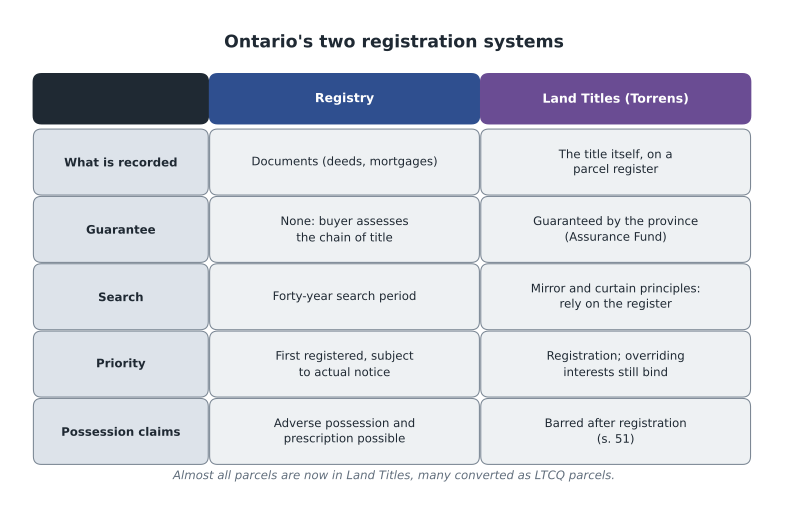
Beginning in the 1980s and 1990s, Ontario built an electronic database of land records and converted most Registry parcels into Land Titles. Most converted parcels are designated Land Titles Conversion Qualified (LTCQ), meaning the province guarantees the title as of conversion, subject to some qualifications, such as rights that had been acquired by adverse possession before conversion. Registration in Ontario is now done electronically by lawyers through the Teraview system, and almost every parcel in the province is in Land Titles. Ferncliffe Farm was converted to LTCQ in 2002.
What the register does not show
No register is a perfect mirror. The Land Titles Act lists a number of interests that bind registered land even though they do not appear on the register, sometimes called overriding interests. They include, for example, certain short-term leases where the tenant is in possession, some claims of the Crown and municipalities, such as unpaid taxes, and rights of way and other interests that existed when land was first registered. Title insurance, which most buyers in Ontario now purchase, covers some risks the register does not, such as survey problems and work orders, as well as fraud.
Section 51 of the Land Titles Act provides that no title adverse to the registered owner can be acquired by length of possession or by prescription once land is registered. Lesson 8 explains how this bar interacts with adverse possession claims that ripened before conversion, the issue at the centre of the Supreme Court's 2025 decision in Kosicki v. Toronto (City).
Indefeasibility and fraud
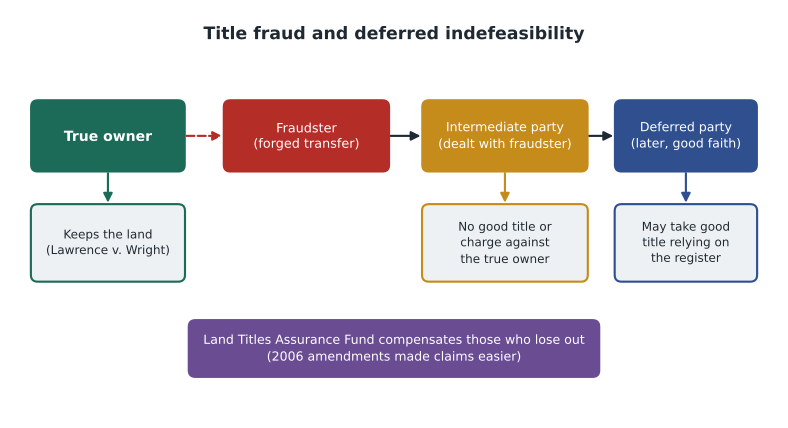
The central promise of a Torrens system is indefeasibility: once a person is registered as owner, their title cannot be defeated except in limited circumstances. The difficult question is what happens when a registration was obtained by fraud. Two approaches compete. Under immediate indefeasibility, a person who registers in good faith gets an indefeasible title immediately, even if the instrument they registered was forged; the original owner loses the land and is compensated from the fund. The Privy Council adopted this approach for New Zealand in Frazer v. Walker, [1967] 1 AC 569. Under deferred indefeasibility, the person who dealt directly with the fraudster, called the intermediate owner, does not get good title, because they were in the best position to detect the fraud; but a later good-faith purchaser who relies on the register, the deferred owner, does. Gibbs v. Messer, [1891] AC 248 (PC), is the classic authority for that approach.
Lawrence v. Wright
Ontario chose deferred indefeasibility in Lawrence v. Wright, 2007 ONCA 55. Susan Lawrence owned a house in Toronto. A fraudster impersonating her registered a transfer of the house to a person called Wright, who then mortgaged it to Maple Trust Company, which advanced the loan in good faith. The fraudsters disappeared with the money. In an earlier Superior Court decision, Household Realty Corp. v. Liu (2005), a court had held that an innocent lender in that position took a valid mortgage, and the motion judge in Lawrence followed it. The Court of Appeal reversed. It held that Maple Trust, as the party that dealt with the fraudster, did not obtain a valid charge against Lawrence's title; the Land Titles Act did not give effect to a fraudulent instrument in favour of the party that dealt directly with the fraud. Lawrence kept her house free of the mortgage. Maple Trust, which had been in a position to check the borrower's identity, bore the loss, with a possible claim against the Land Titles Assurance Fund.
The 2006 amendments
While Lawrence was making its way through the courts, the legislature amended the Land Titles Act in 2006 in response to a wave of frauds. The amendments added definitions of fraudulent instrument and fraudulent person, and provisions to section 78 stating that a fraudulent instrument registered on or after the amendments came into force is generally deemed to be ineffective, while protecting later good-faith parties who register instruments for value after the fraudulent one. The amendments also made it easier for victims of fraud to claim from the Land Titles Assurance Fund, without first having to exhaust every other remedy against the fraudsters, and created procedures for the Director of Titles to deal with suspicious registrations. Since then, the province has added further protections, including requiring identity verification by lawyers registering electronically and giving owners the option of registering restrictions against suspicious dealings.
Asante says that the combined effect of Lawrence and the amendments is that, in Ontario, the risk of fraud falls on the party who dealt with the fraudster, usually a lender, and on the Assurance Fund, rather than on the innocent owner who had no part in the transaction. Theo Marchetti, who has seen several fraud cases in practice, adds that lenders now spend real money on identity verification, and that title insurers pay many of these claims.
Searching title in practice
Asante describes what a buyer's lawyer actually does on a Land Titles purchase. The lawyer pulls the parcel register for the property, which lists the registered owner, the property description and every instrument registered against the parcel that is still in effect: charges (mortgages), easements, restrictions, notices, liens and cautions. The lawyer checks the description against the survey or reference plan, confirms that the seller is the registered owner, and requires that every charge and lien be discharged on closing. Because Land Titles guarantees the register, the lawyer does not need to search back through forty years of documents, though for LTCQ parcels the qualifications on conversion, such as rights acquired by possession before conversion, mean that a survey and inquiries about the neighbours' fences still matter.
Beyond the register, the lawyer makes off-title searches: municipal work orders and zoning compliance, unpaid property taxes and utility arrears, building permits and, for rural land, conservation authority regulations and septic approvals. Many buyers now rely on title insurance instead of some of these searches, but Asante tells the class that title insurance is a promise to pay for a loss, not a guarantee that the buyer will get the property they thought they were buying. For a farm, the lawyer will also ask about rights of way, drainage works and agreements with neighbours that may not appear on the register at all.
Owners can also protect themselves. Ontario lets registered owners register certain restrictions and notices on their parcels, and lawyers registering transfers and charges must verify their clients' identity under the Law Society's rules. Asante recommends that families like the Holloways, whose farm is free of any mortgage and whose owner has recently died, check the parcel register from time to time, because unencumbered properties and estates are favourite targets of fraudsters.
Back to Ferncliffe Farm
Brightway dealt directly with Lund, who was either the fraudster or the fraudster's accomplice, through a forged transfer. Under Lawrence and the 2006 amendments, Brightway's mortgage does not bind the Holloways' title. Ruth, as estate trustee, can apply to have the forged transfer and the mortgage deleted from the register, and Brightway can look to Lund, if he can be found, to its title insurer if it has one, and potentially to the Land Titles Assurance Fund. Hannah Kowalczyk asks what would happen if Lund had instead sold the farm to an innocent buyer, who then mortgaged it to a bank. Asante explains that the buyer, as the party who dealt with the fraudster, would be in the intermediate position and would lose the farm; the bank, as a deferred party relying on a registration that appeared valid, might be protected; and the Assurance Fund would compensate whoever lost out. 'In a fraud,' he says, 'somebody innocent always loses. The system decides who, and the fund softens the blow.'
Worked problem
A second fraud, one step removed
A fraudster forges a transfer of a cottage from its owner, Mei, to himself, and sells the cottage to Alan, who pays in good faith and registers. A year later Alan sells to Bina, who also pays in good faith and registers. The fraud comes to light. Who owns the cottage?
Show solution
- The cottage is in Land Titles, so the question is how indefeasibility treats registrations derived from fraud.
- Alan dealt directly with the fraudster: he is the intermediate party.
- Under deferred indefeasibility (Lawrence v. Wright) and the 2006 amendments, Alan did not acquire good title against Mei.
- Bina dealt with Alan, a registered owner, in good faith and for value: she is a deferred party who can rely on the register.
- Bina likely keeps the cottage; Mei's remedy is compensation, including from the Land Titles Assurance Fund.
Common mistakes
MistakeTreating the Registry system as a guarantee of title.
InsteadThe Registry records documents; the buyer must search and assess title. Only Land Titles is guaranteed.
MistakeSaying a registered owner in Land Titles always keeps the land.
InsteadOntario uses deferred indefeasibility: the party who dealt with a fraudster takes no good title against the true owner.
MistakeAssuming the register shows every interest.
InsteadOverriding interests, such as some short-term leases and tax claims, bind registered land without registration.
MistakeForgetting the actual notice doctrine in the Registry system.
InsteadA purchaser with actual notice of an unregistered interest cannot rely on prior registration to defeat it (United Trust v. Dominion Stores).
Practice problems
Work each problem on paper first, then reveal the answer to check.
What are the mirror, curtain and insurance principles?
Show answer
The register reflects the title; buyers need not look behind it; and losses caused by the system are compensated from a public fund.
What did Lawrence v. Wright decide?
Show answer
Ontario follows deferred indefeasibility: a lender that dealt directly with a fraudster did not get a valid charge against the true owner.
What is the difference between immediate and deferred indefeasibility?
Show answer
Immediate indefeasibility protects the first good-faith registrant even under a forged instrument; deferred protects only later parties who dealt with a registered owner.
What does LTCQ mean?
Show answer
Land Titles Conversion Qualified: a former Registry parcel converted to Land Titles, with the title guaranteed subject to some qualifications.
Why did Ontario amend the Land Titles Act in 2006?
Show answer
To respond to title fraud by making fraudulent instruments ineffective, protecting later good-faith parties and making Assurance Fund claims easier.
Summary and key terms
- Ontario has two registration systems: Registry (records documents) and Land Titles (guarantees title).
- Registry priority depends on registration, subject to actual notice (United Trust v. Dominion Stores) and a forty-year search period.
- Land Titles follows the Torrens principles: mirror, curtain and insurance (the Land Titles Assurance Fund).
- Almost all Ontario parcels are now in Land Titles, many as LTCQ parcels, registered electronically.
- Ontario applies deferred indefeasibility to fraud (Lawrence v. Wright); the 2006 amendments made fraudulent instruments ineffective and eased fund claims.
- Some overriding interests bind registered land, and no title by possession can be acquired after registration (s. 51).
- Registry system
- A system that records documents affecting land without guaranteeing title.
- Torrens system
- A system of title registration in which the government maintains and guarantees a register of ownership.
- Indefeasibility
- The principle that a registered title cannot be defeated except in limited circumstances.
- Deferred indefeasibility
- The rule that a party who dealt directly with a fraudster does not get good title, though later good-faith parties may.
- Land Titles Assurance Fund
- Ontario's fund that compensates people who lose an interest in land through the operation of the Land Titles system.
- Overriding interest
- An interest that binds registered land even though it does not appear on the register.
Lesson quiz · 5 questions
Score 60% or more to complete this lesson.
Create a free account to save your progress, take quizzes and earn a certificate.