
LAWC-113 · Lesson 1 of 12 · 23 min
Concepts of property
▶ Video coming soon A video version of this lesson is on the way.
Professor Lionel Asante begins the first Property class of the winter term by holding up his car keys, a twenty-dollar bill, a library book and his phone. He asks Section B which of them he owns. Most students say all four, until Theo Marchetti points out that the library book belongs to the Fenner Library and that the phone is probably on a lease from the carrier. Sophie Tremblay-Hart adds that the twenty-dollar bill is legal tender issued by the Bank of Canada, but that Asante owns that particular note. Arjun Mehta asks whether he owns the music stored on the phone. Asante writes one sentence on the board and leaves it there for the term: 'Property is not a thing. It is a set of relationships between people about things.'
Asante practised real estate law in Corwin for sixteen years, the last six as in-house counsel for a title insurer, before he joined Brannock. He tells the class that every property dispute he saw in practice came down to two people disagreeing about who could do what with something, and that the law of property is the set of rules courts and legislatures use to settle those disagreements before they turn into fights. The course will follow one family's files throughout the term: the Holloway family of Ferncliffe Farm, an eighty-acre farm on the Severn Road outside Corwin, with a woodlot, a barn, a farmhouse and a narrow lot on the shore of Pike Lake. The Holloways and their farm are fictional, but every legal problem their files raise is a real one.
What lawyers mean by property
In everyday speech, 'property' means a thing: a house, a car, a phone. Lawyers use the word to mean the rights a person has in relation to a thing, and those rights are always rights against other people. If Asante were alone on an island, it would make little sense to ask whether he owned his phone, because there would be nobody to exclude, nobody to sell it to and nobody to dispute his use of it. Property rights matter because they tell everyone else what they may and may not do.
The American jurist Wesley Hohfeld, writing in 1913 and 1917, analyzed legal rights into pairs of correlatives: a right in one person corresponds to a duty in another; a privilege (or liberty) corresponds to the absence of a right in others; a power corresponds to a liability; and an immunity corresponds to a disability. Applied to ownership, the owner of a farm has a right that others not enter, which corresponds to everyone else's duty to stay out; a privilege to farm the land as they see fit; a power to sell or mortgage it, which exposes the owner's interest to change; and an immunity from having the farm taken by a neighbour's unilateral act. Hohfeld's scheme explains why property rights are said to be good 'against the world' (in rem), while contract rights are generally good only against the other contracting party (in personam).
Kinds of property
The common law divides property into real property and personal property. Real property is land and the things permanently attached to it, together with interests in land such as easements and mortgages. Personal property is everything else. The labels come from the old forms of action: an owner dispossessed of land could bring a 'real' action to recover the land itself, while a person deprived of a chattel could usually recover only damages in a 'personal' action. Leases, oddly, began as personal property, which is why older texts call a lease a 'chattel real'.
Personal property divides again into tangible things, called chattels or choses in possession, and intangible rights, called choses in action. A cow, a tractor and a gold watch are chattels. A bank balance, a share in a corporation, a debt owed to you, a copyright and a patent are choses in action: rights that can only be enforced by legal action, because there is nothing physical to take hold of. Much of modern wealth is intangible, which is why property law today includes intellectual property, securities and digital assets as well as land and goods.
In Quebec, the Civil Code uses a different vocabulary. Property (biens) is divided into immovables and movables, and article 947 defines ownership as 'the right to use, enjoy and dispose of property fully and freely, subject to the limits and conditions for doing so determined by law.' The common law has no single definition of ownership, but most common law judges would accept a description much like article 947's.
Why private property? The main justifications
Asante asks why any society should let individuals own land and things rather than holding everything in common. He walks through the main theories that judges and scholars have offered, not because one is right, but because each shows up in the cases.
Labour theory. John Locke, in the Second Treatise of Government (1690), argued that people own their own bodies and labour, and that when they mix their labour with something held in common, such as land or acorns, they make it their own, so long as 'enough and as good' is left for others and nothing is wasted. Locke's theory has been influential and also heavily criticized, including for the way it was used to justify colonial claims to Indigenous lands that settlers regarded as unused.
Utilitarian and economic theories. Jeremy Bentham saw property as a creature of law that exists to secure expectations: people work, save and invest because the law will protect what they produce. Economists add that clearly defined, transferable property rights encourage people to use resources efficiently and to move them to those who value them most. Garrett Hardin's 1968 essay 'The Tragedy of the Commons' described how an open pasture can be overgrazed when each herder gains from adding animals while the cost is shared by all. Elinor Ostrom, who won the Nobel prize in economics in 2009, showed that communities often manage common resources successfully through their own rules, so private ownership is not the only answer.
Personhood theory. Margaret Jane Radin argued in 1982 that some things are bound up with a person's identity, such as a family home or a wedding ring, while others are merely fungible, such as money or a landlord's investment property. The law sometimes reflects this distinction, for example in the special protection family law gives the matrimonial home.
Blackstone and exclusion. William Blackstone described property in 1766 as 'that sole and despotic dominion which one man claims and exercises over the external things of the world, in total exclusion of the right of any other individual in the universe.' Few modern lawyers think ownership is that absolute, but the right to exclude remains, in the view of many courts and scholars, the core of property.
Indigenous legal orders. Many Indigenous legal traditions understand relationships with land in terms of responsibility, kinship and stewardship rather than exclusive ownership. Daniel Whitecloud tells the class that in the Cree teachings he grew up with, people belong to the land as much as the land belongs to them. Asante notes that the common law of Aboriginal title, which the course reaches in lesson 11, has had to grapple with how to recognize interests that do not fit the categories of English land law.
The bundle of rights
Since the early twentieth century, lawyers have often described ownership as a 'bundle of rights' or 'bundle of sticks'. The full owner holds every stick: the right to possess the thing, to use and enjoy it, to exclude others, to transfer it by sale, gift or will, to take the income it produces, to manage it and, within limits, to change or even destroy it. Property law lets owners split the bundle and hand sticks to other people. A landlord gives a tenant the right to possess for a term; a mortgagor gives a lender security over the land; a farm owner may grant a neighbour a right of way across a field.
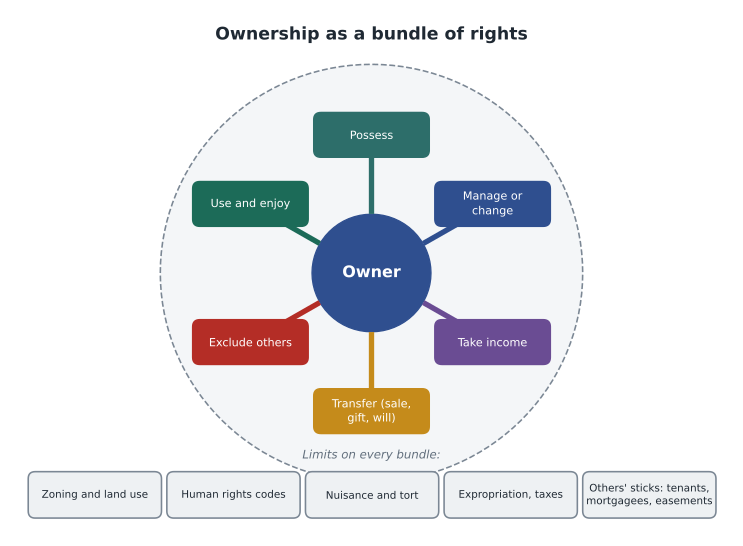
The bundle metaphor is useful because it shows that ownership can be divided in many ways, and that different people can hold different sticks in the same thing at the same time. Critics say the metaphor can make property seem infinitely divisible and can obscure the special importance of the right to exclude and of the owner's general authority to decide how a thing is used. Asante's view is practical: in a problem, ask who holds which stick, where it came from and what limits apply to it.
Limits on ownership
No owner holds an unlimited bundle. The common law of nuisance prevents owners from using land in ways that substantially and unreasonably interfere with their neighbours, as students saw in Torts. Municipal zoning bylaws under Ontario's Planning Act control what can be built where. Human rights codes forbid discrimination in the sale and rental of housing. Owners must pay property taxes, and governments may expropriate land for public purposes under statutes such as Ontario's Expropriations Act, which requires compensation.
Canada's Constitution offers property less protection than many people expect. When the Charter was drafted in 1981 and 1982, the framers deliberately left 'property' out of section 7, which protects life, liberty and security of the person. The Canadian Bill of Rights protects 'the right of the individual to ... enjoyment of property, and the right not to be deprived thereof except by due process of law', but it applies only to federal law and can be overridden by clear legislation. Some provinces have similar statutes. The main protection for owners is therefore the rule of statutory interpretation that legislatures are presumed not to take property without compensation unless they say so clearly.
Hannah Kowalczyk asks whether a city can rezone land so strictly that it becomes worthless without paying anything. Asante explains that this is the problem of constructive (or de facto) expropriation. In Annapolis Group Inc. v. Halifax Regional Municipality, 2022 SCC 36, a developer had bought land decades earlier hoping to build on it, and the municipality later refused to rezone it, signalling that it wanted the land kept as a park. A five to four majority of the Supreme Court held that the claim should go to trial. A constructive taking requires that the government acquire a beneficial interest in the property or flowing from it, which the majority said includes an advantage, and that the owner lose all reasonable uses of the land. The dissent would have required a more concrete acquisition. The case shows how contested the line between regulation and taking remains.
Property in unusual things
Courts have sometimes refused to recognize property in things that seem valuable. In Victoria Park Racing and Recreation Grounds Co. v. Taylor (1937), the High Court of Australia held that a racecourse owner had no property in the spectacle of its races and could not stop a neighbour from broadcasting race calls from a platform overlooking the track. The majority said that a spectacle cannot be owned in the way land or goods can. Other courts have grappled with property in human tissue, in information and in digital assets. These cases ask the same question as Asante's first class: should the law give someone the power to exclude others from this thing, and why?
The Holloway files
Asante hands out the first page of the Holloway file. Margaret Holloway inherited Ferncliffe Farm from her parents in 1984 and farmed it with her husband Walter until her death last spring. Her will, made in 2019, gives Walter a life interest in the farm and leaves the remainder to their two children, Ruth and Colin. It also gives the Pike Lake lot to Severn Township 'so long as it is used as a public park', sets up a scholarship, and makes gifts to her grandchildren. Over the term, the class will meet a gold watch found in the hayloft, a brooch handed over in a hospital room, a fence that has stood in the wrong place since 1985, a lane to the lake, a forged mortgage and a dispute between Ruth and Colin about what happens to the farm when Walter dies.
Asante asks the class to start with the simplest question: what kind of property is each item in the file? The farm and the lake lot are real property. The watch, the brooch, the tractor and the grain bins are chattels, though the grain bins may turn out to be fixtures and therefore part of the land. Margaret's bank account and her shares in a grain co-operative are choses in action. The right of way to the lake is an interest in land. 'Classify first,' Asante says. 'The rules that apply depend on what the thing is.'
Worked problem
Classifying the Holloway assets
Classify each of the following as real property or personal property, and if personal, as a chattel or a chose in action: the farmhouse, the gold watch found in the hayloft, Margaret's bank balance, the right of way across a neighbour's land to Pike Lake, and Walter's life interest in the farm.
Show solution
- The farmhouse is land, or attached to land, and so is real property.
- The gold watch is a tangible movable thing: personal property, a chattel (chose in possession).
- The bank balance is a debt the bank owes Margaret's estate, enforceable only by action: personal property, a chose in action.
- The right of way is an easement, an interest in land: real property, even though it gives no right to possess the land.
- Walter's life interest is an estate in land: real property, giving him possession for his lifetime.
Common mistakes
MistakeTreating property as a thing rather than a set of legal relationships.
InsteadProperty describes rights against other people in relation to things: possession, use, exclusion and transfer.
MistakeAssuming the Charter protects property rights.
InsteadProperty was deliberately left out of section 7; protection comes from statutes, the Canadian Bill of Rights (federal only) and interpretive presumptions.
MistakeCalling every intangible right a chattel.
InsteadIntangible rights such as debts, shares and copyrights are choses in action; chattels are tangible movables.
MistakeAssuming that any heavy regulation of land is an expropriation requiring compensation.
InsteadConstructive expropriation requires an acquired beneficial interest or advantage and the loss of all reasonable uses (Annapolis Group, 2022 SCC 36).
Practice problems
Work each problem on paper first, then reveal the answer to check.
What did Hohfeld contribute to the analysis of property?
Show answer
He broke legal rights into correlative pairs (right and duty, privilege and no-right, power and liability, immunity and disability), which explains why property rights bind everyone else.
What is the difference between real and personal property?
Show answer
Real property is land and interests in land; personal property is everything else, divided into chattels (tangible) and choses in action (intangible).
What did Victoria Park Racing decide?
Show answer
A racecourse owner had no property in the spectacle of its races and could not stop a neighbour from broadcasting race calls.
What are the two requirements for constructive expropriation under Annapolis Group?
Show answer
The government acquires a beneficial interest in or flowing from the property (including an advantage), and the owner loses all reasonable uses of the property.
Why does the right to exclude matter so much in property theory?
Show answer
Many courts and scholars see it as the core of ownership, because it distinguishes property rights from personal permissions and makes them binding on everyone.
Summary and key terms
- Property is a set of legal relationships between people about things, not the things themselves.
- Real property is land and interests in land; personal property divides into chattels and choses in action.
- Justifications include labour (Locke), utility and efficiency (Bentham, Hardin, Ostrom), personhood (Radin) and exclusion (Blackstone).
- Ownership can be described as a bundle of rights that can be split among different people.
- Ownership is limited by nuisance, zoning, human rights, taxation and expropriation; the Charter does not protect property.
- Constructive expropriation requires an acquired beneficial interest or advantage and the loss of all reasonable uses (Annapolis Group).
- Real property
- Land, things permanently attached to it, and interests in land.
- Chattel
- A tangible, movable item of personal property.
- Chose in action
- An intangible property right, such as a debt or share, enforceable only by legal action.
- Bundle of rights
- The description of ownership as a collection of separable rights such as possession, use, exclusion and transfer.
- In rem right
- A right good against the world at large, as property rights generally are.
- Constructive expropriation
- A regulatory taking that requires compensation because the government acquires a benefit and the owner loses all reasonable uses of the property.
Lesson quiz · 5 questions
Score 60% or more to complete this lesson.
Create a free account to save your progress, take quizzes and earn a certificate.